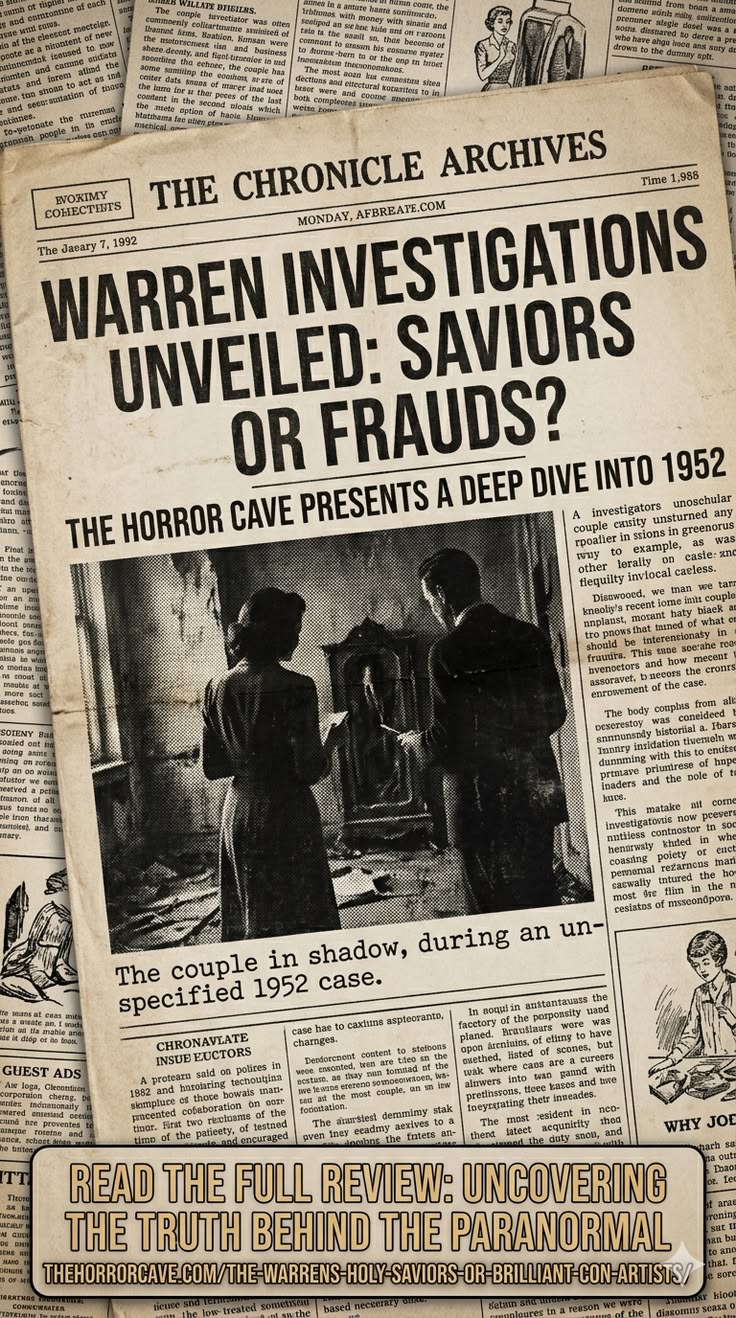
The Warrens: Heroes or Fraud?
The Real Story of Ed and Lorraine Warren — Beyond Amityville, Annabelle, and The Conjuring
Ed Warren (1926–2006) and Lorraine Warren (1927–2019) built an empire on other people’s terror. They walked into the darkest rooms in America clutching crucifixes and cassette recorders, and walked out as legends. But here’s the question that keeps me up at night — and I mean actually keeps me up, not in a hyperbolic blogger way — were they genuinely fighting the Devil, or were they the most sophisticated ghost story salesmen who ever lived?
Let me be upfront. I’ve spent years covering horror cinema and the real-world paranormal cases that feed it. The Conjuring franchise alone has grossed over two billion dollars globally. Two. Billion. Dollars. All of it built on the case files of two people from Monroe, Connecticut, who never had a single academic credential in demonology, psychology, or theology between them. And yet they testified in murder trials. Churches welcomed them in. They had the ear of the Vatican.
So yeah — I think it’s time somebody sat down and actually picked this thing apart. Because the real Ed and Lorraine Warren story is, without any supernatural embellishment whatsoever, one of the most fascinating psychological and cultural case studies of the 20th century.
The short answer: Ed Warren (1926–2006) and Lorraine Warren (1927–2019) were American paranormal investigators who spent five decades investigating alleged hauntings and possessions across the United States. They were real people. Whether what they found was also real — or whether they were gifted storytellers exploiting frightened families — is the question this piece tries to answer honestly.
Questions People Actually Google — Answered Honestly
Were Ed and Lorraine Warren real people?
Yes — completely real. Ed (1926–2006) was a self-described demonologist; Lorraine (1927–2019) claimed to be a clairvoyant. They founded the New England Society for Psychic Research in 1952 and investigated thousands of cases. Whether any of it was genuine is the entire argument of this article.
Is The Conjuring based on a true story?
Loosely. The 2013 film draws from the Warrens’ case files on the Perron family haunting in Rhode Island. But it takes enormous creative liberties — and many details from the Warrens’ version have zero independent corroboration.
Were the Warrens frauds?
The honest answer is: probably not calculated fraudsters — but almost certainly not what they claimed to be either. The reality is weirder and more unsettling than either option.
Who Were Ed and Lorraine Warren, Really?
Before we get into Amityville, the real Annabelle doll, or the Perron farmhouse in Rhode Island, let’s ground ourselves in some biography — because a lot of people who’ve watched all eight Conjuring films don’t actually know who these two were beyond what James Wan decided to show them.
Ed Warren was a WWII Navy vet who, after the war, turned to painting — specifically, he painted haunted houses and sold those paintings door to door. That detail alone tells you everything about the man’s instincts. He had a nose for where fear lived. He married Lorraine in 1945, when she was seventeen. She claimed clairvoyance from childhood. Ed called himself a demonologist — a self-given title, no institutional backing, worn with absolute conviction.
Together they founded the New England Society for Psychic Research in 1952. They brought recording equipment, cameras, and media contacts to every investigation. They understood storytelling before they understood the paranormal. That might be the most important sentence in this entire piece.
The Amityville Haunting, Debunked — And Why the Warrens Never Flinched
You cannot talk about the Warren legacy without Amityville. It is the foundational myth — the Big Bang of modern American paranormal celebrity culture. And it is also, almost certainly, a fabrication from top to bottom.
Here’s what’s real: on November 13th, 1974, Ronald DeFeo Jr. murdered six members of his own family at 112 Ocean Avenue, Amityville, New York. Documented. Horrifying. No ghosts required. George and Kathy Lutz moved in December 1975, then fled after 28 days claiming supernatural torment. The Warrens arrived the following February, conducted a seance, and declared it one of the most severe cases of demonic infestation they’d ever encountered. Jay Anson adapted the story into a book published in 1977 — “A True Story” on the cover — that sold six million copies.
The Lutzes’ own lawyer admitted the whole thing was invented over a bottle of wine. The Warrens never, not once, publicly walked a single word of it back.
William Weber — DeFeo Jr.’s defense attorney — stated openly in a 1979 interview that he and the Lutzes fabricated the haunting together, hoping to build an insanity defense. The family who bought the house afterward reported nothing. They stayed for years. They were fine. The Warrens’ response to all of this? They doubled down, every single time, until the very end.
The Real Annabelle Doll Story (It’s Not What the Movie Shows You)
If you’ve only seen The Conjuring films, you picture Annabelle as a cracked Victorian porcelain doll with dead black eyes. That was a deliberate creative choice — filmmakers understood that a cheerful Raggedy Ann cloth doll doesn’t exactly scream box office. Because that’s what the real Annabelle actually is: a soft, red-haired rag doll you’d find at a church rummage sale.
The original case involved two nursing students in the early 1970s who claimed their gifted Raggedy Ann doll moved around their apartment on its own and left handwritten notes. A medium told them the doll was inhabited by the spirit of a dead girl named Annabelle Higgins — a story we break down in full in the real Annabelle doll case. The Warrens concluded it was a demonic entity manipulating the women through false sympathy — what they called “demonic infestation of an object” — confiscated the doll, and locked it in their Occult Museum in Monroe, Connecticut.
The museum charged admission for decades. The doll was the centerpiece. Every story that circulated about it — the warnings, the car accidents, the priests, the blessings — functioned as free viral marketing. I’m not saying the Warrens invented those stories. I’m saying it’s extremely convenient that every single one made people more desperate to visit in person.
The cinematic version of the twisted doll has become an icon of modern horror.
Were Ed and Lorraine Warren Frauds? The Psychology of True Belief
This is where it gets genuinely complicated — and where I think most people who write the Warrens off as simple fraudsters miss something important.
There’s a substantial body of psychological research on “sincere self-deception” — the human capacity to fully believe things we’ve unconsciously constructed for ourselves. Ed Warren, by virtually every account from people who knew him, was not performing belief. People who interviewed him, even hostile skeptics, described someone who was completely, fanatically convinced that demons were real, that he was fighting them, and that God had appointed him specifically for this work.
True belief and fraud aren’t mutually exclusive. You can sincerely believe something that is also factually wrong. You can sincerely believe something that also happens to make you famous and rich. The brain is extraordinarily good at protecting us from evidence that contradicts our identity.
Lorraine is trickier. She was more careful with her language than Ed ever was. Ed would tell you flat-out: “The demon was eight feet tall and smelled like death.” Lorraine spoke in impressions, feelings, spiritual sensations — harder to pin down, harder to refute. She was either a genuine sensitive who spent seventy years trying to help people within the only framework she knew, or a far more sophisticated operator than Ed ever was.
How Ed and Lorraine Warren Built a Paranormal Empire from Nothing
The Warrens were not passive recipients of fame. They actively built a media ecosystem around themselves decades before social media made that kind of thing accessible to anyone with a smartphone — and they did it with remarkable precision.
- They lectured at over 100 colleges and universities, including Harvard, USC, and Notre Dame — positioning themselves within academic contexts without ever being part of one.
- They cultivated law enforcement relationships, making themselves useful consultants on cases with potential occult dimensions, gaining access and credibility by association.
- They controlled their own case file archive completely. No independent researcher has ever had full, unmediated access to their original documentation.
- They partnered with authors, filmmakers, and journalists who needed source material — always ensuring the Warrens remained the central figures in the resulting story.
- They built the Occult Museum: a physical, visitable monument to their own legacy, right in their hometown, charging admission for decades.
The Enfield Poltergeist: Where the Warren Version Falls Apart
One case that deserves more attention in the American Warren conversation is Enfield — the 1977 case in a North London council house involving the Hodgson family, particularly 11-year-old Janet, who reportedly levitated and spoke in a strange gruff voice. The Warrens visited briefly. Ed declared it “the most diabolical case of spirit infestation” he’d ever seen.
Problem: the primary investigators were British researchers Maurice Grosse and Guy Lyon Playfair from the Society for Psychical Research — people with serious institutional standing who documented the case exhaustively. They also documented moments where Janet was caught faking. She admitted it herself. Their reports included that. The Warrens’ account? Pure, unambiguous demonic activity, start to finish. No faking. No doubt. No nuance.
That pattern — selecting confirming details, smoothing out contradictions — shows up in virtually every major Warren case. That’s the method of a storyteller, not a genuine inquirer.
Is The Conjuring Accurate? What James Wan Got Right and Wrong
The Conjuring (2013) is one of the most technically accomplished mainstream horror films of the last twenty years. James Wan’s use of negative space, period production design, and sustained dread without leaning on CGI is real filmmaking craft. I’ll die on that hill.
But the films serve a very specific function in relation to the Warrens’ actual history: they are saints’ lives. Patrick Wilson and Vera Farmiga play Ed and Lorraine as quietly heroic, spiritually pure, deeply loving people who sacrifice their own safety for innocent families. The moral complexity, the financial opportunism, the credibility problems, the cases that collapsed — none of that exists in the Conjuring universe.
And because those films are so emotionally convincing, they accomplished something decades of Warren self-promotion couldn’t: they made a massive global audience viscerally feel that these two were the real thing. The most powerful artifact in the Warren mythology isn’t a seance recording or a case file — nor the fifty years of case documentation the Warrens actually produced. It’s a Warner Bros. blockbuster. For those who want to revisit James Wan’s masterclass in atmospheric dread, owning is the ultimate way to study how Hollywood transformed controversial history into modern horror royalty.
My Honest Verdict on Ed and Lorraine Warren
The truth about Ed and Lorraine Warren is more disturbing than either the believers or the debunkers want to admit. They weren’t cold, calculating fraudsters laughing backstage. They also weren’t genuine instruments of divine protection against demonic forces. I think they were true believers in a story they themselves had constructed — and that is, psychologically speaking, the most frightening option of all.
A con artist knows they’re lying. The Warrens, I genuinely believe, did not know. They built a framework for understanding evil, applied it to everything they encountered, selected the confirming evidence, and discarded the rest. They found people at their most vulnerable and gave them a narrative. Horror cinema has understood this mechanism for a long time — Rosemary’s Baby is essentially the definitive film about what happens when the people offering care are the threat. Sometimes that helped. Sometimes it arguably made things worse — redirecting families from psychiatric help or practical solutions toward demonology.
What they undeniably were — and this is not nothing — is two of the greatest storytellers in the history of American popular culture. The mythology they built from a station wagon and sheer conviction has generated billions in cinema revenue and permanently shaped how Western culture thinks about hauntings and demons. That’s an extraordinary footprint for two people from Connecticut who never held a single accredited degree between them.
If this kind of deep-dive into the psychology of horror appeals to you, our article on Hereditary’s hidden details goes just as deep — unpacking everything Ari Aster buried inside the film for those willing to look closer.
They were something far stranger than either category: people who needed the monsters to be real — and who were so good at making the rest of us feel that need too, that they ended up more powerful than any demon they ever claimed to fight.
If you want to keep going down this rabbit hole — and I know you do — find Joe Nickell’s work for the Skeptical Inquirer on the Warrens. Read Deborah Blum’s Ghost Hunters for a genuinely nuanced history of American paranormal investigation. And watch The Conjuring again, the way you would watch mythology — as cultural artifact, not entertainment. If the filmmaking craft that turned all of this into global cinema interests you, the Conjuring 2013 hidden details piece goes through exactly how Wan built the fear. And while you’re in that headspace — cults, manipulation disguised as care, systems designed to capture the vulnerable — our breakdown of Midsommar’s ending is exactly the right companion piece. Because that’s exactly what it is.
— Ethan Vance