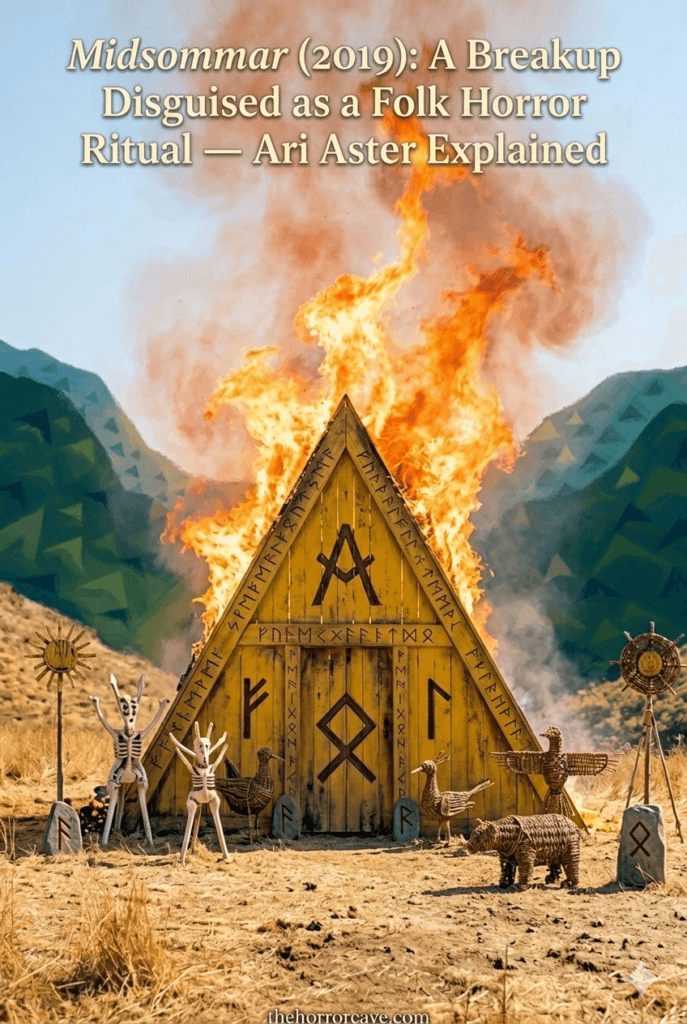
There’s a moment near the end of Midsommar (2019, dir. Ari Aster) where the camera holds on Dani’s face for what feels like a very long time. The temple is burning. The screaming is communal — the Hårga wailing in orchestrated sympathy with the men dying inside, a chorus of mirrored pain that the film has been training you to recognize since the ättestupa. Dani is crying. Then she isn’t. The horror on her face dissolves into something else, and that something else is a smile, and Ari Aster holds on it. Most people read that smile as catharsis. Dani finally free. The bad boyfriend gone. The grief released. That reading is half right and half wrong in a way that matters. What the Midsommar ending explained properly requires is understanding what the Hårga were doing before that smile appeared — and what it cost Dani to get there.
What the Midsommar Ritual Actually Is
Before you can understand what the ending means, you need to understand what the ending is doing — structurally, within the Hårga’s own logic. The Hårga celebrate midsummer every year — but this specific purification ritual, with nine human sacrifices and the burning of the temple, happens only once every ninety years. Nine human lives are required: four outsiders, four Hårga volunteers, and one final victim chosen by the May Queen. The number nine is significant in Norse belief — it appears repeatedly in pre-Christian Scandinavian mythology as a symbol of completion and cosmic cycle. Getting the Midsommar ending explained means getting this arithmetic right first. Aster researched this. The production designer built a world where these details are embedded in murals, textiles, and architectural symbols that most viewers won’t fully decode on first watch. The sacrifice isn’t punishment. That’s the part most readings get wrong. The Hårga volunteers who enter the temple are given a drug to dull the pain. They go willingly. The ritual is described by the elders as a purging — evil expelled, the community cleansed, the cycle closed so a new one can begin. It’s closer to a controlled burn than an execution. The outsiders are fuel. The commune is the forest that survives. Christian doesn’t get the drug. That detail is easy to miss, and it matters. His death isn’t communal catharsis — it’s punishment, specific to him, for specific transgressions: photographing the sacred Rubi Radr text, the coerced mating ritual. He feels everything. And Dani knows this when she chooses him.
What the Bear Symbolizes in Midsommar
The bear is the detail most people want the Midsommar ending explained around, and it rewards the attention. In Norse history, berserkers were warrior-shamans associated with the bear — men who donned bearskins and entered a state of ritual fury that made them, supposedly, immune to pain. The bear as container for masculine power. Christian, paralyzed by powder blown in his face, unable to speak or move, is placed inside that container in the most humiliating possible inversion of what it represents. The image isn’t just viscerally disturbing. It’s making an argument about what Christian actually was, underneath the performance of being a decent man — the kind of man who keeps a woman around out of guilt and calls it love, who mistakes passivity for kindness. Stuffed inside the symbol of strength while being stripped of everything that word once meant. Aster’s instincts are rarely accidental. This one isn’t either.
How the Hårga Manipulated Dani
Here’s where the interpretation gets genuinely complicated, and where most “feminist triumph” readings of the ending take a shortcut they shouldn’t. The Hårga didn’t save Dani. They engineered her. Watch what the commune does from the moment she arrives. Her grief is immediately legible to them — she is exactly the kind of person this system is designed to absorb. She needs to be seen. She needs her pain witnessed. Christian never gave her that. When the Hårga women surround her during her breakdown after discovering Christian’s infidelity, matching her breathing, wailing in unison with her, they are giving her something real. The fact that they are also manipulating her doesn’t make the thing they’re giving her false. It’s worth being careful here, because it’s easy to be too generous to the Hårga. The communal grief mimicry is also just a technique. Cults use it. The mirroring isn’t empathy — it’s recruitment dressed as empathy. The horror is that the distinction doesn’t feel like one when you’re inside it. Dani can’t tell the difference. Maybe that’s the point. Maybe the film is arguing there isn’t one, which is a darker position than most people take away. Pelle is the clearest evidence of the design. He chose her specifically. He knew her grief. He brought her to this place at the precise moment she was most vulnerable and most alone. Her arrival wasn’t coincidence. Her coronation as May Queen wasn’t recognition of something exceptional in her. It was the system completing its intake process.
Midsommar ending explained: Why Dani Smiles at the End of Midsommar
So what is Dani actually feeling at the end? The Midsommar ending explained through the screenplay is unusually direct. Aster wrote that she “surrendered to a joy known only by the insane. She has lost herself completely, and she is finally free. It is horrible and it is beautiful.” He meant both things simultaneously. Not one then the other. Both. Here’s what isn’t complicated: Dani has been carrying grief since the film’s first scene. Enormous, unmanaged grief that her boyfriend acknowledged roughly the way you acknowledge a weather report — you hear it, you nod, you continue with your plans. She cries at the beginning of the film in a specific way, gasping for air, face contorted, the kind of crying that happens when there’s nobody in the room who can actually hold it with you. Christian was never that person. He kept her around from guilt and inertia, which is one of the cruelest things you can do to someone who is drowning. Choosing him as the final sacrifice is the first active decision Dani makes in the entire film. The agency is genuine, however twisted the system that offered it. But the freedom is also a trap. She has nowhere left to go. She has severed her last connection to the outside world. The Hårga life cycle is explicit — every member is eventually sacrificed. The community offered her belonging, family, the experience of being truly seen. The cost is everything else. Including, ultimately, herself. I don’t buy the reading that says Dani’s smile is purely liberatory. I also don’t fully buy that it’s purely horrific. What Dani’s face is doing in that last shot is both, at the same time, and that simultaneity is what makes it disturbing rather than just sad. A successful cult gives you something real. That’s why it works. That’s the whole mechanism.
What Pogorzelski and Krlic Are Doing in the Final Sequence
The technical choices in the ending sequence are what make the Midsommar ending explained at a visual level — they deserve attention, because they’re doing more than most analyses give them credit for. Pawel Pogorzelski has been using light as oppression for the entire film. Where Hereditary used darkness and shadow to hide information, Midsommar does something more unsettling — it overexposes everything. The Swedish summer sun bleaches the frame into something that should feel safe and doesn’t. Horror grammar inverted. By the time the temple burns, the fire is almost redundant — the film has been burning the entire time, just with a different fuel. The final sequence uses firelight against that overexposed palette in a way that feels almost like a corrective. For the first time, the light is directional, warm, coming from the destruction. Pogorzelski frames Dani’s face with it like a portrait. The camera isn’t observing anymore. It’s witnessing. That’s a different thing. Bobby Krlic’s score throughout the film walks a line that’s genuinely difficult to describe. His work as The Haxan Cloak draws on dark ambient and industrial textures, but the Midsommar score reportedly blends those with folk instruments — nyckelharpa, hurdy-gurdy — and orchestral strings in a way that makes the sound of the Hårga feel ancient and ceremonially correct. By the ending, the score isn’t alarming you. It’s accompanying you. That shift is intentional and disorienting. The music has accepted what’s happening. The audience has to decide whether they have too. The Midsommar score is best listened to on vinyl at midnight, and you will regret it.
The Director’s Cut vs. Theatrical Cut: Which Is Correct
The director’s cut is the wrong version. The extra twenty-four minutes add a scene that shows Christian consenting to the mating ritual before he takes any psychedelics. His betrayal of Dani becomes more concrete. His ending becomes, as one analysis put it, a “teensy bit more justified.” And that’s exactly the problem. The theatrical cut leaves Christian in moral gray. He’s weak and passive and complicit in his own way, but the ambiguity of his participation in the fertility ritual — how much was he coerced, how much did he want an excuse — keeps the ending genuinely complicated. The director’s cut simplifies it. It gives you permission to feel unambiguous about his death. The film becomes a revenge narrative with folk horror dressing. The theatrical version doesn’t give you that permission. Dani’s smile is harder to process without it. Which is why the theatrical cut is the correct one. If you haven’t seen it yet, the Midsommar Blu-ray includes both versions.
Why the Midsommar Ending Works When Most Horror Endings Don’t
Midsommar ends the way almost no horror film ends: with the protagonist choosing the horror. Walking into it, eyes open, smiling. My father worked construction. When I was a kid he took me to a job site on a Saturday and showed me a wall he’d framed. “You can’t see it once the drywall goes up,” he said. “Doesn’t matter. Has to be right.” I don’t know why that sentence comes back when I think about how this film is built. It just does. Most horror endings are structured around the restoration of the world — the monster defeated, the threat contained, the protagonist returned to something recognizable. Even films that end badly tend to end with the horror imposed from outside. Dani walks into hers. She picks the sacrifice. She stays. She smiles. Every element is load-bearing. The rituals, the grief, the progressive isolation, the communal mimicry, the dance, the coronation. By the time Dani smiles, the film has already told you everything you need to understand what you’re seeing. It just refuses to tell you how to feel about it. That refusal is what separates a serious horror film from one that is merely about a serious idea. Aster holds on that smile for a long time. He’s right to. That held shot is the Midsommar ending explained without a single word of dialogue — just a face, a fire, and a choice that can’t be undone. For the other Aster ending that operates the same way — the one that refuses to tell you how to feel about a crowned figure in a treehouse — read what actually happens to Peter Graham. Want more on Ari Aster’s folk horror? Read our full Midsommar review, and if you want to go deeper into the visual language Aster uses across his films, our Hereditary hidden details covers the same territory on that film. For Midsommar specifically, the Midsommar hidden details piece goes frame by frame through what Aster and Svensson buried in the set design. And if you want more films in the same vein, our movies like Midsommar guide covers the closest matches.