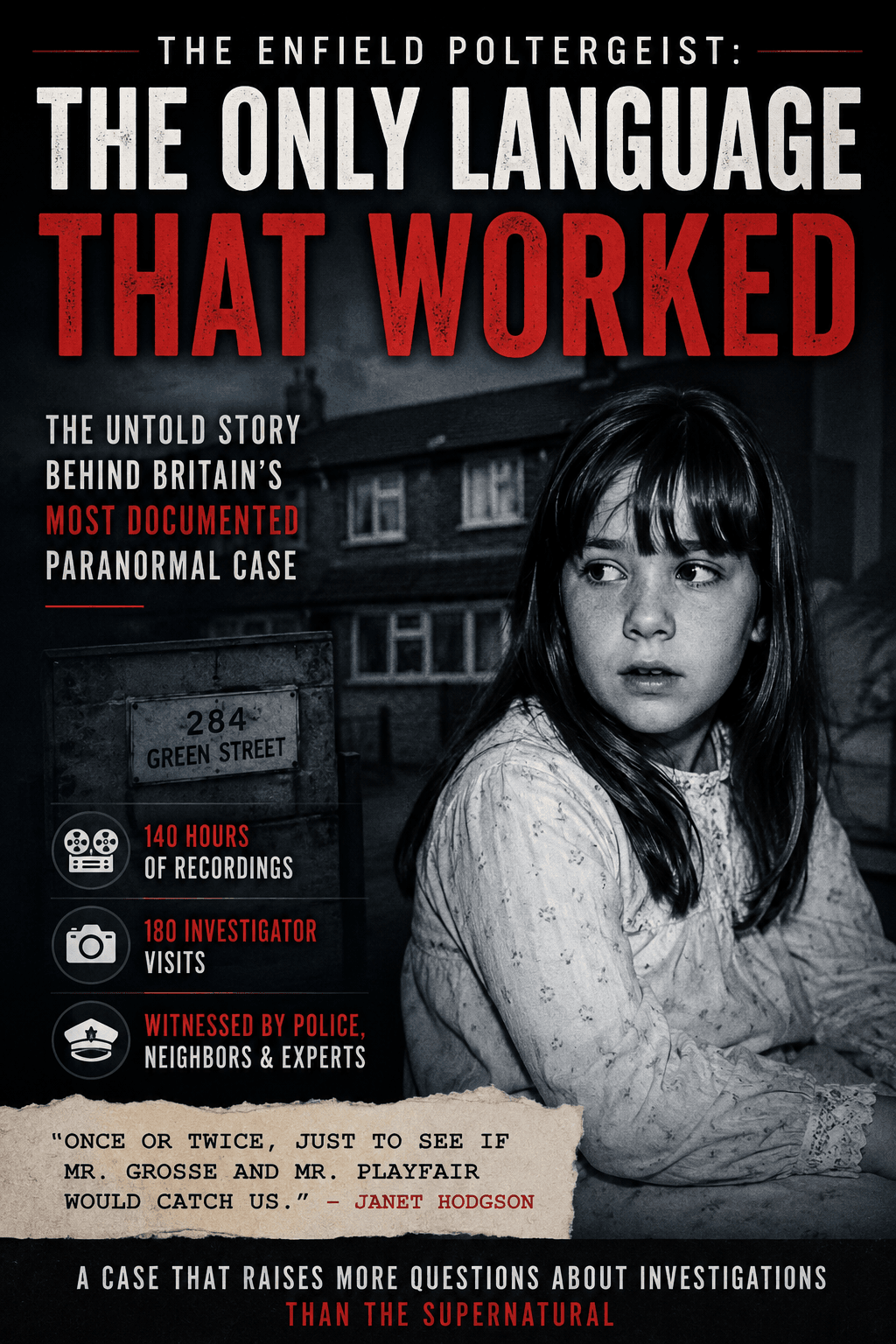
The Enfield Poltergeist: The Only Language That Worked
In December 1977, Maurice Grosse said something out loud that he probably should have kept to himself.
He’d been sleeping in shifts in a council house in Brimsdown, North London for three months. He had tape recordings of knocking sounds and animal growls. He had a Metropolitan Police constable on record who’d watched a chair slide across the floor and signed a statement saying he couldn’t explain it. He had his colleague Guy Lyon Playfair documenting every visit. He had, by any measure, an extraordinary volume of alleged evidence for what would become the most documented case of paranormal activity in British history.
What he still needed, what he announced to no one in particular while Janet Hodgson was in earshot, was for the voices to talk.
That night, they did.
Janet Hodgson was eleven years old. Her parents had recently separated. Her mother, Peggy, was a seamstress raising four children — Margaret, 13, Janet, 11, Johnny, 10, and Billy, 7 — in a rented council house at 284 Green Street that the family had occupied since 1967. The disturbances had begun on August 31st, when Peggy called 999 after watching furniture move and the children reported knocking sounds on the walls. Janet was dreading the start at a new school the following week. The family had lived in the house for ten years without incident.
None of that context traveled with the story when it left the house.
What arrived after that 999 call had its own institutional logic, and the Hodgsons had no mechanism to manage it. The Daily Mirror sent a photographer. The Society for Psychical Research sent Grosse and Playfair. Journalists from several outlets followed. Within weeks, 284 Green Street had become an active site — investigators arriving on rotation, cameras set up in bedrooms, neighbors brought in to witness and sign statements.
The people who came held all the interpretive authority. Grosse and Playfair decided what counted as evidence and what counted as noise. They decided which incidents were genuine and which were discounted. They decided, later, whether a confession given by an eleven-year-old girl to journalists was valid or whether it had been extracted under pressure — and when they decided the latter, the girl retracted. By the time the investigation concluded, Grosse and Playfair alone had made 180 visits to the house and conducted twenty-five all-night vigils. There were 140 hours of tape recordings. More than thirty people had formally documented what they witnessed.
Peggy Hodgson, for her part, had four children to feed on a seamstress’s wage in a house that had been converted, without her authorization, into the focal point of a national paranormal investigation. She had called for help in August. What showed up had no exit condition she could activate.
The believers’ version and the skeptics’ version are both organized around the phenomena. The question underneath sits outside that debate entirely. It’s about how investigations work when you are the investigated rather than the investigator.
The family had access to the house. The investigators had access to everything else: the institutional credibility, the publishing platforms, the authority to decide what the experience meant and what it would be called. When Janet confessed to faking some of what happened, it was Grosse and Playfair who managed that confession. When the case needed voices, it was Grosse who said so out loud.
There is no record of anyone asking Peggy Hodgson whether she wanted the investigation to continue. There is no record of anyone asking Janet. The investigation had become self-sustaining — twenty-five all-night vigils don’t happen unless the investigators have decided, repeatedly, that they are necessary. The Hodgsons were not participants in that decision. They were the location.
That dynamic is what the Enfield Poltergeist actually documents — the part that doesn’t make it into the debate, because neither side has a frame for it.
What the Evidence Shows
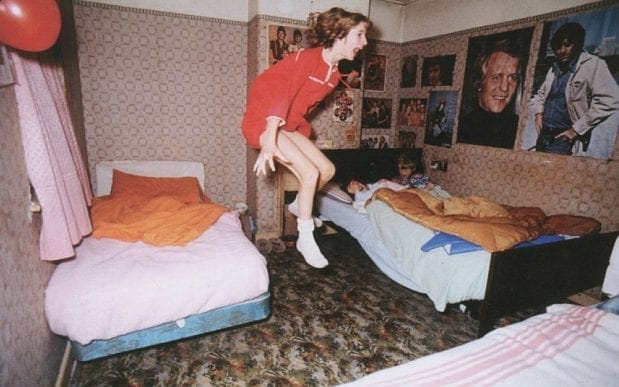
Janet was caught on camera bending spoons and banging a broom handle against the ceiling to produce knocking sounds. The famous levitation photographs have been read as a girl jumping from her bed — the photographer, Graham Morris, gave conflicting accounts of what he saw, at one point describing it as someone “jumping across the room” before later denying that characterization. A ventriloquist who analyzed the tape recordings concluded the voice was produced using false vocal cords. In 1980, Janet acknowledged that she and Margaret had faked some events. “Once or twice,” she said, “just to see if Mr. Grosse and Mr. Playfair would catch us.”
They didn’t catch them. When the girls had confessed to journalists earlier, Grosse and Playfair convinced them to retract — arguing that the admissions were given under pressure from reporters who’d spent weeks pushing for a story. The girls retracted. The investigation continued. Both men maintained until the end of their lives that while some phenomena were faked, others were genuine.
The hoax narrative settles cleanly. The actual case keeps going.
Because underneath the faking question is the sequence of events in December 1977, and the sequence is documented. And the sequence contains a detail that the hoax framing has no real use for: that Janet’s admission covered “once or twice,” not eighteen months. Grosse and Playfair, the two investigators most invested in the case’s authenticity, accepted that framing. They believed a percentage was genuine. Which means they were also, implicitly, deciding which percentage counted and which didn’t — making determinations about an eleven-year-old’s inner experience from the outside, based on criteria they controlled entirely.
The Voice That Knew Things It Shouldn’t
The voices started that December. They began as whistles, shifted to what Playfair documented as dog-like barks, and eventually developed into the voice of an elderly man speaking with a heavy Cockney accent. The voice identified itself as Bill Wilkins. It claimed to have lived in the house. It described going blind. It described a haemorrhage. It described dying in a chair in the room downstairs.
William Charles Wilkins had in fact lived at 284 Green Street. He had in fact gone blind. He had suffered a haemorrhage. He died in a chair in the downstairs room on June 20, 1963. His family moved out in 1964. The Hodgsons moved in three years later.
None of this was confirmed until 1996. Grosse had played the recording on an LBC radio talk show, and a listener recognized it. Bill Wilkins’s son Terry contacted Grosse, confirmed his father’s details, and Grosse obtained the death certificate. For nearly two decades, the voice had described a dead man’s biography accurately without the investigators being able to verify any of it. When verification finally came, it came from outside the case entirely — from a radio broadcast, from a stranger who happened to be listening.
Whether Janet Hodgson knew those facts before she spoke them, and how she might have known them, is a question the Society for Psychical Research’s own case documentation does not resolve. She could have found the name somewhere — a neighbor’s memory, a piece of old post, a conversation that predated the investigation by years. She could have found nothing, and something else produced the voice. Both remain technically open. What’s notable is that Grosse himself couldn’t verify the voice’s claims for nearly two decades — he spent that time defending the core evidence of his most important case without being able to confirm the identity of the man supposedly speaking through it.
What nobody asks is what an eleven-year-old girl decided to become once she understood what the investigators needed.
The Announcement and the Delivery
A decade covering politics in Texas leaves you with a fairly detailed map of how institutional attention operates. Which version of a story gets traction in a committee room and which gets you walked out of the building. Which kind of distress produces results that a plain recounting of facts never would. I watched sources calculate this — most of them adapting — working out which language made the institution stay in the room. They had something real to communicate. The institutions around them responded to certain languages and not others. For most of them, the performance was the only form the reality could take if it wanted any traction at all.
Grosse announced in December 1977 that he needed voices. He said this in a house where an eleven-year-old girl had been living with investigators and cameras for three months — watching what each session required, watching what generated interest and what generated nothing, watching the 140 hours of tape accumulate, watching the twenty-five all-night vigils, watching the investigators decide what counted. That night, she produced voices.
The voices described a dead man’s biography with enough accuracy to be confirmed nearly two decades later. The sequence is documented: announcement, then delivery, same night. An eleven-year-old in a case that defined how paranormal investigations work in Britain understood what the adults in her house were listening for and found a way to speak it.
That observation doesn’t require a position on the supernatural. The believers can hold it without damage to their argument. The skeptics can hold it without conceding anything. What it requires is taking seriously the idea that Janet Hodgson was a careful observer — paying attention to the specific mechanics of what produced results in the rooms she was living in.
The case literature treats this as evidence of faking. That is one reading. A girl who heard exactly what was needed and delivered it the same night was either a talented opportunist or something more interesting: a child who had learned, over three months of institutional occupation of her family home, which language made the adults stay in the room.
What Janet had learned to read, specifically, was a feedback loop. Furniture moving produced a police constable. Knocking sounds produced the Daily Mirror. Growls and whistles produced investigators who stayed the night. Each escalation generated a proportionate institutional response. She had watched this for three months before December. She had watched what expired the investigators’ interest and what renewed it. She had watched Grosse and Playfair make decisions about what was real and what wasn’t — watched them decide, and then decide again, and then decide a third time. By December, she had more observational data about what this investigation needed than most of the people running it.
The same dynamic turns up in other documented cases — the gap between what investigators record and what the person at the center actually experienced is almost always wider than the official account admits. In Enfield, it’s unusually visible. The documentation is too thorough to hide it.
Grosse and Playfair were not malicious men. They were investigators who believed in what they were doing and conducted their work with more rigor than most of what passes for paranormal investigation. That’s what gives the dynamic its actual weight. The most consequential thing about the Enfield case may be that everyone in that house was, in their own way, doing exactly what their situation required of them — and nobody, including the investigators, had full visibility into what they were asking of an eleven-year-old girl.
What It Costs to Be the Channel
Forty-plus years later, in the Apple TV documentary The Enfield Poltergeist, Janet Hodgson — who married and took the name Janet Winter, who largely avoided public discussion of the case for decades — said this: “You never feel like you’re free of it. It’s never left me.”
That statement doesn’t resolve what happened at 284 Green Street. What closes, in that sentence, is something about the cost of being the channel — whatever that channel carried, wherever it came from. An eleven-year-old girl who learned to speak in a dead man’s voice in order to be heard spent the rest of her life carrying what that required of her.
The Enfield Poltergeist is the most documented alleged haunting in British history. It is also, from a slightly different angle, a fairly complete record of what one child had to become in order to get thirty people to stay in the room.
Peggy Hodgson’s story has almost no teller. The case literature is built around Janet — the voice, the levitation photographs, the 1980 admission, the Apple TV interview. Peggy appears at the edges: the mother who called 999, the mother who housed the investigation, the mother who died in 2003. What eighteen months of cameras and investigators and journalists in her living space cost her specifically is not part of the official record. What Peggy Hodgson gave the case was access — to the house, to the children, to eighteen months of institutional occupation she had no mechanism to end.
The house still stands at 284 Green Street. The Society for Psychical Research’s full documentation remains available for anyone who wants to read it.
Most people don’t. The demon version is easier to argue about.
Frequently Asked Questions About the Enfield Poltergeist
Was the Enfield Poltergeist real or faked?
The Society for Psychical Research investigated for eighteen months and concluded that while some phenomena were faked by the children, other incidents remained unexplained by conventional means. Janet Hodgson admitted in 1980 to faking events “once or twice.” Skeptics cite the levitation photos (consistent with jumping), spoon-bending caught on camera, and the voices appearing the same night an investigator said he needed them. The case remains the most documented alleged poltergeist in British history and the most contested.
Who was Bill Wilkins in the Enfield Poltergeist?
William Charles Wilkins was the previous occupant of 284 Green Street. He went blind in his later years, suffered a haemorrhage, and died in a chair in the downstairs room on June 20, 1963. His family moved out in 1964. The voice Janet Hodgson produced in December 1977 identified itself as Bill Wilkins and described his death accurately. These details were not confirmed until 1996, when Wilkins’s son Terry contacted investigator Maurice Grosse after hearing a recording of the voice on LBC radio.
What happened to Janet Hodgson after the Enfield Poltergeist?
Janet Hodgson married and changed her name to Janet Winter. She largely avoided public discussion of the case for decades. In the Apple TV documentary The Enfield Poltergeist, she said: “You never feel like you’re free of it. It’s never left me.” She participated briefly in press activity around The Conjuring 2 in 2016, which dramatized the case.
How accurate is The Conjuring 2‘s version of the Enfield case?
James Wan’s 2016 film centered the Warrens’ involvement, which in the actual case was peripheral — the Warrens visited briefly and Ed Warren made some recordings, but the primary investigators were Maurice Grosse and Guy Lyon Playfair of the SPR. The film substantially condensed and dramatized events. For the documented record of the investigation, the SPR’s own case files remain the primary source.