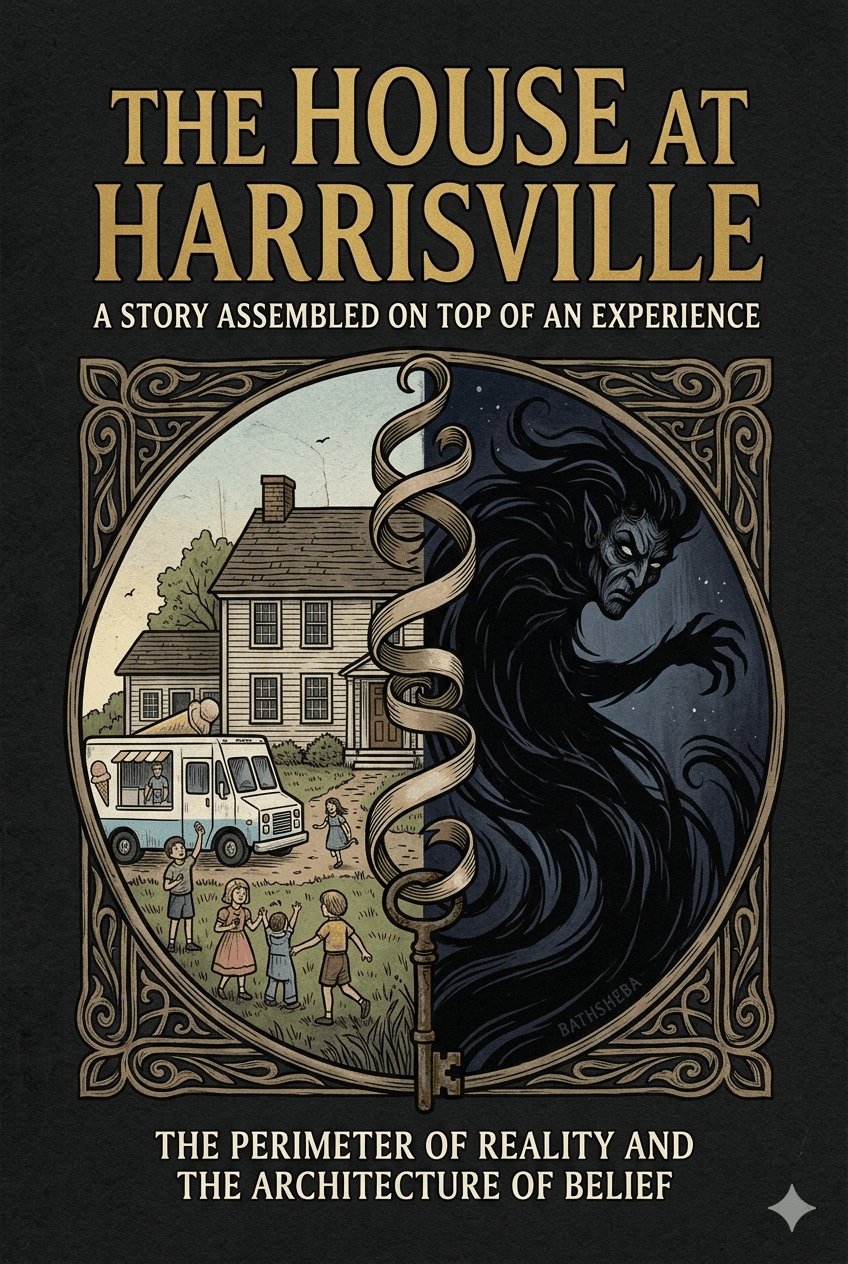
The Perron Family Haunting is one of the most documented cases of alleged paranormal activity in American history. When I was eight years old in Ohio, there was an ice cream truck that came down our street every afternoon without fail. Three bells, pause, three bells. The kids in the neighborhood heard it from whatever yard they were in and ran for the sidewalk like the decision was entirely their own. It took me twenty years to understand that the truck already knew where we’d be. The route was designed around our habits. The structure that produced the desire was in place before any of us felt the desire.
In January 1971, Roger and Carolyn Perron drove their five daughters to a farmhouse in Harrisville, Rhode Island, and believed they were beginning something. They’d chosen the place, signed the papers, packed the boxes. What they were actually doing was entering a story the region had already been telling for a long time — one with a role written for whoever moved in next. The choice was real. The context surrounding it was not something any of them had been given.
The House at Harrisville
The Old Arnold Estate sat on enough land to feel like distance from the world — an 18th-century farmhouse with fourteen rooms, more than two centuries of layered history, and a price that made sense for a family of seven working with limited options.
Roger Perron was practical and skeptical by temperament, a man who fixed things for a living and believed in mechanisms. He saw a farmhouse that needed attention and had room. Carolyn saw the same building and felt something that didn’t have a name in the first few weeks, which was part of what made it difficult to address.
The five daughters — Andrea, Nancy, Christine, Cindy, and April — moved into their rooms, claimed the land, made the adjustments children make when a family relocates. The oldest was twelve. The youngest was five. Andrea Perron documented in House of Darkness, House of Light that the previous owner, when handing over the property, left Carolyn with something close to one piece of advice: don’t look for what you find in there. Then he left quickly.
Roger probably filed that under nervous seller. Carolyn filed it somewhere else.
They moved into the Old Arnold Estate in January 1971. They would not leave until 1980. Nine years in a house that had been waiting for someone to live in it long enough to know it.
The Property’s Actual History
The location at the center of the Perron Family Haunting — a property occupied continuously for two centuries — accumulates generations of events. Some of those events will be violent, because people are.
The Old Arnold Estate had that kind of documented history — multiple families over multiple generations experiencing deaths connected to the property: drownings, suicides, tragedies consistent with the casualty rate of rural New England life before modern medicine reached everywhere it needed to reach. Whether this represents an anomalous cluster or the expected arithmetic of 200 years is a question historians haven’t settled cleanly. What is established: the land was old, it had passed through many hands, and people had died on it in ways that left marks on how the surrounding community talked about it.
The house itself had layers — additions built over the original structure, rooms sealed off, architectural decisions made by people who’d been dead for generations before the Perrons arrived. Roger Perron saw a building project. The house had a different view of the arrangement.
The region’s folklore about the property predated the family. They moved into a place that already had a reputation, the way some buildings accumulate one over enough time regardless of what’s actually happened in them. What the stories were missing, at the time the Perrons moved in, was a name to put on the thing. That name would come later, and from outside the family.
What the Family Experienced
The early phenomena of the Perron Family Haunting were domestic in scale, easy to dismiss individually, and persistent enough collectively that the individual explanations kept failing.
Carolyn would sweep the kitchen floor and find, minutes later, a small pile of dirt in the center of the room. The broom moved between locations without explanation. The kitchen produced scraping sounds — something against the kettle — when no one was in it. Objects displaced. Presences felt in rooms before entering them.
Old houses settle, creak, produce sounds. People leave objects in different places than they remember. Carolyn Perron was managing a household of seven and could have missed a spot on a floor without supernatural involvement. She tried these explanations. They held for a while and then they stopped holding.
Over time the phenomena divided into two categories. The first was diffuse — sounds, movements, presences experienced by multiple family members independently, the kind of thing that Andrea Perron would eventually spend three volumes documenting with careful specificity in House of Darkness, House of Light. Frightening, but distributed across the household.
The second category targeted Carolyn specifically.
Andrea has described the logic of it across multiple interviews with a consistency that suggests it’s the framing she settled on early and never revised: whatever occupied the space perceived itself as its rightful mistress of the house, and Carolyn, as the adult woman running the household, was in competition for that position. The presence came for Carolyn with a specificity it didn’t apply to anyone else.
Andrea documents in House of Darkness, House of Light that the physical incidents involving Carolyn escalated over years — that Carolyn woke with marks she couldn’t account for, something consistent with puncture wounds, unexplained by anything in her daily routine. Her sleep deteriorated. Her weight changed. The woman who had moved into the farmhouse with plans and energy became someone her family watched with a specific kind of fear — the kind that builds slowly and is worse for it.
Roger noticed all of this. Roger continued looking for the rational explanation. He found it approximately as often as the individual floor-sweep explanations had held.
Roger Perron
Roger Perron is the figure the film collapses into a supporting role, and the film is wrong to do it. His experience of the Perron Family Haunting was shaped entirely by his resistance to interpreting it as haunting.
He was skeptical — a genuine epistemological position he maintained across nine years in a house that was systematically eroding his wife. He wanted documentation. He needed mechanism, something with cause and effect he could map. The supernatural framework offered him nothing he could push back against in the way he knew how to push back against things.
He stayed anyway.
The financial argument is real: they had bought the property, rural New England farmhouses don’t sell quickly, and they didn’t have money for a clean exit. That explains the early years more cleanly than the late ones. By the late 1970s, what was happening to Carolyn was undeniable in its effects, whatever the contested cause. Roger was watching his wife change in ways he couldn’t fix, in a house he couldn’t leave, still looking for the explanation that kept receding.
When the Warrens finally came to Harrisville, Roger and Ed Warren understood each other with the immediate clarity of two people who share no common ground. Ed was a man who’d built a career on confidence in the invisible. Roger was a man who needed to see a thing before he’d believe it. The meeting was not going to go well, and it didn’t.
Andrea Perron has written about her father with a precision that resists easy framing. He was paying close attention throughout. He held a different position on what the details meant. He was a man who loved his family and believed a rational explanation was still out there, and who paid for that belief across a decade that didn’t offer one.
The Real Bathsheba Sherman
Here the story requires a stop, because this is where it gets taken away from the Perron family entirely.
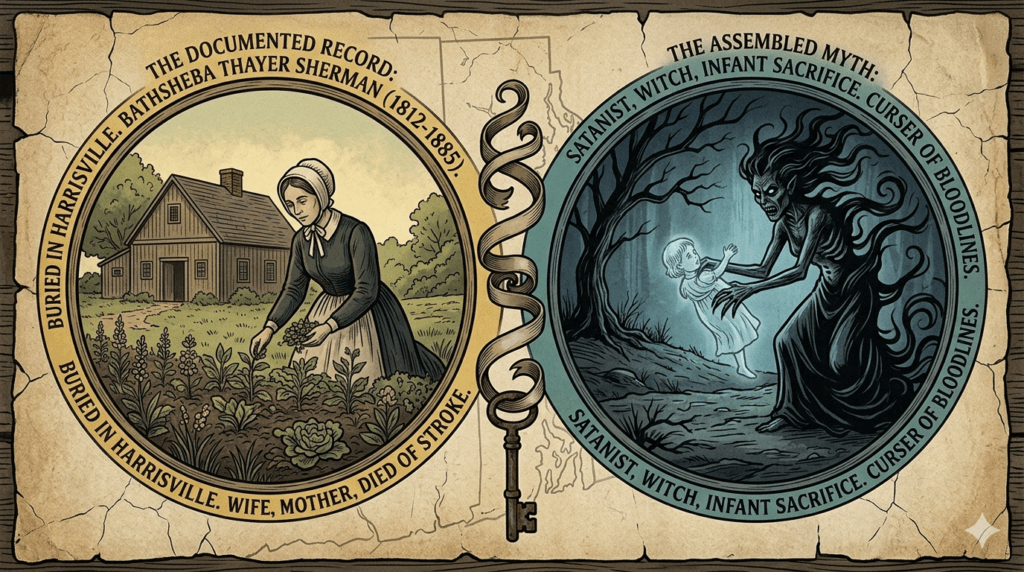
Bathsheba Thayer was born on March 10, 1812, in Burrillville, Rhode Island. She married a farmer named Judson Sherman in 1844. She had children, several of whom died young — a common tragedy in 19th-century rural America with limited access to medical care. Judson Sherman died in 1881. Bathsheba remarried Benjamin Greene in 1883. She died on May 25, 1885, at the age of 73. The Burrillville Gazette recorded her cause of death as “a sudden paralysis” — the standard 19th-century phrasing for what we now call a stroke.
She is buried in Harrisville. Her gravestone exists. Her marriage records exist. Her death records exist.
What do not exist: any trial of Bathsheba Sherman. Any documented accusation of witchcraft. Any historical record of infant sacrifice. Any investigation, any formal charge, any community scandal in the available archives. J’aime Rubio, a researcher who spent years examining primary sources on the real Bathsheba Sherman, found nothing — no inquest, no documentation of anything sinister connected to her name in any archive she could locate. The Boston Globe published an investigation into her historical record in 2023 that reached the same conclusion: an ordinary Rhode Island woman who married, lost children in the way people lost children then, outlived her first husband, and died of a stroke in her seventies.
She also did not live on the Old Arnold Estate. The Sherman property and the Arnold property were different parcels of land. Bathsheba Sherman had no documented connection to the house the Perrons bought.
This is not a minor historical footnote. A real woman with a documented life and a real grave has been transformed — across fifty years of Warren mythology and a global film franchise — into a Satanist who cursed a bloodline and hunts women across centuries. Millions of people have seen The Conjuring. A much smaller number have read the Boston Globe’s correction, or J’aime Rubio’s research, or Bathsheba Sherman’s actual death record. The historical record is findable. It requires effort to locate, and the franchise has no incentive to direct anyone toward it.
How the Warrens Named the Monster
Ed and Lorraine Warren arrived at the Perron house after years of the family’s experiences. Timelines in different accounts place the arrival at various points across the 1970s; the exact date is not consistent across sources. What is consistent, including in Andrea Perron’s own documentation, is the sequence by which Bathsheba became the official designation for whatever was in that house.
Carolyn Perron told Lorraine Warren about the local legends she’d absorbed after moving in — the folklore about Bathsheba Sherman, the regional stories that had accumulated around the name. Lorraine took that information and applied it to what she believed she was sensing in the property. The attribution was Lorraine’s interpretation, made using the name Carolyn had provided. From that conversation forward, the house had a named entity, the named entity had a biography, and the biography found its way to Hollywood.
I’ve written before about the Warren apparatus and the mechanism of sincere self-deception — and in the broader case for and against whether they were frauds. The Bathsheba attribution is a clean example: Lorraine was interpreting — using the name Carolyn had given her, placing it on what she believed she was sensing. The interpretation acquired the permanence of documented fact because Lorraine Warren’s identifications carried institutional weight by the time she arrived in Harrisville.
The same machine produced the Annabelle narrative. The mechanism is identical. The consequences for actual human beings vary only in scale.
The Séance
The séance is one of the few events from the Perron Family Haunting that belief accounts and skeptic accounts largely agree on in basic outline, even when interpreting it differently.
The Warrens conducted it in the house. During the séance, Carolyn Perron lost consciousness. Witnesses described her speaking in a voice unlike her own. She was thrown violently from her chair. She appeared, to everyone present, to be somewhere other than the room she was in.
Roger Perron was not in the room when it began.
When he entered and found Carolyn in that state — his wife, apparently having been used as a channel for something while he was elsewhere in his own house — he ended the séance and told the Warrens to leave. His concern, by Andrea Perron’s account, was his wife’s mental stability. Nine years in that house had moved through Roger Perron without displacing his skepticism. What he found when he walked through that door did.
The Warrens left. The Perrons stayed for more years after. Whatever had been in the rooms before the séance was still there. The name that had been given to it was now attached in a way that couldn’t be untaken.
Why They Stayed
Why the family remained at the center of the Perron Family Haunting for nine years is a question the film doesn’t spend time with, which is understandable. The film has different work to do.
The financial explanation has real weight: they had purchased the property, rural New England farmhouses are difficult to sell quickly, and the Perrons didn’t have money for a clean relocation. That covers the early years most cleanly, but it doesn’t hold for the full nine — by the later years, something else kept them there.
Andrea Perron, who has processed those years in ways most people never have to process a decade of their childhood, has described something more complex than economic constraint across multiple interviews. She has talked about loving the house — the land, the structure, something about the property that coexisted with what the property was doing to her family. Her three-volume account is the record of a complicated relationship — the fear and the attachment running in parallel across nine years.
The family left in 1980. Andrea has said that when they finally drove away, the presences went quiet — that the connection between the family and the house dissolved with the departure.
What she has also said, consistently and across multiple formats, about what Hollywood made of her family’s decade: the film is “about 95% fiction and 5% truth” — and for a close reading of exactly what Wan built in the other 5%, the Conjuring 2013 hidden details breakdown is where to start. She has not expressed particular bitterness about this publicly. She seems to understand that a film is a film, that the studio’s priorities were not her family’s documentation, and that the documentation is in the three books for whoever wants to find it. She wrote them. They exist. The other version got the budget.
What This Case Actually Shows
The Perron family haunting is a study in how a story gets assembled on top of an experience, and what the assembly costs.
The experience: a family of seven lived in a 200-year-old farmhouse for nine years and documented, through multiple witnesses and across decades of consistent testimony, things that remained beyond their capacity to explain. Carolyn Perron was harmed — in ways observable in their effects even if the cause remains genuinely contested. Roger Perron spent nine years looking for a rational explanation in a house that kept making that search harder. Five daughters grew up with fear as a domestic constant.
The story built on top of that needed a villain with a face. Bathsheba Sherman’s name was already in the region’s folklore, Lorraine Warren had placed it on the presence, and by the time Hollywood arrived the casting was done.
What happened to the Perrons was real to them. The Perrons can speak for themselves — and they have, across decades of consistent testimony.
Bathsheba Thayer Sherman cannot.
She was born in 1812. She married a farmer named Judson Sherman. She buried children, as many people did then. She outlived her husband, remarried, and died of a stroke in 1885 at the age of seventy-three. Her gravestone is in Harrisville. She is the villain of a franchise watched by hundreds of millions of people, assembled from local legend and Warren interpretation and production design. She had no say in any of it. The historical record has her dying peacefully, in her seventies.
The rest is someone else’s story, told in her name.
Frequently Asked Questions
Who were the Perron family?
The subjects of the Perron Family Haunting, Roger and Carolyn Perron moved with their five daughters — Andrea, Nancy, Christine, Cindy, and April — into the Old Arnold Estate in Harrisville, Rhode Island in January 1971. They lived on the property for nine years before leaving in 1980. Andrea Perron, the eldest daughter, later documented the family’s experiences in a three-volume account titled House of Darkness, House of Light.
Was Bathsheba Sherman a real person?
Yes. Bathsheba Thayer Sherman was born March 10, 1812, in Burrillville, Rhode Island, married farmer Judson Sherman in 1844, and died May 25, 1885, from paralysis consistent with a stroke. Historical records contain no trial, no documented accusation of witchcraft, and no evidence of infant sacrifice. She also had no documented connection to the Old Arnold Estate — she lived on a different property. The identification of the Perron house presence as “Bathsheba” came from Lorraine Warren, who applied the name based on local legend Carolyn Perron relayed during the investigation.
How accurate is The Conjuring?
According to Andrea Perron, the eldest daughter and primary documentarian of the family’s experiences, the film is “about 95% fiction and 5% truth.”
Why did the Perron family stay in the house for nine years?
A combination of financial constraint and what Andrea Perron has described as genuine attachment to the property. Selling a rural New England farmhouse quickly without relocation funds is difficult under any circumstances. Andrea has also spoken across multiple interviews about loving the house itself — the land, the structure — in ways that made a clean departure complicated. The family left in 1980. Andrea has said the presences went quiet when they did.