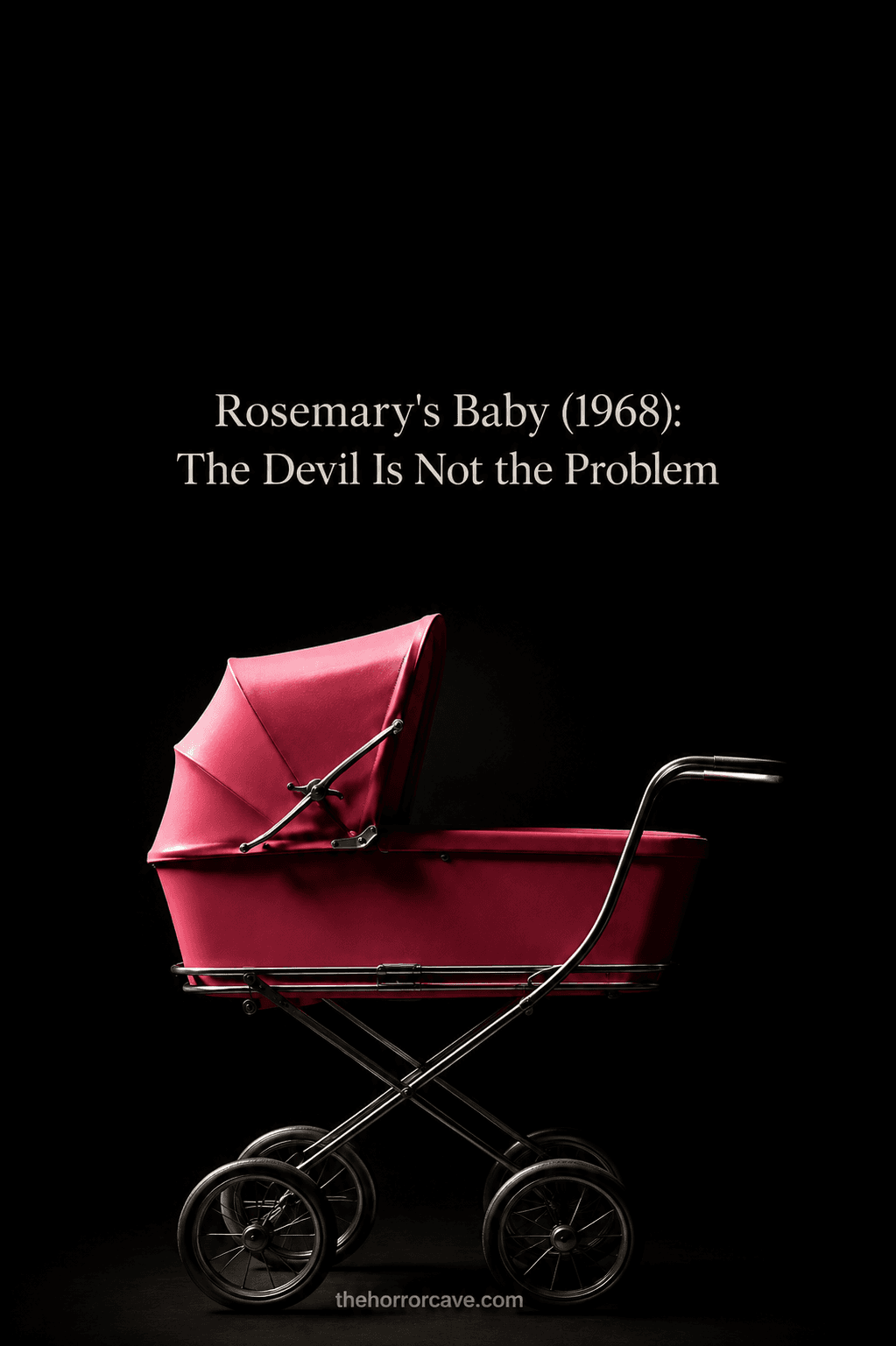
Rosemary’s Baby (1968): The Devil Is Not the Problem
My grandmother used to make apple pie. Not the supermarket kind — pie that would start smelling before you even walked through the door, cinnamon and melted butter warming the whole hallway. She’d hum while she rolled the dough. No real melody, just the sound of someone who knows you’re coming and is making something good. Whenever I got home from school and that smell hit me at the door, there was an immediate, physical certainty of being safe. A feeling that didn’t need an argument — the kind the body understands before the head does.
It’s a completely useless memory for analyzing a film. I think about it every time I watch Rosemary’s Baby.
Roman Polanski adapted Ira Levin’s 1967 novel with a fidelity that Levin himself publicly praised. That includes something American horror of the era would have gladly avoided: the refusal to show clearly what’s happening. For most of the film, the question stays open. Is Rosemary losing her mind? Is the pregnancy consuming her emotionally and she’s projecting fear onto the only neighbors who are trying to help? Polanski films the ambiguity the way an investigator films a crime scene — without concluding early, without winking at the camera.
Rosemary’s Baby is plausibility horror. The hardest kind to make and the hardest kind to shake afterward.
Before going further: there’s no honest way to write about this film without mentioning what Polanski did outside it. In 1977, he was indicted in the United States on multiple sexual charges against a 13-year-old girl — including rape — and pleaded guilty to the reduced charge of unlawful sexual intercourse with a minor. He fled the country before sentencing. He never came back.
Polanski is a brilliant filmmaker. And that doesn’t resolve anything.
I don’t have an elegant position on how those two things coexist. I don’t think anyone does. What I can say is that ignoring it would be a form of dishonesty I don’t practice. What you do with that information while watching is your call, not mine.
Rosemary’s Baby has been on my essential list for years. What keeps it there is the honesty with which it describes the specific mechanism by which a woman can be destroyed — by her husband, her doctor, her charming neighbors, the entire system of authorities she was trained, over the course of her whole life, not to question.
Guy Woodhouse Is Scarier Than Anything Else in This Film
I’ll be direct about Guy: John Cassavetes plays him with such calibrated normalcy that the first time you watch — especially if you watch young, before you understand what the film is doing — you probably believe him as much as Rosemary does. He’s charming. Ambitious in a way that reads as completely human. The kind of man who does the right things while always choosing himself above everything else.
Cassavetes distributes the betrayal in flashes across the film — an expression that shouldn’t be there, a smile slightly out of place, the quality of a man who has already made a decision and is simply managing the logistics of what comes next. Never explicitly, never long enough for you to be certain of what you saw. It’s a performance choice that demands enormous control, and Cassavetes almost never gets credit for it.
He sold the woman he loves. And what the film suggests, in a fairly disturbing way, is that the word “loves” is still technically accurate. Guy simply loves her less than he loves the idea of what he could become. That distinction — between love as a choice and love as decoration — is the heart of the domestic horror at the center of this film.
The man beside you who made a decision and determined you didn’t need to know.
I’m not sure Cassavetes has gotten enough credit for this work. I don’t think he has.
Mia Farrow Is Better Than You Remember
Mia Farrow is a better actress than most people admit. Full stop.
What she does across the film is gradually build the presence of someone being erased — in the quiet, cumulative way that real erasure actually works — without fanfare. The hair she cut during filming (Vidal Sassoon did the cut; accounts of who decided vary depending on whose version you read) changes something in the film’s visual dynamic in a way no wig could have managed. She becomes visibly smaller. More alone, even when surrounded by people.
There’s a scene — and I mention this without being fully able to explain why it stayed with me over more “important” ones — where Rosemary is at the Castevet party and looks around with the expression of someone who doesn’t know exactly what they’re seeing, but feels something is wrong. It’s pure discomfort — something still trying to decide whether it has a right to exist. Farrow holds that intermediate state with a precision most actors would have abandoned in favor of something more legible to the camera.
She was nominated for a Golden Globe. She didn’t win. It makes sense that she didn’t, because what she’s doing isn’t the kind of performance awards know how to name.
Minnie Castevet and the Architecture of Care
Ruth Gordon won the Academy Award for Best Supporting Actress for Minnie Castevet. Deservedly. But what interests me about Minnie isn’t the eccentricity — it’s the warmth. Minnie cooks. Minnie shows up at the door with bowls and recipes and that way of entering an apartment as if it’s already a little bit hers. She cares in a way that reads as real, because it is real within her belief system. Rosemary is alone in a new city, far from family, married to a man whose work comes before she does — and then this older woman appears who knows her name, asks how she’s sleeping, brings homemade food.
I thought of my grandmother when Minnie shows up at the door a second time with the chocolate mousse. The smell you sense before you see who’s carrying it. The voice that already knows what you need before you ask. Rosemary wasn’t being naive when she accepted Minnie’s care. She was being human — recognizing the grammar of affection because she already knew that grammar. The problem isn’t that she couldn’t identify warmth. It’s that the warmth was genuine, and genuine in service of something she was never invited to know.
In Rosemary’s Baby, care as a cage works precisely because the care is genuine. A trap built on coldness you learn to avoid. The kind built on cinnamon and butter and a warm voice in the hallway — that one you walk into smiling.
Dr. Sapirstein — Ralph Bellamy, with exactly the right amount of benevolent authority — operates on the same logic, but with the added weight of medicine. When Rosemary starts expressing concerns about the pregnancy, the medications, the pain that won’t let up, Sapirstein does what doctors do with patients who insist on having opinions about their own bodies: he reassures her. Paternally. With the conviction of someone who knows better and doesn’t feel the need to justify it.
The Exorcist — Friedkin, 1973 — works in part on the same principle: the horror begins before the demon arrives, begins when medicine fails to explain what’s happening to Regan. Polanski understood this five years earlier. The most lasting horror is what science dismisses without examining.
William Fraker and Krzysztof Komeda
William Fraker’s cinematography does something I only caught on the second watch: t
he Woodhouse apartment never actually gets darker across the film. The light stays warm, the framing stays composed the same way. What changes is the intention of the space — a quality Fraker introduces so gradually you can’t pinpoint the moment the apartment stopped feeling welcoming. It’s one of the most quietly effective contributions to Rosemary’s Baby.
Krzysztof Komeda’s score is extraordinary. The lullaby over the opening credits — sung by Mia Farrow herself, in a soft, slightly childlike voice — does exactly what the whole film does: it feels safe, it feels maternal, and there’s something irreparably wrong with it that you can only name after you’ve already walked in. He was alive to see the film open, in June 1968, and died ten months later — before anyone knew what it would become.
The Rosemary’s Baby Ending: An Unresolved Question
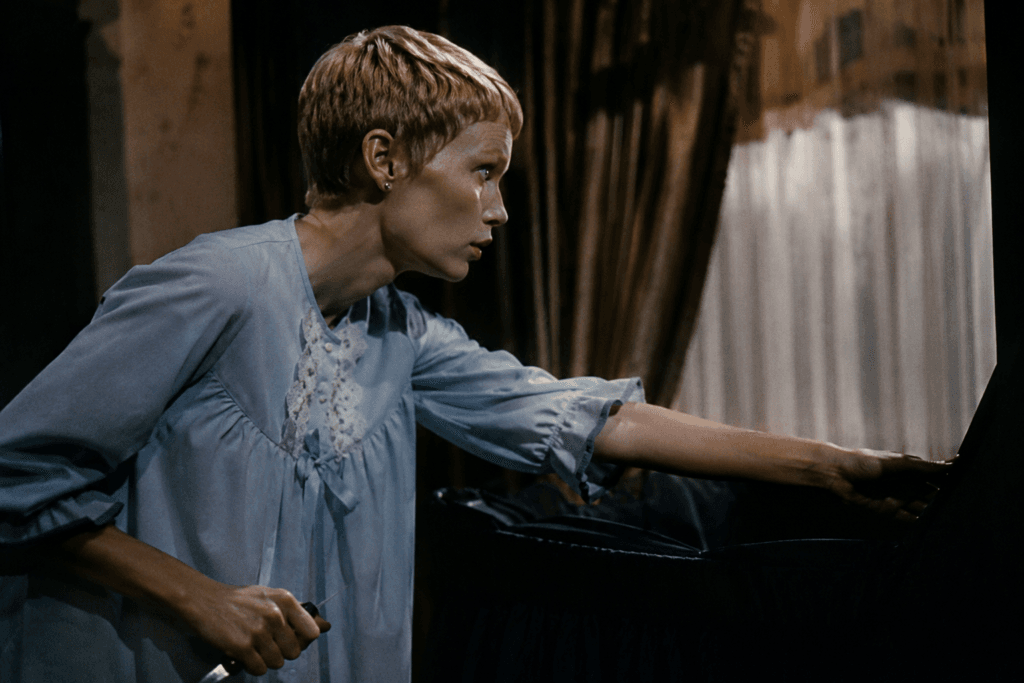
The ending of Rosemary’s Baby is frequently praised as courageous — Rosemary faces the cradle, looks at the baby, and instead of fleeing or destroying, chooses to stay. It’s read as total defeat, the system winning absolutely, motherhood deployed as the final tool of capture.
Sometimes I agree with that reading. I rewatched recently and I’m not so sure anymore.
What seems equally possible to me is that Polanski is doing something more complicated: Rosemary isn’t being defeated — she’s making a choice no one else in that room is capable of making. She’s the only person who can see the baby as a baby and not as an instrument of someone else’s project, because she’s the mother. It’s something else entirely — a choice the film refuses to simplify.
But maybe that’s just me. Maybe the ending is exactly what it looks like.
What Rosemary’s Baby Is Really About
There’s a reading of Rosemary’s Baby that sees it primarily as a film about religion — about Satanism, about the inversion of the Christian nativity, about corrupted faith. It’s a reading the film supports.
Rosemary’s Baby is about what happens when you love someone who has decided your life is an available resource. When the person who was supposed to be your fundamental ally in the world determined, sometime before the film begins, that you are negotiable. That is the horror at the center of this film. Everything else — the cult, the ritual, the Devil himself — is the mechanism. The subject is what Guy decided about Rosemary.
Rosemary isn’t destroyed by Satan. She’s destroyed by Guy’s decision, executed through Minnie, ratified by Dr. Sapirstein, and legitimized by every authority figure she encounters along the way. The cult is terrible. The husband is worse, in a way the film lets you discover on your own, because Cassavetes never underlines it — and the system that makes both of them possible is what goes home with you after the credits roll.
For a documented real-world case where that same mechanism — trust as a weapon, care as the door — played out in a Connecticut apartment with a Raggedy Ann doll, read about the real Annabelle doll.
Ari Aster built the same thesis into Hereditary fifty years later — different decade, same designed trap.
This is what makes Rosemary’s Baby still work, fifty-eight years later. The structure it describes doesn’t require a Satanic cult to exist. It just requires the right people in the right positions, and a woman who was taught to believe that whoever loves her knows what’s best for her. That the right smell in the hallway means she’s safe. That a warm voice at the door is reason enough to open it.
My grandmother used to make apple pie and I’d walk in every time without thinking twice. So did Rosemary.
Rosemary’s Baby (1968), directed by Roman Polanski, is essential horror. It remains the definitive film about a woman whose instincts are correct and whose entire social world is organized to make her distrust them. Mia Farrow’s performance alone justifies the watch. The Devil is almost beside the point. For the full critical breakdown — pacing, cinematography, Komeda’s score, and where the film sits in the horror canon — read our Rosemary’s Baby review, or go deeper with our Rosemary’s Baby ending explained.
9.3/10
The Criterion Collection edition is the right way to watch Rosemary’s Baby. Fraker’s cinematography and Komeda’s score deserve a proper screen and proper sound.
Frequently Asked Questions
Is Rosemary’s Baby based on a true story?
No. It’s based on Ira Levin’s 1967 novel, which is fiction. The fictional “Bramford” building was filmed at the Dakota Building in New York, which has its own history, but has no documented connection to any supernatural occurrences.
Is the baby really the Devil’s child, or is it Rosemary’s paranoia?
Polanski deliberately maintains the ambiguity for most of the film. The ending confirms the supernatural reality within the film’s internal logic — but the psychological horror works regardless of how you interpret the supernatural element. Both readings hold up until nearly the end.
Why did Mia Farrow cut her hair so short?
The cut was done by stylist Vidal Sassoon during filming. Accounts of who made the final call vary depending on whose version you read.
Did Ruth Gordon deserve the Oscar?
Yes. Without hesitation.
Do I need to read the book first?
No. The adaptation is faithful enough to stand entirely on its own — and it has at least one advantage over the book: Mia Farrow.