The Real Annabelle Doll: What Hollywood Got Wrong and Why It’s Scarier
My cousin Amber had a doll she kept on the shelf above her bed. I was eleven, staying at my aunt’s for two weeks that summer for reasons that were never fully explained to me in a way a child could use. The doll had yarn hair — I remember it as orange, Amber says it was red, we’ve had this argument — and a cloth face with a stitched smile and small button eyes. Nothing unusual about it. Completely ordinary. The kind of thing that accumulates in houses where children live.
I didn’t like it. During the day it was fine — just fabric, just a thing on a shelf. At night I’d wake up and there it was, smiling in the dark with that fixed expression that couldn’t change, those button eyes catching whatever light came through the curtains and holding it. I never said anything. I was eleven and I knew that saying the doll bothers me would produce a reaction I didn’t have the energy for. So I lay there in the dark and looked at the ceiling and listened to the house settle and waited for morning.
Nothing happened. It was just a doll.
I thought about those two weeks the first time I saw a photograph of the real Annabelle doll.
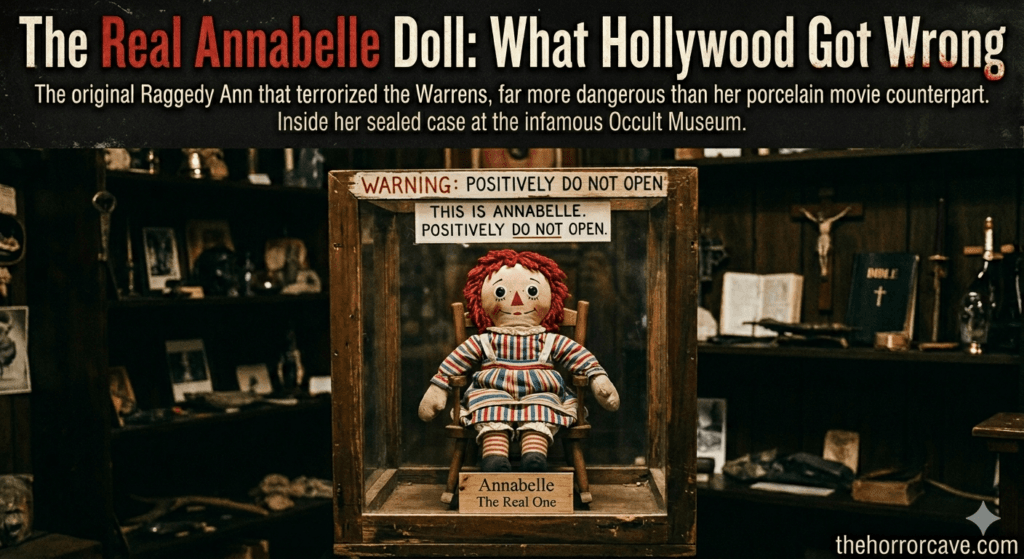
Here’s what the real Annabelle doll looks like: a Raggedy Ann doll. Cloth body, yarn hair, stitched smile, button eyes. The kind of thing your grandmother keeps in a wicker basket on the landing. You have seen a hundred of them. Not one made you uncomfortable.
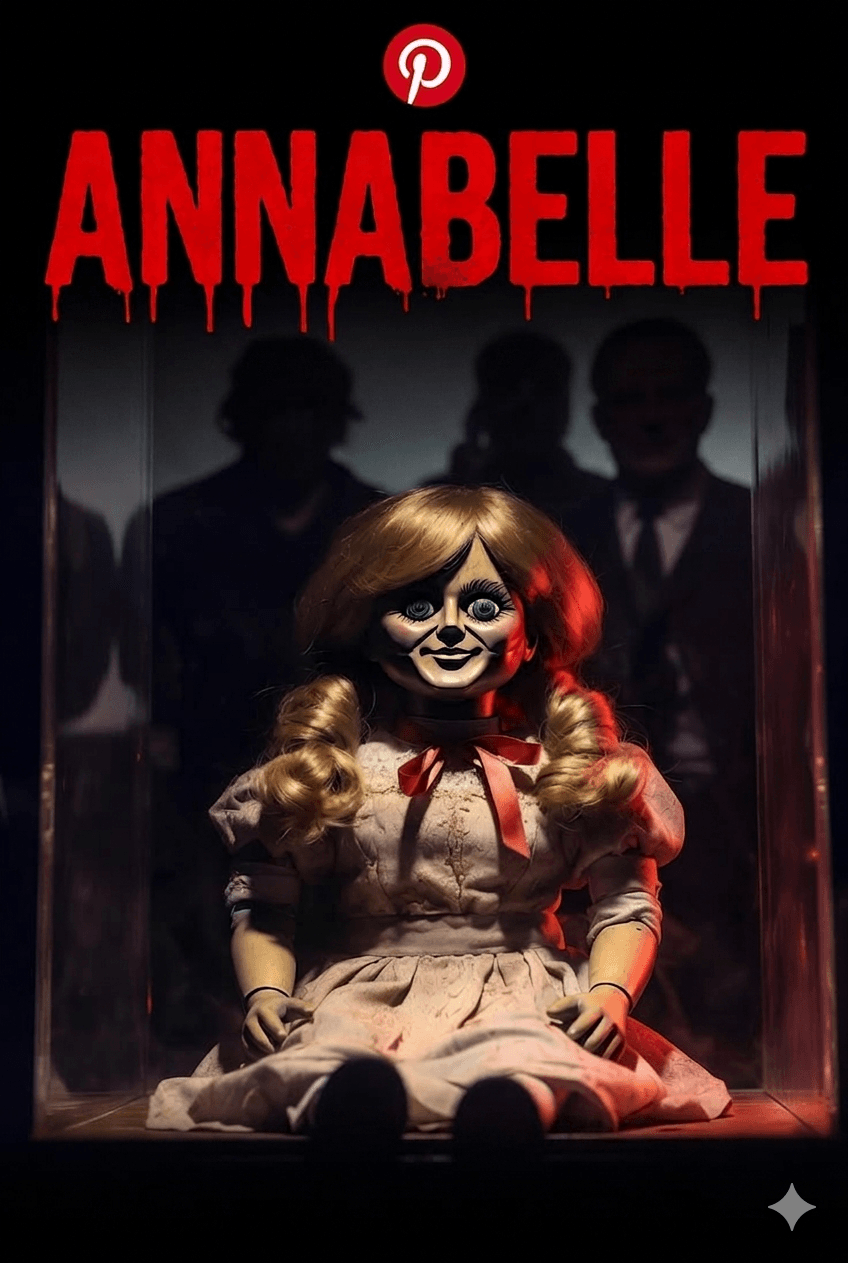
Most people who think they know what Annabelle looks like are picturing a cracked Victorian porcelain doll with hollow eyes and a face built to disturb — the one from The Conjuring (2013) and the three spinoff films that followed. The porcelain version was designed to communicate danger from across a room. You see it and your body responds before your brain does. The Raggedy Ann gives you nothing like that — it gives you a stitched smile and button eyes and the specific cheerfulness of something made for a child’s bedroom.
That gap — the one the real Annabelle doll lives inside — between the thing people think they’re scared of and the thing that actually exists — is the whole story. Everything interesting about this case lives inside that gap.
The Nursing Students
In 1970, a woman bought a Raggedy Ann doll at a hobby store and gave it to her daughter Donna as a birthday gift. Donna was twenty-eight, a student nurse from Hartford, Connecticut, sharing an apartment with her roommate. The real Annabelle doll went on a shelf. Standard domestic detail.
Then it started moving.
Small changes — the kind you can dismiss individually and can’t dismiss collectively. Leave it on the couch, come home to find it in the bedroom. Leave it sitting one way, find it turned. Both of them noticed. Neither could account for it. Then came the notes: handwritten, in pencil, on parchment paper that neither of them owned. Help us. Help Lou. Lou was a friend of theirs. The notes appeared. Nobody wrote them.
They hired a medium. The medium told them the doll was inhabited by the spirit of Annabelle Higgins — a seven-year-old girl who had died on the property where the apartment building stood, before the building existed, and who had attached herself to Donna because she was lonely and liked her.
Donna said yes. She told the spirit it was welcome to stay.
I’ve sat with that detail a long time. A twenty-eight-year-old woman, away from her family, one roommate between her and total solitude, working a program that would grind most people into the floor — told that a dead child wanted her company. Her first instinct was yes, stay. She didn’t call a priest. She didn’t throw the doll out. She opened the door wider and said come in.
That impulse — the reflex that says someone is lonely and I have room — is the same one that makes people good nurses in the first place. Donna was exactly the person she’d spent years training herself to be. The thing on the other side of the door knew that.
What happened next: the entity started touching Lou. Scratching him. Appearing in his dreams as something that felt much less like a lonely seven-year-old girl. The Warrens concluded the “Annabelle Higgins” story was fabricated — by the entity, through the medium — as a way of gaining consent. A demonic presence had identified Donna’s specific vulnerability, her capacity for care, and dressed itself as a dead child to earn her permission. It’s the same mechanism Polanski builds Rosemary’s Baby around — the horror that works precisely because the care is genuine.
Whether or not you believe in demons, that mechanism is worth sitting with. Something chose a disguise that Donna’s instincts wouldn’t flag — something that looked safe, that looked like what she’d say yes to. The innocence was the whole mechanism. A thing approaching you through the door you already left open, wearing the face of what you’d already decided to trust.
No historical record of a girl named Annabelle Higgins has ever been found. No death certificate, no record of a child dying on that property. The name came from the medium’s session and went nowhere.
What the Warrens Did With It
They took the doll. Ed claimed he had to pull over three times during the drive back to Monroe, Connecticut because he kept losing control of the vehicle. That’s the kind of detail that’s either completely true or the most efficient piece of marketing copy ever produced on a Connecticut highway. With Ed Warren, I genuinely cannot tell which, and I’ve stopped trying.
The real Annabelle doll went into the Occult Museum. The museum charged admission. The doll was the centerpiece — displayed in a glass case with a handwritten warning not to touch it. Stories circulated with the consistency of a press release: the visitor who mocked it and died in a motorcycle accident on the way home. The priest who insulted it and crashed his car into a tree. The homicide detective who claimed it stabbed him, forcing him into early retirement. Psychic slashes that drew blood. Each story reached local papers. Each story brought more people to Monroe, Connecticut to stand in front of a glass case and feel something.
In 1980, Gerald Brittle published The Demonologist — the result of what he described as an exclusive arrangement with the Warrens — with an entire chapter on the Annabelle case. The book sold steadily for decades. The doll, the book, the museum: a closed ecosystem where every road led back to Monroe.
I’ve written about the Warrens at length on this site — including the full case for and against whether they were frauds — and my position hasn’t changed: I think Ed Warren believed every word he ever said, which is in some ways more unsettling than the alternative. The Annabelle case follows their standard operating pattern — take the object, control the case file, ensure all subsequent stories run through them — but I can’t locate the cynical calculation I keep looking for. What I can locate is the structure. Every incident that followed the doll’s arrival at the museum involved no independent witness, no corroborating documentation, and a story that circulated freely through channels the Warrens happened to control.
Science writer Sharon Hill put it plainly: “Real-life Annabelle is actually far less impressive.” Of Ed’s claims, she said: “We have nothing but Ed’s word for this, and also for the history and origins of the objects in the museum.”
One scholar of paranormal folklore pointed out that the demonic doll trope likely predates the Annabelle case by several years — traceable to earlier pop culture anxieties around possessed objects, including a Twilight Zone episode from roughly the same era in which the mother character is, notably, named Annabelle. The Warrens didn’t invent the fear. They inherited it, branded it, and built a museum around it. I find that more unsettling than a clean fraud would be.
Where Is the Real Annabelle Doll Now
The Occult Museum closed in 2019, shut down over zoning violations — a mundane end for a building that charged admission to see cursed objects. Ed had been dead since 2006. Lorraine followed in April 2019, the same year the museum went dark, and the collection passed to Tony Spera, her son-in-law, who runs the New England Society for Psychic Research out of the same corner of Connecticut.
In May 2025, reports spread — fast, across every platform — that Annabelle had gone missing. The doll was gone. Nobody knew where it was. The internet said the obvious things out loud, because the internet always does.
It was a marketing campaign. The Warren estate was promoting a tour called “Devils on the Run,” taking objects from the collection on the road for paranormal enthusiasts across the country. “The doll was never missing,” Spera confirmed. They’d been on tour. The disappearance was an announcement. The fear was the ticket. Fifty years after Ed Warren drove back from Hartford with a Raggedy Ann on the seat beside him, his heirs understood the same thing he understood: the story is the product.
The tour’s lead organizer, Dan Rivera — who had been posting videos of Annabelle on TikTok to millions of views — died unexpectedly in Gettysburg, Pennsylvania in July 2025 while handling the doll on the road — a death confirmed by USA Today. Police investigated and found nothing unusual. The internet found plenty to say about it. I don’t know what to say about it. I’m leaving it here because leaving it out would be dishonest.
Then in August 2025, comedian Matt Rife and a partner purchased the Warren home and the Occult Museum in Monroe. The deal made Rife the legal guardian of the entire haunted collection — including the real Annabelle doll — for at least five years.
The most famous haunted doll in modern American culture now belongs to a stand-up comedian best known for his Netflix specials. The mythology the Warrens spent fifty years constructing, the doll at the center of four Hollywood films and a franchise that grossed over two billion dollars — and it ends up in the hands of a comic. I genuinely don’t know what to do with that. Maybe it’s a fitting end for a story that was always partly performance. Maybe Ed, who sold paintings of haunted houses door to door before he became a demonologist, would have understood it completely.
I haven’t decided.
The Thing About the Smile
Hollywood made the right commercial decision when they replaced the Raggedy Ann with porcelain. The cracked face sells. The hollow eyes work. The image communicates danger immediately, and immediate communication of danger is what horror marketing requires.
What got lost is the actual horror.
The real Annabelle doll smiles. A stitched smile that doesn’t move and doesn’t change — the same at 2pm as at 3am when you wake up and look at the shelf. It looks like something that belongs in a child’s room. It looks like something made to be held, to be dragged around by its yarn hair, to accumulate years of being loved. If there’s an entity inside it — if something chose this as its interface with the world — the choice says something. It chose to look like what Donna would say yes to. It chose, specifically, to look like something that makes a twenty-eight-year-old woman who spends her days caring for strangers feel like she isn’t alone.
The horror wearing a stitched smile bypasses everything. It arrives before the alarm sounds. It’s already in the room, already on the shelf, already smiling.
My cousin Amber’s doll — nothing like the real Annabelle doll — is still at my aunt’s house somewhere, she thinks. She’s in her thirties now, doesn’t remember caring much about it either way. When I mentioned I’d been thinking about it lately she laughed and said she’d probably give it to Goodwill if she ever came across it.
That’s probably the right call.
If the mechanism here — consent weaponized, care as delivery system — interests you in fiction, Rosemary’s Baby runs the same engine. The Castevets and Joan from Hereditary use identical architecture. The object is different. The entry point is the same.
I also understand now, in a way I didn’t when I was eleven, exactly why I didn’t sleep well those two weeks. The fixed smile is fine when you can explain it. When you can’t, the explanation your nervous system reaches for is the one it already knew — the one that doesn’t need words, the one that was there before you were old enough to dismiss it.
The real Annabelle doll looks like something safe. Hollywood spent tens of millions of dollars across three films trying to make you afraid of what they replaced it with.
The real Annabelle doll — the Raggedy Ann — was always scarier. They just couldn’t figure out how to sell it.
— Ethan Vance
For the family at the center of the film the Annabelle case helped launch, the full history of the Perron family haunting is considerably stranger than what Hollywood built from it — and for the craft decisions Wan made in turning all of it into a horror film, the Conjuring 2013 hidden details breakdown goes through exactly how.