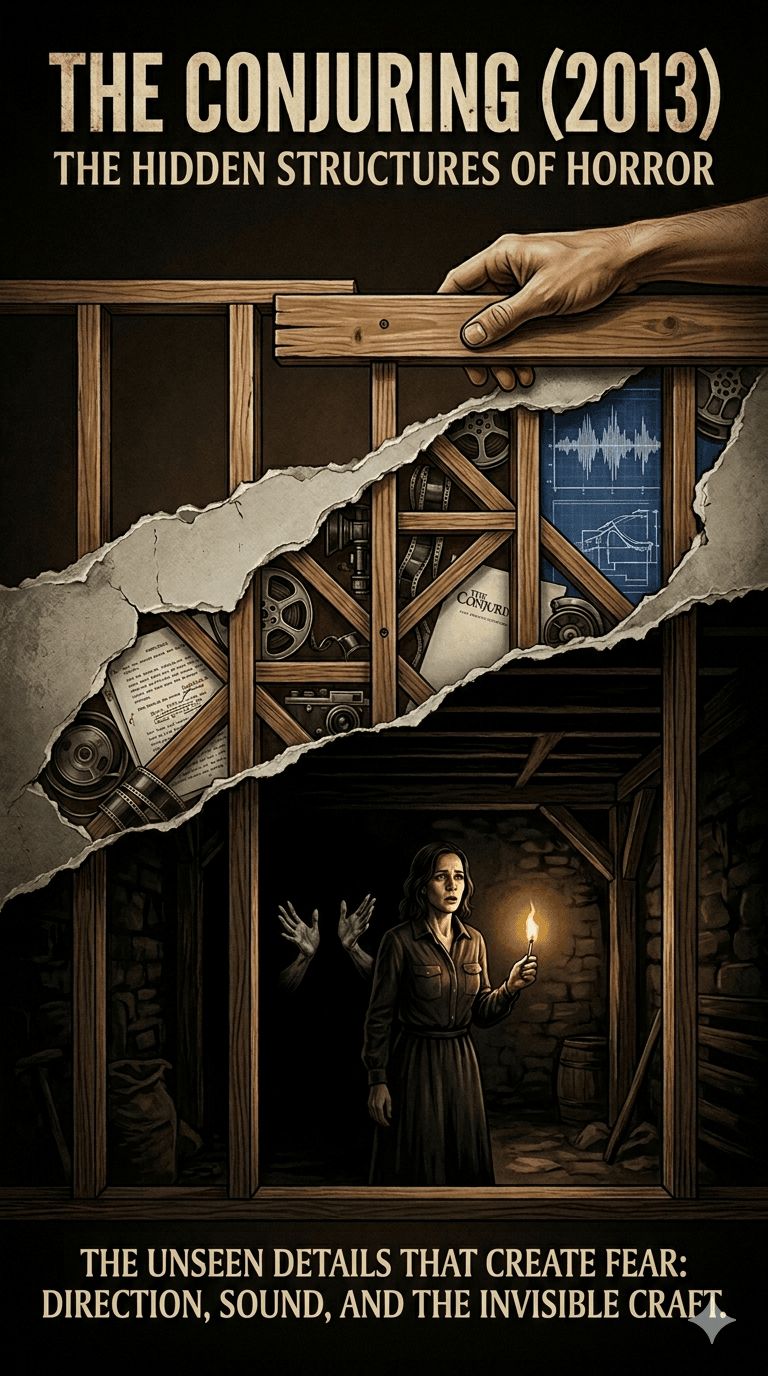
These are the Conjuring 2013 hidden details that most second-watch guides miss — not Easter eggs, but the structural craft James Wan buried in the framing so the surface would hold weight you’d never consciously test.
My father framed a wall on a Saturday morning when I was about nine and made me look at it before the drywall went up. Studs, headers, the cavity where the wiring would run. I didn’t understand what I was looking at. He pointed at a corner where two pieces of lumber met at an angle I couldn’t have named and told me it was right. Then he told me the part I’ve never been able to put down. You can’t see this once the drywall goes up. Doesn’t matter. Has to be right. He wasn’t being sentimental.
He was a man who believed the hidden work was the work, that the part nobody would ever inspect was precisely the part you couldn’t fake, because faking it was the one thing the wall itself would eventually report on. A wall framed wrong stands until it doesn’t. Then it tells everyone.
Most people, when they talk about “hidden details” in a horror film, mean Easter eggs. A poster in the background. A recurring number. Something to screenshot and post. That’s not what I’m doing here.
What’s actually hidden in The Conjuring (2013) is the structural work — the decisions Wan and John R. Leonetti and Joseph Bishara made that you’re not supposed to notice, the kind that either holds the surface up or lets it collapse. And I’ll be honest with you: I went into this piece expecting to confirm my existing position, which is that the Conjuring franchise is the horror equivalent of a chain restaurant — consistent, competent, spiritually vacant. I’ve called James Wan a gifted technician with nothing interesting to say. I’m not walking that back.
What I found when I actually looked at the mechanics is more annoying than I wanted it to be. The framing is right. I’ll get to why that complicates things rather than resolving them.
The Conjuring 2013 Hidden Detail #1: The Clap That Was Never in the Script
Start with the scene the entire internet associates with this film: Carolyn alone in the cellar, a lit match, the dark accumulating behind her, and then two hands clapping out of that dark, close enough to touch her. Hide and clap. It is the single most efficient scare Wan has ever staged, and here is the first hidden detail, the one I had to confirm against the actual document: it isn’t in the screenplay I read. Not the version I have in front of me, anyway — a second draft by the Hayes Brothers, dated to production.
In that draft the children don’t play hide and clap at all. The only clap in the early pages is a little girl clapping for a dog that turns out to be dead.
The real Perron children, by the family’s own account, played hide-and-seek — an ordinary game, the kind every kid plays in a house too big for them. Someone, somewhere between that draft and the screen, took the ordinary game and removed the seeing from it. Replaced sight with sound. Blindfolded the mother and made the house answer her. That’s the whole film in one design decision. The clap is terrifying because a clap is a reply. You make a noise, and something answers. That’s it. That’s the whole thing. It requires a second pair of hands that shouldn’t be there.
Wan doesn’t spend it once. He plants the game early, as children’s play, so that when Carolyn later hears clapping in an empty house, your body has already been taught what clapping means in this world. The demon doesn’t invent a new torment. It learns the family’s game and plays it back.
That’s craft you don’t see — the setup buried thirty minutes before the payoff, framed into the wall so the scare has something to stand on. The fact that it had to be added, that the page didn’t have it and the film found it, is the first sign of what this movie actually is.
The Conjuring 2013 Hidden Detail #2: The Composer Is Wearing the Monster’s Face
The score of The Conjuring (2013) — those scraping brass clusters, the prepared-piano dissonance that arrives in your chest a few seconds before you have any visual reason to feel it — was composed by Joseph Bishara. Bishara also plays Bathsheba. The witch. The thing floating over Lili Taylor’s face in the dark is the man who wrote the music telling you to be afraid of it.
This is nearly without precedent — at least as far as I’ve been able to find. The only other case I know of is Bishara himself in Wan’s Insidious, where he wrote the music and also wore the Lipstick-Face Demon.
The dread in this film has a single author across two senses. The sound that crawls under the scene and the body that erupts out of it are the same intention, expressed twice. There’s a closed loop in the fear here that most films can’t achieve because the composer and the creature are strangers who never meet. In The Conjuring (2013) they share a nervous system.
Bishara earned it physically, too. The scare where Lorraine stands under the tree in the yard, feels something wrong, and turns to find Bathsheba’s bare feet hanging behind Ed — that tree was a fifty-foot structure the production built from nothing, and Bishara spent a day suspended in it to make the shot.
The feet mark the spot where the witch died. The camera tells you where the rope was without a word of explanation, and the man who scored your unease is the one hanging there to deliver it. I credit composers in these pieces because most critics won’t. Here the credit goes twice to the same name, and both times it’s deserved.
The Conjuring 2013 Hidden Detail #3: The Night the Clocks Don’t Stop
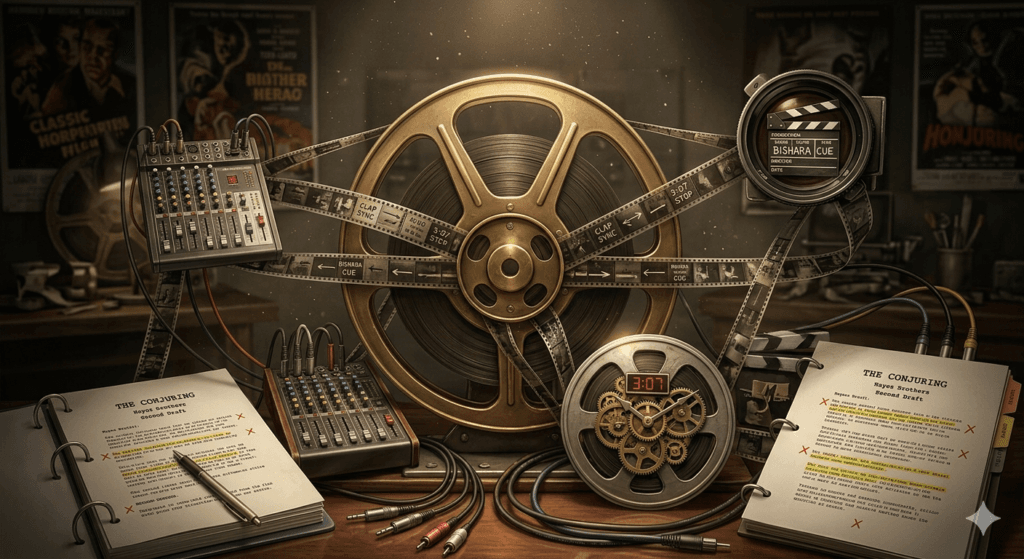
Every clock in the Perron house stops at 3:07 in the morning. That’s the witching hour the film assigns to Bathsheba, the minute the haunting keeps returning to. Once you know it, you start catching the stopped hands in the background of shots that aren’t about clocks at all.
But the real hidden detail isn’t the time. It’s the night the clocks don’t stop.
When Ed and Lorraine return with equipment — thermal cameras, motion alarms, a second investigator wiring the house — the first monitored night produces nothing. The clocks run clean through 3:07. The house behaves. The film is quietly telling you something it never says out loud: the entity will not perform for the instruments. It torments a mother alone in a cellar. It will not be documented. The moment you point a camera at it, it goes still and waits you out.
I came out of investigative journalism, and that detail lands harder than any jump scare in the movie. It is the exact shape of the story you can’t get on the record — the source who’ll tell you everything until the recorder is on the table.
The Conjuring (2013) understands that the most frightening version of a haunting is the one that refuses to leave evidence. I’ve spent a lot of words elsewhere on this site examining whether the real Warrens ever produced any — and across fifty years of their case files. The film stages the absence of proof as a deliberate taunt. The Warrens built a whole career on the same absence and called it humility.
The Conjuring 2013 Hidden Detail #4: The Score Named the Body Before You Saw It
Pull the track listing for Bishara’s score and read it like an autopsy report. Dead Birds. Birds Pulled In. Hanging Drop. Sleepwalking. Black Bile. Annabelle. The cues are named for the film’s organs, and they tell you the anatomy before the film shows it to you.
The birds fly into the house and die against it — a flock pulled toward the place the way everything in this film is pulled toward the place. The sleepwalking is Cindy, drifting out of bed to stand and beat her head against an old wardrobe. The wardrobe is a door: behind it the film hides a passage down into the cellar, which is where the house keeps what it’s collected.
Each cue name is a load-bearing event. The film’s dread was orchestrated as a structure — composed, in the literal sense — and the cue sheet is the blueprint left in the wall for anyone who bothers to open it.
You cannot accidentally name your score after the body of your film. Somebody sat with the architecture and labeled the rooms. That’s deliberateness. And the deliberateness is the thing that keeps complicating my dismissals of this franchise. I’ve been saying for years that Wan has nothing interesting to say. The score sheet says someone in that production was paying very close attention.
The Conjuring 2013 Hidden Detail #5: The Mirror That Does the Film’s Actual Thinking
April Perron has a music box. You wind it, a small tune plays, and a mirror inside spins slowly enough to catch a reflection. April says she has a friend she can only see in the mirror. This is the film’s most elegant idea: the mirror is the only place the unseen becomes visible. The things that can’t be looked at directly arrive sideways, in glass, in reflected light, in the half-second where a surface shows you what the air won’t.
That’s clairvoyance rendered as cinematography — Lorraine’s whole gift is that she sees what’s already there but reflected, displaced, available only at an angle. The music box is the family’s small private version of her.
And then the film’s final shot. The haunting at the farmhouse is finished, and Ed carries the music box home to a locked room — the inventory of everything he’s taken off other people’s hands and shelved. He sets the box down. He and Lorraine leave. The box begins to play by itself. The camera pushes slowly into that spinning mirror until the tune ends and the screen goes black.
This is where I stop praising and tell you what I actually think. The last image of The Conjuring (2013) is an inventory. A man’s private collection of trapped things, and the movie wants you to read it as the work of a humble servant standing between us and the dark.
I read it as a stockroom. The film was very nearly called The Warren Files, and you can feel that title’s logic in this ending — the haunting reduced to an artifact, the artifact shelved next to a doll the real Warrens kept behind glass and charged admission to see. The gears are honest. The cabinet they wind down into is a gift shop.
Rated R: The Conjuring 2013 Hidden Detail Nobody Talks About
The Conjuring (2013) was rated R for being too scary — no gore, no sex, no real profanity, just sustained dread the ratings board decided a thirteen-year-old shouldn’t be left alone with. As a verdict on the craft, that’s the highest possible compliment. A film that frightens you that hard with that little is a film where every piece is doing its job. There’s nothing cheap propping it up. No gore, no skin, nothing to hide behind. Just sustained atmosphere — the kind that stops working the moment you stop believing it, and this one never stops.
“Too scary for the kids” is also the best marketing hook a horror studio can be handed, and this one rode it straight to three hundred million dollars and a decade of sequels. The rating proves the engineering works. The rating also got framed and hung in the lobby. I notice the second part because noticing the second part is the job I had before this one.
The Deepest Conjuring 2013 Hidden Detail: The Draft Itself
I’ll close the inspection where the wall is most exposed: the gap between what the Hayes Brothers wrote and what reached the screen. The draft in front of me is a different, lesser film. It opens with a long period prologue — a man riding up to the farmhouse in the eighteen-hundreds — that never made it to screen.
It gives the Perrons two daughters instead of five. It’s set a year later than the film. The clocks stop at a different time entirely. The climax happens in a bedroom, with a rifle, instead of in the cellar where the finished film stages its exorcism. And the clap — the clap that is the whole movie — isn’t there at all.
Almost everything I’ve spent this piece admiring was found after the page. The structure of the fear, the game that became the film’s signature, the time on the clocks, the location of the climax — these are decisions of the rewrite and the build and the edit.
I’ve always said Wan is a technician working with borrowed materials. The draft proves it. The materials were ordinary. The bones were a competent haunted-house script with the usual parts in the usual places. What happened between the page and the screen — the framing, the patience, the joinery you can’t see once the surface goes up — is the entire reason anyone remembers this film. The achievement was never the story. It was the build.
My father died in 2009. He didn’t watch horror. He watched baseball and the evening news. But I know he’d have noticed if the wall was wrong — that much I’m certain of. The rest I’m not.
The carpentry is sound. I’ve been saying that for the length of this piece and I mean it. What the carpentry encloses is still a cabinet, and the cabinet is still the part I came in not believing. I’m leaving the same way. More respect for the people who built it. None for what they built it around. Every time I open this one up: a shelf, a locked room, and one more thing behind glass.
A Few Things People Usually Ask
Was “hide and clap” something the real Perrons actually did?
No. The real Perron children played ordinary hide-and-seek. The clapping version was invented for the film — and it isn’t in the Hayes Brothers’ second draft either. It was added somewhere in the build. Which is, for my money, the most interesting thing about it.
Who plays Bathsheba?
Joseph Bishara — who also composed the score. He spent a day suspended in a fifty-foot tree the production built from scratch to film the hanging-feet scare. He did the same double role in Insidious. Whether that makes him unique in film history I genuinely don’t know, but I haven’t found another example.
Why do the clocks stop at 3:07?
That’s the witching hour the film assigns to Bathsheba. But the detail that matters more is the night the clocks don’t stop — when the Warrens set up monitoring equipment and the entity produces nothing. It refuses to be documented. That one withheld night does more work than any jump scare in the film.
How different is the screenplay from the finished film?
Very. The second draft opens with an 1800s prologue, gives the Perrons two daughters instead of five, sets the story in 1972, and stages the climax in a bedroom with a rifle. The hide-and-clap game doesn’t exist. Almost everything people remember about The Conjuring (2013) was found after the page.
The second film built directly on what Wan laid down here — the Conjuring 2 review tracks what carries over and what the franchise mythology adds.
For a parallel look at the sequel’s craft, the Conjuring 2 hidden details covers the same structural layer of Wan’s second film.