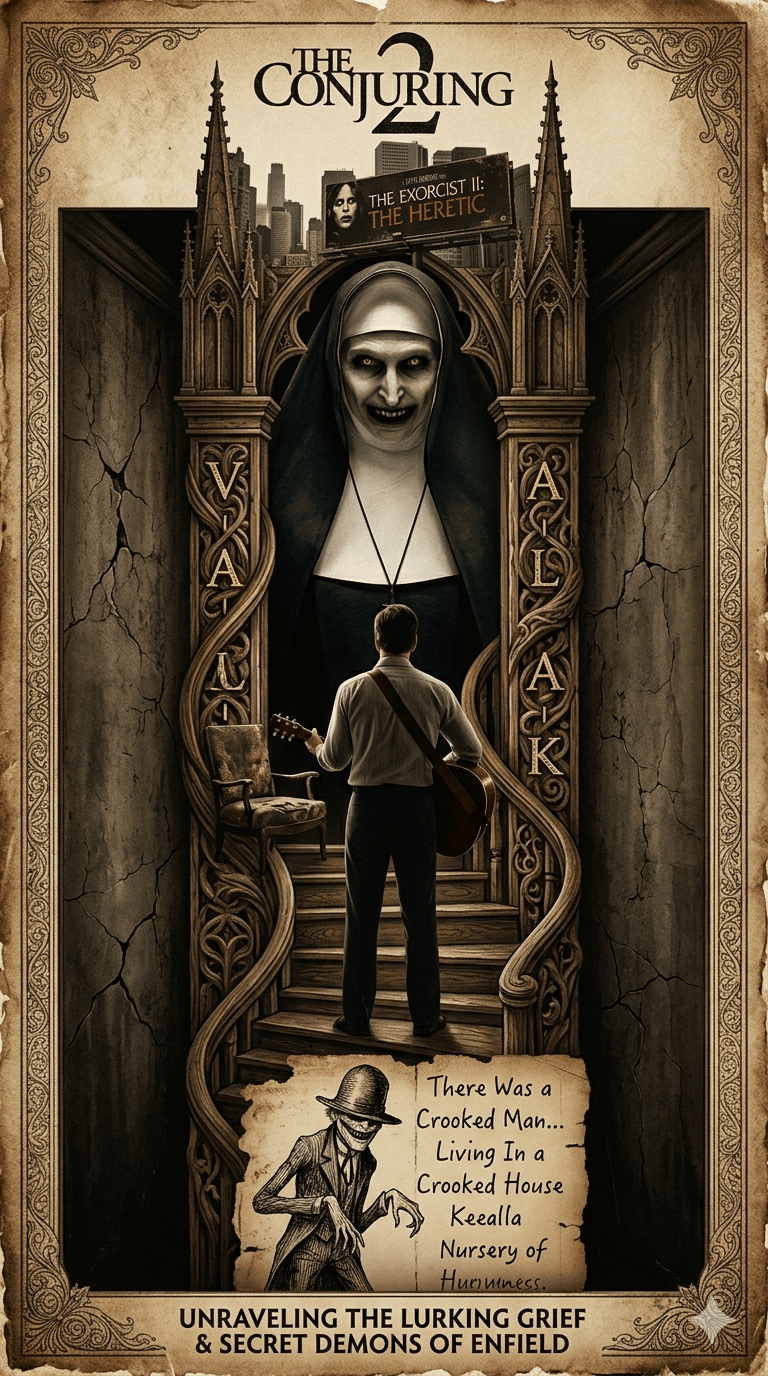
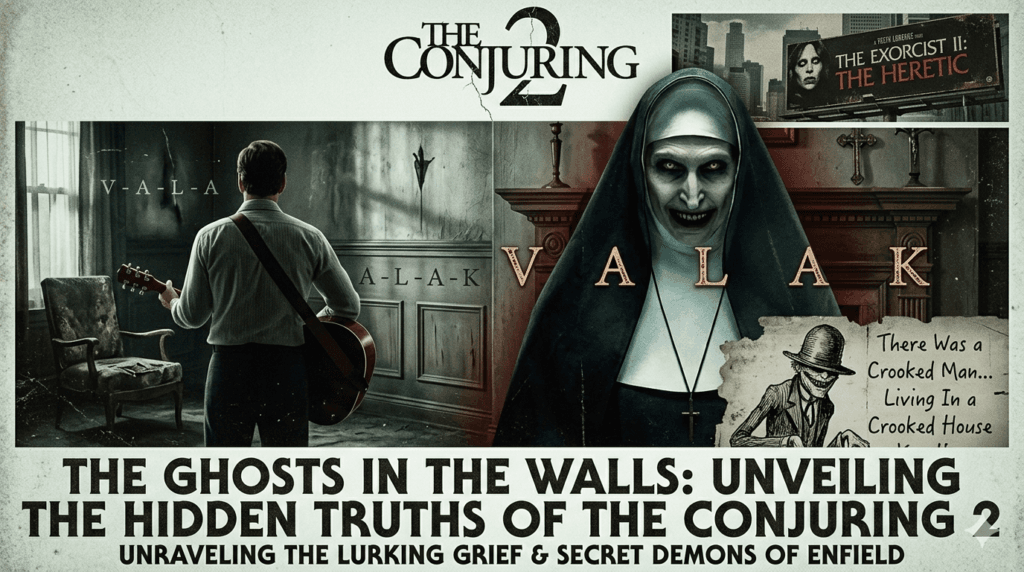
There is a moment in the opening of The Conjuring 2, before Lorraine Warren knows what is hunting her, before she has even a name for it, where the demon’s name is already written on the walls of her house. In the breakfast scene after her first vision of the nun, if you look behind Ed at the windowsill — at the decorative letters arranged among the knick-knacks — the name is there. Partial, distributed, but there: V-A-L-A. Then the K appears in the next shot, in the paneling near the word “LOVE” where the V is bigger than the other letters and the A-L-A-K is etched into the wood molding below it. On the bookshelf where Lorraine later sits reading, wooden letters on the shelf behind her spell it out completely. In the bracelet their daughter Judy is weaving, there it is again.
VALAK.
The demon’s name was in Lorraine Warren’s home long before she traveled to Enfield. Before the Hodgson family, before England, before the voice on the tape recording said it was Bill and it had 72 years old and it died in a chair in the corner. The entity was already inside her house, hiding in the decoration, in the letters nobody was reading.
James Wan built this into the set design of the Warren home. The Conjuring 2 is a film about a woman for whom the supernatural is an environment — and the demon was already there when the film began. That’s the first thing you miss on the first watch.
The Name That Was Already in the Room
The VALAK Easter egg in the Warren home is typically discussed as a clever detail, a reward for careful rewatching. But it functions as something more uncomfortable than that.
The standard reading of the Enfield haunting — the one the film establishes in its first act — positions Lorraine Warren as someone who travels toward the threat, who enters the Hodgson house and encounters the demonic presence there. The VALAK lettering in her own home reorients that reading. The entity had already arrived. Enfield was where it became impossible to ignore.
The name is deliberately planted throughout the Warren home’s set decoration — each instance another data point in a film that thinks carefully about what it means for something evil to be hiding in plain sight. Lorraine sees Valak in a vision. Lorraine draws Valak’s face obsessively and pins the drawings in a closet she keeps locked. The name of the thing is already on her walls. What she doesn’t yet have is the language to identify what she’s been living beside.
There’s a second hidden detail in the film’s opening act, easier to miss because it appears in a different register — ironic rather than threatening. In the montage establishing London, 1977, there is a billboard advertising The Exorcist II: The Heretic. The Exorcist II was widely considered among the worst sequels in horror history at the time of its release. Wan put it in the establishing montage of his own sequel — a private joke from a director who knew exactly what he was asking of an audience, and what skepticism they were carrying with them through the door.
Bill Wilkins, June 20, 1963
Before anything else happened in that house, before the Hodgson family moved in, before the poltergeist voices and the furniture moving and the cameras — there was a man named Bill Wilkins who had gone blind, and had a haemorrhage, and fell asleep and died in a chair in the corner of the living room at 284 Green Street, Enfield, North London.
He died on June 20, 1963.
In December 1977, three months into the disturbances, a voice began to come from Janet Hodgson — low, harsh, guttural, nothing like Janet’s own. The voice said: I went blind, and I had a haemorrhage, and I fell asleep and I died in a chair in the corner.
Bill Wilkins’s son Terry confirmed it. His father had died in that house, in exactly those circumstances. The voice had given accurate information about a man who had been dead for fourteen years, speaking through an eleven-year-old girl who had no way to know any of it.
The Conjuring 2 reproduces this accurately. The voice identifies itself as Bill, gives the age, says it went blind, had a haemorrhage, died in the chair. What the film then does is build on this confirmed fact: Bill Wilkins was real, the death was real, the voice was telling the truth about his history. And the film establishes that the old man’s spirit was being used as a mask — his voice, his memories, his accurate death turned into cover for something far more dangerous underneath. Bill Wilkins was a dead man’s identity being weaponized. When the voice says I just like to hear them scream, it’s Valak speaking through a borrowed persona. Bill’s truthful testimony existed in service of concealment.
The first voice on the recording — the one the investigators spend the film analyzing, fragmented and unclear before the Bill persona takes over — is possibly Bill Wilkins himself, attempting to say something true through the only channel available to him, before what was using him reasserted control. The film doesn’t confirm this reading. It leaves it as a structural possibility, a door left slightly open. But the logic of the story supports it: Bill’s death was real, Bill’s details were verified, and Bill was the one entity in that house who didn’t want anyone to be harmed. He was also the one who couldn’t stop what was using him.
The Composer Inside the Demon
Joseph Bishara composed the score for The Conjuring 2. He also, in an earlier version of the film, wore the demon.
The original antagonist was a winged creature — a practical animatronic creation with an animatronic head, built by makeup artist Justin Raleigh. Bishara wore the suit on set. The composer of the film’s entire sonic architecture of dread was also, physically, the monster inside the frame.
Then James Wan changed his mind.
During post-production, Wan reconceived the villain. The winged creature didn’t fit what he was trying to do. He wanted something that attacked Lorraine’s faith specifically — the imagery she’d built her life around, the sacred framework she depended on to do this work without being destroyed by it. He remembered Lorraine Warren speaking warmly about her love for the nuns in her life. A demon wearing the shape of a holy figure could threaten the thing at her center in a way a winged creature couldn’t reach. So Wan replaced the original design with Valak, shot additional photography in March 2016 with Bonnie Aarons as the Nun, and rebuilt the film’s antagonist around the specific architecture of what Lorraine held sacred.
The original demon still exists. Wan has shared footage of it. Impressive work that never reached the screen.
What remains of Bishara’s physical presence in the final cut is minimal — a glimpse during the Amityville prologue, a performer credit at the end of the rolls. But his other presence in the film is total. The score is everywhere. He composed it in an abstract, texture-based mode: no melody, no thematic statements, something closer to organized unease than to traditional film music. He recorded it before Wan began shooting — the musicians improvised within Bishara’s broad structure, and Bishara sent completed recordings to Wan during the edit so the music could shape the images as they came together. The score was built into the film before most of the film existed.
Hollywood Studio Symphony. London Voices: thirty-one singers. The sound assembled at scale to create something that felt less like accompaniment and more like a surrounding presence — the audio equivalent of a room you can’t find the edges of.
The man who made that score was also the man in the original suit. When Wan changed the villain, Bishara’s visible presence contracted to that performer credit, and his invisible presence expanded to fill everything else. The fear you feel in The Conjuring 2 has Bishara’s name on it twice: once for the music, once for the thing the music replaced.
Maurice Grosse and the Girl With His Daughter’s Name
Maurice Grosse joined the Society for Psychical Research after his daughter died. He was investigating the Enfield poltergeist within a year of her death. These two facts sit next to each other in his biography without any clean connective tissue, and the film handles them the same way: with restraint, and with the understanding that some connections don’t require explanation to be felt.
Grosse’s daughter Janet was killed in a motorbike accident in August 1976. She was twenty-two.
In September 1977, Grosse arrived at 284 Green Street to investigate claims of poltergeist activity centered on a family with four children, one of whom was an eleven-year-old girl named Janet.
The Conjuring 2 gives Grosse a scene — quiet, private, set apart from the escalating haunting — where he describes losing his daughter to Ed Warren. What the real history records: Janet Grosse died in a motorbike accident in August 1976, a year before Grosse arrived in Enfield.
What the film never states explicitly — what neither the script nor the dialogue ever names — is the coincidence of the name. His daughter was Janet. The girl he was trying to help was Janet. The film gives you both facts in proximity and trusts you to notice or not notice, to weight it or let it pass.
Grosse stayed at 284 Green Street long after most researchers had moved on or grown skeptical. He documented hundreds of incidents over two years. He also watched Janet get caught faking events, absorbed the criticism that followed, and didn’t leave. The name doesn’t explain that. But the name is part of what surrounded it — a gravitational field around a professional relationship that was, clearly, about more than professional interest.
The film trusts you to carry the coincidence forward without having it explained. Janet, who died on a motorbike in 1976. Janet, who was eleven and needed someone to stay.
The Guitar Scene Was Written First
Before James Wan had a script for The Conjuring 2, before he had a story structure or a villain or a confirmed location, he had one scene in mind. He brought it to Patrick Wilson in their first meeting. The idea: Ed Warren finds a guitar in the corner of the Hodgson living room and plays and sings for the children.
Wilson’s response, as Wan has recounted it: That’s literally the other thing I do.
Patrick Wilson is a trained singer. He plays guitar. He did not learn these things for the film. The scene in which Ed Warren performs “Can’t Help Falling in Love” for the Hodgson family is a scene in which Patrick Wilson simply does what Patrick Wilson does — and what emerges looks like something Ed Warren would simply do as well, without calculation, because it’s the tool available.
The scene works for reasons harder to name than the technical ones. Peggy Hodgson has been barely holding a household together — behind on rent, rationing everything, four children in a house where something is moving furniture and speaking in the voice of a dead man. The father took the records when he left. Music, the kind that fills a room and lets children feel like children, had been stripped from this space by abandonment.
Ed plays it back in. He found the guitar and the children needed something to respond to, so he played. There’s no visible strategy in the scene, which is what makes it land.
Lorraine watches from the side with an expression the camera catches and then moves away from — the particular look of someone watching the person they love do exactly what they’re capable of, in exactly the right moment, without being asked.
Wan built the entire film outward from this scene. The haunting, the Amityville prologue, the Valak mythology, the institutional skepticism, the rain and the recording equipment and the long investigation — all of it exists to make the moment in the living room possible. The horror is the frame. The center is this.
There’s a further layer, which the film doesn’t underline. The guitar scene was the first thing Wan knew. The score — Bishara’s textures, his organized dread — came later and was built to surround everything. The film was conceived in warmth and assembled in darkness, and the two live inside each other for the entire running time. “Can’t Help Falling in Love” is still there underneath all of it.
What Janet Knew About the Camera
Janet Hodgson admitted to faking some of the phenomena at 284 Green Street. She said so directly, in an interview, years later. She and her sister Margaret had staged incidents — “about two percent,” she estimated. They wanted to see if the investigators would notice.
The investigators had video equipment in the house. Janet was caught on camera bending spoons, bending a broom handle, hiding a tape recorder. The footage was used as evidence against the case — proof that what the SPR investigators had documented was theater.
The Conjuring 2 takes this material and does something specific with it. The film shows Janet getting caught faking an incident in the one room where a camera had been set up. Ed Warren reviews the footage, confirms the staging, and has the conversation with Lorraine about what it means.
Then Ed makes an observation the film doesn’t resolve. The camera was positioned in one specific room. The house had multiple rooms. Janet staged her fake incident in the one room with recording equipment.
Either Janet knew where the camera was — which would require her to have information no child should reasonably have, since the investigators hadn’t announced which room they’d chosen — or she staged it elsewhere and was in the camera’s range by coincidence. Or something directed her there.
The film presents this as a genuine question and then moves forward. The skeptic reading is that Janet was perceptive and observant and found the camera and used it deliberately. The other reading is that the entity using Bill Wilkins as a front had reasons to want the investigators to doubt Janet — reasons that had nothing to do with Janet’s choices. The two readings produce the same footage. A girl bending a spoon in a room with a camera. What you make of that depends entirely on what you believe was in the house with her.
The Nursery Rhyme and the Border It Described
“There Was a Crooked Man” was first recorded in print in 1842, though it likely predates that collection by decades or longer. One theory of its origin is political: the crooked man is thought to be the Scottish General Sir Alexander Leslie, who negotiated a covenant between the Scottish and English Parliaments during the reign of Charles I. The “crooked stile” at the center of the rhyme is, in this reading, the contested border between the two nations — the line neither side could accept cleanly, the compromise that satisfied nobody.
A crooked man, walking a crooked mile, finding a crooked sixpence, living in a crooked house with a crooked mouse. Everything in his world slanted. Everything in the world of that treaty slanted. The rhyme encodes a political fracture in the form of a children’s song.
Wan puts this rhyme at the center of The Conjuring 2 as the mechanism by which the Crooked Man entity exists. Billy Hodgson sings it. Billy sees the figure. The figure becomes real enough to move through the house and appear in Janet’s room and be something the film takes seriously as a threat. The nursery rhyme is the summoning.
This is consistent with everything else the film believes about language. The voice on the tape recording names Bill Wilkins and his details, and those details are confirmed. Lorraine draws the nun obsessively until she has its image, and the image gives her something to act on. The riddle the entity speaks to Lorraine — I am given and I am changed, I was there, your first breath, and you did not choose me, but I will accompany you to death — resolves to a name. Yours, given at birth, unchosen, carried to the grave. The answer is the weapon. You can name the demon because names are the only thing that makes the invisible finite.
The nursery rhyme calls the Crooked Man because language in this film creates what it describes. A political poem about a failed border compromise becomes the summoning text for a demon because children sing it without knowing what it was once about, the original context eroded into pure form, and the form is enough. The rhyme doesn’t need to be understood. It only needs to be spoken.
Don Burgess’s camera performs the same grammar: it shows you a room, then a corner, then the corner again with something different in it. The film trains your eye to look for what changed between one look and the next — the same discipline the characters apply to the voice recordings, looking for the detail that was always there and only becomes visible on the second pass.
What Don Burgess’s Camera Does in The Conjuring 2
Don Burgess shot The Conjuring 2 on Arri Alexa cameras. The palette is gray and downcast, the color register of a cold English autumn that never quite becomes brown — just drains. The visual tone matches the Hodgson house: functional, worn, stripped of warmth by circumstance and time.
Burgess and Wan developed a specific technique for the scare sequences that is more restrained than most horror cinematography. In one scene, Janet may or may not be possessed and moving in the background. Burgess stays tight on Ed Warren’s face. The audience can’t see what’s happening behind him. You’re watching Ed’s expression rather than the event — learning about the threat through the person encountering it rather than being positioned alongside them. Ed’s face changes. What’s behind him remains just outside the frame.
Most horror films are generous with their sights — they show you the monster, the movement, the thing that has changed, because showing is the easy path to shock. The harder path is to stay on the person watching the monster while you withhold the monster itself, and trust that what you see in their face is more frightening than whatever’s behind them. Burgess and Wan take the harder path consistently throughout The Conjuring 2.
Production built the Enfield house on Warner Bros. sound stages in Burbank — forty of the film’s fifty shooting days on a constructed set, with ten days on location in London. The control over the Burgess palette was total as a result: every corner, every piece of furniture, every angle of the overhead light placed deliberately for the camera to find.
The Exorcist II billboard in the London establishing montage sits against all this craft like a private signature. Wan put one of horror’s most famous sequels — a film widely considered one of the genre’s worst follow-ups — into his establishing shot of 1977 London. An acknowledgment that the burden of a sequel is real, and the answer to that burden is to name it and keep working.
Frequently Asked Questions About The Conjuring 2 Hidden Details
Was Bill Wilkins a real person in The Conjuring 2?
Yes. Bill Wilkins was a real former occupant of 284 Green Street, Enfield, who died in a chair in the living room after going blind and suffering a haemorrhage. He died on June 20, 1963. His son Terry Wilkins confirmed the details after the poltergeist voice describing his father’s death was recorded from Janet Hodgson in December 1977, fourteen years after Wilkins died. The film reproduces this accurately.
What was the original demon in The Conjuring 2 before Valak?
The original antagonist was a winged creature — a practical animatronic design built by makeup artist Justin Raleigh and worn on set by composer Joseph Bishara. During post-production, James Wan reconceived the villain, wanting something that would attack Lorraine Warren’s faith specifically. Additional photography in March 2016 replaced the winged creature with Valak, the demonic nun played by Bonnie Aarons. Wan has shared footage of the original design publicly.
What song does Ed Warren sing in The Conjuring 2?
Ed Warren sings “Can’t Help Falling in Love” by Elvis Presley, accompanying himself on a guitar found in the Hodgson living room. Patrick Wilson, who plays Ed Warren, is a trained singer and guitarist — he didn’t learn for the film. James Wan conceived this scene before anything else in The Conjuring 2 existed and pitched it to Wilson before a script was written. For more on Wilson’s performance throughout the film, see our full review.
Is the nursery rhyme in The Conjuring 2 real?
“There Was a Crooked Man” is a real English nursery rhyme first recorded in print in 1842. One theory holds it originated as a political poem about Scottish General Sir Alexander Leslie and the uneasy border treaty between Scotland and England under Charles I. Wan uses it in The Conjuring 2 as the summoning mechanism for the Crooked Man entity — the children sing it before the figure appears.
What the Second Watch Reveals
The detail you didn’t see on the first watch through The Conjuring 2 isn’t the name on the wall, or the billboard, or the nursery rhyme’s political history. All of those are surfaces — the places where what the film is actually doing becomes briefly visible before it retreats.
What the film is doing is building grief into the architecture of every scene. Maurice Grosse stayed at 284 Green Street for two years because a girl named Janet needed someone who believed her, and his daughter’s name was Janet, and he couldn’t undo one so he stayed for the other. Joseph Bishara built the sonic environment of dread and then had his physical presence in the film reduced to a performer credit — the demon he wore was replaced, but the music remained. Bill Wilkins died in that chair in 1963 and spent fourteen years unable to leave, his death used as cover by something that didn’t want to be identified. Lorraine Warren had the demon’s name in her house and didn’t know it was there.
The guitar scene was written first because it was the emotional truth that required a horror film to justify itself. Ed plays into the silence that abandonment left, and the children sing along, and for the length of that song the house is something other than what it has been. The haunting resumes. It always resumes. But the song was there, and the song was real, and nobody in the house is exactly the same on the other side of it.
What you missed the first time is how much the film already knew was breaking underneath everything. You were watching for the demon. The film was watching for the grief.
The real history behind Ed and Lorraine Warren is worth understanding before trusting what the film tells you about them — their full record is in the Ed and Lorraine Warren article.
The craft hidden in the 2013 film gets more interesting once you know how Wan expanded it — the Conjuring (2013) hidden details maps what was buried there before the franchise existed.
The Conjuring 2 (2016). Directed by James Wan. Cinematography by Don Burgess. Score by Joseph Bishara. With Vera Farmiga, Patrick Wilson, Madison Wolfe, Frances O’Connor, Simon McBurney.