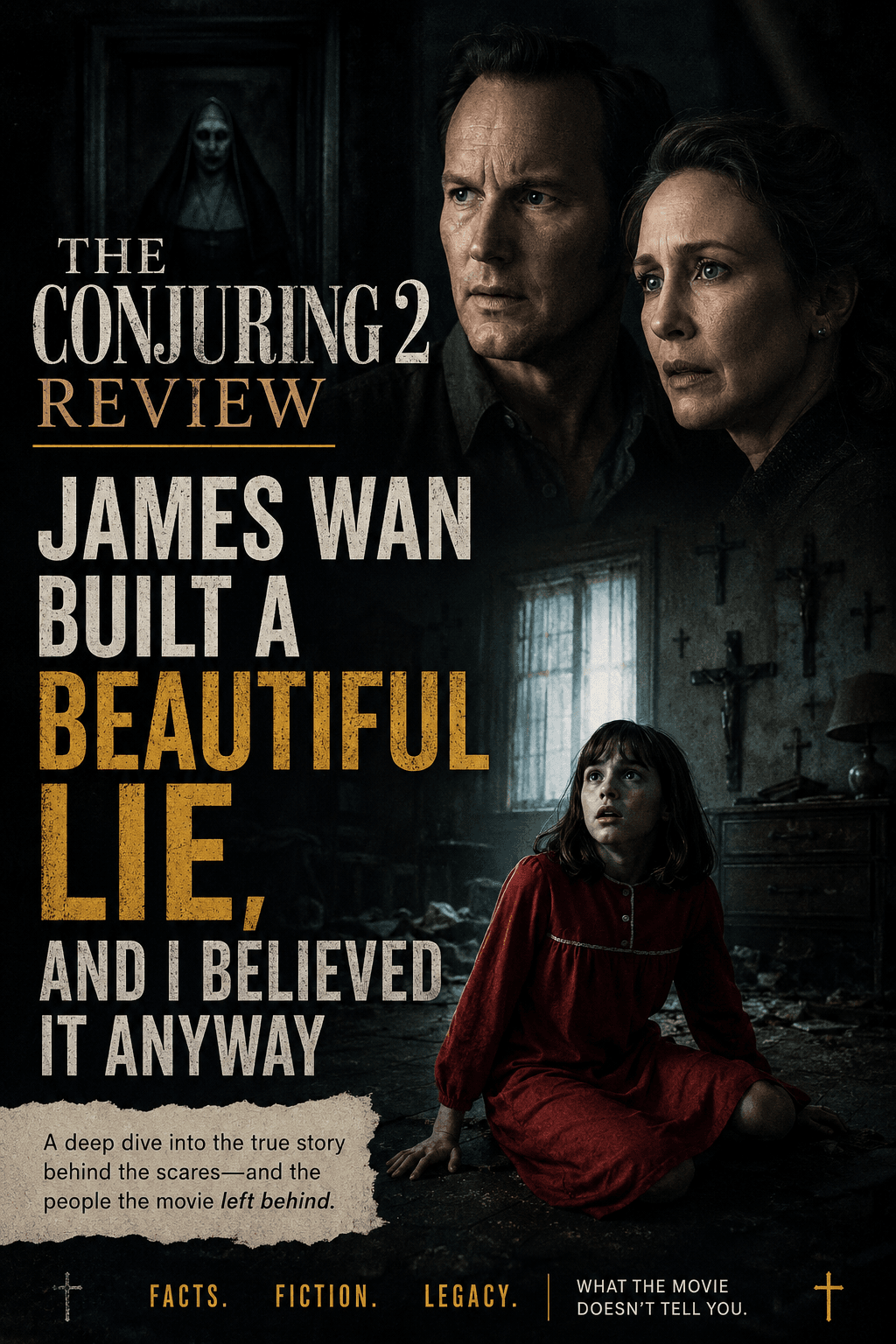
There’s a scene in The Conjuring 2 where Ed Warren picks up a guitar in a freezing council house in Enfield, north London, and sings Elvis to a family that has not slept properly in months. The children, who have spent the film being terrorized, start to smile. Lorraine watches her husband from across the room, and something passes between them that the rest of the movie has been trying to earn. James Wan has said this was the scene that made him want to come back and direct the sequel at all. I understand why. It’s the best thing in the film and possibly the best thing in the entire franchise, and I have been trying for some time to reconcile the fact that I love it with the fact that almost nothing around it is true.
I want to be honest about where I’m standing before I say anything else, because this is a film that makes honesty complicated. I’ve read the actual Enfield material. I’ve read about Maurice Grosse and Guy Lyon Playfair and Anita Gregory and the eighteen months they spent arguing about whether two girls in a poltergeist case were lying. I came into The Conjuring 2 already knowing the shape of what the movie was going to do to that history, which is to say I came in suspicious. And the strange thing — the thing I’ve been circling for a while now — is that the suspicion didn’t protect me. The guitar scene got me anyway. Wan is too good for the suspicion to hold.
So that’s the position, established early, the way I always establish it: I think The Conjuring 2 is a genuinely well-made horror film built on a foundation I find quietly dishonest, and those two facts sit next to each other and refuse to resolve. The refusal is the most interesting thing about watching it.
What The Conjuring 2 Gets Right
Let me start with what works, because a lot of it does.
Don Burgess and the Camera That Teaches You the House
Don Burgess shot this film, and he’s the reason it doesn’t feel like the first one. Burgess is a veteran — he shot Forrest Gump, he shot Cast Away, he shot Spider-Man — and what he brings to Enfield is a camera that never stops moving and never seems to be moving for show. The frame tilts. It drifts toward doorways it has no business drifting toward. There’s a long, unbroken push through the Hodgson house that follows the geography of the place until you’ve memorized it without realizing you were being taught, which means that later, when something is wrong in a corner you recognize, the wrongness lands in a part of your brain that already lived there. The first Conjuring was a haunted-house film about a house. This one is about a house you’ve been made to live in. That’s Burgess.
What Joseph Bishara’s Score Does in The Conjuring 2
Joseph Bishara did the score, as he did for the first film and most of this universe, and I want to give him real credit because his work is the kind that gets dismissed as “horror music” by people who aren’t listening. Bishara is a composer who understands that dread is texture, not melody — it’s the sound underneath the sound. His Enfield score withholds. There are long stretches where the film is almost silent, where the only thing you’re hearing is the house settling and a child breathing, and Bishara lets that silence do the work before he arrives. When he does arrive, it’s a pressure, not a sting. He also plays Valak, the demon nun — the composer of the film is also the thing in the painting, which is a detail I find more charming than I should.
The Performances in The Conjuring 2
And then there are the performances, which are where the film makes its strongest case for taking itself seriously.
Madison Wolfe as Janet Hodgson
Madison Wolfe plays Janet Hodgson, and she carries more of this film than a child actor should be asked to. The role is a trap — she has to be both a frightened eleven-year-old and the vessel for a dead man’s voice, sometimes within the same shot, and the easy version of that performance is the showy one, the head-snapping, the contortion. Wolfe mostly resists it. What she understands is that the worst part of being Janet lives in the watching: the cameras, the investigators, the neighbors, the strangers who have decided her suffering is content. She plays a girl who has lost the ability to be believed, and the loss reads on her face even in the scenes where nothing supernatural is happening. There’s a moment where she tells Lorraine she has no friends, that she can’t go anywhere, that the thing in the house wants her to feel like she isn’t normal — and Wolfe plays it as the loneliest thing in the film. That’s the performance the movie deserved, and she gives it.
Frances O’Connor as Peggy Hodgson
Frances O’Connor plays Peggy, the mother, and she’s doing something quieter and almost thankless. Peggy is the woman holding four children together in a house falling apart in every sense — financially, structurally, supernaturally — and O’Connor refuses to make her noble about it. She’s exhausted. She’s ashamed. She bought biscuits the family couldn’t afford because she wanted, for one evening, to be the kind of mother who buys biscuits. O’Connor finds the specific texture of poverty and abandonment underneath the ghost story, and it’s the realest thing in the film, realer than anything Valak does.
Ed and Lorraine Warren in The Conjuring 2: The Central Problem
Which brings me, finally, to the Warrens, and to the problem.
Patrick Wilson and Vera Farmiga are the engine of this entire franchise, and they’re very good here — better than the material around them, frankly. Wilson plays Ed as a fundamentally decent square, a man who fixes the family’s washing machine because that’s a thing a good man does, who sings Elvis because the children are scared and someone has to. Farmiga plays Lorraine as someone carrying a vision of her husband’s death that she can’t put down, and she plays the fear of losing him with a restraint that the genre rarely allows. Their marriage is the real subject of The Conjuring 2. The haunting is the setting. The love is the horror — specifically the horror of having something you could lose. Wan knows this. The guitar scene knows this. It’s why the film works.
What the Warrens Actually Did at Enfield
Here’s the thing I can’t get past. The Warrens were barely involved in Enfield.
This isn’t a matter of interpretation. The real Ed and Lorraine Warren showed up at the Hodgson house in 1978, after the case had largely died down, uninvited, and were shown the door fairly quickly by the people actually doing the work. One of the witnesses present at the time put it bluntly in a later interview: the Warrens banged on the door a year later and got whatever they wanted. The investigation that the film compresses into a few harrowing nights of Warren heroism was actually eighteen exhausting months of work done by two other men — Maurice Grosse and Guy Lyon Playfair — who appear in The Conjuring 2 as background figures, supporting players in a story that was theirs.
Maurice Grosse and the Grief The Conjuring 2 Redistributed
And here is the part that genuinely unsettles me, the part I keep returning to.
The emotional weight of this film runs on grief. There’s a scene — quiet, private, away from the haunting — where a character describes a daughter who died in an accident, and how afterward something in them broke open toward the paranormal, toward the desperate hope that the dead are still somewhere. The scene is written as motivation. It lands as something more. And the film implies, in the architecture of the Warrens’ marriage and Lorraine’s visions, that this kind of loss is what makes the work sacred rather than professional.
The daughter who died belonged to Maurice Grosse. Her name was Janet — the same name as the girl at the center of the haunting, which is a coincidence so heavy it almost reads as fiction. She died in a motorbike accident in August 1976, the year before Enfield began. Grosse came to the case a grieving father who had lost a daughter named Janet and found himself in a house with a tormented girl named Janet, and whatever you believe about poltergeists, you cannot watch that man’s involvement without understanding that he was a person trying to do something with an unbearable loss. That’s the real story. That’s the human being. The film takes the gravity of his situation — the grief that drove him there, the need that kept him there — and redistributes it to the celebrities, because the celebrities are the ones with the franchise. Grosse becomes a scene partner. The Warrens become the heart.
I keep using the word “quietly,” and that’s deliberate, because the film isn’t loud about any of this. It doesn’t lie aggressively. It rearranges the truth so that the people who sell tickets are standing where the people who did the work used to stand. The real Grosse spent the rest of his life proud of his association with Enfield. The real Janet Hodgson has said, consistently into adulthood, that the family faked a small percentage of incidents — partly, she’s suggested, to see whether the investigators would catch them — and that the rest was real. The real Anita Gregory, who the film flattens into a sneering skeptic-villain, was an actual academic parapsychologist at London Polytechnic whose doubts were serious and, in many specifics, well-founded; the girls were caught bending spoons, banging a broom handle on the ceiling, hiding a tape recorder. The real case is a genuinely unresolved thing, a mess of belief and grief and adolescent performance and media pressure that has never been settled and probably never will be.
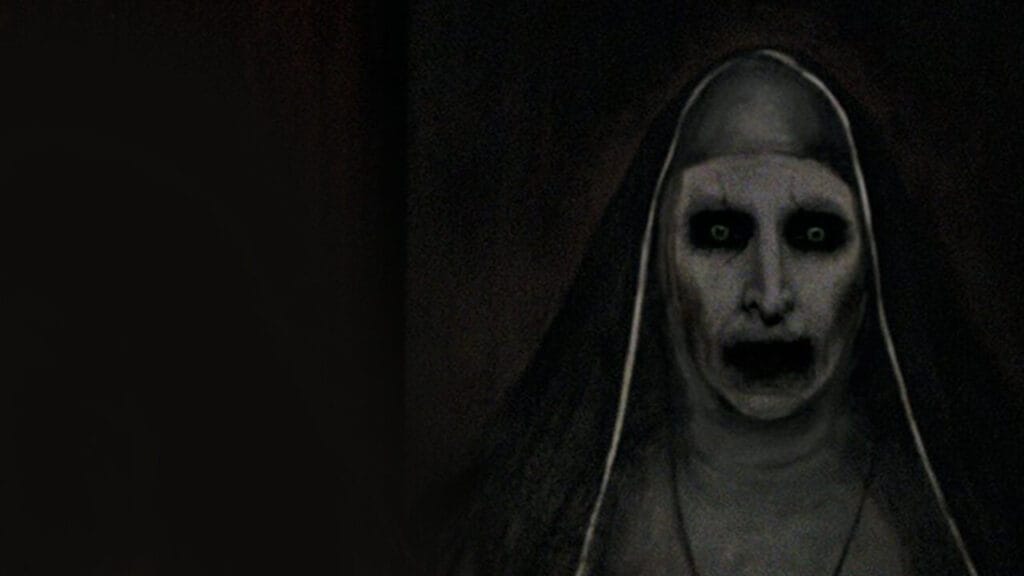
None of that is the problem with the film’s inventions. Invention is what horror does; a movie “based on a true story” is allowed to build its own nightmares, and I’d defend that right for any director. What I can’t wave away is the choice of whose weight gets borrowed. The film names the demon — Valak, layered on late in production, after Wan reportedly dreamed of a blasphemous nun and changed the villain in reshoots. It stages an exorcism that never happened. It gives you a Crooked Man, a long-limbed nightmare visualization based on a nursery rhyme the real family used, conjured as a monster entirely for the film. All of that I can hold. What I keep putting down and picking back up is the grief — the specific grief of a specific man — and what the film does with it without ever saying his name in the credits.
The Conjuring 2 and What It Won’t Tell You
This is what I mean when I say my suspicion didn’t protect me. I know all of this. I knew most of it walking in. And the film is so well-constructed — Burgess’s camera, Bishara’s restraint, Wolfe’s loneliness, Wilson’s voice cracking on an Elvis song in a cold room — that it gets past the part of me that knows better and reaches the part of me that just wants the scared children to be okay. I’ve gone back and forth on what to do with that, honestly, and I don’t have a clean landing for it. James Wan is a gifted technician. I’ve said before, in print, that I don’t think he has much to say, and I’m not fully retracting it — but writing that sentence now, after this film, it feels thinner than it did. Maybe knowing exactly how to make an audience feel something is the thing he has to say, and I’ve been too snobbish to count it. Or maybe I’m just describing what good manipulation feels like from the inside and dressing it up as a concession. I genuinely can’t tell which, and I’ve stopped pretending the not-telling is a failure on my part rather than the actual condition of watching this movie.
So where does that leave me. The Conjuring 2 review keeps pulling in two directions and I’ve stopped trying to make it point one way. The film improves on its predecessor — it’s warmer, more frightening, more emotionally coherent, and visually working in a different league. The marriage at its center is one of the more genuinely moving relationships in modern studio horror. The guitar scene earns every second of its sentiment. All of this is true. It also accomplishes everything it does by standing on the grief of real people who don’t get a producer credit, by converting Maurice Grosse’s dead daughter into emotional fuel for a couple who weren’t there, by resolving a mystery that real human beings still live inside. You can hold both. The film counts on the fact that you will.
That’s the Warrens’ whole operation, when you get down to it. True believers in a story they helped build, distributing credit where the brand required it. The films are true believers in the same way — sincere, well-meaning, and untroubled by the distance between what happened and what sells.
The last image the film leaves you with is a real one, and it’s the one that stays with me. Peggy Hodgson lived in that Green Street house for the rest of her life. She died there, in 2003, in an armchair — in the room where the dead man’s voice supposedly first spoke. She didn’t leave. Whatever was or wasn’t in that house, she stayed in it until the end. The film uses this as a final chill, a last note of the uncanny. I read it as something sadder and more human: a woman who lived through something nobody believed, or believed too much, and who never got to be anything other than the haunted mother for the rest of her days.
The Warrens walked away from Enfield with a franchise that’s still printing money. Grosse walked away with nothing the film was willing to give him — least of all his own daughter, who’s in there somewhere, behind Lorraine, uncredited. And Peggy didn’t walk away at all. She stayed in the house until it killed her, or until something did, depending on what you believe. That’s the arithmetic the movie performs without ever showing you the math.
That’s the real horror of The Conjuring 2, and it’s the one the film isn’t trying to tell you.
Ethan’s Score: 7 / 10
The Conjuring 2 Review: Is It Worth Watching?
Yes. The Conjuring 2 (2016), directed by James Wan, is the strongest entry in the franchise and one of the better studio horror films of the decade. Patrick Wilson and Vera Farmiga deliver performances that ground the supernatural in genuine emotional stakes, and Don Burgess’s cinematography gives the Enfield house a physical presence that most haunted-house films never achieve. The mythology troubles me for documented reasons, but the craft is real.
Who Are the Real People Behind The Conjuring 2?
The film is based on the Enfield Poltergeist case of 1977–1979, centered on Peggy Hodgson and her children — primarily eleven-year-old Janet — at 284 Green Street, Enfield, London. The real investigators were Maurice Grosse and Guy Lyon Playfair of the Society for Psychical Research. Ed and Lorraine Warren had minimal documented involvement in the actual case, arriving after the primary investigation had concluded. Janet Hodgson has confirmed as an adult that some incidents were faked, while maintaining the core events were genuine. Peggy Hodgson lived in the house until her death in 2003.
Is The Conjuring 2 Based on a True Story?
Partially. The Enfield Poltergeist case is real and extensively documented — over 180 hours of recordings, multiple witness testimonies, and nearly two years of investigation. What the film invents: the Warren-led conclusion, Valak the demon nun, the Crooked Man as a physical entity, and the dramatic exorcism sequence. The film’s version of the Warrens’ central role is a significant creative liberty. The Annabelle mythology that opens the film has its own documented problems, covered separately on this site.
How Does The Conjuring 2 Compare to the First Film?
It’s better. The first Conjuring is competent haunted-house mechanics — well-executed, emotionally thin. The sequel is warmer, more frightening, and more honest about what it’s actually interested in, which is the marriage at its center rather than the haunting around it. Burgess’s cinematography is a significant upgrade over the first film’s visual language. If the franchise mythology doesn’t bother you, The Conjuring 2 is the one worth your time. If it does bother you — as it does me, for reasons I’ve written about at length in the Warren article — the film is still the more accomplished piece of filmmaking and worth the complicated feeling.
The craft layered into the film goes much deeper than the surface scares — the Conjuring 2 hidden details catalogues the structural choices Wan made that most viewers miss.