Ed and Lorraine Warren: The Cases, The Evidence, and Fifty Years of Open Files
The Museum Is Still Open
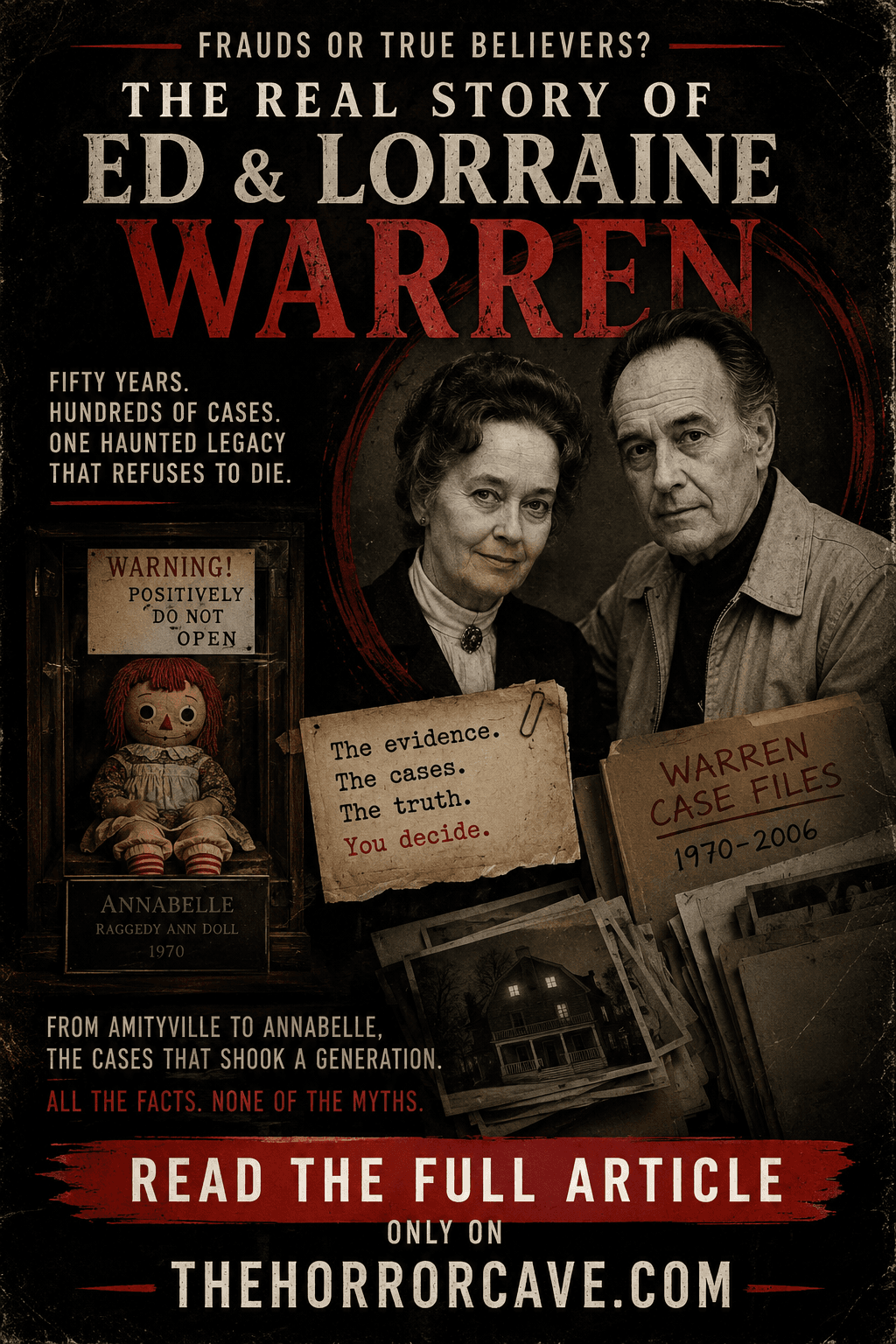
The Occult Museum in Monroe, Connecticut is a basement. Admission by appointment only. There is a sign on the glass case that contains the Annabelle doll — a handwritten warning, a request not to touch the glass, a note about what has allegedly happened to people who dismissed it.
The doll is a Raggedy Ann. It has been in that case since 1970.
Ed Warren died in 2006. Lorraine Warren died in 2019. Tony Spera, their son-in-law, manages the museum now. The doll is still in its case. The case files — hundreds of them, accumulated across fifty years of investigations — still exist.
Whatever else is true about Ed and Lorraine Warren, and the argument about what’s true has not slowed down since they started making it, they built something that outlasted them. That’s a documented fact. Everything else requires more careful examination.
Who Ed and Lorraine Warren Were
Edward Warren Miney was born in 1926 in Bridgeport, Connecticut. He grew up in a house he later described as haunted. At seventeen, he was painting portraits of abandoned New England houses — pieces designed to look like something was wrong with the structure — and selling them door-to-door. He served in the Navy, came home, and married Lorraine Moran in 1945. She was seventeen. She had described herself as clairvoyant since childhood — able to see auras, sensitive to presence in a way she considered factual about herself, not metaphorical. Ed built around it.
In 1952, they founded the New England Society for Psychic Research, making it one of the oldest paranormal research organizations in the United States. They developed a working methodology: site visits, witness interviews, audio and photographic documentation, classification of phenomena as residual haunting, intelligent haunting, or demonic infestation. Ed investigated and classified. He was a self-taught demonologist — a title no certifying body conferred, rooted in Catholic theological tradition and a decade of fieldwork. Lorraine walked through rooms and felt what was there.
They lectured at more than a hundred college campuses. They published. They built the Occult Museum in Monroe. Ed and Lorraine Warren were not fringe operators working in secret — they were institutional, in the specific sense that they built an institution and maintained it across five decades.
The question of what that institution produced — and whether it was worth anything — is harder. The debate over their honesty, their self-deception, and whether they were believers in a narrative they could no longer distinguish from reality is examined in full in this piece on whether the Warrens were frauds or true believers. This article is about the cases themselves.
The Warren Investigation Method
The standard critique of Ed and Lorraine Warren is accurate on all its points: no formal academic credentials, no peer-reviewed publications, a self-conferred title, a methodology inseparable from Catholic demonology, and a financial interest in outcomes that confirmed what they were investigating.
Every point lands.
The thing they were investigating, though, had no established methodology to borrow from. Academic parapsychology in the 1950s and 1960s was contested, underfunded, and producing nothing close to consensus. The Society for Psychical Research in Britain was more rigorous but also more reluctant to conclude anything. Ed and Lorraine Warren were willing to conclude things. That’s a liability in some contexts and an asset in others.
Case by case, the output was consistent: witness testimony gathered on-site within days of reported phenomena; photographic and audio documentation of claimed activity; property history research; a classification and a recommendation delivered to the family. In cases they considered severe, they involved Catholic clergy for formal religious investigation and, where warranted, exorcism.
A journalist looks at that process and asks: is any of it reproducible? Falsifiable? Both questions are genuinely difficult to answer from outside the room. The evidence Ed and Lorraine Warren produced was experiential and testimonial — the most impactful kind for the people involved, and the most difficult to evaluate from the outside.
I’ve spent more time with the Warren case files than I’ll admit to here. The pattern I kept running into was not bad faith. It was real conviction operating on methodology that couldn’t carry what they were asking it to carry.
The Amityville case shows what happens when that system meets adversarial scrutiny.
Case File: Amityville
In December 1975, George and Kathy Lutz moved into 112 Ocean Avenue in Amityville, New York — a house where Ronald DeFeo Jr. had murdered his entire family thirteen months earlier. Twenty-eight days later they left, claiming a haunting. The book Jay Anson published from their account in 1977 became one of the most commercially successful haunting narratives ever printed.
Ed and Lorraine Warren investigated. They claimed photographic evidence of a ghost on the stairs. Ed described the house as among the most demonically infested he had ever entered.
In 1979, William Weber — the attorney who had defended Ronald DeFeo Jr. — gave an interview to People magazine. He stated that he and the Lutzes had “created this horror story over many bottles of wine.” His stated motive: he needed documented paranormal history at the house for a post-conviction insanity defense he was building for his client.
George Lutz contested this account until his death in May 2006. He maintained, to the end, that the haunting was real. The Warrens never retracted their investigation.
One of the principals in the case publicly stated the narrative was constructed. No subsequent residents reported comparable activity. The Warrens’ evidence was produced inside a case that the case’s own lawyer called fabricated. Whether they investigated and found what they were incentivized to find, or investigated and found something Weber’s admission doesn’t actually invalidate — that question doesn’t resolve cleanly. It stays open.
Case File: Annabelle
The Annabelle case doesn’t have a William Weber. That distinction matters.
Around 1970, a nursing student in Connecticut received a Raggedy Ann doll as a gift from her mother. The student — identified in Warren records as Donna — reported the doll moved on its own between rooms. Notes appeared in the apartment that neither she nor her roommate had written. A medium told them the doll was inhabited by the spirit of a deceased child named Annabelle Higgins.
Ed and Lorraine Warren were contacted. Ed concluded the doll was being used by a demonic entity — manifesting as an innocent child spirit to gain the occupants’ trust, a manipulation strategy in demonic taxonomy. He took possession of the doll.
It has been in the Occult Museum in Monroe ever since, locked in a glass case. No historical record of a child named Annabelle Higgins has been found in the area. The medium’s identification was either fabricated or wrong. The Warrens’ reinterpretation — demonic entity, not child spirit — is the more theologically sophisticated read, and it’s the position the documentary record shows them holding consistently across fifty years.
The doll exists. The chain of custody from 1970 to the present is documented. The witness testimony is in the Warren archive. What that chain actually represents — and how the documented case compares to what the films built from it — is covered in full in the real history of the Annabelle doll.
Case File: The Perron Family
The Harrisville case differs from both Amityville and Annabelle for one reason: primary source documentation from the family themselves, written thirty years after the events.
Andrea Perron — the oldest of the five Perron daughters — published a three-volume memoir through AuthorHouse titled House of Darkness House of Light (2011, 2013, 2014). More than 900 pages. It is the most detailed first-person account of a Warren investigation that exists outside of the Warrens’ own records, written by someone who was a child during the events and has spent her adult life examining what happened to her family.
The Perrons moved to a farmhouse in Harrisville, Rhode Island in January 1971. Roger Perron was skeptical of what his family reported. Carolyn Perron was the most consistently affected — recurring headaches, a persistent sense of presence, physical incidents Roger attributed to the age of the house and Carolyn could not. The five daughters reported experiences across a spectrum. Andrea’s account distinguishes between them carefully.
Ed and Lorraine Warren arrived. Ed identified demonic infestation connected to the property’s history. Lorraine conducted a séance. According to Andrea’s account, Carolyn was seized during it — rose from her chair, spoke in a voice and a language that were not her own. Roger Perron intervened physically. The Warrens left.
Andrea Perron published the account because, she has said, she believed the record needed to exist. Roger Perron maintained his skepticism throughout his life. Seven people, the same house, ten years — with irreconcilable accounts of what was happening to them. The full documentation is in the complete history of the Perron family haunting.
Case File: Enfield
The Enfield Poltergeist ran from 1977 to 1979 in a council house in north London. It is the most extensively documented case Ed and Lorraine Warren were connected to — and the one where the evidentiary record is most genuinely complicated, because multiple investigators with different methodologies worked it simultaneously.
The Society for Psychical Research sent Maurice Grosse and Guy Lyon Playfair. Playfair published detailed field records in This House Is Haunted in 1980. Physical media exists for Enfield in a volume no other Warren case approaches: audio recordings, photographs, film footage, witness testimony from neighbors, school officials, journalists, and SPR investigators spanning nearly two years.
The Warrens visited. Ed stated that Lorraine encountered a demonic entity in the house. Their contribution to the Enfield record — relative to the SPR’s — was brief. A visit, a statement, a characterization.
SPR investigator Anita Gregory expressed skepticism about specific phenomena, particularly as the case expanded in ways that tracked with increased media attention. Janet Hodgson, the eleven-year-old at the center of the case, was caught fabricating phenomena on at least one occasion and later admitted in interviews to testing investigators to see if they were paying attention.
The admission doesn’t close the case. The audio recordings of a voice produced by or through Janet — low, adult, male, grammatically functional — remain unexplained. Every investigator who engaged seriously with those recordings, including skeptics, has struggled to produce a convincing mechanism for them. The full weight of the two-year Enfield record is in the complete Enfield investigation.
The Record After Fifty Years
After fifty years, Ed and Lorraine Warren produced a substantial archive of case documentation, a large body of witness testimony, photographic and audio material, and a framework for understanding demonic activity rooted in Catholic demonology.
The serious criticism is right: no single investigation produced phenomena observed under controlled conditions by independent investigators using agreed-upon methodology. The SPR came closest at Enfield. The case is still disputed.
The structural problem is this: the thing they were investigating doesn’t submit to the conditions that would make evidence compelling to outside scrutiny. Demonic entities — if they exist — are not going to perform reliably for a skeptic with a camera. Hauntings don’t respect experimental design. The kind of proof that would satisfy the people who most need satisfying may be constitutionally unavailable in this domain.
Ed and Lorraine Warren never addressed this directly. Ed held his framework with the certainty of faith, which is the appropriate relationship to have with faith and a poor one to have with evidence. He never appeared to notice the gap. The instruments shaped by conviction are built for the practice of faith, and they produce poor evidence — the serious critique of the Warren methodology doesn’t require dishonesty. It requires that they were working with tools that couldn’t reach what they were trying to establish.
What I can document — and this I can document — is that Ed Warren went into houses where people were frightened, in some cases genuinely destabilized, and he took them seriously. He built a record substantial enough that investigators, journalists, and skeptics are still working through it sixty years later, because it’s substantial enough to argue with.
That is its own kind of answer to something.
Ed Warren died on August 23, 2006. He was seventy-nine years old. Lorraine Warren died on April 18, 2019, in Monroe, Connecticut. She was ninety-two. In her last interviews, she spoke about Ed with the calm specificity of someone who had known him for seventy years — which she had. The museum is still open. The doll is still in its case.
The files don’t close. For those interested in how the 2013 film translated these cases into craft, the Conjuring 2013 hidden details breakdown goes through exactly how Wan built the fear from this material.
Frequently Asked Questions About Ed and Lorraine Warren
Who were Ed and Lorraine Warren?
Ed Warren (1926–2006) and Lorraine Warren (1927–2019) were American paranormal investigators who founded the New England Society for Psychic Research in 1952. Over more than fifty years, Ed and Lorraine Warren investigated hundreds of reported hauntings and demonic infestations across the United States and abroad. Ed was a self-taught demonologist; Lorraine described herself as a clairvoyant and light trance medium. Their cases became the basis for The Conjuring film franchise, though the films compress and dramatize events the actual case documentation handles differently.
What was the Warrens’ most famous case?
Amityville is the most commercially famous Ed and Lorraine Warren case, but it carries the weakest evidentiary record. William Weber, defense attorney for murderer Ronald DeFeo Jr., publicly stated in 1979 that he and George Lutz had constructed the haunting story together. The cases with the most substantial documentation are the Annabelle doll case (1970), the Perron family haunting in Harrisville, Rhode Island (1971), and the Enfield Poltergeist in London (1977–1979).
Were Ed and Lorraine Warren ever debunked?
The Amityville case was directly undermined by Weber’s 1979 admission, and Ed and Lorraine Warren never retracted their investigation. The Enfield case — the most extensively documented of their cases — involved admitted fabrication of some phenomena by Janet Hodgson, though not all phenomena were explained. No Warren investigation produced evidence under independently controlled, reproducible conditions. Whether that reflects the nature of what they were investigating, or the limits of what they were actually finding, is what fifty years of documentation can’t settle.
What happened to the Warrens’ Occult Museum?
The Occult Museum operates from the Warrens’ home in Monroe, Connecticut, currently managed by their son-in-law Tony Spera. The Annabelle doll remains in a locked glass case with a warning notice. The museum continues to admit visitors by appointment.
Did Ed and Lorraine Warren work with the Catholic Church?
In cases they classified as demonic infestation, Ed and Lorraine Warren regularly involved Catholic clergy and coordinated with the Church for formal religious investigation. Ed Warren’s demonology was rooted in Catholic theological tradition. Church involvement in specific cases is documented in Warren records; Church documentation of individual cases is rarely made public.
Their cases were dramatized most extensively in The Conjuring 2 (2016), which took the Enfield Poltergeist as its basis and placed the Warrens at the center of the story.