Director: Ari Aster / Year: 2019 / Runtime: 147 min (Theatrical) / Studio: A24 / Square Peg / B-Reel Films
This Midsommar review has taken me a long time to write. The problem was never what to say, but how to say it without sounding like someone who just got out of a three-year relationship and watched the wrong movie at the wrong time. Ari Aster’s 2019 folk horror masterpiece is one of those films that doesn’t wait politely in your memory. It moves in. It hangs its clothes up. Three days later you’re still thinking about that smile. There are horror movies that scare you. Then there are horror movies that contaminate you. Midsommar is the second kind. And this Midsommar review is going to try to explain why without ruining what makes it work. It’s the kind of film that feels emotionally cursed before a single drop of blood hits the ground — and there will be blood, eventually, in ways that will make you deeply uncomfortable in broad daylight. Which is, not coincidentally, where the entire movie takes place. Eighty-three percent on Rotten Tomatoes. For a $9 million folk horror film about grief and Swedish death cults. Let that number sit for a second.
Midsommar Review: What This Film Is Actually About
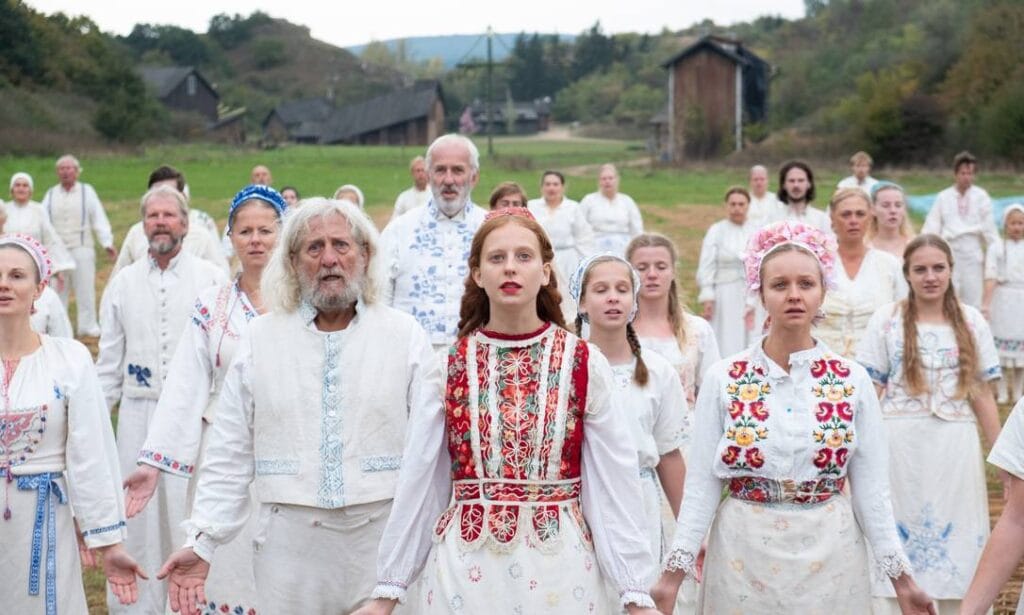
Here’s what Midsommar is not about: Sweden. Flowers. Pagan ritual. The Hårga commune. A24’s marketing team desperately wants you to walk in thinking you’re getting a sun-drenched Wicker Man knockoff, and technically you are — except you’re also walking into a two-and-a-half-hour autopsy of a dying relationship, performed in full sunlight, in front of everyone. Dani (Florence Pugh) loses her entire family in the film’s first ten minutes. Her sister kills herself and their parents in a carbon monoxide murder-suicide. Her boyfriend Christian (Jack Reynor) is the kind of emotionally absent, vaguely handsome man who comforts a grieving woman by staring at the wall slightly to the left of her face. He was going to break up with her before the tragedy. He doesn’t. He just… keeps her around like a guilty obligation. That dynamic — the grief-destroyed woman clinging to a man who was already halfway out the door — is the horror. The cult, the rituals, the festival that only happens every ninety years? Those are just the setting. Aster has said himself that for Dani, this isn’t a horror movie at all. It’s a perverse wish-fulfillment fantasy. A fairytale. The commune offers her something Christian never could: a community that absorbs her pain, mirrors her grief, and holds her like she matters. That’s the terrifying part. The Hårga are the most emotionally present people in the film.
Ari Aster Midsommar: Why This Director Is Built Different
After Hereditary — a film I’ve already called a family autopsy disguised as horror — Aster arrived at Midsommar carrying a very specific obsession. He was going through a real breakup. He processed it the way most of us process breakups — by crying, drinking bad wine, and watching old movies. Except Aster also wrote a feature-length folk horror film about a Swedish cult that ritually slaughters outsiders. Which is admittedly a more interesting coping mechanism than scrolling through Instagram at 2AM. What Aster does that almost no other mainstream horror director does right now is refuse to explain himself. He trusts the audience to feel the wrongness of a scene without a jump scare to confirm it. He trusts silence. He trusts a held shot. He trusts that watching a woman cry while twenty strangers wail in perfect synchrony is more disturbing than anything a monster could do. His background is rooted in emotional realism filtered through the grotesque — grief, inherited trauma, family collapse dressed as supernatural horror. Midsommar is him pushing that formula further than Hereditary dared. There, the horror arrived in the dark, in cramped rooms, in small terrible sounds. Here, he strips all the shadows away and asks: what if the horror happened at noon, in a meadow, under eternal summer light? What if the scariest thing was something that looked beautiful? The answer is uncomfortable and correct. Every serious Midsommar review should grapple with that question, because it’s where Aster’s real genius lives.
Midsommar Review: What This Film Does That Others Can’t Touch
Let me tell you about the cinematography, because Pawel Pogorzelski deserves his name said out loud more often. Most horror films use darkness as a weapon. Shadow, obscured frames, light as a reward. Midsommar does the opposite. Every frame is overexposed, golden, almost pastoral — shot like a Scandinavian tourism ad that has been quietly infiltrated by something deeply wrong. The flowers are too bright. The white linen robes are too pristine. The sky never changes. The sun never moves. It creates this relentless visual pressure — the sensation of being trapped somewhere that looks safe and isn’t. There’s a scene early on, during a hallucinogenic trip in the meadow, where the grass appears to breathe. The ground moves under Dani’s feet. The world is alive and wrong. The theater went completely silent during that sequence. The kind where The kind where you notice your own heartbeat and you’re not entirely sure if that’s your anxiety or the score doing it to you.
Bobby Krlic’s score deserves equal credit. It operates at frequencies that don’t read as traditionally scary — choral, folk-inflected, deceptively warm — and then it turns on you. The sound design treats music the way the commune treats outsiders: welcoming until it isn’t. If you want to understand what Krlic built here, the Midsommar soundtrack on vinyl — limited Green Marble edition is the only way to listen to it properly. Ten tracks, one LP, Bobby Krlic pressed into wax. The kind of record you put on at midnight and immediately regret.
Most A24 horror looks interesting. Midsommar looks infected. There’s a difference.
Florence Pugh Carries This Film on Her Back Across a Swedish Meadow
This is not a subtle observation: Florence Pugh’s performance as Dani is one of the finest pieces of acting in 21st century horror. Full stop. No qualifiers. Every Midsommar review that skips past her performance is doing you a disservice. The opening scene, where Dani learns her family is dead, is almost unwatchable in the best possible way. She makes a sound — not quite a scream, not quite a wail — something pre-verbal and animal. The kind of grief you can’t perform. The kind that happens to you whether you want it to or not. Pugh plays the physiological reality of being destroyed — the thing underneath sadness, before it has a name. And she sustains that through 147 minutes of gradual psychological unraveling, through psychedelics and ritual humiliation and watching her boyfriend sleep with someone else as part of a fertility ceremony, through being crowned May Queen, through choosing to sacrifice the man who failed her repeatedly — and then smiling about it. That smile is the whole film. Whether it’s liberation or psychotic collapse or both simultaneously — Pugh and Aster have publicly disagreed about what it means — is a question the movie refuses to resolve for you. Which is exactly right. The Midsommar review that tells you definitively what that smile means hasn’t been written, because Aster designed it to live in the space between answers.
The Honest Flaw: Midsommar Has a Pacing Problem and It Almost Costs Everything
Here it is. The thing I can’t pretend isn’t there. No Midsommar review worth reading buries this. The middle third of this film is exhausting in the wrong way. There’s a difference between slow-burn atmosphere and genuinely meandering pacing — Midsommar occasionally crosses that line, particularly in the sequences involving Josh (William Jackson Harper) and Mark (Will Poulter) doing anthropology-student things that feel like they’re being stretched to fill runtime rather than build dread. Will Poulter, who is doing the kind of broad comedic work that belongs in a different film entirely, creates tonal whiplash every time he opens his mouth. He’s the movie in a multiplex wandering into the movie in an arthouse. The director’s cut at 171 minutes is, respectfully, too much. The theatrical cut at 147 minutes is right on the edge. There are twenty minutes in the middle that could be surgically removed without losing a single thematic beat, and the film would be tighter, meaner, and better. I’m still recommending it without hesitation. But I want you to be prepared. Get comfortable. The payoff is worth the patience. Any Midsommar review that doesn’t warn you about this is setting you up for the wrong expectations. The ending alone justifies everything that precedes it, including the parts that test you.
Midsommar Review: Final Verdict — See It or Forget It?
See it. Immediately. Then sit with what it does to you. Midsommar is a horror movie about what grief does to the part of you that decides what’s acceptable. The cult is the vehicle; grief is the subject. It’s about how loneliness makes people vulnerable to belonging — even the wrong kind of belonging, even the kind that burns you down to the foundation and calls it rebirth. It’s a thread that runs through the best cult horror, from Rosemary’s Baby to Hereditary — but Aster makes it feel uniquely personal. Most horror movies are content to scare you and send you home. Midsommar is content to rearrange something fundamental about how you understand emotional dependency. This is Ari Aster operating at the peak of what he can do — atmospheric, merciless, genuinely original in a genre that has been strip-mined for thirty years by Blumhouse and their assembly-line haunted-house products. Midsommar looks nothing like a Blumhouse movie. It’s lit like a painting instead of a parking garage. It’s paced like a ritual instead of a roller coaster. It trusts you to feel something instead of just react. For a more recent film operating in this same register — supernatural horror as a mirror for obsessive emotional damage — see our review of Obsession (2026).
If Midsommar sent you looking for more, we’ve mapped out the five folk horror films that work the same wound.
FAQ: Midsommar (2019)
Is Midsommar worth watching?
Yes — with zero caveats if you’re a horror fan who values atmosphere over jump scares. This is folk horror operating at the top of the genre: slow, psychologically brutal, visually extraordinary. If you need traditional scares delivered on a schedule, this one will frustrate you. If you want a film that lingers in your mind for days, it’s essential viewing. And if you’ve already read this Midsommar review, you already know why.
Does Midsommar have jump scares?
Almost none in the traditional sense. The film builds dread through accumulation — wrong details in the background, rituals that feel slightly off, a community that smiles a fraction too long. The horror doesn’t leap at you. It slowly covers your lungs like smoke.
What does the Midsommar ending mean? Why does Dani smile?
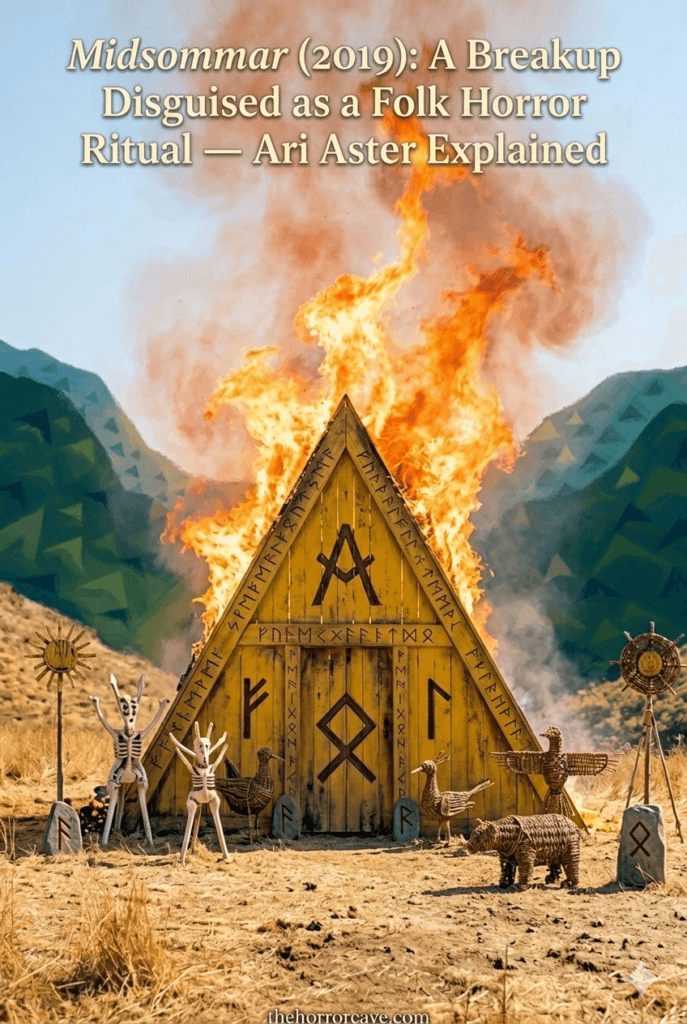
Aster has called it a breakup movie in folk horror clothing — and the smile is the breakup finally completing itself. Dani chooses Christian as the final sacrifice and, surrounded by a commune that mirrors her every emotion, begins to cry with them and then smile with them. Whether that’s liberation, psychological collapse, or cult indoctrination is deliberately left open. Pugh and Aster have publicly given different interpretations. That ambiguity is the point. For a closer look at every detail, read our full Midsommar ending explained.
Is Midsommar based on a true story?
No — the Hårga commune and its rituals are fictional, though Aster drew from real Scandinavian Midsummer traditions, Norse folklore, and pagan ritual history. The ättestupa ceremony depicted in the film has roots in actual historical accounts of elderly sacrifice in Norse culture, though historians debate how literal those accounts should be taken.
Where can I stream Midsommar?
As of 2026, Midsommar is available on Apple TV+. Availability shifts — check your region’s current streaming catalog. It’s also available for digital rental or purchase across major platforms.
Director: Ari Aster Cast: Florence Pugh, Jack Reynor, William Jackson Harper, Vilhelm Blomgren, Will Poulter, Ellora Torchia, Archie Madekwe Production Company: A24 / Square Peg / B-Reel Films Runtime: 147 min (Theatrical) / 171 min (Director’s Cut) Content Rating: R Ethan’s Score: 9/10