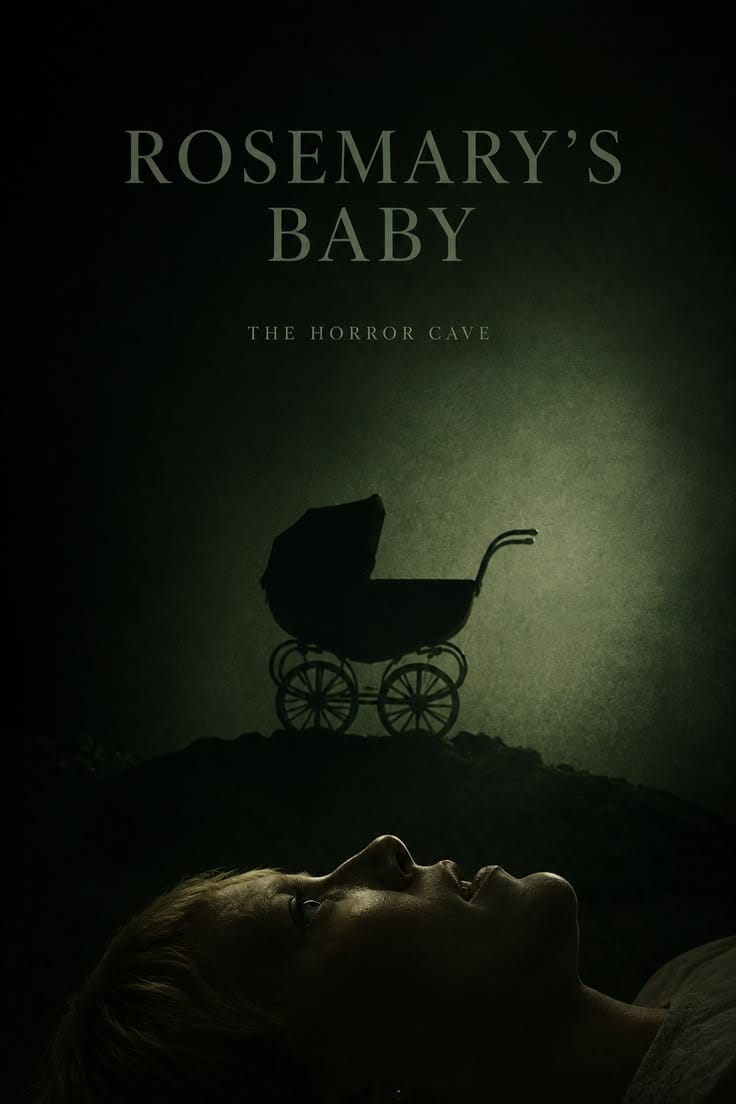
Director: Roman Polanski | Year: 1968 | Runtime: 136 min | Studio: Paramount / William Castle
Roman Polanski received a call from producer Robert Evans in 1966 with an offer: adapt Ira Levin’s not-yet-published manuscript for Paramount. He read it in one sitting, called back the same day, and began writing the screenplay before the novel was even in stores. What he understood, reading Levin’s pages, was that the horror in this story wasn’t supernatural at its core — and that a director who kept faith with that insight would produce something more durable than any haunted-house picture. He was right. Fifty-eight years later, Rosemary’s Baby (1968) is still the most precisely assembled horror film ever made.
The setup: Rosemary Woodhouse (Mia Farrow) and her actor husband Guy (John Cassavetes) move into the Bramford, a large Gothic apartment building on the Upper West Side — filmed at the Dakota, which was at the time exactly the kind of building where wealthy eccentrics and old money coexisted in the specific proximity that Manhattan enforces. They meet the Castevets: Minnie (Ruth Gordon) and Roman (Sidney Blackmer), an elderly couple who immediately install themselves as neighbors in the particular way that certain people do, without invitation, with complete confidence that their presence is welcome. Rosemary becomes pregnant. Things get strange. The film is 136 minutes of Polanski asking you to decide what you’re watching.
That question — what you’re watching — is the whole mechanism. And it is, I’d argue, the thing that has made this film impossible to replace in the fifty-eight years since.
How Polanski Constructed a Horror Film Around Deniability
Most horror films tell you, visually, what you’re supposed to be afraid of. A score change, a camera movement, a lighting cue — the grammar of genre signals when to be scared. Polanski largely refuses these tools for the first two acts of Rosemary’s Baby. He films the Bramford as a handsome building with good light. He films the Castevets as enthusiastic if slightly intrusive neighbors. He films Guy as a charming if vaguely distracted husband.
Every element reads as normal. The wrongness has no single source. It accumulates in the gaps between scenes — in expressions that hold a fraction too long, in kindnesses that are slightly too precisely timed. Polanski studied Hitchcock thoroughly before making this film. What he came away with — my read of the work, not a claim he’s confirmed in those exact terms — was a precise attention to deniability: the formal principle that the most frightening thing is what can be explained away.
The result is a horror film that works on viewers who don’t believe in Satanism and viewers who do, on first-time watchers who genuinely aren’t sure whether the supernatural is real in the film’s world, and on rewatchers who know every detail and watch it spread across the mise-en-scène like something they can only now fully read. That is an almost unrepeatable achievement. I’ve tried to think of films that do the same thing as cleanly and I keep coming up short.
The Production Context
Mia Farrow was in the middle of filming Rosemary’s Baby when Frank Sinatra — her husband at the time — delivered an ultimatum: leave the production or he would file for divorce. She had been cast while working on a Sinatra film; he wanted her on set for his next picture, not Polanski’s. Farrow stayed. Sinatra filed before the film opened.
That biographical fact is not incidental to what appears on screen. Farrow was playing a woman whose husband had decided his ambitions mattered more than her autonomy, while her actual husband was demonstrating something structurally similar. Whether that pressure fed the performance or the performance survived it despite the pressure, I can’t say. What I can say is that the isolation Rosemary carries through the film — the specific quality of a woman who has stopped expecting to be heard — reads as something Farrow understood from the inside during those months.
The film came out in June 1968. Farrow and Sinatra’s divorce was finalized the same year.
Why Mia Farrow’s Performance in Rosemary’s Baby Still Stands Alone
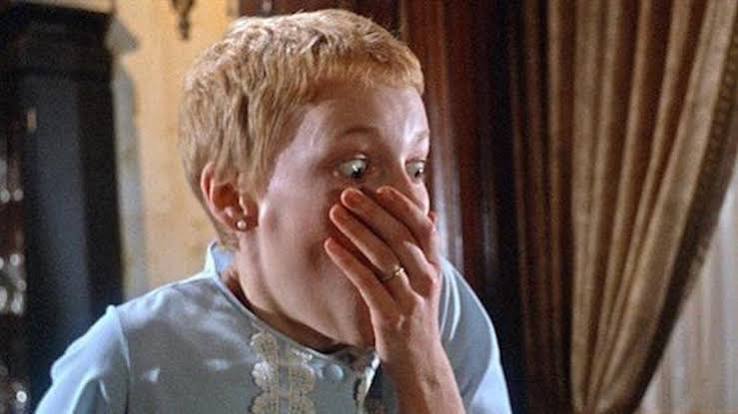
I’ll say it plainly: Mia Farrow’s work as Rosemary Woodhouse is one of the three or four best lead performances in the history of horror cinema.
The challenge she faced that almost nobody discusses: she couldn’t play suspicion. The film requires Rosemary to stay genuinely uncertain about what’s happening to her — genuinely inhabiting the state of a woman who keeps second-guessing her own perceptions — something a less disciplined actor would have betrayed with a knowing glance at the camera. If Farrow tips her hand too early, the ambiguity collapses. The performance is built almost entirely on restraint — on what she withholds at every moment where a less disciplined actor would have given the audience something to hold on to.
The physical deterioration across the film is real. Farrow lost weight during production. The bone structure that becomes prominent in the second half wasn’t a makeup effect. There’s a scene — raw liver at the kitchen table, eaten compulsively, without comment — that is among the most disturbing things in the film precisely because it’s played matter-of-factly. Rosemary doesn’t explain it. The camera doesn’t linger. The film simply includes it and moves on, which is somehow worse.
The Academy didn’t nominate her. It’s one of the more frustrating institutional failures in the genre’s history, for whatever that’s worth.
William Fraker’s Cinematography Is Doing More Than It Looks Like
William Fraker shot Rosemary’s Baby the year before he would shoot Bullitt — two entirely different assignments that share one quality: control under pressure. What he understood about the Dakota — the building Polanski chose to film as the Bramford — is that its architecture was already doing half the work. Long corridors. A service elevator. Apartments arranged around a central courtyard that lets sound travel in ways that feel slightly wrong. His approach was to let the building’s geometry establish enclosure before anything supernatural has happened to justify it — shooting Rosemary from positions that keep doorframes and thresholds in the foreground, so that every room she occupies already has a frame around it.
The more significant decision is harder to see because it involves an absence: Fraker keeps the camera at Rosemary’s eye level for almost the entire film. The visual grammar of menace — high angles that imply surveillance, low angles that imply threat, expressionist tilts — is almost entirely absent. What you get instead is a sustained insistence on the ordinary, and that insistence, maintained long enough, becomes its own form of dread. The camera refuses to confirm what the body is starting to suspect.
What Krzysztof Komeda’s Jazz Score Brings to Rosemary’s Baby
Komeda was primarily a jazz composer — one of the most significant in postwar Poland — and it shows in how the score for
Rosemary’s Baby is built. Jazz has a different relationship to resolution than orchestral horror music. It circles, delays, doesn’t always arrive where the listener expects. Applied to this film, that structural quality becomes almost philosophical: the score circles away from resolution, stays oblique and unhurried, matching the film’s overall refusal to signal alarm — in exactly the way the people around Rosemary stay oblique and unhurried.
What Komeda withholds matters as much as what he plays, probably more. There are scenes a conventional composer would have scored — Komeda left them silent. That silence is a decision, and it is the most unsettling sound in the film.
Komeda died in April 1969, ten months after the film opened. He was 37. He never saw what this score became.
Where Rosemary’s Baby Sits in the Canon
The films that followed it most seriously — Hereditary (2018), Midsommar (2019), The Witch (2015) — all make the same formal bet Polanski made: the supernatural horror is only as disturbing as the human horror it literalizes, and the human horror survives even if you remove the supernatural entirely. Aster’s debt to Polanski is visible in the work. The Graham family in Hereditary was “spiritually farmed,” as I wrote in the Hereditary review, in the same way that Rosemary was farmed by the Castevets — through warmth, proximity, and the patient management of someone else’s most vulnerable moments.
The difference between Rosemary’s Baby and its descendants is ambiguity. Polanski maintains it through the entire runtime. Aster abandons it in the third act — deliberately, as a narrative choice — because he’s making a different argument. The Witch maintains it throughout and ends on a question. Polanski’s version is the one that stays most open, the one where the viewer’s uncertainty is most fully preserved, and this is part of why it’s still the foundational text. It doesn’t resolve your uncertainty for you. It validates it.
The film is also about not being believed — about a woman whose instincts are demonstrably correct and whose entire social world is organized to redirect her toward trust she was never given reason to have. Polanski builds that mechanism into every room Rosemary enters, into every interaction, without editorializing about it. It’s there to be seen — Polanski trusts the viewer to arrive at the conclusion without a narrator to announce it.
For a deeper examination of the specific mechanisms at work — particularly how Guy Woodhouse functions as the film’s real horror, and what the ending is actually doing — our ending explained breakdown covers that specifically, and our deeper analysis of the film goes scene by scene through those questions. The review you’re reading now is the entry point. That piece is for after you’ve seen it.
The One Thing Rosemary’s Baby Doesn’t Quite Get Right
The middle third has pacing problems Polanski’s reputation tends to protect from honest scrutiny.
Hutch (Maurice Evans), Rosemary’s friend who begins to investigate the Bramford, gets more screen time than he strictly needs for what he accomplishes. Several scenes in the second act run slightly long for their narrative function — Polanski is building accumulation, and accumulation requires time, but there are four or five minutes in the middle of this film that could have been tighter without losing a single thematic beat. I’ve now watched it four times, and each time I think this in the same places. I’m not sure Polanski noticed.
Final Verdict
Rosemary’s Baby is essential horror because it solved a problem that the genre still mostly doesn’t solve: how to construct dread out of warmth, precision, and sustained uncertainty. Polanski understood that ambiguity is not a deficiency to be managed but a formal strategy to be deployed — and he deployed it with a control that 58 years of imitators haven’t fully replicated.
Mia Farrow is the reason the film works. Fraker’s cinematography is the reason it holds together. Komeda’s score is what’s still sitting somewhere in the back of your head two days later. The film around these three things is one of the most carefully assembled pictures in American horror.
Watch it alone, at night, with the phone in another room. Then, if you want to understand what it was doing to you while you watched, go read the deep dive.
Ethan’s Score: 9.3 / 10 ★★★★½
The most precise horror film ever made. Polanski assembled the conditions for dread and let it grow on its own.
FAQ: Rosemary’s Baby (1968)
Is Rosemary’s Baby actually scary?
Depends what you mean by scary. There are no jump scares, no monster, no scenes designed to make you flinch. What the film produces — and what it produces reliably, over multiple viewings — is the sustained unease of watching a world that looks ordinary reveal itself as something other than ordinary, at a pace slow enough that you can’t point to the moment it changed. Some people find that profoundly disturbing. Some find it slow. If you need horror delivered on a schedule, this will frustrate you.
How does Rosemary’s Baby compare to Hereditary?
Both films are about families designed to fail — systems running on schedule while the characters believe they’re making free choices. The horror in both isn’t the supernatural event. It’s the realization that the event was always planned. The key difference is ambiguity: Polanski never fully confirms what happened. Aster does, in the third act, deliberately, and builds a different argument around that confirmation.
Should I watch the director’s cut or the original?
There is no director’s cut of Rosemary’s Baby. The theatrical release at 136 minutes is the film.
How does Rosemary’s Baby hold up in 2026?
Uncomfortably well. The mechanism at its center — a woman’s instincts systematically invalidated by her husband, her doctor, her neighbors, and every institutional authority she encounters — hasn’t required updating. The film was made in 1968 and describes something that doesn’t belong to a particular decade. That’s part of why it’s still the foundational text rather than a period piece.
Where does Rosemary’s Baby fit in horror history?
It’s the foundational text for what later became elevated horror — films that use genre mechanics to examine psychological and social damage rather than simply to frighten. The films that follow it most directly: The Witch (2015), Hereditary (2018), Midsommar (2019). The debt is visible in the work. The lineage is clean.
Where can I watch Rosemary’s Baby?
As of 2026, Rosemary’s Baby is available on the Criterion Channel and for digital rental or purchase on most major platforms. The Criterion Collection physical edition remains the best way to watch it — Fraker’s cinematography and Komeda’s score deserve a proper screen and proper sound.