James Wan made The Conjuring (2013) with $20 million, a period setting, and a camera that holds its position past the point where genre discipline usually breaks. The result is the best mainstream horror film of its decade — a sentence I write without equivocation, because equivocation belongs in the films that made it necessary.
Wan is working with borrowed materials. The haunted house, the based-on-a-true-story framing, the faith-versus-darkness climax — all of it has precedent. The innovation is execution, and in 2013, execution at this level was rarer than the genre’s output suggested. Paranormal Activity had produced four entries in four years. Found footage had calcified. Insidious — Wan’s own earlier work — had demonstrated what the subgenre could achieve on a reduced budget and simultaneously clarified what limited resources cost in terms of visual scope. The Conjuring arrived with a studio behind it, a period aesthetic that demanded genuine visual thinking, and a director who had spent the intervening years studying why the mechanics of screen horror work before deciding to deploy them at scale. That study is visible in every sequence. This is a film — The Conjuring (2013) — made by someone who understood what James Whale understood and what Mario Bava understood and what Kubrick turned into architecture at the Overlook Hotel — that the camera’s relationship to physical space determines whether fear is possible in any given scene.
How James Wan and John R. Leonetti Build Fear in The Conjuring (2013)
John R. Leonetti’s cinematography is the instrument through which this understanding operates. The widescreen compositions are period-appropriate — a deliberate choice to anchor the film’s visual grammar in 1971, when films were lit differently because the technology demanded it. Within that period frame, Leonetti and Wan build their language around a single operating principle: hold the shot until it has done its work. There is a sequence in the Perron farmhouse cellar — Carolyn alone, a candle her only light, the darkness accumulating at the frame’s edges — that demonstrates what sustained unease looks like when it’s built from camera placement and patience alone. Wan knows precisely where to position the camera in The Conjuring (2013) and when to leave it there, and what follows once the positioning is right is simply time — more of it than studio horror usually permits. The tracking shots through the farmhouse operate like a guided tour by someone with reasons not to show you everything. The camera moves through doorways, settles on corners, reframes what you thought you were looking at. You see almost everything. The almost is the entire film.
What Joseph Bishara’s Score Does in The Conjuring
Joseph Bishara’s score is most interesting in what it withholds. Bishara — who worked on the Insidious films — builds with prepared piano and string clusters that sit at the edge of mechanical rather than musical, sounds your brain tries to process as ambient before recognizing them as intentional. That ambiguity is the point. Familiar movie-music grammar lets audiences attach emotional context to what they’re hearing — it operates as instruction, as a cue for how to feel. Bishara’s score bypasses that layer entirely. The dissonance approaches harmonic resolution and refuses it at the last moment, which means the dread arrives somewhere below cognition, before interpretation gets involved. By the time you have a visual reason to feel the tension, it has been present in your body for several seconds, and the gap between that advance notice and what you’re seeing has been used against you.
What Bishara is doing in The Conjuring (2013) is the musical equivalent of Wise’s silence in The Haunting (1963): refusing the audience a stable emotional frame, forcing the nervous system to supply what the soundtrack declines to name. Most horror composers amplify what’s already on screen. Bishara arrives ahead of it — and that is what makes The Conjuring (2013) work at the physiological level most genre films never reach.
The Performances That Make The Conjuring (2013) Work
Lili Taylor is the element of The Conjuring (2013) that hasn’t been discussed with sufficient loudness. Carolyn Perron is the gravitational center of the film — the person the family’s stability orbits — and Taylor builds her performance through gradual internal displacement that takes the full running time to complete. The possession accumulates across the film’s runtime in her body: a quality of attention that shifts in the early sequences, a weight that redistributes incrementally, a relationship between her intentions and her physical expression that starts arriving slightly late. Her movements acquire an almost imperceptible resistance, as though her body is processing instructions from a distance. There is a scene in the first act — Carolyn at the kitchen table after the children have found the boarded-up cellar — where Taylor holds a stillness that is already slightly wrong in a way you can’t name until the film’s final act gives you the language for it. She builds all of this at a frequency below conscious notice. By the time the exorcism sequence arrives, she has spent the preceding ninety minutes planting what that scene requires, and the audience has watched every step without registering it as preparation. That retroactive architecture is the mark of a performance built for more than one viewing.
Vera Farmiga has the harder structural assignment, which is making Lorraine Warren’s clairvoyance credible in a film that requires the audience to accept clairvoyance as real and operative. The path through that structural problem runs through response: the moment Lorraine explains in specific terms what she’s perceiving, the fiction collapses. Farmiga solves it by registering effects only — what the perceiving does to the perceiver, legible on her face, present in how her body holds the weight of what she has seen. There is a barn sequence where Farmiga registers the moment Lorraine encounters something that can’t be unseen, and what her face does in that instant is genuinely difficult to describe technically. She decided the character wouldn’t protect herself from the experience. That decision carries the scene.
Patrick Wilson grasps something about Ed Warren that keeps the performance from collapsing into hagiography: Ed Warren completely, genuinely believes everything he is doing. This is a performance about the specific quality of a man who has decided, entirely, that God and the devil are real and that he stands between them carrying particular responsibilities. The discomfort this creates — a man who may be right about the reality of supernatural forces, whose credentials for being right about them are, to put it carefully, contested in the documented record — the film holds without resolving. Wilson holds the space that unresolved tension opens in The Conjuring (2013) and makes it feel inhabited. There is something specific in his delivery — the way Ed handles evidence, catalogs cases, speaks to the Perron family about what is happening in their house — that belongs to a man whose vocation is the structure his days are built around, something he carries rather than performs, visible even in how he reaches for the case files before anyone has asked him to.
The Conjuring (2013) structures itself as a sustained test of what people can hold under pressure. Carolyn Perron holds a family together as a house works to decompose it from within. Lorraine Warren carries what she sees across a career that has visibly cost her something — the film shows us this briefly and moves on, which is the right choice. And Ed Warren holds a faith that an investigative journalist finds professionally difficult to evaluate with neutrality: the kind that doesn’t modulate when observed, doesn’t perform for an audience, doesn’t hedge when the evidence complicates the theology. The ghost story is the mechanism by which The Conjuring (2013) finds out what each of these people is made of — it runs through them, tests the load-bearing structures, finds the cracks. The thematic claim beneath it — that what a place has witnessed accumulates in its walls, that damage doesn’t dissipate but waits, that what the Perrons encounter in that farmhouse was deposited there before they arrived — is the actual subject the Hayes Brothers screenplay is working with. Wan shoots it with the commitment of someone who believes every word, and in horror filmmaking, that commitment is what separates a film from a product.
Is The Conjuring (2013) Based on a True Story?
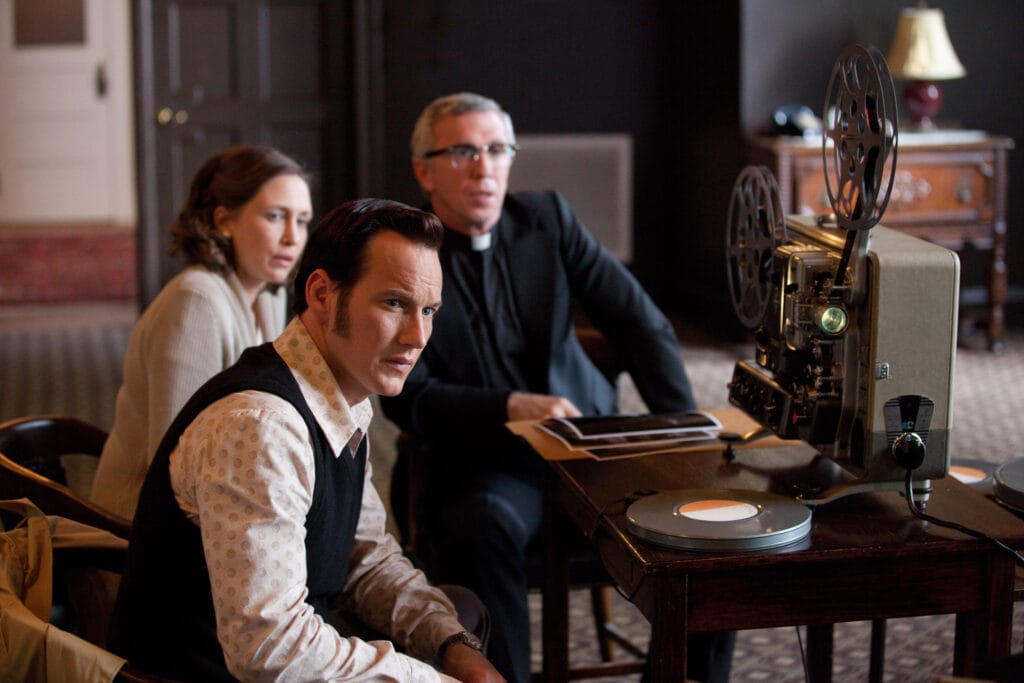
I’ve covered the Warrens and the Perron family in separate pieces on this site — the Warren profiles and the Perron true-crime piece give the full account. But the basics are worth establishing here. Bathsheba Sherman was a real person: she died in Harrisville, Rhode Island in 1885, at 73 years old. The historical record describes an ordinary woman. There are no court proceedings against her, no arrest records, no documented accusations of witchcraft or child sacrifice during her lifetime or afterward. She was a farmer’s wife. The mythology — Salem witch descendant, infant sacrifice, generational curse on the land — was assembled by the Warrens from local gossip, attached to their case files, and eventually handed to the Hayes Brothers, who gave it narrative shape. The Annabelle case that opens the film has documentation inconsistent with the official Warren version, as I detail in the Annabelle case file. Wan shoots all of this fiction with the conviction of someone who believes every word, and that conviction, inside a horror film, is exactly the right tool for the material he was given.
The Conjuring (2013)’s genuine failure is its resolution. The exorcism sequence gives Bathsheba motivation, predictable behavior, and an internal logic that systematizes what the first ninety minutes had correctly left wild — but the more specific problem is visual. Wan gives Bathsheba a face. A presence. Something with physical weight in the frame that can be directly confronted and specifically defeated. The Conjuring’s first ninety minutes operate almost entirely through absence: the cellar the camera enters slowly, the dark behind the wardrobe door, the corner of the room where something accumulates without being shown. Horror that works through implication — the engine that drives The Conjuring (2013) — collapses when the thing is made visible, when it acquires motivation and a history and the specific vulnerability of anything that has been named. The Hayes Brothers script demonstrates real intelligence in its handling of character and period detail throughout; what it can’t survive is its own final act, which asks the audience to accept that the forces it has spent ninety minutes refusing to define are, in fact, definable. The film that exists before the exorcism is smarter than the film the exorcism requires. The franchise apparatus this resolution helped launch — the sequels, the spinoffs, the expanding Conjuring universe — belongs to those subsequent productions. The Conjuring (2013) predates all of it, and should be evaluated as what it was before it became a franchise origin point.
What’s on screen in The Conjuring (2013) is a period horror film built from familiar materials and executed with craft the genre’s mainstream output hadn’t produced in years. The kitchen table scene. The clapping game in the dark. The bells strung through the house. The cellar, the barn, the photographs developing in the darkroom. Each of these works because someone understood, at a technical level, what the sequence needed to accomplish and had the patience to stop adding once it was there — a discipline that’s rarer in studio filmmaking than any individual piece of it.
Horror films spend their entire running time attempting to manufacture the specific fear of something that shouldn’t exist in the room you’re sitting in. Most of them produce something closer to the awareness that they’re trying — you feel the machinery, the beats, the familiar escalation — which is a different experience entirely. The Conjuring produces the real thing in its best stretches. There are moments in it — the cellar, the clapping game, the barn — where I’m watching a director who has understood exactly what a given sequence requires and had the discipline to stop adding to it once it was there. In 2013, that combination was rare enough to make The Conjuring (2013) feel like something. It still does.
Ethan’s Score: 8 / 10
Frequently Asked Questions About The Conjuring (2013)
Is The Conjuring (2013) based on a true story?
It draws from the Warren case files on the Perron family haunting in Harrisville, Rhode Island in 1971. The core event — a family experiencing disturbances in a farmhouse — is documented. The Bathsheba Sherman mythology and the Annabelle framing are considerably more complex than the title card implies. I’ve covered both in the Perron piece and in the Annabelle case file on this site.
Who directed The Conjuring (2013)?
The Conjuring (2013) was directed by James Wan, who had previously made Insidious (2010) on a fraction of the budget. The Conjuring is the more fully realized of the two — wider cast, period setting, and a visual scope the earlier film’s resources couldn’t support. Wan’s subsequent work, including Aquaman and the Conjuring sequels he produced rather than directed, doesn’t replicate what he built here.
How scary is The Conjuring (2013)?
The Conjuring works through sustained unease rather than isolated jolts. John R. Leonetti’s cinematography and Joseph Bishara’s score carry most of the weight. The first ninety minutes hold up across multiple viewings because the craft is what’s doing the work. The exorcism climax is the weakest section — it systematizes what the film had been wise to leave unresolved — but the hour that precedes it is as effective as mainstream horror gets. For a closer look at the specific decisions that make those ninety minutes work, see the Conjuring 2013 hidden details breakdown.
Does The Conjuring connect to the other films in the franchise?
The Conjuring (2013) launched a franchise that includes Annabelle (2014), The Conjuring 2 (2016), and over a dozen spinoffs. The original works as a standalone and predates the franchise apparatus entirely. The sequels and spinoffs are a separate subject — they belong to a different kind of ambition than what Wan was after in 2013.