
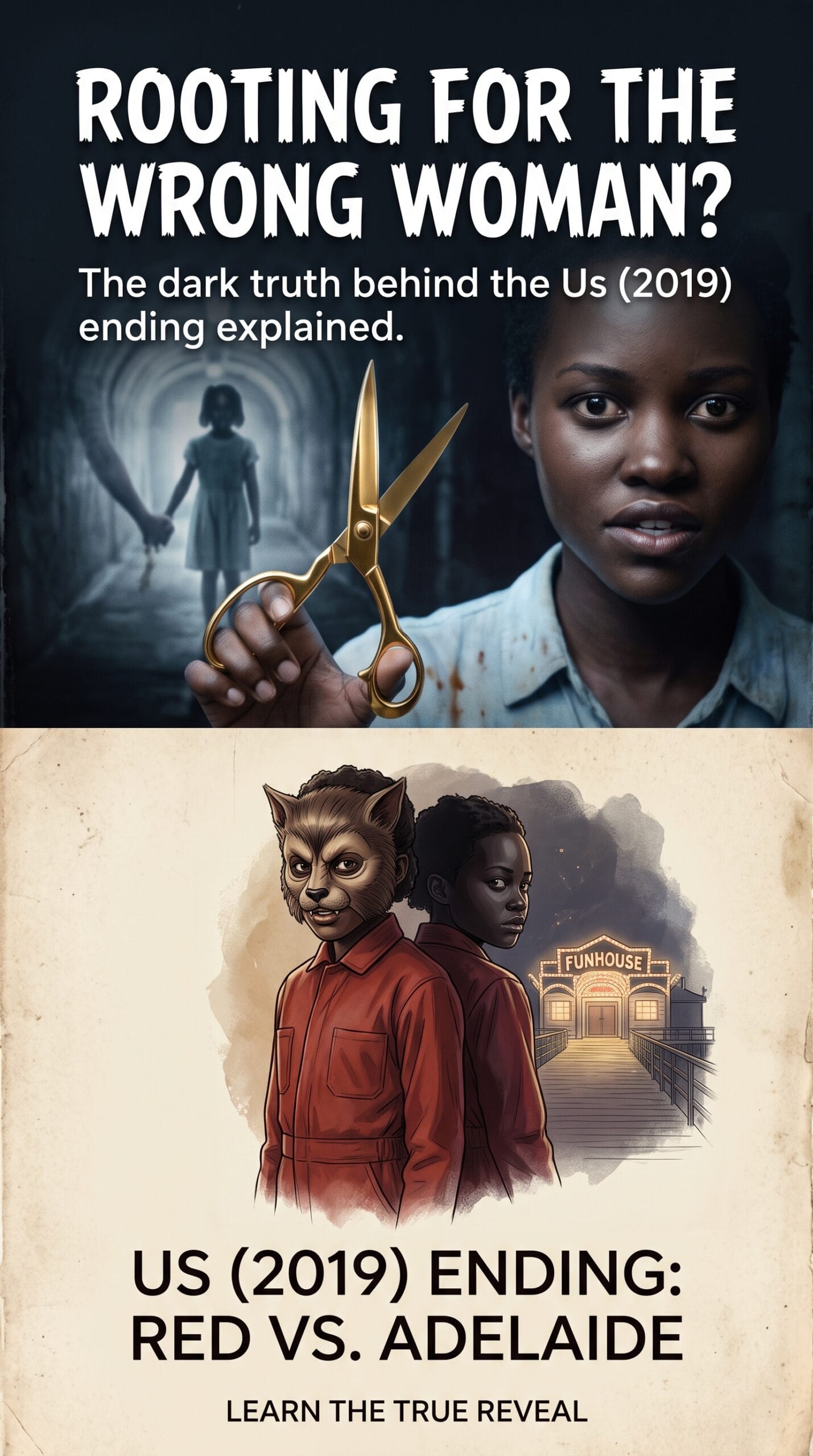
Us (2019) ending explained, short version: Jordan Peele’s film reveals that the woman we’ve spent two hours following as Adelaide Wilson is actually Red, the Tethered double who swapped places with the real Adelaide in a boardwalk funhouse in 1986. Red — the woman we thought was the threat — is the original Adelaide, killed in the final confrontation. The film hands you that evidence and then dares you to keep rooting for the woman holding it.
The girl who walked into the Vision Quest funhouse on the Santa Cruz boardwalk in 1986 and never walked back out the way she came in is Adelaide. The woman standing in the ambulance at the end, holding her son and telling him everything’s going to be like it was before, is the thing that came out of the tunnel in her place. Us doesn’t ask you to accept this quietly. It lets you spend two hours loving the wrong woman first.
Most of what gets written about this ending treats the twist as the whole event — the swap happened, roll credits, wasn’t that clever. My own review of Us covers that verdict and the craft behind it. The twist is the setup. The actual event is the question the last twenty minutes of Us is asking, which is uglier and more specific: once you know what she did, do you still let her have the ending she wants? A startling number of people say yes without noticing they’ve said it.
Us (2019) Ending Explained: What Happens at the End
In the underground tunnels beneath the boardwalk, Adelaide — the woman we’ve followed the entire film — fights her double, Red, in an abandoned classroom and barracks. During the fight, the film cuts between the present-day struggle and a flashback to 1986: two little girls, one who’s spent her life on the surface and one who’s spent it underground, dancing the same ballet piece at the same moment, one on a lit stage and one alone in a tunnel.
The flashback resolves the mystery the entire film has been sitting on. The girl we’ve called Adelaide for two hours is revealed, in that intercut sequence, to be the Tethered — the one who was dragged underground as a child and chained to a bed while her double took her life. Red, dying on the classroom floor with a fire poker through her, was the original Adelaide Wilson, stolen from her own childhood thirty-three years earlier.
Adelaide kills Red by choking her with the chain of her own handcuffs — the same handcuffs Red used on her, decades before, in reverse. She weeps while she does it. The weeping turns into laughter partway through. She finds her son Jason hiding in a locker, tells him “they’re all gone now,” promises him everything will be like it was before, and the family drives away in an ambulance as a line of red-suited Tethered, holding hands, stretches to the horizon behind them — Hands Across America, finally finished, thirty-three years and one government abandonment later.
That’s the plot. The plot is not actually the hard part of this ending. The hard part is what you’re supposed to do with it once you have it.
The 1986 Reveal, Beat by Beat
The flashback the film cuts to during the fight is doing more careful work than “twist confirmed, moving on.” It shows a specific sequence: young Red — the girl who will spend the next thirty-three years pretending to be Adelaide — dragging young Adelaide’s unconscious body into the tunnel and chaining her wrist to a barracks bed with a pair of custom brass handcuffs.
When the real Adelaide wakes up alone, tethered, she calls out for her parents. Two figures approach in the dark — Eartha and Weyland, the Tethered versions of Russell and Rayne Wilson — and they don’t understand a word she says. She realizes, in that moment, that these are not her parents. They’re the underground’s version of them, and they have no idea what to do with a child who isn’t behaving the way their own daughter behaves.
Meanwhile, on the surface, the girl now wearing Adelaide’s life gets driven home by her actual parents, silent in the back seat, already smiling a smile that isn’t grief and isn’t relief. It’s the first look at the performance that’s going to last thirty-three years.
What the flashback confirms, if you’re being precise about it, goes well past “they switched.” The switch was violent — it required physical restraint and the abandonment of a child in a chained bed — and irreversible from the moment it happened, because nobody on either side of the tunnel wall had any framework for noticing the substitution. The real horror sits in how completely unremarkable the aftermath was to everyone involved except the two girls who lived it.
The Psychiatrist’s Office Flashback, and What Nobody Noticed
Buried inside the film’s final minutes is a shorter flashback that gets far less attention than the tunnel reveal, and it might be the more damning one. As the ambulance carries the family away, the film cuts back to young Adelaide’s parents sitting with a psychiatrist shortly after she was “found” in 1986 — Russell insisting she wasn’t traumatized by anything specific, just lost for fifteen minutes on the boardwalk, and the psychiatrist gently noting that being lost that long, at that age, can be very scary.
Nobody in that office is lying, exactly. They genuinely believe the story they’re telling, because the girl in front of them believes it too, or has decided to perform believing it convincingly enough that a trained professional has no reason to push further.
That’s the detail worth sitting with: an entire mental health apparatus, built specifically to catch a traumatized child slipping through the cracks, looked directly at a girl who had just replaced another girl through violence and abduction, and filed her under ordinary. Not because anyone was careless. Because the substitution was flawless enough that carelessness was never required. The film returns to this scene deliberately, right after showing you the truth in the tunnel, so you can watch the cover-up succeed a second time, with full knowledge of what it’s actually covering.
Why Adelaide Laughs
Adelaide’s laugh, right after she kills Red, is the single most important four seconds in the ending, and it’s the one detail the film refuses to soften. She’s been crying. The crying tips over into something closer to relief, and then the relief curdles into something that isn’t grief at all.
It reads, on a first watch, as a woman processing trauma badly, the kind of inappropriate laugh that sometimes follows extreme stress. On a second watch — once you know Adelaide is Red, and Red is Adelaide, and the woman laughing just killed the person she stole a life from thirty-three years ago and is about to walk free with the theft complete — it reads as exactly what it is. She won. The laugh isn’t the sound of a person crying too hard. It’s the sound of someone getting away with it.
I want to be clear about why this detail matters more than it’s usually given credit for — my Us hidden details piece catalogs everywhere else the film plants this kind of evidence in plain sight. Most ending explainers move past the laugh in a sentence, treat it as texture on the way to the bigger reveal. Texture undersells it badly.
The laugh is the film telling you, one more time, before the credits, exactly how uninterested it is in handing you a clean protagonist to root for retroactively. It’s the tell the movie plants specifically so you can’t pretend, on a rewatch, that you weren’t warned.
What “Everything’s Gonna Be Like It Was Before” Actually Means
Adelaide finds Jason locked in an industrial closet, terrified, and the first thing she says is a promise: they’re all gone now, they can’t hurt him, everything’s going to be like it was before. Sit with what that sentence is actually asking a traumatized child to do. Underneath the comfort is an instruction to forget — to return, specifically, to the version of normal built on a woman raising her own biological family in a life she took by force from someone else’s daughter. Before was never safety. Before was the lie, running uninterrupted.
Jason doesn’t answer with relief. The film gives him a flat, subdued “yeah” — not a child’s relief at rescue, something closer to compliance. He’s already flinched away from her once in this scene, once he registered how she was speaking to him. That flinch is the whole relationship going forward, compressed into a single beat: a son who has just watched his mother do something he doesn’t have language for yet, being asked to file it under normal.
Jason’s Mask, and What Peele Says He Knows
Here’s where the film gets quieter than its own marketing wants you to notice. Jason spends the movie’s back half a step ahead of everyone else — he’s the one who first clocks that something’s wrong with the family in the driveway, the one who reads the situation through his toy binoculars before anyone else does.
Jordan Peele has described Jason, in press interviews around the film’s release, as a kind of “wizard” who “can sorta see through the veil” — the character who’s “a little step ahead of us,” already sensing there’s more to his mother’s story than the rest of the family, or the audience, has caught up to yet.
At the very end, driving away in the ambulance, Jason turns and looks at his mother. He’s carrying his werewolf mask — the one he’s worn through the entire film — and in that last look, he lowers it back over his face. Peele has talked about that gesture as deliberately layered: read one way, it’s a boy putting a literal mask over his own uncertainty, choosing not to show what he now suspects.
Read another way, it’s the film handing the audience the same gesture Adelaide has been performing for thirty-three years — a mask going back on, a version of yourself you show the people who need you to be fine.
Adelaide gives Jason a smile in that same exchange that Peele has described as doing several things simultaneously — an echo of the same unsettling smile Red wore as a child, and, in Peele’s words, an acknowledgment of something like intimacy: the two of them, mother and son, bonded now by an experience the rest of the family doesn’t fully carry.
None of this gets spoken out loud in the scene itself — no accusation from Jason, no confirmation from Adelaide. What plays instead is a boy who heard something in that tunnel he can’t unhear, and a mother who watches him figure that out in real time and decides, correctly, that she doesn’t need to explain herself to a child who’s already stopped asking questions out loud.
That’s a colder ending than “the family survives.” What the family actually gets is a kid who now knows, on some level, that the woman raising him got there by violence, and a mother who has just demonstrated, in front of him, exactly what she’s capable of doing to protect the life she’s built.
Nobody in that ambulance is going home to safety. They’re going home to a much better-managed version of the same silence Jason’s grandparents lived in with Red, thirty-three years earlier, except this time the child understands enough to know he’s supposed to stay quiet about it.
It’s worth noticing what the film withholds from Jason, too. Peele had every opportunity to write a confrontation scene, a moment where the boy says the word “mother” like it’s a question, and skipped it deliberately. That omission is its own kind of statement: this family’s survival strategy runs on the same tools Adelaide has used for thirty-three years — keep moving, keep smiling, let the silence do the work grief and confrontation would otherwise have to do.
The Final Shot: What the Chain Actually Shows
The last image of Us is an aerial shot of a human chain — Tethered, hand in hand, stretching across the countryside as far as the frame can hold, completing the Hands Across America event Red spent decades planning as her statement to the country that built and abandoned her people.
It’s the image the film has been quietly building toward since the opening flashback, and it lands as something closer to inevitability than triumph — less a victory montage than a demonstration of scale, the private violence that just happened in one family’s ambulance magnified out to a continent, the same abandonment repeating itself at a size nobody in charge will be able to ignore twice.
Adelaide watches it from inside the ambulance with her family, implicated in it twice over — she’s the reason Red is dead and the uprising has lost its architect, and she’s also, herself, Tethered, however successfully she’s spent thirty-three years pretending otherwise.
The film doesn’t resolve what that makes her going forward. It ends on the chain instead, and lets you sit with the fact that the woman in the ambulance is both the uprising’s accidental beneficiary and one of the only members of her own class who will never have to live in the world she just helped create.
Gabe and Zora get almost nothing in this ending, and that’s worth noticing too. They spend the film’s climax hiding in the ambulance, and what they witness of the reveal is limited to Adelaide arriving with Jason in tow, shaken, unreadable. They get no version of the tunnel flashback, no access to Red’s monologue — whatever Jason has started to piece together, his father and sister are driving away from this story with less information than the people watching the movie.
That gap doesn’t close by the time the credits roll, and there’s no indication it ever will. It’s one more silence layered onto a family that’s about to spend the rest of its life running on a story only two of its members have any real reason to doubt.
The Ending Doesn’t Ask You to Forgive Her. A Lot of People Do Anyway.
Here’s my actual argument, and it’s the reason I think this ending gets misread as often as it gets praised. Adelaide is not a woman who escaped a monster. She is the monster’s origin story, told from the monster’s own later perspective, dressed up for two hours as a survivor’s tale so completely that by the time the reveal lands, most of the audience has already decided who deserves to live.
She took a child’s life by force, left that child chained in the dark, built thirty-three years of a stolen identity on top of it, and the film’s last act asks you to watch her win a physical fight against the person she stole from and then lets her leave the frame with her family intact.
A lot of coverage of this ending treats that as bittersweet, or morally ambiguous, or — worst of all — as a kind of earned redemption, because she loves her children the way any mother would. I don’t buy the redemption reading, and I think it says something uncomfortable about how easily an audience will grant absolution to a protagonist as long as the camera stayed on her side of the tunnel wall for two hours first.
Red had thirty-three years alone in the dark, raised a plan precise enough to organize a continent, and delivered a monologue that is, if you actually listen to it instead of just cataloguing it, the most coherent account of institutional abandonment this film has to offer — the doubling folklore underneath that abandonment is its own rabbit hole, and I went four thousand years deep into it here. She still loses. She loses to a woman who is, functionally, guilty of what amounts to the theft of a childhood and, eventually, a killing to protect the cover-up.
The film knows this. It gives you the laugh, the flinch from Jason, the mask going back down, specifically so you can’t say later that it didn’t tell you. What you do with that information afterward is the part Us actually leaves in your hands, and I don’t think “she earned it” is the honest answer most people land on it as.
An ending that actually wanted you to feel good about Adelaide would have cut away before the laugh. It would have let Jason run into her arms instead of flinching first. It didn’t do either of those things, on purpose, and the fact that so much of the conversation around this film smooths both details over anyway tells you more about what audiences want from a mother figure than it does about what Us actually put on screen.
Us (2019) Ending Explained: Quick Answers
Who is really Adelaide at the end of Us?
The woman revealed to be the “real” Adelaide Wilson is Red, killed in the final confrontation. The woman who has spent the film as Adelaide — wife, mother, protagonist — is actually the Tethered child who dragged the real Adelaide underground in 1986 and took her place on the surface.
Does Jason know his mother’s secret at the end?
The film never has him say so directly, but Jordan Peele has described Jason as a character who senses more than the rest of the family throughout the movie, and the final exchange between them — her extended smile, his mask going back over his face — is built to suggest he’s worked out more than he’s saying out loud.
What does the final shot of the Tethered chain mean?
It completes Hands Across America, the real 1986 charity event referenced throughout the film, with the Tethered forming the human chain instead of surface volunteers — Red’s planned statement to a country that built an underclass and then forgot it existed, now carried out at a national scale.
Why does Adelaide laugh after killing Red?
Her crying shifts into laughter once Red is dead, and the film plays it as relief curdling into triumph rather than grief. Once the twist recontextualizes who Adelaide actually is, the laugh reads as the sound of someone who just successfully protected a stolen life, not someone recovering from trauma.