The Us 2019 hidden details you missed start before the plot does. The film tells you who Adelaide really is in the first sixty seconds of the 1986 flashback — on a t-shirt, in a throwaway line of dialogue, in a rigged game of rock paper scissors nobody in the scene notices. None of it is a puzzle. It’s evidence, sitting in plain sight, six years before most coverage of this film caught up to it.I went back through Jordan Peele’s script this week and cross-referenced it against the finished film. What I found made me angrier at the discourse around
Us than at the film itself. A twist implies a movie was withholding something. This one wasn’t.I still think the classroom monologue near the end is a rhythm problem — I said so in
my review. But rhythm and evidence are separate arguments. Peele trusted you with the second one from frame one. Here’s everywhere he did it.
The T-Shirt Adelaide Is Already Wearing
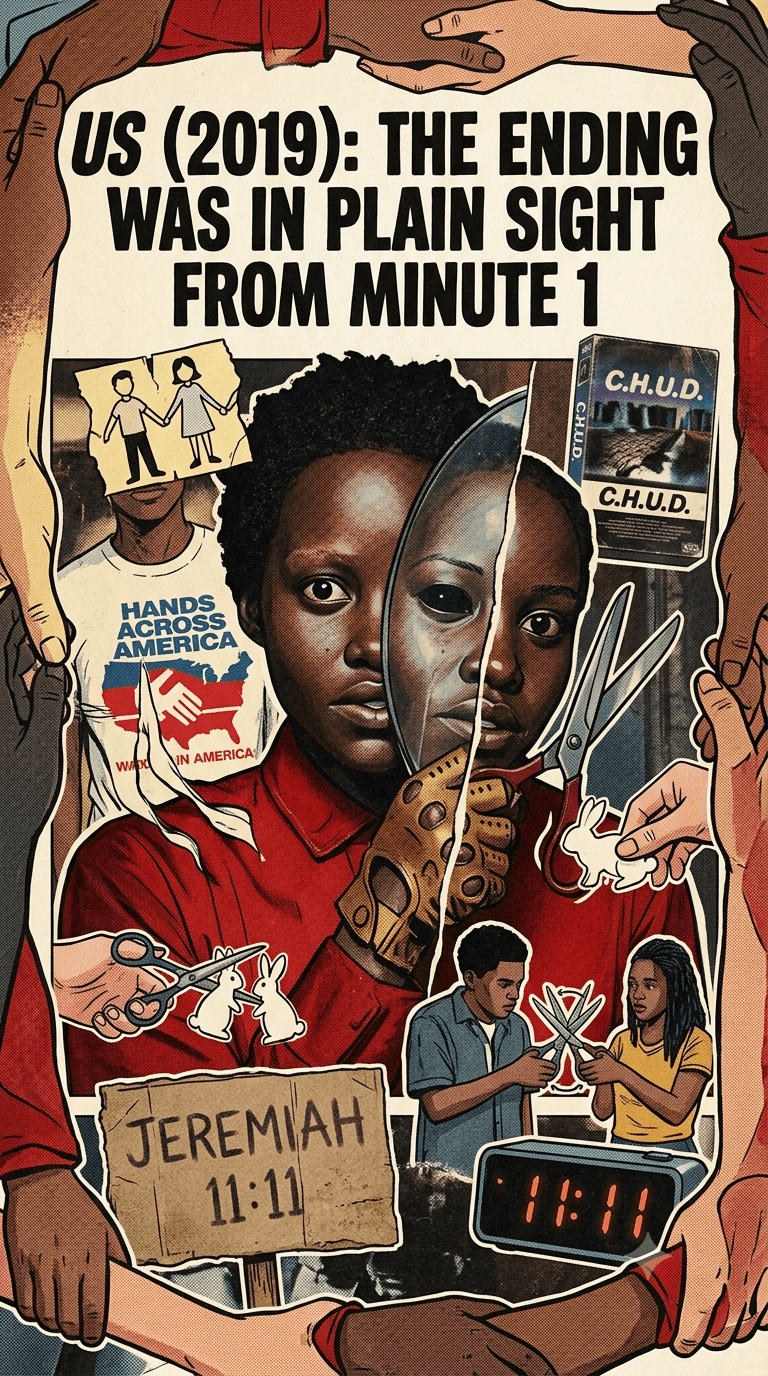
Go back to the very first flashback image, before the bottle-toss booth, before anything else happens. Young Adelaide is standing on the boardwalk in 1986 wearing a Hands Across America t-shirt.It’s not a detail the film introduces later as a symbol. It’s what she’s already dressed in when the scene starts — background wardrobe, the kind of thing a costume department picks without expecting anyone to freeze-frame it.The final shot of
Us is the literal event printed on that shirt: a human chain stretching coast to coast, except now it’s the Tethered holding hands instead of a Reagan-era publicity stunt. The film’s closing image sits on a nine-year-old’s chest in the opening scene, forty seconds before that same girl gets swapped for her double in a hall of mirrors.A film that plants a clue and cashes it in through dialogue is being clever. A film that plants its entire ending as unremarked-upon wardrobe is testing whether you’ll process it as information or scenery.
Us is a film about a class of people nobody looked at closely enough to notice living underneath them. It opens by running that same test on its own imagery.
“You Hid Your Eyes When the People Came Out the Ground”
Minutes later, in her new Michael Jackson’s
Thriller t-shirt, Adelaide’s parents have a clipped argument about whether the shirt is appropriate. Rayne tells Russell it better not give their daughter nightmares. Then she says the line that should stop a second viewing cold: “You hid your eyes when the people came out the ground.”She’s talking about the
Thriller music video, where the dead claw up out of graves to dance. On a first watch it’s a throwaway parenting beat. On a second watch, it’s the plot of the movie, spoken by a character who has no idea she’s describing it.People come out of the ground. Adelaide has already hidden her eyes from it once, on a television screen, months before she has to live through it in a hall of mirrors.
Rock Paper Scissors, Playing Itself
This is the one I’d bet against most readers catching even on a rewatch. It lasts four seconds and involves two characters who never appear again.While Adelaide walks past a homeless man holding a cardboard sign, two teenagers named Glen and Nancy are playing rock paper scissors nearby — and they keep landing on the same combination. Scissors, over and over. “That’s impossible,” one of them says. Neither of them is doing anything.The world around Adelaide has started to glitch, synchronizing itself against probability, seconds before she meets the person she’ll stay synchronized to for the rest of her life. Scissors aren’t incidental, either — it’s the weapon Red carries for the entire back half of the film. Two extras the script never revisits are quietly rehearsing the movie’s iconography in a beat almost nobody clocks.
“Get Lost.” “Find Yourself.”
The attraction Adelaide wanders into is called Shaman’s Vision Quest. Two signs flank the entrance, painted directly onto the facade: GET LOST and FIND YOURSELF.Read them as instructions instead of decoration and the whole attraction becomes a diagnosis. Adelaide does get lost — she never leaves the way she came in. And she finds herself, in the most literal sense a horror film has ever staged that phrase: she turns to face her own reflection and finds another girl’s head instead, one that doesn’t turn when she does.Most funhouse signage in horror is wallpaper. This is a thesis statement on painted plywood, betting you’ll read it as texture. I did, the first time.
Hidden Clues Inside the Wilson House
The Stick-Figure Family on the Car Window
When the Wilsons arrive at the beach house years later, the script frames the shot through the rear windshield, past a set of stick-figure family stickers — father, mother, daughter, son — before revealing the actual family inside the car.It’s the most generic image of a family America makes: four interchangeable stick figures sold in a pack at any auto parts store, standing in for any household that buys one. The film introduces the Wilsons through the same universal shorthand it later uses to justify the Tethered’s uprising — that any family, reduced to its outline, has an identical shape hiding somewhere behind it.
The Tape on the Shelf
This one isn’t in Peele’s script — it’s a production detail, confirmed by multiple outlets that covered the film’s design after release, so I’ll flag it as exactly that rather than pretend I found it in the pages.On a shelf of VHS tapes in young Adelaide’s bedroom sits a copy of
C.H.U.D. — the 1984 B-movie about mutated people living in the tunnels under New York, surfacing to kill. Peele has talked about the film with some real personal history attached to it; an early girlfriend’s father directed it.Whether or not you know that history, the tape sitting in the background of a child’s bedroom, years before that child gets pulled into a tunnel full of people who look exactly like her, is the genre’s own DNA sitting in plain view — doing the job a more anxious script would have handled with a line of dialogue instead.
Jeremiah 11:11, Twice
The homeless man on the boardwalk holds up a cardboard sign reading “Jeremiah 11:11” as young Adelaide walks past him, seconds before she enters the Vision Quest attraction. In full, the verse reads: “Behold, I will bring evil upon them, which they shall not be able to escape; and though they shall cry unto me, I will not hearken unto them.”No mercy, no escape, and — this matters — no one listening when the suffering finally does cry out. That’s not a vague warning. That’s a specific prophecy about exactly what happens to this family thirty-three years later, delivered by a man the film never explains and never needs to.The number returns once more in the Wilson boys’ bedroom, when Jason points at his digital alarm clock and shows Adelaide it reads 11:11. Two appearances, thirty years apart, both clocked by children, both dismissed by adults with better things to worry about. 11:11 is a palindrome — the same read forward or backward — which is the tidiest possible numeral for a story about two people who are, structurally, mirror images of the same person.
What the Rabbits Are Actually Doing
The first image after the title card is a rabbit’s eye in close-up. The camera pulls back to reveal cage after cage of them, stacked against a tiled wall — the food source keeping an entire underground population alive on raw meat, because nothing else grows down there.Peele has said in interviews that he thinks of the film as “a dark Easter of sorts,” and that the rabbits carry a rebirth reading on purpose: Red as a kind of messiah rising from the hole she was left in.I find that reading persuasive, and also slightly too generous to the film’s own comfort with it. Easter is a holiday about a resurrection that redeems something. What rises out of the ground in
Us doesn’t redeem anything — it replaces what was already there, and the film is honest enough in its final shot to leave that substitution sitting unresolved.The motif closes the way it opens. The white rabbit that hops out at Adelaide’s feet during the climax is the same animal, doing the same work, on the other side of the story — cute, docile-looking, and, in Peele’s own words, carrying “the brain of a sociopath” behind the eyes.
The Soundtrack Is Hiding Details Too
“I Got 5 On It” by Luniz plays straight and almost comic during a family car ride early on — the kind of scene that exists to establish ordinary before ordinary stops being available. Later, a slowed, warped version of the same track, credited as the Tethered Mix, scores the final fight between Adelaide and Red.Same song, same words, run through a different register — the way the film runs the same girl through two entirely different lives. The lyric itself is built around splitting something in half: an unequal transaction dressed up as friendship.Play that against a story where one girl got the surface and the other got the tunnel, and the song stops being a needle-drop. It starts being commentary the film trusted you to hear without a caption underneath it.
The Ballet Scene Hides the Film’s Biggest Clue
I covered Madeline Hollander’s choreography as craft in my review — the final fight cut against a twisted Nutcracker pas de deux. Here’s the detail underneath the craft, which is stranger than the craft itself.The film insists, structurally, that both girls are dancing to the exact same piece of music, in the same year, at what the editing implies is close to the same moment. One is on a lit stage in front of parents with a camcorder. The other is in a barracks hallway, in front of a silent audience of Tethered who have never seen a real performance in their lives.If you take the ending seriously — if the girl we’ve called Adelaide for two hours was actually born in the tunnels — then this cross-cut isn’t two people expressing two separate emotional states. It’s one relationship, split down the middle by an accident of childhood, both halves compelled toward the same music without choosing it independently.The film never explains this. It lets you notice, on your own schedule, that a soul “remains one, shared by two” isn’t a line Red invents late in the film. It’s a rule
Us has already been dramatizing in dance for eighty minutes before anyone says it out loud.
What Red’s Monologue Actually Confirms
I went back to the monologue itself rather than my memory of it. In Red’s own words: “I believe they figured out how to make a copy of the body, but not the soul. The soul remains one, shared by two. They created the Tethered so they could use them to control the ones above. Like puppets. But they failed, and they abandoned the Tethered. For generations the Tethered continued without direction. They all went mad down here. And then… there was us.”Read it slowly and it plays as a confession, delivered in the calm, procedural tone of someone reciting a case file. Somebody built a program, watched it fail, and walked away rather than shutting it down or fixing it — left thousands of people underground for generations because closing the file was cheaper than owning what they’d started.Nobody in this film is ever held accountable for that decision. No agency name appears, and no bureaucrat gets a face. The horror doesn’t have an office you can find and burn down, and that’s the most honest thing about it — the worst damage in this story belongs to whoever decided that abandoning a failed program was an acceptable way to close it.Red is furious at Adelaide for a theft that happened between two nine-year-olds who didn’t design any of it. The actual design — the copy without a soul, the abandonment without a plan — belongs to people the film doesn’t bother naming, because it already knows you won’t find them either.A film that tells you its ending in the first shot, then waits years for anyone to say so out loud, is measuring how long an audience will look at something before deciding it was decoration.
Us passed that test in
its original 2019 release, and most of us failed it — myself included. I didn’t catch the shirt either, not the first time, not the fifth.The evidence of who got left underground was never hidden. It was worn on t-shirts, painted on funhouse walls, sitting on a bedroom shelf next to a kid’s other tapes, written into a rigged game between two extras who don’t matter to the plot. If you want the deeper history that imagery is standing on, I dug through four thousand years of it in my
piece on the doppelgänger folklore behind Us. Peele’s other film runs the same trick with different props — I broke that one down in
my piece on what Get Out hides in plain sight.
Frequently Asked Questions
What are the Us 2019 hidden details you missed on first watch?
The biggest ones include young Adelaide already wearing a Hands Across America t-shirt before the swap happens, a rigged game of rock paper scissors near the Vision Quest entrance, a C.H.U.D. VHS tape in her bedroom, the “Jeremiah 11:11” sign, and a digital clock reading 11:11 years later.
What does the Hands Across America shirt mean in Us?
Young Adelaide wears the shirt in the film’s very first flashback scene, before any of the night’s events happen. The final shot of the movie recreates the event printed on that shirt with the Tethered instead of real participants, meaning the ending is visible on her chest from minute one.
What is the significance of 11:11 in Us?
The number appears on a homeless man’s “Jeremiah 11:11” sign in 1986 and again on a bedroom clock decades later. The verse warns of evil that can’t be escaped and cries that go unheard, and 11:11 itself is a palindrome — a fitting number for a story about mirrored selves.
What does Red’s monologue reveal about the Tethered’s origin?
Red explains that an unnamed program created the Tethered to copy the body but not the soul, intending to use them as puppets to control people above ground. The program failed and abandoned the Tethered underground for generations without direction, food, or oversight.