Us (2019) Review: Jordan Peele’s Sophomore Horror, Explained
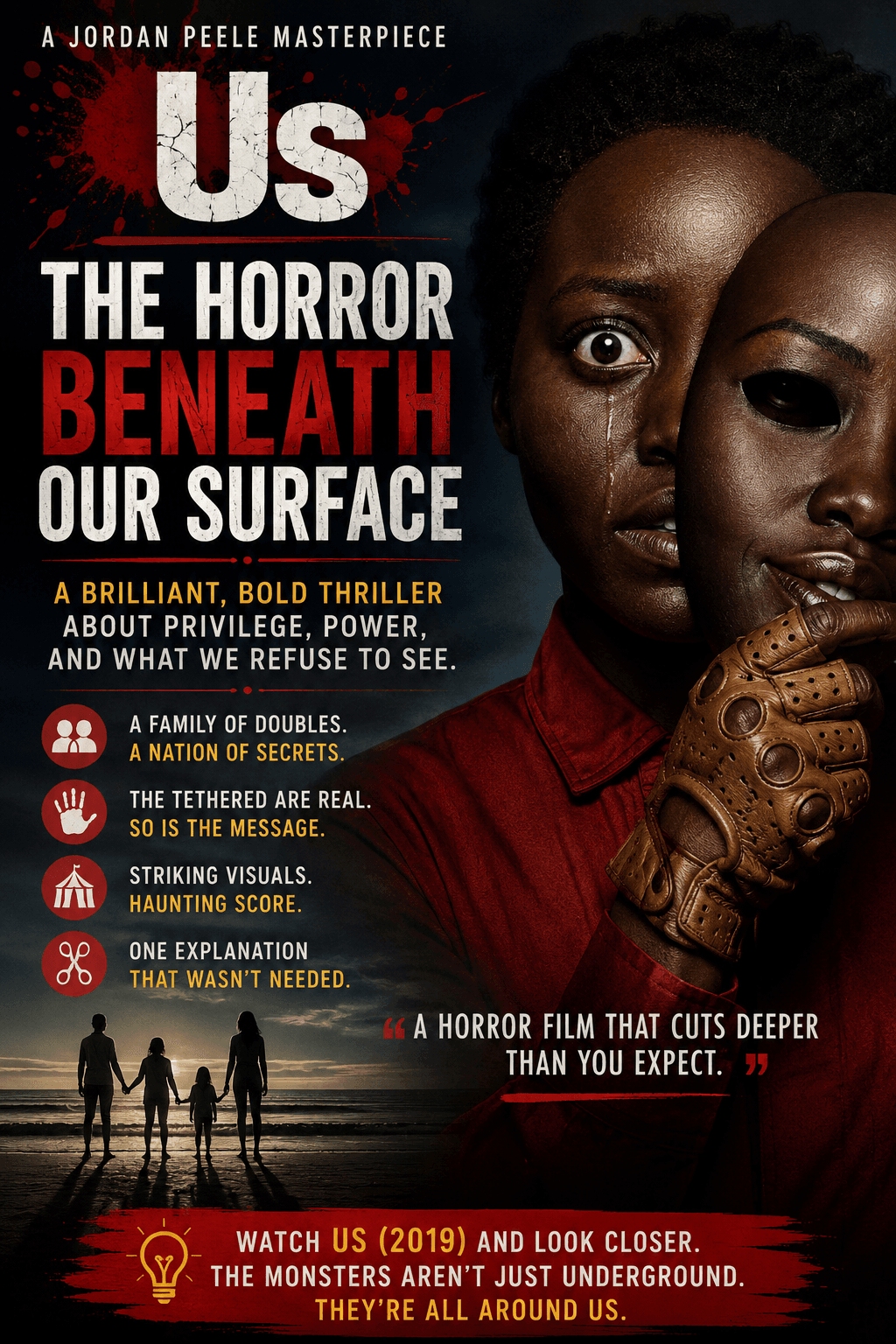
Us (2019) review, short version: Jordan Peele’s sophomore horror film is ambitious, formally daring, and carried by a Lupita Nyong’o performance that ranks among the best physical acting horror cinema has produced this decade.
It’s held back by exactly one decision — a third-act monologue that explains a mythology the film had already proven it didn’t need explained. That’s the verdict. Here’s how I got to it.
My father taught me how to fix a leaking faucet over the phone. I was maybe twenty-one, in my first apartment, and the pipe under the sink had started weeping onto the cabinet floor.
He walked me through it from four hundred miles away — shut off the valve, pull the cartridge, look for the worn washer, don’t overtighten going back in. He couldn’t see my hands. He couldn’t see the pipe. He talked, and I did what the voice told me, and it worked.
That was the last real conversation I had with him. He died a few weeks later, on an icy stretch of Ohio highway, on his way to a job site before sunrise.
I have fixed every leaking faucet since without calling a plumber. His voice is still in there somewhere, running the sequence.
I bring this up because Us opens on a fact I didn’t know until I looked it up: there are thousands of miles of tunnels under this country, abandoned subways, disused mine shafts, service routes nobody maps anymore.
Jordan Peele’s film is built on the idea that something underneath is quietly determining what happens on the surface, and that the people living the surface life have no idea they’re being directed. I understood that premise on a level the film didn’t intend. I’ve been taking instructions from someone I can’t see for sixteen years.
Us (2019) Review: What the Film Is Actually Doing
This is the film where Peele stopped being a promising first-timer and became someone whose second movie you had to take as seriously as the debut. Get Out was a scalpel.
Us is a much stranger, much bigger, much less disciplined instrument — and I mean that as a compliment more often than a complaint. It opened to roughly $70 million on its first weekend, the biggest debut an original horror film has ever had, and it earns most of that.
The Wilson family arrives at a beach house for summer vacation and is attacked that night by four red-jumpsuited doubles of themselves, and Adelaide recognizes something the rest of the family doesn’t yet.
The Class Argument Hiding Inside Us (2019)
Under the home-invasion mechanics, this is a film about the story America tells itself regarding who deserves what. The Tethered are a government project, abandoned once it failed, left to live underground for generations while their surface counterparts got sunlight, ballet lessons, birthday boat rides.
Peele has said the film’s engine is close to a single idea: a country built on collective privilege tends to assume that privilege was earned, when for one person to have something, someone else usually goes without it. He doesn’t put that sentence in anyone’s mouth. He puts a family of doubles in your driveway instead.
The Hands Across America framing is where that argument gets its teeth. The 1986 event was real — a human chain meant to symbolically address hunger by holding hands across the continent, Reagan-era optimism translated into a single gesture that made everyone who participated feel useful without changing anything structural.
Red spends decades planning a second version of it, enacted by an underclass the country built and then forgot existed. It’s the kind of horror I keep coming back to on this site — bureaucracies and institutions that were supposed to help someone and simply stopped, the way the Warren case files show an institution failing long before anyone takes a priest’s word seriously.
Red’s Antagonist Logic
Red is dangerous specifically because she isn’t a monster in the traditional sense — she’s a person with a coherent, internally consistent grievance who chose violence as its expression. That’s a harder thing to sit with than a demon.
I felt something similar watching Curry Barker’s Obsession last year: the villain you can’t dismiss is always the one who’s recognizable.
The Craft Behind Us (2019)
Mike Gioulakis’s Cinematography
Every actor in Us is playing two roles against themselves — Nyong’o, Winston Duke, Shahadi Wright Joseph, Evan Alex, all doubled, all sharing frames with versions of their own performance. Mike Gioulakis shot most of it on a single camera, refusing the kind of split-screen trickery that would announce the effects work happening underneath every scene.
The result holds together because the space never breaks; you never catch the seam where one performance ends and its double begins.
Michael Abels’s Score
A children’s choir hums under the title card before a single character has appeared on screen — a chant in an invented language, melodic, completely wrong. The track is called “Anthem.”
Abels has said he wanted it to sound like an evil march, something announcing that a group of people with unclear intentions was organizing and coming closer. The lyrics stay nonsense on purpose.
Peele wanted the audience to feel the coordination without understanding it, and that’s exactly what the choir does — your ear keeps reaching for a source it can’t find.
Nicholas Monsour’s Editing
Nicholas Monsour cut the film, and the choice that says the most isn’t a single transition — it’s the rhythm of the home-invasion sequence, which never lets a scare settle into comfort before the next one arrives.
The one moment of real formal ambition in the whole edit comes during the final confrontation, when the fight between Adelaide and Red is intercut with a twisted pas de deux from The Nutcracker, choreographed by Madeline Hollander and danced by Ashley McKoy in both roles. Two versions of the same girl, same music, one shaped by a family and the other shaped by nothing at all.
Us (2019) Review: The Performances
Lupita Nyong’o as Adelaide and Red
Nyong’o is doing two performances here and neither is a lesser draft of the other. Adelaide moves like someone who spent thirty years teaching her body caution.
Red moves like something learning, from underground, to imitate a person it’s only ever observed from a distance, and never quite landing the calibration. Nyong’o built Red’s voice around spasmodic dysphonia, a real neurological condition that causes involuntary spasms in the larynx — she met with people who live with it.
The result is a voice that sounds like it’s never been allowed to work the way a voice is supposed to, which is exactly what Red is: a body that’s been used, finally speaking for itself.
Winston Duke as Gabe
Duke gets the quieter job. Gabe starts the film as an archetype I’ve never had much patience for — the well-meaning, slightly incompetent husband whose boat won’t start, whose jokes land wrong, who gets talked over by his own kids.
Horror leans on that man constantly because he’s easy to write and easier to kill. Peele sets Gabe up as exactly that figure and then, alone on the water with a bat and a garbage bag and a doppelganger who wants him dead, lets him become something else.
Duke plays that turn as something Gabe is discovering about himself in real time, not a twist the script springs on the audience.
Us (2019) Review: Where the Film Loses Its Nerve
Late in the film, Red — cornered, finally alone with Adelaide — delivers a monologue that walks through the entire mythology of the Tethered: what they are, why they were made, why the plan took the shape it did.
I understand why it’s there for a viewer who needs the mechanics spelled out. I still think it’s the film’s weakest four minutes. The best horror films I’ve championed on this site refuse to over-explain themselves, because ambiguity is what keeps a film alive in your head after the credits.
Us spends ninety minutes trusting its audience completely and then, briefly, stops trusting them.
Some critics have picked at the mechanics underneath all this — how the Tethered coordinated a nationwide uprising with no visible communication, how a population that’s apparently eaten raw rabbit for forty years stayed physically capable of a hand-in-hand chain spanning a continent.
Those questions are fair. I don’t think they matter much, because Us was never built to be a procedurally sound thriller. It’s built to be a fever, and on that measure it mostly succeeds.
The Ending of Us (2019), Explained
The film recovers from the monologue with its final image: the reveal that Adelaide herself was swapped as a child, that the woman we’ve spent two hours rooting for is the Tethered one, and Red, dying underground, was the original girl all along.
That’s the kind of twist I respect — a retroactive reframing, the same mechanism I keep pointing to in Midsommar’s ending, that sends you back through everything you already watched with new eyes rather than just surprising you once and evaporating.
The ballet recital becomes a girl who clawed her way into someone else’s life and then earned it, loving her own children exactly the way any biological mother would. The film leaves that discomfort sitting there. It doesn’t try to talk you out of it.
I think about my father’s voice on that phone call more than I’d admit to most people. Not the exact words — I don’t actually remember those anymore — just the sequence of actions they produced.
What I remember is that he couldn’t see what I was doing and I did it anyway, because the instruction carried enough authority that checking felt unnecessary.
Watching Us, I kept thinking about how the Tethered move when they mirror their surface counterparts: unbroken, blind synchrony, one body executing what another body, somewhere else, decided to do.
My father has been dead for sixteen years and I still fix faucets exactly the way he told me to, in the dark, under a sink he never saw, because some connections outlive the person on the other end of them.
Score: 8.4/10 — Nyong’o alone is worth the price of admission. The classroom monologue is the only place the film flinches, explaining a mythology it had already proven, for ninety minutes, that it didn’t need to explain.
Frequently Asked Questions
What is Us (2019) about?
Us follows the Wilson family, vacationing at a beach house, who are attacked by exact doubles of themselves called the Tethered. Underneath the home invasion, the film is about privilege, complicity, and a government experiment abandoned underground for generations.
Who plays Red in Us (2019)?
Lupita Nyong’o plays both Adelaide Wilson and her double, Red, building Red’s damaged, rarely-used voice on research into spasmodic dysphonia, a real neurological condition affecting the larynx.
Is the ending of Us (2019) confusing?
The ending reveals Adelaide was swapped with her Tethered double as a child. It’s meant to be a retroactive reframing rather than a puzzle with one clean solution — the confusion some viewers feel is closer to the intended effect than a flaw.
What does this Us (2019) review say about the ending?
This Us (2019) review argues the ending’s twin-swap twist is the film’s strongest device — it recontextualizes everything before it — but that the classroom monologue just before it over-explains a mythology the film had already earned the right to leave ambiguous.