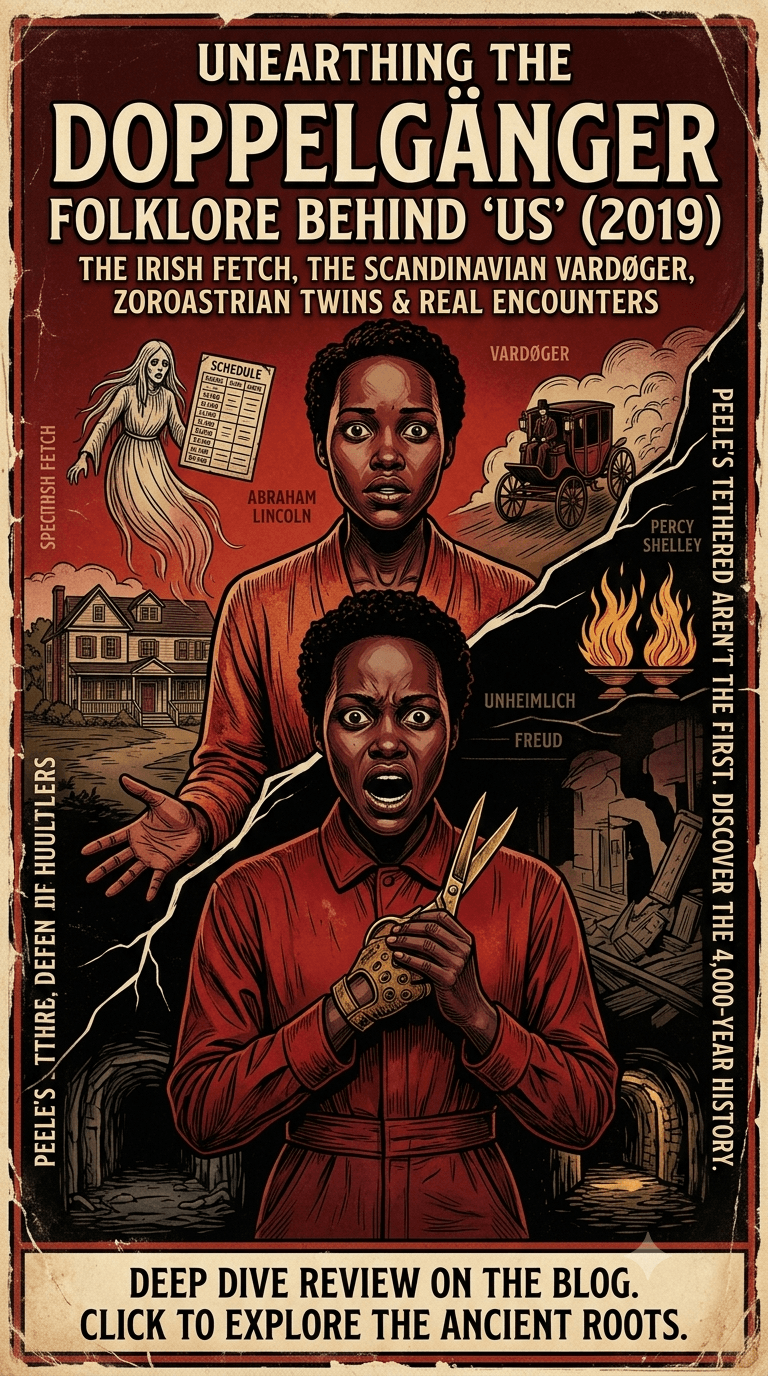
The doppelgänger folklore behind Us (2019) is centuries older than Jordan Peele’s film — built out of the Irish fetch, the Scandinavian vardøger, Zoroastrian twin-spirit cosmology, and a string of documented “double” sightings tied to Abraham Lincoln, Percy Shelley, and Guy de Maupassant. Peele has said the concept traces back to a Twilight Zone episode called “Mirror Image” and to his own lifelong fear of seeing another version of himself smile back. That’s the tradition Us is standing on top of, whether the average viewer clocks it or not.
My father framed houses for thirty years, and there’s a thing he told me once that I’ve never known what to do with until now.
You can’t see it once the drywall goes up. Doesn’t matter. Has to be right.
He took me to a job site when I was nine. A half-built house on a lot outside town, studs up, nothing hidden yet. He walked me along a wall and made me look at how the studs lined up, sixteen inches on center, plumb, square, load calculated down to the stud. I asked him why it mattered so much if nobody would ever see it. That’s when he said it.
I was nine. I thought he was talking about houses. He was talking about the thing underneath the thing — the structure nobody inspects because the wall goes up and everybody just trusts it. Us is a film about exactly that question: what happens when the thing behind the wall was never inspected, never plumb, never right, and it’s been standing there load-bearing your entire life. My position, up front: most of the coverage of Us skips past four thousand years of history to call the doppelgänger Peele’s invention. I want to spend this piece on the history he actually inherited.
A lot of Us think-pieces treat the Tethered as a blank metaphor Peele invented to talk about class and stop there, as if the imagery could just as easily have been masks, or clones, or aliens. Every image in this film — the mirrored movements, the identical faces, the sense that something has been quietly living your life in a version slightly worse than the one you got — comes from a specific, ancient, well-documented human fear that predates the concept of class entirely.
The folklore reading and the class reading reinforce each other: the class argument lands as hard as it does because Peele built it on top of a fear that was already fully loaded before he got there.
What “Doppelgänger” Means, and Where Us (2019) Got the Idea
The word “doppelgänger” is younger than you’d think for something this old. German writer Jean Paul coined it in 1796, in his novel “Siebenkäs” — literally “double-goer.” He had already circled the idea a year earlier, in “Hesperus” (1795), but “Siebenkäs” is where the actual word first appears in print. English absorbed the word in the 1850s. Germanic folklore had already spent the better part of a century treating a person’s exact duplicate as an omen of death before the term even existed to describe it.
Jordan Peele didn’t need the German word to find the fear. He’s pointed to The Twilight Zone episode “Mirror Image” — a 1960 episode where a woman becomes convinced her double is trying to replace her — as the spark. In his own words: “It’s terrifying, beautiful, really elegant storytelling, and it opens up a world. It opens up your imagination.” He’s also described visions of his own doppelgänger from his college years at Sarah Lawrence, and a childhood fear of seeing another version of himself smile back.
The Ancient Roots of the Doppelgänger Folklore Behind Us
The earliest versions of this fear treat doubling as a property of the whole universe. Humans just happened to be included in the pattern.
Zoroastrian Twin Spirits and the Logic of Two
Go back far enough and doubling stops being folklore and becomes cosmology. Zoroastrian thought, fifth century BCE and earlier in ancient Persia, names two spirits — Spenta Mainyu and Angra Mainyu, truth and the lie — as twins born from Ahura Mazda, one choosing truth, light, and life, the other choosing deceit, darkness, and death. Zurvanite theology pushed the idea further, making the pair equal-but-opposite sons of Zurvan, primordial Time itself, so that neither twin outranks the other. The universe runs on a doubling principle in this reading. Good and evil arrive paired, and neither one makes sense without the other standing across from it.
Gilgamesh and Enkidu: The First Double in Literature
The Epic of Gilgamesh, something like 2100 BCE, gives us the oldest story we have in writing, and it already contains a version of this. Enkidu is a counterpart, built by the gods specifically to equal Gilgamesh, to check him, to be what Gilgamesh needs so badly that his absence drives the entire second half of the epic. The double, from the beginning of storytelling, exists because a person alone is somehow insufficient — someone else has to be built to complete the account.
Enkidu doesn’t survive the epic. He’s cursed by the gods for a transgression that’s arguably as much Gilgamesh’s fault as his own, sickens over twelve days, and dies while Gilgamesh watches, unable to do anything but catalogue the changes in his friend’s face as it happens. Gilgamesh spends the rest of the poem trying to reverse death itself, because losing his double turned out to hurt more than he had any framework for.
Sit with that for a second. It’s the exact shape of the Tethered: created, necessary, built to complete something, and abandoned the moment they stopped being useful.
The Doppelgänger in Gothic Literature: Poe, Dostoevsky, and the Self That Replaces You
By the nineteenth century, the doppelgänger had migrated from folk belief into fiction, and fiction made it worse. Edgar Allan Poe’s “William Wilson,” published in 1839, gives us a narrator stalked from childhood by another boy who shares his exact name, face, and voice, and who shows up at every moment of moral weakness to stop him. The narrator spends the story trying to outrun his own conscience wearing a human shape. At the end he stabs the double and discovers, in the story’s final line, that he has killed himself.
Seven years later, Fyodor Dostoevsky published “The Double,” about a minor government clerk named Golyadkin who watches a man identical to himself walk into his office, take his job, charm his colleagues, and slowly replace him in his own life while nobody else seems to notice the substitution happening at all. Golyadkin ends the story being carried off to an asylum, and Dostoevsky never fully resolves whether any of it happened outside Golyadkin’s collapsing mind.
Both stories do something the older folklore hadn’t quite done yet: they turn the double into a competitor. Poe’s double punishes; Dostoevsky’s double promotes itself. That shift — from fate to ambition, from something that happens to you to something that wants your seat — is the exact hinge Us swings on. The Tethered don’t want to warn Adelaide. They want her house.
The lineage didn’t stop with Poe and Dostoevsky. Twentieth-century cinema kept returning to the same wound, usually by way of literal twins standing in for a fractured single self. David Cronenberg’s “Dead Ringers” (1988) casts Jeremy Irons as two identical gynecologists, Elliot and Beverly Mantle, whose merged identity collapses once a woman comes between them. Cronenberg’s camera treats the two brothers as a single organism slowly tearing itself apart — the folklore’s grandchild, dressed up in surgical steel instead of graveclothes.
The Doppelgänger in European Folklore: The Fetch and the Vardøger
Move west and north across Europe and the double stops being cosmology and starts showing up somewhere much closer to home — literally, since these traditions treat it as something that appears at your own front door.
The Irish Fetch: An Omen With a Schedule
The Irish “fetch” is a doppelgänger with office hours. See your fetch in the morning and it’s good luck — long life, apparently, some cosmic paperwork filed correctly. See it at night and it’s a death omen; start writing your will. The same event, seeing your own double standing in a field or a doorway, gets an entirely different verdict depending on what the sun happens to be doing at the time. It’s paperwork wearing your face, deciding whether you got good news or a death sentence before you’d even seen the thing standing there.
The Vardøger: The Double That Arrives Early
The Scandinavian vardøger is polite by comparison, and somehow worse for it. The vardøger arrives ahead of schedule, doing your life before you get there — footsteps on the stairs, your voice in the hallway, your car in the driveway, all clocked minutes before you actually walk through the door. Nobody explains the overlap. Sit with that arrangement too long and it starts to feel crueler than a monster that at least wants something from you; the vardøger wants nothing, and still manages your Tuesday better than you do.
Real Doppelgänger Sightings That Preceded Real Deaths
Folklore turns into a body count with alarming regularity once you read the actual historical accounts — the same real-versus-mythologized question I dug into with the Warrens earlier this year. Three of the best-documented cases all end the same way.
Abraham Lincoln’s Mirror, 1860
The day after his first election, November 1860, Lincoln threw himself onto a sofa at home and looked into a bureau mirror across the room. He saw himself full-length, but with two faces.
Mary Todd Lincoln later confirmed the story; Lincoln himself recounted it to journalist Noah Brooks, who wrote it down years afterward, in 1864 by his own account, and eventually published it in his 1895 memoir “Washington in Lincoln’s Time.” John Hay, Lincoln’s private secretary, remembered the timing differently, placing the vision closer to Lincoln’s nomination. Nobody in the room disputed that Lincoln saw it. Lincoln kept it to himself for years before telling Brooks at all, which says something about how much it unsettled a man not otherwise known for superstition. Mary Todd read it as an omen: two terms, and death at the end of the second. She was right.
Percy Shelley’s Terrace, 1822
Weeks before Percy Shelley drowned in the Bay of Spezia, two separate people reported seeing his double. Shelley himself described a figure of himself meeting him on the terrace and asking a single question: “How long do you mean to be content?”
Separately, Jane Williams watched from a window as Shelley walked onto the terrace and vanished into a dead end — except Shelley was somewhere else in town at the time. Edward Trelawny, standing beside her at the window, saw nothing himself, which only made the account stranger to everyone who heard it secondhand. Mary Shelley wrote about her husband’s account in a letter to Maria Gisborne that August. He drowned on July 8, 1822, boat capsized in a storm.
Guy de Maupassant’s Ghostwriter, 1887
Maupassant’s account is the strangest of the three. His double allegedly walked into his study, sat down at his desk, and dictated a story to him; when Maupassant finished writing and stood up, the figure was gone.
The story became “Le Horla,” published in its final form in May 1887, about a man slowly erased from the inside by an invisible, superior presence he can’t see or fight. Maupassant attempted suicide in January 1892 and spent his final year confined to a private asylum, dying in 1893 of a syphilitic disease of the nervous system — nearly six years after he wrote the story his own double supposedly gave him. Contemporaries close to him treated the episode less as literary invention than as a symptom, one data point in a decline that had already started.
The Third Man Factor: When the Double Helps Instead of Warns
One doubling story in this piece breaks the body-count pattern. Sir Ernest Shackleton wrote in his 1919 memoir “South” that during the brutal final march across South Georgia’s mountains and glaciers in 1916, “it seemed to me often that we were four, not three.” He never named what the fourth presence was. T.S. Eliot borrowed the image directly for “The Waste Land” in 1922, and the phenomenon has carried a name ever since — the third man factor, documented since in mountaineers, solo sailors, and shipwreck survivors for over a century. This presence, unlike the fetch or the vardøger, shows up when a person is closest to dying and simply keeps them company.
A president, a poet, a novelist, and an explorer who needed the company more than the warning. Comfort is the detail most retellings of doubling folklore leave out entirely, in favor of the omens and the body count.
Freud, Otto Rank, and Why the Double Turns on You
Otto Rank, a student of Freud’s, published “Der Doppelgänger” in 1914, arguing that the doppelgänger figure across mythology works as a defense — a hedge against death, a second self the psyche builds specifically to insure against the extinction of the first. Freud picked this up five years later in his essay “The Uncanny” and framed it almost identically.
Freud’s word for all of this is unheimlich — usually translated “uncanny,” but literally the opposite of heimlich, the German word for familiar, homely, belonging to the house you grew up in. The double is unheimlich because it’s both at once: the most intimate thing you know, wearing the face of a stranger. That’s the whole marketing pitch for Us minus the marketing — a home invasion where the invader carries your own driver’s license photo.
And then Freud says the double curdles. What starts as insurance against death becomes an omen of it over time. The thing built to protect you from ending becomes the thing that announces your ending is near, and nobody updates the paperwork — it just flips on you while you’re not looking.
Read that line again next to the tunnel scene in Us. Think about what the government built the Tethered to be, and what they became once nobody was watching. That Freud essay sits next to this film on purpose. It’s framing lumber holding the whole structure up, the kind you’re not supposed to see once the walls go up.
How Us (2019) Rewrites the Doppelgänger Folklore It Borrows From
My review of Us covers the craft in detail — Mike Gioulakis’s cinematography, Michael Abels’s score, the performances. If you want the full argument about whether Us earns its reputation, that piece has it. This one stays underground, in the tunnels, with the folklore doing the load-bearing work nobody credits it for.
The fetch and the vardøger both treat the double as something that happens to you, an omen delivered by forces outside your control. Us moves that origin into a government basement — the Tethered are engineered, built as a control mechanism and then abandoned when the mechanism failed. That’s Peele’s real addition to four thousand years of doubling folklore: he makes the horror bureaucratic and man-made, not cosmic — and that switch is what makes it worse, because nobody can subpoena a vardøger.
The visual language backs this up. Red jumpsuits stand in for grave-shrouds; gold scissors for a scythe. Even Hands Across America — the real 1986 charity event the film borrows and warps into the Tethered’s final image — swaps cosmic fate for a bureaucratic gesture that had already failed once in real life before Peele repurposed it as nightmare fuel. Folklore gave people fetches and vardøgers to explain a feeling. Us gives people a supply chain.
I think this is where the film earns the most respect and also where it gets bravest, because Adelaide pays for this too. She clawed her way into someone else’s life, kept it, and spent decades being loved for a life she stole. Otto Rank’s insurance policy, collected on by force, never repaid.
That reframing is why Us rewards a second viewing more than almost any horror film released this decade. Every scene with Adelaide plays differently once you know the folklore logic underneath it: she’s the vardøger who arrived early and simply never left, footsteps on the stairs that turned out to be permanent.
There’s a version of this essay that stops at “the folklore made me realize the movie is smarter than I gave it credit for,” and I want to push past that, because smart isn’t actually the compliment people think it is. Smart is table stakes. What the folklore does, once you actually sit with it, is explain why the ending of Us works on audiences who can’t articulate why it’s working on them. Nobody needs to know what a vardøger is to feel the specific wrongness of Red’s dancing, that too-smooth, too-controlled quality that reads as “off” before the reveal gives you a reason.
Madeline Hollander’s movement work is drawing on the same instinctive human recognition that produced the fetch and the vardøger in the first place — something in the body that clocks a double before the conscious mind catches up.
That’s the actual argument of this piece, if I’m being honest about it instead of dressing it up as trivia. Peele didn’t need to teach his audience Zoroastrian cosmology or footnote Otto Rank for Us to land. The folklore is already inside people, sitting under thousands of years of drywall, and all a filmmaker has to do is knock on the right stud.
Frequently Asked Questions
Is the doppelgänger folklore in Us (2019) based on real mythology?
Yes. Us (2019) draws on centuries-old doppelgänger folklore, including the Irish fetch, the Scandinavian vardøger, and Zoroastrian twin-spirit cosmology, along with documented “double” sightings tied to Abraham Lincoln, Percy Shelley, and Guy de Maupassant. Jordan Peele has also cited the Twilight Zone episode “Mirror Image” as a direct inspiration for the film.
What does “doppelgänger” mean, and who coined the word?
“Doppelgänger” is German for “double-goer.” Writer Jean Paul coined the term in 1796 in his novel “Siebenkäs,” building on an idea he’d already explored a year earlier in “Hesperus.” The folklore itself predates the word by thousands of years — Zoroastrian twin-spirit cosmology and the Gilgamesh and Enkidu pairing both describe a version of doubling more than two thousand years earlier.
Are the Lincoln, Shelley, and Maupassant doppelgänger stories true?
They’re documented historical accounts, recorded by credible named witnesses close to each man. Lincoln’s mirror vision was written down by journalist Noah Brooks and confirmed by Mary Todd Lincoln. Shelley’s terrace encounter was described by Shelley himself and, separately, by Jane Williams. Maupassant’s account comes from his own circle. Read them as coincidence or omen — that part’s yours to decide.
What is the real doppelgänger folklore behind Us (2019)’s “Tethered”?
The Tethered echo doubling folklore where a double serves as an omen or a fated counterpart — the Irish fetch, the vardøger, and Freud’s theory that the double starts as protection against death and curdles into a warning of it. Peele’s specific addition is bureaucracy: a government built and then abandoned the Tethered, swapping cosmic fate for paperwork, and paperwork for a body count once the funding ran out.
I watched Us again for this piece, later than I meant to, and somewhere around the tunnel sequence I thought about my father again, and this time the houses had nothing to do with it.
I thought about every version of me that didn’t get the drywall — the ones who stayed in Ohio, the ones who didn’t leave when leaving cost something, the ones still down in whatever tunnel I built by getting out.
I don’t know what’s behind my own wall. Nobody does — that’s the whole design of the fetch, the vardøger, Maupassant’s houseguest at the writing desk. You just have to trust it was framed right, because you’re never going to see it. And if it wasn’t — if something down there got left out instead of insured against the dark the way Freud said doubles were supposed to be — you won’t find out until it starts walking toward you with your own hands and nothing left to lose.
My father never got to finish explaining the sentence past the wall he was pointing at. He died on ice on a road he’d driven four thousand times, the kind of day that seemed identical to every other day right up until it changed everything — its own private version of doppelgänger cruelty, if you think about it long enough. I have.
Has to be right. I still don’t know if mine is.