The people who search “movies like Midsommar” at midnight are looking for something specific. They’ve watched a film that did something to them they can’t entirely name — a film where the light was wrong and the community was warm and the horror accumulated so quietly they couldn’t pinpoint when it started. They want more of that. And they’ve understood, somewhere in the aftermath, that what they want is rare.Midsommar belongs to a tradition of horror where the danger is the host. Where warmth is the weapon. Where the pastoral setting is mechanism — structure deployed with the same precision as decoration. The community is the trap, and the trap looks like somewhere you’d want to belong. This is folk horror’s specific grammar, and it’s older than Midsommar and narrower than the label suggests. “Folk horror” gets applied to anything with flowers and paganism. What these films actually share is a formal logic: the outsider enters a closed world without the equipment to read it, and the system runs to completion regardless.If you’re here searching for movies like Midsommar because the film wrecked you and you need to understand why this kind of horror works on you, these five are the ones worth your time. Arranged from the most accessible entry point to the most formally demanding.
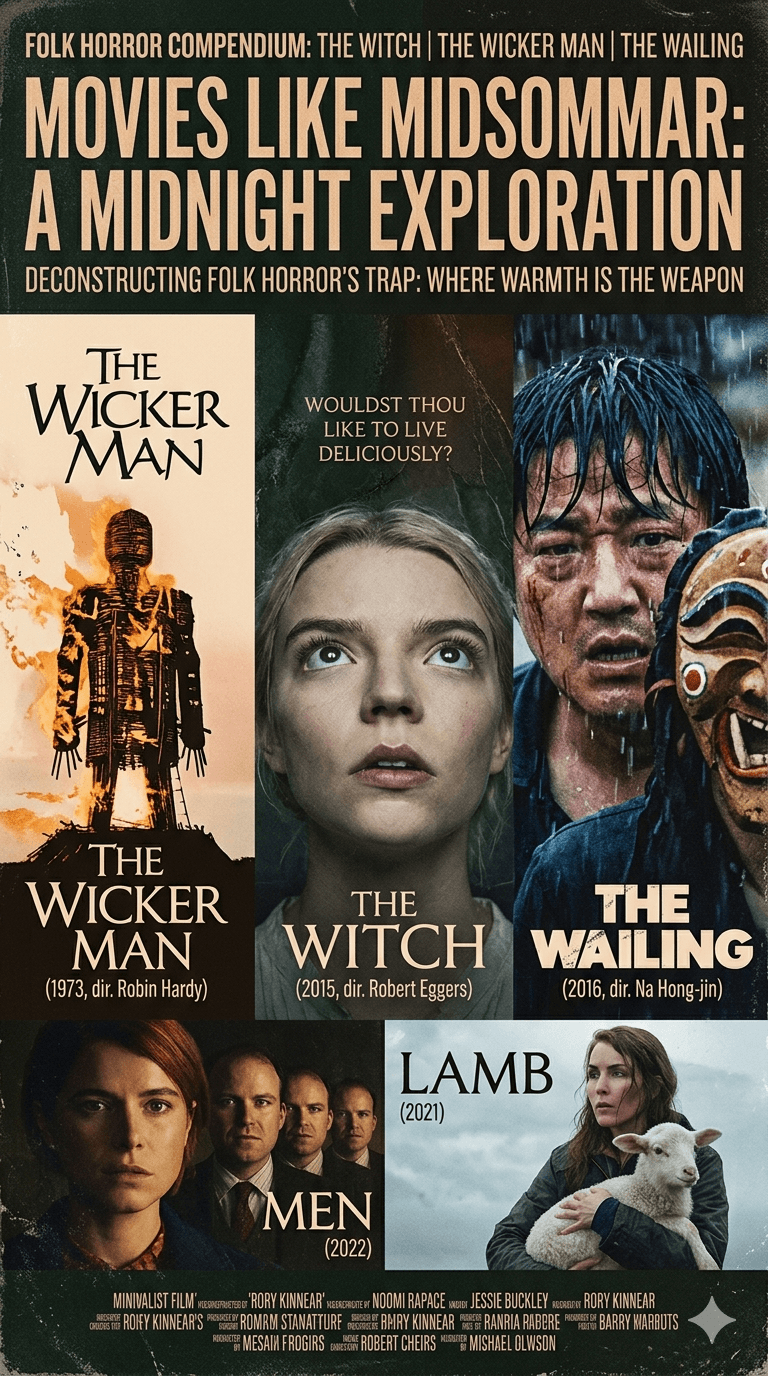
The Wicker Man (1973, dir. Robin Hardy)
Every conversation about movies like Midsommar starts here, and that’s because Robin Hardy’s film invented the template Aster is working within. That lineage is worth understanding before you decide folk horror is a contemporary invention.A Scottish island in summer. A pagan community. An uptight Christian policeman investigating a missing girl. The threat, when it arrives, is the completeness of the belief system — a world so fully realized and internally consistent that Howie, the investigator, has no framework to process what he’s encountering. He keeps applying the logic of his world to a place running on entirely different software. He does this until he can’t anymore.Christopher Lee’s Lord Summerisle is one of the great performances in horror history: gracious, educated, genuinely pleasant. The hospitality is structural, built into how the community functions across generations. There’s no gap between what Summerisle presents and what he is — that seamlessness is exactly what makes him frightening. He is precisely what he appears to be, and what he appears to be has no place for Howie in the long run.I’ll be direct about the pacing: by contemporary standards, The Wicker Man asks for patience. There are folk songs. There is dancing. There are rituals that read as community customs until you understand what they’re building toward. Some people stall in the middle. The ones who stay reach an ending that is among the most purely logical in horror history — by the time the horror is explicit, you’ve already understood the reasoning behind it, and you might find the reasoning almost defensible. Which is, in both The Wicker Man and Midsommar, the correct response to land on.Multiple versions of The Wicker Man exist. Watch the director’s cut.
The Witch (2015, dir. Robert Eggers)
Robert Eggers built his debut feature on one question: what if the Puritans were right? The witch in the woods is real. Everything that terrified 17th-century New England was accurate — and Eggers’ insight is that confirming these fears makes things no worse than they already were.A family expelled from their colonial settlement builds a farm at the edge of a forest. The isolation tightens. The youngest children are strange. The parents collapse against each other under the weight of a faith that delivers guilt more reliably than grace. Thomasin (Anya Taylor-Joy) watches from the position of the oldest daughter — old enough to see what’s happening, young enough to have no leverage within it.Eggers built the dialogue from period court records and diaries. The language creates an enclosed quality that is one of the film’s primary horror tools. These characters inhabit a belief system with no exits and no room for doubt, and that totalness is where the dread grows. The Hårga operate the same way — a world comprehensively built, internally consistent, with its own category of mercy that looks nothing like the one outsiders would recognize. This is why The Witch belongs on any list of movies like Midsommar: because the formal architecture is identical — a structural resemblance, not a visual one. Community as closed system. Internal logic as mechanism. The outsider who can’t find the seams.Thomasin’s final choice mirrors Dani’s. Both women accept what the horror is offering, with full understanding of the cost. Eggers, like Aster, refuses to tell you whether the choice was right.The Witch runs 92 minutes. It’s the most accessible film on this list.
Men (2022, dir. Alex Garland)
Alex Garland’s folk horror film arrived divisive and remains divisive. The divide maps onto something more interesting than whether the ending is good.Harper (Jessie Buckley) rents a house in the English countryside following her husband’s death — a death she can’t entirely separate from the confrontation they had before he fell. The film deliberately keeps the circumstances of that death unresolved, which matters for everything that follows. The village is pastoral and cooperative. The man who rents her the house is friendly. The priest is welcoming. The children are polite. Rory Kinnear plays every man in the village — different ages, different faces, same actor — a formal decision that some read as clumsy shorthand and others find correctly suffocating.Garland is working in a specific British tradition here. The English countryside has been doing this in horror since The Wicker Man — the pastoral as pressure rather than relief, the village that looks safe and keeps being subtly wrong. What Men adds to that tradition is a contemporary argument: the suffocation is specifically gendered. The pattern Harper encounters is the pattern of a particular kind of male behavior that presents as accommodating, shifts to aggrieved, and cycles back as if nothing happened. Kinnear playing every iteration of it isn’t metaphor. It’s anatomy.Buckley carries the film with a quality I’d describe as managed damage — someone performing the mechanics of recovery while something else runs underneath. It’s one of the finest performances in recent horror, and it’s doing most of the heavy lifting in scenes where Garland’s formal choices threaten to become too abstract for their own good. This is the one genuine weakness in Men: the film occasionally trusts its architecture more than its actors. In those moments, Buckley is the only thing keeping the emotional logic tethered.The ending is correct. A meaningful portion of the audience disagrees. Both positions are defensible, which is more than most horror films manage.
The Wailing (2016, dir. Na Hong-jin)
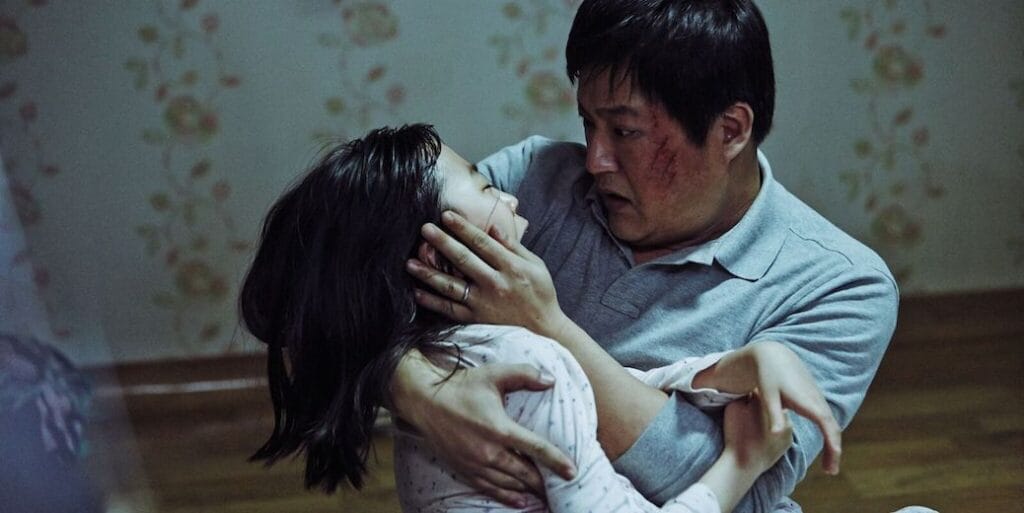
156 minutes. Korean. Make time for it.Na Hong-jin’s film is the one on this list that will take the longest to metabolize and leave the deepest mark. A stranger arrives in a rural South Korean village. Mysterious illness follows — villagers turning violent against their families without apparent motive. A local policeman named Jong-goo, already overwhelmed and not well-equipped for being overwhelmed, watches the situation expand beyond any framework he can apply to it.What The Wailing shares with movies like Midsommar isn’t primarily its folk horror setting. It’s the epistemological problem at the center of both films. Jong-goo is confronted with two incompatible truth systems — two frameworks that each fit the available evidence — and he has to choose one under pressure. He chooses wrong. What makes this devastating is the mechanism: he selects the framework that feels more familiar, more legible to him, and this is precisely why it fails. Midsommar does the same thing to Christian’s group. The Hårga’s ritual logic is entirely readable if you know how to read it. The outsiders simply don’t have the language.The third act contains a sequence where two competing rituals run simultaneously — a shamanic ceremony and a Christian exorcism — that is among the most formally accomplished passages in contemporary horror. The editing, the sound design, the cutting between spaces: it creates pressure that is almost physical. The ending refuses resolution. Some films earn that refusal. This one has earned it completely.If you’ve been sleeping on Korean horror, this is where to stop. The Wailing is available on IMDb for reference and most major streaming platforms depending on your region.
Lamb (2021, dir. Valdimar Jóhannsson)
Valdimar Jóhannsson’s debut feature is the strangest film on this list and the most formally patient. It’s also the loosest fit — I’ll admit that upfront — but the quality it shares with Midsommar is specific enough that it belongs here.An Icelandic sheep farm. A childless couple who find something unusual in a newborn lamb. They name her Ada. They raise her. They love her with a completeness the film presents without irony or commentary.What Ada is, exactly, the film declines to explain. This is the right decision.Noomi Rapace plays María with a stillness that carries the whole film — a woman who has received something she’d given up expecting, and who accepts what that requires of her with a certainty that is both moving and troubling. The Icelandic landscape does continuous structural work: vast, indifferent, and beautiful in the specific way that removes human scale from the frame entirely. When the film needs you to feel the weight of something larger than human desire, the landscape does it without dialogue.The formal connection to movies like Midsommar is this: both films demand you accept the internal logic of the world being shown, on the film’s terms, without a guide and without apology. The Hårga’s rituals make coherent sense once you accept their premises. Lamb makes the same demand for a different premise. The ending arrives from within the logic of that world — the only place it could arrive from — with a completeness that is, depending on how you’ve been watching, either devastating or simply correct.
FAQ: Movies Like Midsommar
What makes movies like Midsommar different from regular horror?
Four elements: folk horror logic, where the threat comes from the host community rather than an external monster; slow atmospheric dread over conventional scares; settings where beauty is doing structural work; and a central emotional framework — grief, isolation, fractured relationships — that the horror exploits. The films that hit hardest share all four. Every film on this list shares at least three.
Is The Wicker Man still worth watching in 2026?
Yes, without reservation. The 1973 original — not the 2006 Nicolas Cage remake, which is a separate and unwelcome conversation — holds up because it isn’t chasing contemporary horror rhythms. It’s building dread through accumulation, which is a more durable method than jump scares and ages accordingly. The director’s cut is the version worth watching.
Why isn’t Hereditary on this list of movies like Midsommar?
Because it’s covered at length elsewhere on this site. If you arrived here from the Midsommar review and haven’t read the Hereditary review, that’s your next stop. Two reviews, an ending explainer, and a hidden details piece — it has what it needs.
Is The Wailing subtitled?
Korean. Yes. If subtitles are a dealbreaker, you’re going to miss one of the finest horror films made in the last decade, and that seems like your problem more than mine.
Which of these movies like Midsommar is the closest match?
Men (2022) shares the most direct emotional DNA: grief-stricken female protagonist, beautiful pastoral setting with violence underneath, slow accumulation of dread, A24 sensibility. The Wicker Man shares the most structural DNA: pagan community as mechanism, summer as the context for the horror, an outsider who cannot read the rules. Both are correct answers to different versions of the same question. Midsommar is one of the few films that generates both at once — which is why no single film on this list can fully replicate what it does, and expecting one to is probably the wrong expectation. The list above is the closest available approximation.