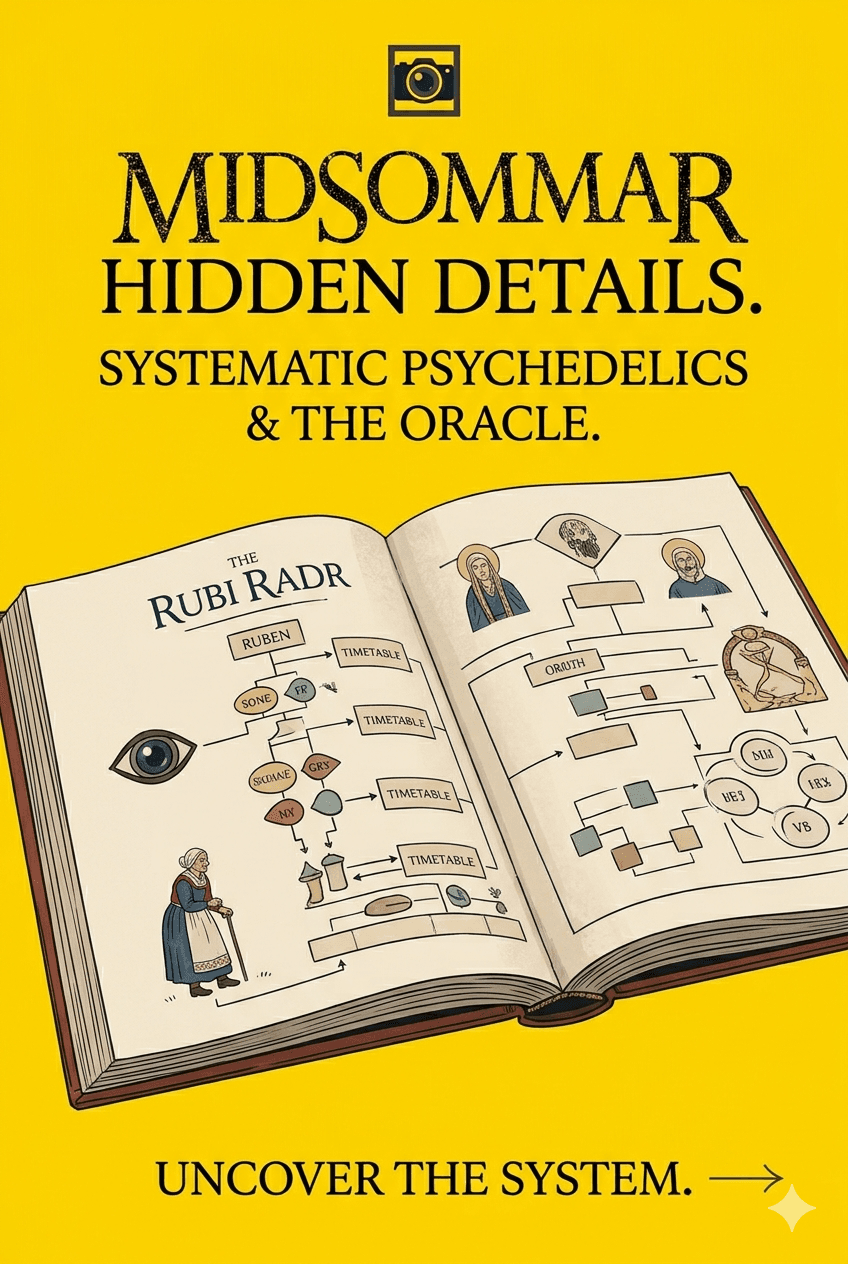
The first time you watch Midsommar (2019, dir. Ari Aster), you’re watching Dani survive. The second time, you realize the film was never structured around survival — it was structured around a process completing itself exactly as designed, on schedule, with no room for deviation. Every detail you registered as folk art, as background atmosphere, as decoration, was a blueprint.
Aster and production designer Henrik Svensson built a world that tells you precisely what is going to happen to these people. The problem is that the world looks beautiful. Beautiful things are difficult to read with the necessary suspicion on a first encounter.
Here are the Midsommar hidden details that survive the translation from decoration to evidence — and what each one means once you know how the film ends.
The Murals Are a Complete Schedule of the Film
1. The communal building of the Hårga is covered floor-to-ceiling in hand-painted murals depicting the full ritual cycle of the midsommar festival. On first watch, this reads as elaborate folk art — the kind of thing you’d expect from a community with deep traditions and a lot of free time. On rewatch, you recognize specific images: the ättestupa cliff ceremony, the mating ritual, the final fire. The sequence you’re about to witness is already on the walls when you arrive.
Aster and Svensson researched and constructed these murals with documentary precision. They function as a timeline — the complete sequence of events the film is about to show you, already painted on the walls. If you could pause and read every wall on your first watch, the film would tell you its own ending before the third act begins. Most viewers don’t pause. The camera doesn’t encourage it. The images are there to be seen and not seen simultaneously — which is exactly how the Hårga operate throughout. It’s the defining logic behind every Midsommar hidden detail the film plants.
Pelle Is Already Smiling in the Opening Scene
2. When Dani calls Christian in the film’s first minutes — panic in her voice, something wrong with her sister — Christian is with his friends in his apartment. Pelle is in the background. Pay attention to his expression when Christian takes the call.
I’ll be direct about this one: I’ve watched the scene several times and I’m still not entirely sure how much of what I’m reading is directorial intent and how much is projection. What’s there reads, on first watch, as ambient energy. On rewatch, it fits precisely with what we eventually learn about Pelle — that he selected Dani deliberately, that he brought her here knowing what her grief would be useful for. Whether Aster planted it or the film rewards the interpretation, the expression is on screen. Look at it knowing what you know, and decide for yourself.
Christian Steals Josh’s Thesis — and This Is His Most Revealing Scene
3. Josh is writing his anthropology thesis on the Hårga. He has been researching them specifically — this is his project, what he came to Sweden to document. When Josh mentions this to Christian in conversation, Christian immediately announces he wants to write about the same thing.
Most viewers clock this as minor character friction between two academic friends. It isn’t minor. It is the most precise description of Christian’s character in the entire film — he takes what belongs to someone else, without asking, and frames it as coincidence or parallel interest. The film has been showing you exactly who Christian is from the beginning. His treatment of Dani — keeping her around out of guilt and inertia while not actually choosing her — follows the same blueprint. The thesis scene states it plainly, in the first act, in front of everyone.
What Gets Added to Christian’s Food
4. This detail is more explicit in the director’s cut, but it’s present in the theatrical version if you’re watching closely enough. The Hårga girl Maja — who is clearly interested in Christian — has help from the community in what the film frames as traditional love magic: specific ingredients added to Christian’s food and drink to bind his attention to her.
In the director’s cut, pubic hair is observable being added to Christian’s food — on screen, in keeping with real European folk magic traditions involving bodily materials. What this does to your understanding of Christian’s behavior in the mating ritual shifts considerably once you know it’s in the food. He was being prepared as well as selected. The film leaves space for both to be true simultaneously, and the space is deliberate.
The Camera Inverts When You Arrive in Sweden
5. The sequence where the group drives into the Swedish countryside contains a camera move that most viewers process subconsciously and never consciously identify. The frame slowly rotates 180 degrees, showing the landscape upside down before righting itself.
Aster used this as a formal statement about what you’ve entered. The rules of the world you know no longer apply here. What the film has established as safety and threat is about to invert. The warmth you’re about to feel has been designed to feel like warmth. The move is the thesis of the film’s visual grammar, placed the moment you cross into Hårga territory — one watch to miss it, one rewatch to find it permanently. Of all the Midsommar hidden details, this is the one most purely about structure.
The Rubi Radr and the Ritual Logic of Midsommar
6. The Rubi Radr is the sacred text of the Hårga — a large illustrated book documenting the community’s complete ritual traditions. Josh photographs it against explicit instruction. His death follows.
What’s worth understanding is what Josh photographed: the complete logical framework for everything the film depicts. The midsommar rituals, the cycles, the rules governing sacrifice — it’s all in the text. Josh treated a living sacred document as research material, and the Hårga’s response was internally consistent with their own logic. The Rubi Radr is the most explicit instance of a pattern running through everything Aster built: the information is available. The horror belongs to people who didn’t know how to read it.
The Psychedelics Are Targeted, Not Ambient
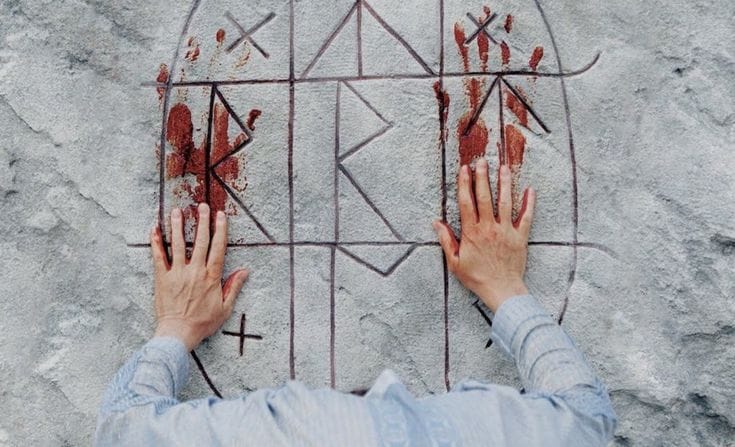
7. The Hårga administer psychedelics to the outsiders throughout the film — in tea, in food, at specific points in the ceremonial schedule. Most viewers read this as the commune’s general ritual substance use, incidental to the wider experience.
On rewatch, the administration is systematic. Outsiders receive psychedelics at specific moments calibrated to when psychological vulnerability is most useful to the ritual process. Dani’s visions during the maypole dance — which surface her grief about her dead family with particular precision — are the substance doing exactly what it was administered to do. The drug is a tool of the ritual. Dani wasn’t just experiencing altered perception. She was being opened to specific things, at a specific time, for a specific reason the community had already determined.
The May Queen Flowers Are Already Everywhere
8. The yellow flowers woven into Dani’s May Queen crown appear much earlier in the film’s visual language — in decorative elements, in the Hårga’s clothing, in the backgrounds of communal spaces. On first watch these read as folk decoration consistent with a community that takes its botanical traditions seriously.
This one I’ll present as an observation worth active verification on rewatch rather than a frame I can cite with precision from memory. What the Hårga’s visual world was constructed to establish is that Dani’s coronation was always prepared — that the crown was present in some form before she had any awareness of what was being organized. Watch for those flowers from the opening sequence. They were always her flowers. She just hadn’t been told yet.
What Being May Queen Actually Means Going Forward
9. The film makes a crucial distinction here: the Hårga celebrate midsommar every year. What happens once every ninety years is this specific purification ritual — the nine human sacrifices, the burning of the temple. Pelle says it plainly: “not quite like this one.” Dani is crowned May Queen at the conclusion of this ceremony. The nine required sacrifices have been made.
The ninety-year cycle means the next purification ritual is in 2109 — Dani will never witness it again. But the Hårga’s community life continues every year. Annual rituals, harvests, ceremonies. Dani isn’t waiting a century for anything. She is already inside the ongoing cycle, with no exit and no clock counting down. The film ends with her smile. It says nothing about what the morning looks like, or the morning after that. That gap is where the horror continues past the final frame — tomorrow, and every morning after that.
The Oracle Was Designed to Be Different
10. The community’s spiritual oracle — the child named Ruben, whose drawings carry prophetic authority within the Hårga — is the product of intentional inbreeding. The Hårga practice deliberate consanguineous reproduction to produce what they understand as heightened spiritual sensitivity. What most viewers register as developmental difference is, within the Hårga’s belief system, a designed condition: the price paid for prophetic capacity.
The film presents this without explanation and without editorializing. Understanding it doesn’t produce the kind of horror that the ättestupa produces. It produces something quieter and more systematic — the recognition that a community which deliberately creates children to suffer in service of a spiritual function is operating on a logic that extends considerably further than what the midsommar festival shows you directly. The nine sacrifices are the festival’s visible requirement. Ruben is the community’s ongoing one. Among the Midsommar hidden details in this film, Ruben is the one that most clearly establishes the scale of what the community is willing to maintain.
What the Second Watch Does to Midsommar
Hereditary’s second watch is about finding a hidden film inside the first one — the visual evidence that was always there, only readable in retrospect. The experience is discovery: there was a map, and you can now read it.
Midsommar’s second watch is something else. The beauty doesn’t recede. Pawel Pogorzelski’s overexposed summer light is still there, still golden, still pastoral. The communal meals still look warm. The communal spaces still look like somewhere a person could belong.
What changes is your understanding of what the beauty is for — and that shift is exactly what makes Midsommar hidden details worth cataloguing at all. The warmth was always the mechanism — the delivery system for something the film makes legible only once you know how it ends.
There is one more thing worth naming: the Midsommar hidden details are not scattered accidents of a dense production — they form a single argument. Each one encodes the same premise. The Hårga do not hide what they are. Their rituals are documented on their walls, in their books, in the flowers they wear and the expressions they carry into every frame. What they rely on, entirely, is the assumption that outsiders will not read the evidence correctly. Christian doesn’t read it. Josh reads it too late and too academically. Mark never reads it at all. Dani reads it last, at the point when reading it changes nothing — only confirms what has already been decided. The film’s architecture depends on that sequence. Every detail Aster and Svensson planted exists to demonstrate that the information was always available. The horror belongs to the people who didn’t know what they were looking at.
The first watch you register the beauty and the wrongness as two separate things. The second watch you understand they were always the same thing, and the summer light was the point of all of it. Every entry in this list of Midsommar hidden details functions that way: visible on first watch, legible only on the second.
For more on the film’s emotional architecture — why this is, at root, a breakup film that uses folk horror as its vehicle — read our full Midsommar review. And our Midsommar ending explained goes scene by scene through the ritual logic of the final act, including what Dani’s smile is actually doing.
If the architecture of the Hårga has you looking for more films built on the same logic, we’ve put together the essential movies like Midsommar — five films that work the same wound from different angles.
Midsommar Hidden Details — FAQ
What are the most important Midsommar hidden details?
Among all Midsommar hidden details, the murals in the Hårga’s communal building are the most structurally significant — they depict the complete midsommar ritual cycle, including the ättestupa and the fire ceremony, before either happens on screen. The love magic performed on Christian and the camera inversion on the group’s arrival in Sweden are the most visually verifiable details that most viewers miss entirely on first watch.
Did Aster deliberately plant these details?
The murals, the camera inversion, and the love magic are documented and intentional — Aster and production designer Henrik Svensson built the Hårga’s visual world with research-level precision. The Pelle opening scene detail sits between confirmed intent and productive interpretation; the expression is on screen, and what to make of it is partly the film’s choice to leave open. Aster tends to trust viewers to find things rather than announce them.
Does the director’s cut reveal more hidden details?
The director’s cut makes the love magic sequence significantly more legible — the preparation of Christian’s food is clearer in those additional minutes. For most other details — the murals, the camera inversion, Christian’s thesis theft, the oracle — the theatrical version contains everything. Worth noting: the theatrical cut is the stronger film. The extra twenty-four minutes clarify Christian’s moral culpability in the mating ritual, which removes the ambiguity that makes the ending more complicated than it would otherwise be.
What does Ruben represent in Midsommar?
Ruben is the Hårga’s oracle — the community’s spiritual seer, whose drawings carry prophetic authority within their tradition. Within the film’s internal logic, he is the product of intentional inbreeding, a practice the Hårga maintain to produce what they understand as heightened spiritual perception. The film presents this without comment. It is one of the details that most clearly establishes how far the community’s logic extends beyond the midsommar festival itself.
How many times should you watch Midsommar?
Twice at minimum, with some distance between watches. The first time you’re inside the experience. The second time you’re reading a completely different document that was always underneath the first one. If you find yourself pausing on murals and rewinding to the opening scene, that’s the film working as intended.