“
Longlegs” (2024), directed by Oz Perkins, is worth the ticket for its first two acts and falls apart in its third — a Nicolas Cage horror film with genuinely disciplined craft behind it and an ending that doesn’t earn what came before it. That’s the short version.The longer version starts with how it got sold: Neon mailed vinyl records to journalists, somebody built a cipher into the trailer that horror forums spent a full week cracking letter by letter, and a title card at the film’s start claiming it was “based on true events” turned out, on inspection, to describe nothing that happened to anyone. That’s the mood to hold onto walking in: a studio betting that dread can be manufactured before the projector even starts. Mostly, it worked.Audiences turned up in numbers no one expected from a film with this small a budget, and for a long stretch, the hype and the movie are in agreement.
Longlegs (2024) Review: Is It Worth Watching?
Oz Perkins has been circling this exact trick for three films now — “The Blackcoat’s Daughter,” “I Am the Pretty Thing That Lives in the House,” “Gretel & Hansel” — each one betting that atmosphere alone can carry a thin plot across the finish line. He’s the son of Anthony Perkins, who spent a career being unable to escape Norman Bates, and there’s a version of this review that spends a paragraph on inherited anxiety and generational horror lineage. Skip it.What matters is craft, and “Longlegs” is the first time Perkins has had the budget, the cast, and the discipline to make that trick actually land for two-thirds of a runtime.The setup borrows its skeleton wholesale from “The Silence of the Lambs” and “Se7en” — a rookie FBI agent with an unnervable gift for reading crime scenes, chasing a killer who signs coded letters and has evaded capture for decades — and Perkins knows exactly what he’s doing by borrowing it.He wants the audience settled into procedural-thriller autopilot, comfortable with the genre’s usual promises, before he starts swapping the wiring underneath, and the single detail he plants early and lets sit for the longest — that the killer, by the case file’s own physical evidence, was never actually present at any of his crime scenes — is the whole movie in miniature.Perkins has said in interviews that this was the point all along: lure the audience in on the promise of a Bureau procedural, then hand them an occult film with more in common with “Rosemary’s Baby” and “The Omen” than with anything Clarice Starling ever investigated.
The Cinematography and Score Behind Longlegs (2024)
What earns Longlegs its reputation, more than the script, is Andrés Arochi’s cinematography, which treats the 1970s prologue and the 1990s investigation as two different visual languages entirely. The opening sequence — a girl, a house, a man with an unnervingly long torso and a face like poured wax — is boxed into a claustrophobic 4:3 frame on 35mm, an homage to Harris Savides shot on Cooke lenses, subjects planted dead-center with the corners of the image warping around them.Once Longlegs jumps forward to Harker’s investigation, the frame widens to 2.39:1 on digital, and the effect isn’t relief — the wider frame gives the horror more room to hide in the negative space Arochi keeps deliberately empty. He’s said the goal was to make fear live behind the viewer’s back, and it’s the rare stated intention that actually shows up on screen: entire scenes play out with a third of the frame given over to nothing, daring your eye to check what’s standing in it.Zilgi’s score — the pseudonym under which Elvis Perkins, the director’s own brother, composed the film — does the same job with sound that Arochi does with space. It’s built from warped, foreboding synths that rarely resolve into a recognizable melody, functioning less as a musical cue than as sustained pressure under the scene, and it’s mixed low enough that the film’s silences register as their own instrument.Sound designer and editor Eugenio Battaglia gets credit for two tracks on the soundtrack album, and the collaboration between score and sound design is tight enough that it’s genuinely hard to tell, in the film’s tensest stretches, where one stops and the other starts. None of it would survive outside the theater as music worth choosing to hear again, and that’s exactly the point — it’s built to work only inside the scene it’s scoring.
The Performances: Cage, Monroe, and Witt in Longlegs (2024)
In Longlegs, Maika Monroe carries the investigation on a performance built almost entirely out of withholding. Harker enters every room like a small animal that’s already clocked the exits, all clipped answers and unreadable stillness, and Monroe plays her intuition — the film’s half-serious suggestion that she’s “half-psychic” — as a kind of low-grade exhaustion, something her body pays for every time she uses it.There’s a scene early on where a superior runs her through a number-guessing test meant to measure her instincts, and Monroe’s face during it does more storytelling than the dialogue around it: she’s somewhere else entirely, already listening for something the test can’t measure. It’s a performance that trusts silence to carry real weight, and for two acts, that trust is earned.Nicolas Cage, obviously, is the reason half the audience bought a ticket to Longlegs, and the film is smart enough to ration him.He’s barely on screen for the first hour, glimpsed mostly through crime-scene photographs and a single interrogation tape, and the makeup team — Felix Fox and Harlow Macfarlane, who spent two and a half hours a day transforming him — built a face like a wax figure left too close to a heater, barely human and unmistakably wrong, an explicit homage to Lon Chaney’s “Phantom of the Opera” filtered through decades of aging between the character’s 1970s and 1990s appearances.Cage has said he pulled from his late mother’s struggles with schizophrenia to find the character’s cadence, describing the voice as something that had “hijacked” the man underneath it, and that idea is legible in the performance: the sing-song delivery, the way his sentences trail off mid-thought like he’s listening to something else talk over him. It’s the rare Cage performance built on genuine strangeness, calibrated instead of loud, and it’s most effective specifically because the film hoards it.The film’s most interesting performance, though, belongs to Alicia Witt, playing Harker’s mother with a stillness that reads as devotion for most of the runtime and curdles, in retrospect, into the tenor of a hostage negotiation stretched across two decades. Witt has said she found the shoot the most cathartic experience of her career and has refused to watch the finished film because of what she had to access to play it, and none of that reads as actorly overstatement once you’ve seen what the role asks of her in its final stretch.She spends most of Longlegs as background texture — a worried mother on the other end of a phone call, invoking prayer, insisting no stranger ever visited their house — and Perkins uses that background placement as a structural weapon. By the time her actual function in the plot becomes clear, the film has spent ninety minutes training the audience to read her as harmless.
What Longlegs (2024) Is Really About
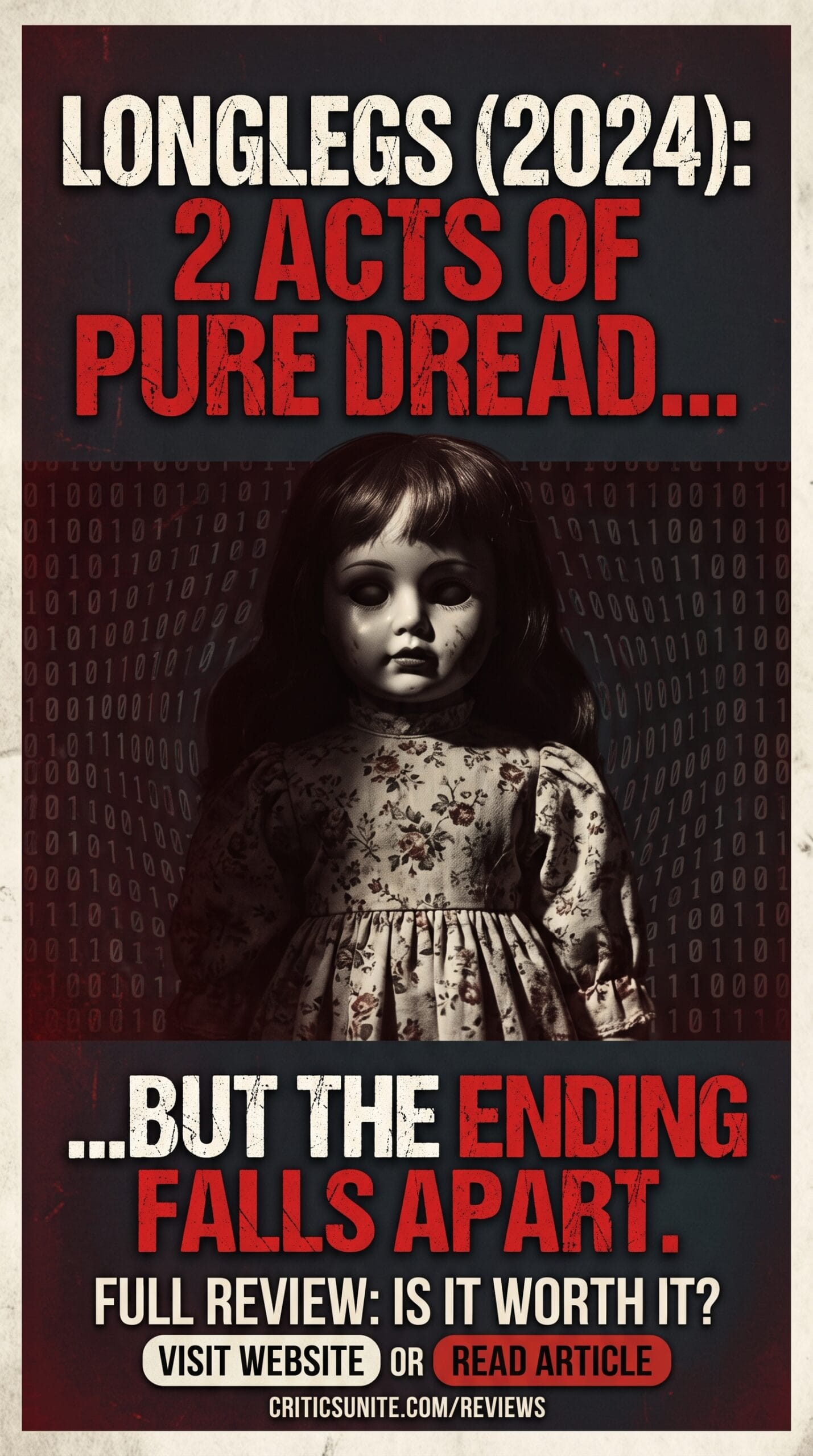
That function is where the Longlegs (2024) plot earns its genre swerve, and it’s a good one on paper: the killer never needs to enter a house because he was never the delivery mechanism to begin with. The dolls do that work, handmade and hollow-headed and left as “gifts from the church,” carried across thresholds by whichever ordinary, trusted person the household would let inside without a second thought — a mechanism that shares more with
how a handmade doll becomes a vessel than with any conventional slasher weapon.Harker’s mother turns out to be exactly that person, a former nurse who struck a bargain thirty years earlier to keep her own daughter alive, and who has spent every year since delivering those dolls to other families in her place. It’s an upsetting piece of design — the horror isn’t a monster breaking in, it’s a mother deciding, over and over, that someone else’s child is an acceptable trade for her own.Underneath the occult machinery, the actual subject here is a very old horror archetype getting a distinctly fresh angle: the mother who decides her own child’s survival justifies whatever gets done to somebody else’s. It’s the same structural nerve
Rosemary’s Baby hit fifty-six years earlier, a mother’s love repurposed as the delivery system for harm, except Perkins strips away Polanski’s ambiguity and shows the bargain being kept, decade after decade, in plain daylight.Ruth Harker made a calculation thirty years ago and has lived inside it ever since, long enough that morality became, for her, a closed question. The film sets its entire case in the early ’90s specifically to lean on that pre-digital, door-knocking, evidence-in-a-manila-folder period when institutions like the FBI moved on paper and instinct — the same procedural texture that made the Warrens’ era of
door-to-door occult investigation possible, and it’s a smart choice: an investigation this analog leaves room for a killer whose real weapon is a trusted, ordinary-looking woman nobody thought to run a background check on.
Where the Longlegs (2024) Ending Falls Apart
Where Longlegs (2024) loses its footing is the execution of that reveal, which arrives at a children’s birthday party staged with all the geographic clarity of a first draft. Characters wander in and out of a kitchen for a suspiciously long stretch of screen time; the tension the first two acts built through careful withholding gets spent on a climax that mostly consists of people standing in rooms insisting things are fine while the camera insists they aren’t.Cage, so carefully rationed for ninety minutes, is nearly absent from his own film’s ending, and the satanic cosmology the film has been hinting at — a doll with an empty hollow head somehow functioning as a conduit, a killer who calls himself a servant of “the man downstairs” — never gets pressure-tested past the level of atmosphere. Perkins wants the audience to feel the presence of something ancient and organized without ever having to explain its mechanics, and for a while that restraint plays as confidence.By the final scene, it plays as a film that built an extraordinary amount of dread and then didn’t know exactly where to put it down.
Longlegs (2024) Box Office and Critical Reception
The commercial numbers back up how well Longlegs (2024)’s first two acts landed. Neon spent under ten million dollars making this and pulled in a $22 million opening weekend, eventually clearing the $100 million mark worldwide and closing out the year as the highest-grossing independent release of 2024, a startling result for a film this strange and this quiet.Critics mostly agreed with the box office receipts — the film’s Rotten Tomatoes score has held around 86% across nearly three hundred reviews — but the audience score tells a different story, sitting closer to 65%, with opening-day crowds handing it a flat C+ CinemaScore. That gap is the whole marketing bet coming due: a campaign built on ciphers and mailed vinyl and a “based on true events” title card that doesn’t survive five minutes of fact-checking promised something the film’s actual ending wasn’t built to deliver, and a meaningful chunk of the audience noticed.
The Verdict on Longlegs (2024)
None of that erases what the film does well, and what it does well is considerable. This is a movie that understands atmosphere is a craft discipline — that a boxed-in aspect ratio and an unresolved synth line and a withheld performance can do more work than a script’s back half ever needs to. The audience score sitting well below the critical one tells its own story: a campaign promising the scariest thing anyone would ever see left plenty of ticket buyers owed a sturdier ending than the one they got.For a genre that spent the last decade arguing with itself about whether “elevated horror” means anything, “Longlegs” is a useful specimen: proof that formal control can carry an audience a long way on faith alone, and proof of exactly how far that faith runs out. Perkins clearly has a great film in him. This is three-quarters of one, shot and scored and performed by people operating at the top of their craft, attached to an ending that never figures out how to be as disciplined as everything that came before it.
Longlegs (2024) Review: Frequently Asked Questions
Longlegs (2024) Review in One Paragraph
Longlegs is a satanic-serial-killer thriller from director Oz Perkins, built on unsettling cinematography from Andrés Arochi, a warped score from Zilgi (Elvis Perkins), and committed performances from Maika Monroe, Nicolas Cage, and Alicia Witt. Its first two acts rank among 2024’s strongest horror filmmaking. Its climax, unfortunately, doesn’t carry the same control.
Is Longlegs Based on a True Story?
No. Despite an opening title card claiming the film is “based on true events,” Longlegs is entirely fictional. Director Oz Perkins has called the claim a marketing device, and no real FBI investigation, killer, or family-murder pattern resembling the plot has ever surfaced.
Why Does the Longlegs Ending Feel Rushed?
The final act compresses its biggest reveals — Ruth Harker’s true role, the birthday-party confrontation, and the fate of the doll network — into one chaotic sequence. After ninety minutes of deliberate, patient restraint, the ending trades that control for staging that prioritizes shock over the geographic and emotional clarity the rest of the film built.
Who Plays Longlegs in the 2024 Film?
Nicolas Cage plays Dale Ferdinand Kobble, the killer known as Longlegs. Cage drew on his late mother’s struggles with schizophrenia to shape the character’s voice, and makeup artists Felix Fox and Harlow Macfarlane spent roughly two and a half hours each shooting day transforming him into the role.