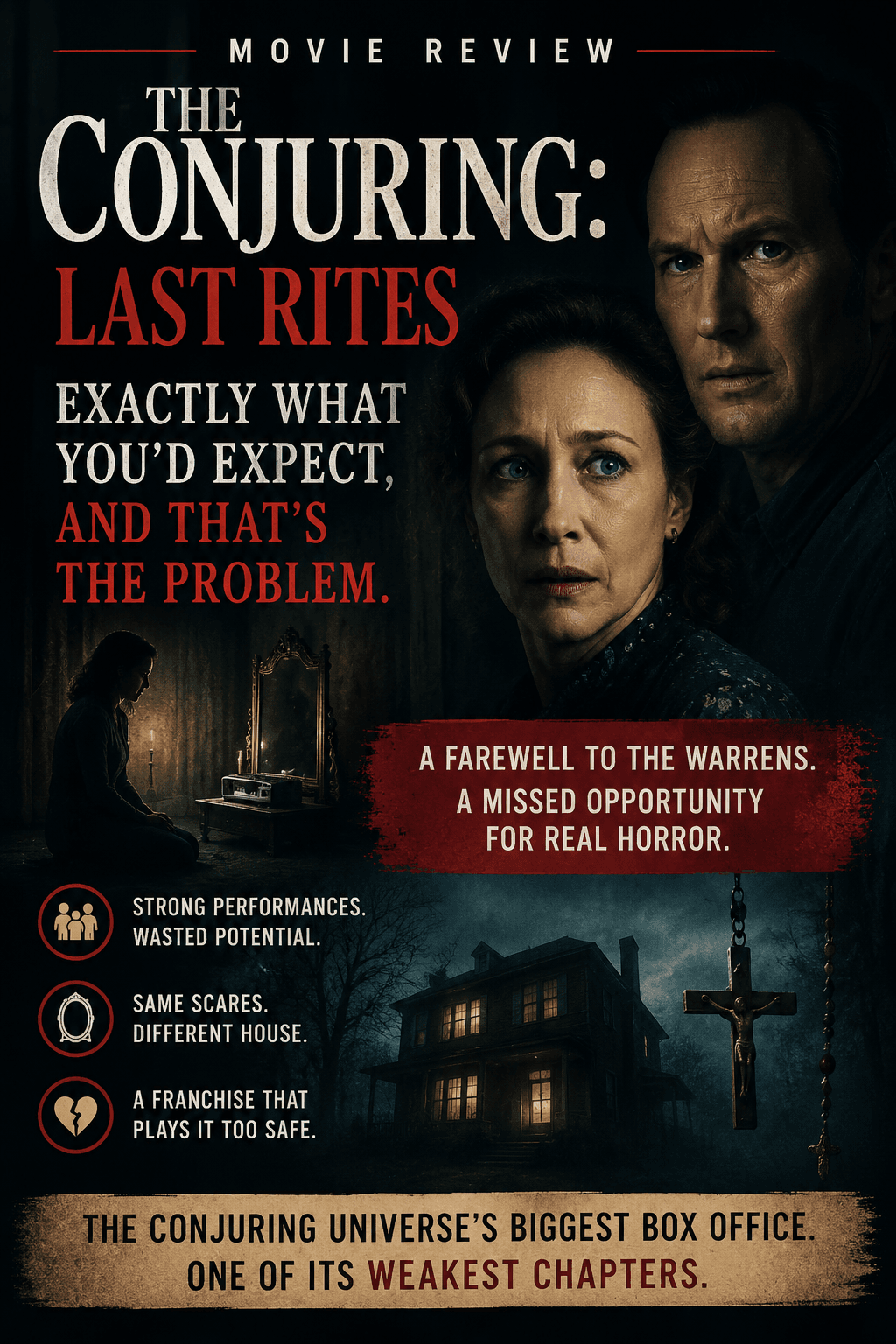
The Conjuring: Last Rites Is Exactly What You’d Expect, and That’s the Problem
There’s a moment in The Conjuring: Last Rites (2025) that almost made me forgive the franchise. It happens in 1964, before the title card, before any of the Smurl family machinery starts grinding. Lorraine Warren is alone in a dark room with a tape recorder and something she can’t see. A mirror. A presence. An entity connected to a woman named Victoria Grainger whose father died after hearing voices in the same house. Lorraine is pregnant. The entity comes, and the sequence becomes the most effective piece of horror filmmaking in the entire film — maybe the best the franchise has managed since James Wan left the director’s chair. The lights go out in the hospital delivery room. Something follows Lorraine into labor. Judy Warren is born under duress that is both medical and supernatural, and for ten minutes, the film earns the word “horror” without caveats.
Then the title card arrives, the film catches up to the 1980s, introduces the Smurl family, and The Conjuring: Last Rites remembers what franchise it belongs to. The machinery clicks into place. The competence resumes. And I sat there for two more hours watching a gifted cast do their best with a script that hands them nothing genuinely difficult to play.
A Franchise That Knows Exactly What It Is
Directed by Michael Chaves and written by Ian Goldberg, Richard Naing, and David Leslie Johnson-McGoldrick from a story by Johnson-McGoldrick and James Wan, Last Rites is the fourth mainline Conjuring film and the ninth entry in the franchise overall. It’s based — loosely, generously, with the kind of looseness that suggests the writers read the Wikipedia summary and decided they could improve on it — on the Smurl family haunting, a case that consumed a family in West Pittston, Pennsylvania between 1974 and 1989. The Warrens investigated. They concluded something was there. They never solved it. That last detail is, of course, nowhere in the film. Patrick Wilson and Vera Farmiga return as Ed and Lorraine Warren. Mia Tomlinson steps in as adult Judy Warren. Ben Hardy plays Tony, Judy’s fiancé. The film grossed $499 million worldwide, the highest take in the series. The franchise knows what it is, and what it is has always been profitable.
Some context on my bias, since it shapes everything that follows. The first Conjuring and its sequel sit in my ledger as competent haunted-house machinery — the cinematic equivalent of a well-managed restaurant chain, where the portions are consistent, the seasoning is familiar, and you always know what you’re getting. The real Warren case files tell a story the films work hard to avoid. Last Rites does nothing to disturb that ratio of competence to emptiness, and at this point in the franchise, I no longer expected it to.
Wilson and Farmiga Are Still the Whole Game
What Chaves does reasonably well here is the family material. Wilson and Farmiga remain the franchise’s only genuine asset, and the film knows this — it gives them more emotional real estate than any previous entry. Ed has had a heart attack. His doctor tells him to eat fish and egg whites and stop challenging the demonic. Lorraine is torn between protecting her husband and doing the work that defines them both. Their daughter Judy, now grown, has inherited her mother’s psychic sensitivity and has spent her entire life being taught to shut it out. The “Lucy Locket” nursery rhyme that Lorraine uses as a coping mechanism — sing it, close the door, the visions go away — becomes the film’s central motif, repeated until it curdles from lullaby into something with teeth. Chaves handles that turn with real care, which surprised me.
Mia Tomlinson’s Judy carries a quiet physical tension — the held shoulders, the flinch that lands a half-second before she sees — that suggests an actress operating above the material. She’s the film’s most interesting new presence, and the script gives her exactly enough to make you wish it had given her more.
The Smurl Family Deserved to Be People
The Smurl family gets the treatment the franchise has always reserved for its victims: they exist to be furniture. Jack and Janet Smurl are there to be scared. Their daughters — Heather, Dawn, and the twins Carin and Shannon — are there to be threatened. The family dog is there to bark at the right moments. There is a grandpa who is kind and a grandma who gets pushed down stairs. None of them register as people the way the Perron family did in the original, or even the Hodgsons in The Conjuring 2. They are the most forgettable family in the franchise, and the film seems half-aware of it — it keeps cutting back to the Warrens whenever the Smurls threaten to become interesting, as if the script is nervous that spending too long with the haunted family might accidentally turn this into a film about them instead of a farewell tour for its stars.
Scares Built From Borrowed Blueprints
The haunting mechanics are standard issue. A conjuring mirror from the 1964 cold open resurfaces as the film’s MacGuffin — a cursed object carrying the entity that touched Lorraine during Judy’s birth. It enters the Smurl home through means the film doesn’t bother to explain, because in the Conjuring Universe, cursed objects travel with the narrative efficiency of Federal Express. Furniture moves. Temperatures drop. A daughter swallows glass at a family dinner. A shadow figure attacks Heather in her bedroom. Father Gordon, a priest from Connecticut who’s been following the case on the news, visits the house, gets rattled, goes to the bishop, and gets killed for his trouble. None of this is poorly executed, and all of it is predictable. The scare architecture is textbook: long silence, slight movement in the background, loud noise, cut. Chaves knows the grammar and constructs his sequences with patience. The problem is that James Wan already built every one of these scares in the first two installments, with more precision and considerably more menace. Chaves is conducting the same orchestra with the same sheet music. He hits every note and adds nothing to the arrangement.
The exception — the one sequence that earns its fear honestly — is the birthday VHS scene, in which Jack rewinds footage of a family party and finds a frame that shouldn’t be there. It’s built with genuine craft: the mechanical repetition of the rewind, the dread accumulating under the domestic noise, the payoff earned through patience rather than volume. It’s the single scare in the film that works the way Wan’s best scares worked, and its presence only underlines how rote the rest of them are.
The Real Smurl Case Was Scarier Than This
The real Smurl case is where my patience finally gave out. The actual haunting lasted fifteen years — from minor oddities in 1974 to alleged demonic assault in the mid-1980s. Jack Smurl claimed to have been sexually assaulted by a succubus-like entity. Janet reported being molested in her sleep. Jack had undergone brain surgery in 1983 to address complications from childhood meningitis, a detail that skeptics found rather significant. The Warrens concluded there were four separate entities in the house, including a demon, and then couldn’t get rid of any of them. Multiple priests spent nights in the home and reported nothing unusual. The family co-wrote a book with the Warrens and a local reporter, and it was criticized for being exactly what you’d expect from a book written by the subjects and their hired investigators.
That material is dramatically rich precisely because it refuses to resolve. The tension between a family’s genuine suffering and the possibility that the suffering had explanations requiring no demon — the medical history, the skeptics, the priests who found nothing, the Warrens’ own methodological problems — is more frightening than anything Chaves puts on screen, because it’s the kind of horror that doesn’t come with a third act. Last Rites throws nearly all of it out. The assaults are gone. The brain surgery is gone. The skeptics are gone. The unresolved ending — the thing that makes the case genuinely disturbing — gets swapped for a clean victory, a banished demon, a Lucy Locket singalong, and a wedding epilogue scored to Van Morrison that plays like a greeting card someone dropped in a haunted house by mistake.
A Sendoff Built for the Earnings Report
I understand the calculus. Wilson and Farmiga needed a sendoff. Wan wanted the finale to feel emotional and uplifting. Warner Bros. needed $499 million. Everyone got what they came for. Whether any of it has anything to do with horror is a separate question, and the answer — delivered with the specific tiredness of someone who’s watched this franchise sand down its own edges for a decade — is no. The Conjuring: Last Rites is a family drama with supernatural interruptions, a farewell tour for two actors who’ve carried the series on their backs and a studio that’s been banking their goodwill since 2013. It does everything the earnings report needs it to do and nothing the genre needs. Those two facts are not in conflict. They are the same fact, viewed from different angles.
Wilson, in the final act, performs CPR on his daughter while his own damaged heart threatens to quit — and that’s an actor doing real work in a scene the script has already defused by making her survival a foregone conclusion. Chaves has grown since The Curse of La Llorona, and I’ll credit him that. He hasn’t grown enough to justify being the man who closes this franchise, and the ghost of Wan’s direction haunts every frame in a way that has nothing to do with the supernatural. The original Conjuring worked because Wan treated pacing as a weapon — the long held shots of the Perron farmhouse, the sustained dread of the clapping game, the trust that the audience’s imagination would do more damage than any reveal. Chaves works from the opposite instinct. He shows you everything, explains everything, resolves everything. The film runs 135 minutes and feels longer, because dread needs uncertainty and Last Rites has spent all of its.
If you need to watch it, watch it for Wilson and Farmiga — they earned every cent of their paycheck and most of yours — and for the 1964 opening and the birthday tape. Skip the epilogue. And if you find yourself curious afterward about what actually happened to the family in West Pittston, the parts the film was too polite to show you, go read the case files. The real horror, as always, is sitting in the primary sources, waiting for someone willing to look at it without a Van Morrison needle drop softening the blow.
The Verdict
The Horror Cave Rating: 2.5 / 5
The most profitable Conjuring film and its most creatively exhausted, which turn out to be the same thing. Wilson and Farmiga are as good as ever, the 1964 opening is the franchise’s best work since Wan, and a single VHS sequence remembers how dread is built. Everything else is competent machinery running on borrowed blueprints, with the genuinely disturbing real-life case sanded down into a greeting card. Worth it for the leads. Not worth it for the horror.
Frequently Asked Questions
How long is the new Conjuring movie?
The Conjuring: Last Rites runs 135 minutes, or two hours and fifteen minutes. That makes it the longest film in the mainline Conjuring series by a wide margin. Whether the runtime is justified depends on your tolerance for family drama between set pieces — the haunting mechanics could comfortably fit in 100 minutes, and the remaining 35 are largely devoted to the Warren family’s emotional arc and an extended wedding epilogue.
Who bought the Conjuring house?
The ownership of the real Conjuring house — the 18th-century Perron farmhouse on Round Top Road in Burrillville, Rhode Island — became a public mess in late 2025. Jacqueline Nuñez bought it in 2022 for roughly $1.5 million and ran it as a paranormal tourist attraction before defaulting on her mortgage. A foreclosure auction was scheduled for Halloween 2025, then abruptly canceled when YouTuber Elton Castee (of the channel TFIL) purchased the underlying $1.2 million mortgage through a holding company called Summit & Stone LLC. As of late 2025, Castee held the mortgage but not the deed, which technically remained with Nuñez, and competing efforts — including a GoFundMe led by Ghost Hunters star Jason Hawes at the request of Andrea Perron — were still in play.
Castee wasn’t acting alone in the broader Warren real-estate grab. Earlier in 2025, he and comedian Matt Rife jointly purchased the Warrens’ Occult Museum in Monroe, Connecticut — the collection of allegedly haunted artifacts Ed and Lorraine assembled over their careers, including the real Annabelle doll. Rife had also bought an 80-acre property in Rhode Island, roughly twenty minutes from the Conjuring house, in 2024. So the same two content creators who acquired the Warrens’ museum were circling the farmhouse as well. Note that the Burrillville property is the house from the original The Conjuring, not the Smurl home depicted in Last Rites — the Smurl house was in West Pittston, Pennsylvania.
Is The Conjuring: Last Rites based on a true story?
Loosely. The film draws from the Smurl family’s reported experiences and the Warrens’ involvement, but takes significant liberties. The conjuring mirror that drives the plot is invented. The film compresses fifteen years of reported phenomena into what looks like a few months. The sexual assaults reported by both Jack and Janet Smurl are omitted entirely. The film hands the Warrens a definitive victory over the entity — in reality, the case was never resolved to anyone’s satisfaction, the family’s included.
Where can I watch The Conjuring: Last Rites?
The film premiered in theaters on September 5, 2025, and has been streaming on HBO Max since November 21, 2025. It’s also available for digital purchase and on Blu-ray.