
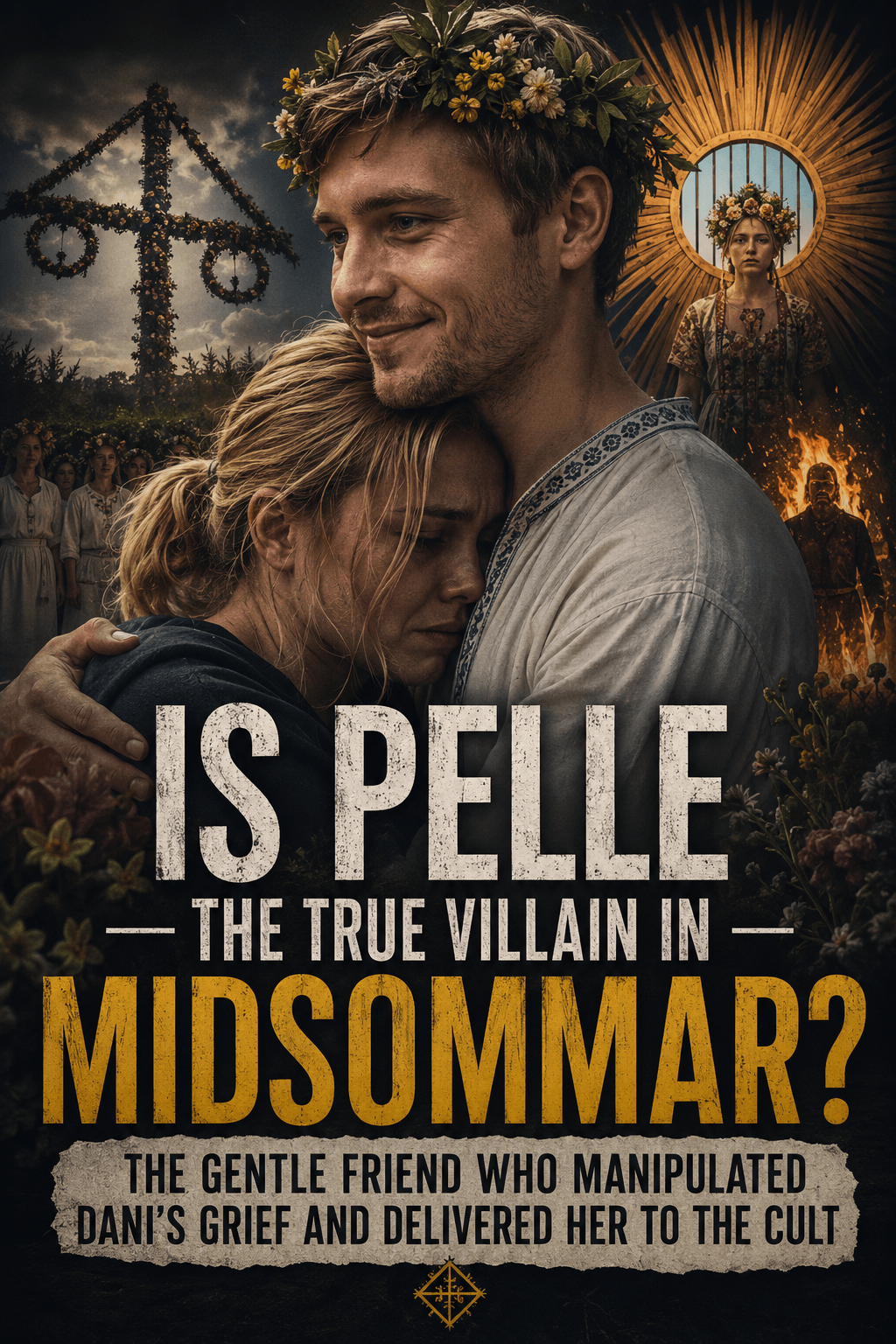
Is Pelle the villain in Midsommar? Yes — more directly than the Hårga’s cult elders, more than the drugs, more than the ritual violence itself. In Ari Aster’s 2019 film, Pelle (played by Vilhelm Blomgren) doesn’t recruit Dani Ardor. He selects her, the way you’d select livestock you’d already decided you wanted before you’d finished the paperwork. A tourist accepted the invitation. A recruit was cultivated for months by someone who already knew, before either of them boarded a plane, exactly which kind of grief he was looking for and exactly how patient he could afford to be about collecting it. The film spends its entire runtime daring you to miss this, because Pelle is gentle in every scene he’s in, and gentleness reads as its own alibi.
He never raises his voice. He never touches anyone who hasn’t already leaned in first. He cries once, convincingly, at exactly the moment it will do the most work. By the time the Hårga elders stand up in front of the whole commune and thank him publicly for delivering “new blood,” the film has already shown you, scene by scene, precisely how he did it — and most of our own review of this movie still calls him a friend who happened to belong to a cult, rather than the cult’s most effective instrument.
I want to be exact about the timeline first, because the timeline is the crime. Dani’s sister kills their parents and herself, and gasses the house to make sure of it, and this happens roughly six months before the trip to Sweden. That is not enough time to grieve a murder-suicide. It’s barely enough time to stop flinching at the phone ringing. The trip itself was already being planned before Dani knew about it — Christian invites her only after she catches him lying about it, a guilt reflex dressed as generosity, and it is Pelle, not Christian, who receives her warmly the moment she says yes. He doesn’t ask if she’s sure. He doesn’t ask if this is a good time, three months after a funeral for her entire family. He says he’s glad, and then, at the first private moment they share, he brings up her dead parents and sister without her having said a word about them first.
Watch what that scene actually does. He’s warm about it. He’s careful. He tells her, unprompted, that he lost his parents too, in a house fire, when he was young — a fact he could have mentioned at any point in the friend-group’s years of knowing him and chose to mention to her, alone, within minutes of confirming she was coming. She cries. He doesn’t perform surprise or discomfort at having caused it; he sits with it, competently, like someone who has done this before. This is the entire Pelle method compressed into one scene: identify the wound, name it before anyone else will, and be the first person to make her feel less alone in it. Everything after this is elaboration.
The Gifts He Makes You Keep Secret
A few scenes later he gives her a drawing — something personal, made for her specifically, a small private ritual he says he does for people’s birthdays. Christian has forgotten her birthday entirely; this is not incidental, it’s the whole point of the timing. And Pelle asks her to keep the drawing between them. A secret is a bond, and a bond kept from Christian is a bond that belongs only to the two of them — a more effective gesture than an open one would ever be. This is the oldest trick in the intimacy-manufacturing toolkit and it works precisely because it doesn’t look like a trick. It looks like tenderness. It looks like someone finally noticing you. A grieving woman who has just watched her boyfriend forget her birthday is not in a position to interrogate why the stranger who remembered is asking her to hide it from him.
He does this again before the cliff ritual, singling her out specifically to warn her that what’s about to happen might be hard to watch. Not the group. Her. He has just spent the boat ride and the drive and the meadow full of dancing establishing himself as the one person paying enough attention to her interior state to flag danger before it arrives. It’s targeting dressed as consideration, and it produces exactly the effect targeting is supposed to produce: when the actual violence happens, and it is horrifying, Dani has already been trained to associate Pelle with the one voice in the group that tried to protect her from it.
The Grief He Gets to Narrate for Her
There’s a quieter version of the same move buried in the mushroom sequence, easy to miss because the scene reads as atmosphere rather than strategy. Dani’s grief surfaces mid-trip, unbidden, the way grief does, and Pelle is the one who catches it and reframes it — with the commune’s own vocabulary for death instead — cyclical, generative, a body becoming fertilizer for something that keeps growing, rather than any room to simply sit with the feeling itself. It’s a beautiful idea if you don’t examine who benefits from Dani adopting it. A woman who has spent six months unable to make sense of a murder-suicide is being handed, gently, by the one person who has already told her he understands loss, an entire philosophical system that reclassifies her family’s deaths as natural rather than senseless. It’s comfort offered by the one person in the scene who needs her to eventually find death unthreatening enough to walk toward it herself.
What Everyone Else Gets Instead
Here is the part that should embarrass anyone still calling Pelle a well-meaning naif who “got in over his head.” Compare how he treats Dani to how he treats the three men in the friend group he’s known far longer, and the asymmetry stops looking accidental. Christian gets logistics and a joke about his sister’s sexual availability — a transactional pairing, not an intimacy; when Pelle tells him Maja “has taken a liking” to him, it’s delivered with the flat efficiency of a man assigning a room, not a friend sharing gossip. Josh, whose academic thesis is the closest thing to a real investment any of these men have in the trip, gets stonewalled, then quietly informed that Christian has been trying to steal his research angle behind his back, a piece of information that does nothing for Josh and everything to sour his one remaining alliance.
Mark gets managed like a liability, tolerated the way you tolerate someone you’ve already filed under expendable — even the one moment Mark actually needs Pelle’s help, after he damages a sacred tree and a Hårgan elder named Ulf turns on him, Pelle’s intervention is smooth, practiced, and entirely about restoring communal order, not about protecting Mark specifically. He apologizes on Mark’s behalf like a man closing a support ticket. He picked his moment the way a good angler picks a season, not because the fish decided to bite. None of the three men receive a disclosed backstory. None of them receive a secret. None of them are asked how they’re feeling. The men are handled. Dani is cultivated. If Pelle’s kindness were a personality trait rather than a function, it would show up evenly. It doesn’t. It shows up exactly where the commune needs it to.
The Scene Where He Almost Tells You Outright
The clearest evidence against him is the scene the film hands you without even hiding it. Dani is packing to leave, close to the one moment in the whole film where she might have walked away clean, and Pelle sits her down and asks her — plainly, warmly — whether Christian ever makes her feel “held,” makes her feel like “home.” It’s a devastating question because it’s true, and because Pelle knows it’s true, and because he has spent the entire trip making sure he would be the alternative example standing right there when she finally let herself answer it honestly. Then he says something that should have ended the conversation right there: he half-jokes that he could be using all of this — the disclosures, the closeness, the emotional shorthand he calls “the way we talk here” — to manipulate her. He says it and smiles and calls her rare, vulnerable in a good way, and the joke does exactly what jokes about your own manipulation are designed to do. It names the thing so precisely that naming it starts to feel like honesty instead of what it actually is, which is confirmation.
I don’t think Pelle is lying when he says he cares about her. That’s the part that should make people angrier at this movie, not less. Vilhelm Blomgren has said in interviews that he played Pelle as genuinely good, someone operating from a worldview where death is an honor rather than a horror, someone who isn’t performing warmth so much as living inside a belief system that makes warmth and recruitment indistinguishable from the inside. I believe the actor. I think that’s exactly the mechanism, and it’s a scarier one than a con man running a script. A con man knows he’s lying. Pelle has been raised, from the fire that killed his own parents forward, inside a community that trained him to feel his affection and his usefulness to the collective as the same emotion. He isn’t overriding a conscience to do this. He never developed the version of a conscience that would flag it as wrong, because the community got to him first, at exactly the age children build one.
Is Pelle the Villain in Midsommar? What “Unclouded Intuition” Is a Euphemism For
None of the friend group ever catches this in real time, and that failure is worth naming too, because it’s the mechanism working exactly as designed. Christian is too self-absorbed and too guilty about the relationship to scrutinize the one person making his exit easier. Josh is too focused on his thesis to notice he’s being isolated from his one ally. Mark is too oblivious to notice anything that isn’t directly in front of him. Dani is too grateful for the first person in months to ask how she’s actually doing.
Every blind spot in that group is a door Pelle walks through without needing to force it, a group of people too busy managing their own grief, ambition, and obliviousness to compare notes on a man who was, the whole time, running the same play on all of them at slightly different speeds, and the film never gives you a character whose job is to be suspicious on the audience’s behalf — no skeptical friend, no outside voice pulling anyone aside to ask why a virtual stranger knows this much about a woman he met a handful of times in New York. The closest the film gets is Dani herself, mid-argument with Christian, voicing out loud that it’s strange Pelle would trust a group of near-strangers enough to bring them somewhere this significant — and the film lets that suspicion surface for exactly one line before the plot moves past it, which is its own quiet acknowledgment that the question was worth asking and nobody was going to follow up on it.
The Argument That He’s Just as Trapped as They Are
The strongest defense of Pelle, the one worth taking seriously before dismissing it, is that he’s a product of the same system he’s feeding, raised inside it from childhood, never given the chance to consent to his own role any more than Dani consents to hers. There’s real weight to that. He didn’t choose to lose his parents in a fire, and he didn’t choose to be absorbed into a community that would eventually train him to read grief as an opening. But the argument collapses the moment you compare outcomes instead of origins.
Christian is fed a psychoactive drug without his knowledge and walked, paralyzed, into a bear carcass to be burned alive inside a temple. Pelle stands in the crowd outside, uninjured, publicly celebrated, one of the four commune members who carries the new May Queen’s throne. If the system had simply used him the way it used everyone else, the film would show some cost landing on him too — a ritual he didn’t choose, a role he resented, a moment of visible reluctance about what happens to the friends he’s known for years. It shows a man who benefits, specifically and materially, from every stage of a process he specifically and materially engineered, without a single scene of cost landing anywhere near him. Being raised inside a system that made you this way is an explanation. It stops being an excuse the moment you keep choosing to profit from it as an adult with every opportunity to do otherwise.
It’s also worth sitting with how the community’s larger machinery mirrors exactly what Pelle does one-on-one, just distributed across more people. Maja’s pursuit of Christian works the same way his approach to Dani works — flattery, physical closeness, the sense of being chosen rather than pursued, all of it timed to land on someone whose guard is already down. The difference is that Pelle is the one who opens the door for all of it. He’s the one who identifies which outsiders are worth the community’s investment in the first place, who curates the pairing before anyone else in Hårga has met these people, who shows Maja a photograph of Christian before the group has even landed in Sweden. It’s a talent scout’s job, performed with enough warmth that nobody in the friend group ever thinks to ask who’s actually running the audition.
By the film’s final ceremony, the elders stand Pelle up in front of the whole commune and thank him, specifically, for bringing “new blood” to the Midsommar and for delivering the new May Queen — the phrase used for his gift is “unclouded intuition,” which is the community’s polite word for a talent his own friend group would have called something closer to a con. He is honored instead — in public, by name, celebrated rather than questioned — for doing precisely what he did to Dani, and the film lets that honor land without a single character in the room treating it as strange.
Compare his fate to everyone he brought with him: Christian, drugged and paralyzed and finished inside a bear’s skin; Josh, murdered mid-photograph; Mark, killed and skinned into a scarecrow. Pelle attends all of it as a member of the community that orchestrated it — fully reintegrated, fully vindicated, his methods validated by results, present at every funeral he arranged without attending a single one as a mourner. He’s the one member of the friend group’s extended circle whose name gets said aloud, with honor, in front of the entire village, while the men he traveled with are reduced to props in a ceremony he helped stage. The shooting script goes further still, placing him among the commune members who physically carry the new May Queen’s throne — a detail the released film’s audio can’t confirm one way or the other, but one that fits everything the confirmed ending already establishes about where he stands when the credits roll.
The visual language does some of this work without a line of dialogue needed. This film almost never lets you retreat into shadow the way a conventional horror film would — the violence, the rituals, the manipulation all happen in unbroken daylight, which means Pelle’s tactics aren’t concealed from the audience any more than they’re concealed from Dani. You see every one of them happen in full sun, at a leisurely pace, scored so gently it barely registers as tension until the tension has already done its work. That choice is the most damning thing about the whole production. It’s a story about a method that keeps working even when you can see it happening in real time — a far more accurate account of how manipulation actually operates than horror usually bothers with, closer to a documented process than a third-act twist.
Bobby Krlic has said he didn’t approach this score as horror at all — he’s described building it closer to a twisted fairy tale, pulling from old Disney orchestral recordings as much as from anything in the genre, and that framing explains something specific about how Pelle sounds on screen. Krlic spent real research time with Nordic and Scandinavian folk instrumentation, and the nyckelharpa and hurdy-gurdy he wrote for produce a low, wheezing groan that sits underneath scenes without ever announcing itself as dread — the same way Pelle never announces himself as a threat. Aster reportedly insisted the score’s electronic elements be built on tape and analog synthesizers rather than anything computer-generated, which keeps even the eeriest passages feeling handmade, folk-adjacent, warm at the edges.
That’s the sound of a fairy tale, not a warning siren, and it’s the exact register Pelle operates in as a character: nothing about the music tells you to distrust him, because nothing about him is built to be distrusted on a first pass. A warning score would have done half the film’s work for it. This one refuses to, which is worth sitting with alongside how much of the film’s Swedish folklore turns out to be invention rather than inheritance — the sound design isn’t the only place this movie tells you it’s authentic when it isn’t.
Which brings me back to Vilhelm Blomgren’s own account of the character, because it’s the last piece of evidence and it’s outside the film entirely. An actor who spent months inside this role came out the other side describing Pelle as genuinely good — a person operating from a place of love, whose intentions just happen to end with three of his four friends dead. It’s the argument, one layer further out, restated by the one person outside the film with the clearest view of the character’s interior logic. If the person who studied this character most closely, for the longest, with the most access to his interior logic, still emerges convinced he was acting out of love, then the manipulation isn’t a plot device contained inside a two-hour runtime. It’s a working model of how the real thing operates on people who are far more sophisticated than a grieving twenty-five-year-old three months out from burying her whole family.
Pelle never has to raise his voice, never has to lie in any way you could catch on a second viewing, because the affection is real. It’s the theory, confirmed by the one person who had the most reason to defend him instead of naming it — worth remembering the next time Dani’s final smile gets read as pure liberation with nothing else underneath it.
Ethan’s Score: 9/10
Frequently Asked Questions
Is Pelle the Villain in Midsommar?
Yes, by the film’s own logic. Pelle identifies Dani’s grief, cultivates her trust for months, isolates her from the friends who might question his role, and delivers her to the commune as its new May Queen — then is publicly honored for it while the rest of the friend group is killed.
Did Pelle Plan to Bring Dani to the Hårga From the Start?
The film implies calculation rather than accident. Pelle receives Dani’s acceptance warmly, raises her family’s death unprompted at their first real conversation, and the elders later credit his “unclouded intuition” for delivering both new blood and the new May Queen — language that only makes sense if his choice of Dani was deliberate.
What Happens to Pelle at the End of Midsommar?
Pelle is not sacrificed. He’s honored publicly by the Hårga elders for bringing new blood to the commune and delivering the new May Queen, and he remains fully integrated in the community while Christian, Josh, and Mark are all killed.
Does Vilhelm Blomgren Think Pelle Is a Good Person?
Yes. The actor who plays Pelle has said in interviews that he approached the character as genuinely good, operating from a worldview where death is an honor rather than something to fear — a reading that doesn’t contradict the film’s darker argument so much as extend it.