The cliff is a fabrication, full stop, and it has a specific paper trail proving it, one that Swedish scholars have been citing for well over a century. The ättestupa, the cliff where Swedish villages supposedly sent their elderly to jump to their deaths once age made them a burden — the ritual that opens the film’s own final act, broken down in
Midsommar Ending Explained — has been debunked by Swedish linguists and historians since the late nineteenth century. It comes from a medieval saga, a comic passage about a family so miserly they’d rather die than share their wealth, and somewhere in the intervening centuries a joke got mistaken for an ethnography.
Midsommar puts it on screen in its most notorious sequence and lets an entire audience walk out convinced they’d just watched something rooted in real Swedish pagan practice. It’s the sequence people still bring up as proof the film “did its research,” and it’s the one place the Midsommar folklore actually fails.I want to be precise about what Midsommar actually did and didn’t do, because the honest version is more interesting than either the film’s own mystique or the reflexive dismissal of it as pure invention, and because the gap between the two tells you something real about how folk horror actually gets made. Some of this is real. Most of the specific horror is not, and the seams between the two matter more than the marketing wants them to.
The Midsommar Folklore That’s Completely Invented
Ättestupa translates roughly to “kin precipice,” and Swedish antiquarians spent the seventeenth through nineteenth centuries labeling actual cliffs around the country with the name, treating local legend as documented history. The linguist Adolf Noreen started dismantling the myth at the end of the nineteenth century, and the scholarly consensus since has been unambiguous: there is no archaeological or historical evidence that Norse or medieval Swedish communities practiced ritual senicide by cliff. The word itself traces back to a single saga, Gautreks saga, in a section modern scholars read as satire, mocking a family too cheap to host guests rather than documenting anything communities actually did. It was never a manual. It was a joke about misers that later readers took literally.None of that stopped the myth from spreading. Nineteenth-century collectors folded it into the broader romantic project of recovering a lost, pure Nordic past, and it’s been recycled ever since, showing up in everything from tourist folklore to the Netflix series Norsemen. Midsommar didn’t invent this error. It inherited it, dressed it in sunlight and flower crowns, and handed it to an audience that had no reason to know the difference between a debunked Victorian legend and something a Hälsingland commune might actually have practiced.
What Ari Aster Actually Researched
Aster has talked about the Midsommar folklore behind the film’s origins more candidly than most directors handle their own mythology, and what he’s said complicates the film’s reputation as a folklore deep-dive. He pitched it, in his own words, as an “apocalyptic break-up movie,” and has said outright: “it’s a breakup movie dressed in the clothes of a folk horror film.” That’s the actual engine of the story before any pagan iconography gets involved.On The Wicker Man specifically, Aster has been unusually direct.
“I basically let go of The Wicker Man as an influence the minute I decided to make this,” he told Empire, adding that the film “tries to point to The Wicker Man and set up expectations native to that film, then take a left-turn from there and go somewhere surprising.” That’s a strange thing to say about a film that opens with an outsider drawn into an isolated community, runs on a festival calendar used as a countdown, and ends with a sacrifice staged as celebration rather than horror — the exact skeleton of the 1973 film. Aster seems aware of the tension himself; he’s also said, of that same skeleton, “I know the trajectory, I know how it works, and I was really excited about putting this movie in that skeleton and not doing anything to fuck with its spine.” It reads like a director building a house on someone else’s foundation and then, in the same interview, insisting he’d moved out.
The Genre Midsommar Is Actually Borrowing From
The tradition behind the actual Midsommar folklore isn’t Swedish. It’s British, and it has a name and a founding trio of films that critic Adam Scovell, writing for the British Film Institute, called the “Unholy Trinity”: Michael Reeves’s Witchfinder General in 1968, Piers Haggard’s The Blood on Satan’s Claw in 1971, and Robin Hardy’s The Wicker Man in 1973. The phrase “folk horror” itself is older than any of the three films’ reputations as a category — a 1970 review in the trade magazine Kine Weekly used it to describe the shoot that became The Blood on Satan’s Claw — but the term didn’t stick until Haggard himself readopted it in a 2004 Fangoria interview looking back on his own film. The genre’s defining features are all present in Midsommar almost point for point: a rural setting that isolates its characters from any outside authority, a community organized around folk religion and seasonal ritual, and a nihilistic ending that refuses the audience the relief of institutional rescue.This lineage matters because it locates Midsommar’s actual inheritance correctly. The film isn’t drawing on lived Swedish tradition so much as it’s drawing on a fifty-year-old British cinematic tradition about the terror of encountering someone else’s lived tradition, one that emerged out of a very specific late-1960s anxiety about counterculture communes and the New Age movements springing up around Britain at the time. That anxiety had a real referent: the same years that produced these three films also produced a wave of real communes across Britain and the United States experimenting with exactly the kind of folk spirituality and collective living arrangements these films turned into monsters on screen. Midsommar’s “Sweden” is closer to a folk horror setting built to those genre specifications than it is to any village a Swedish ethnographer would recognize.
Where “Sweden” Actually Was
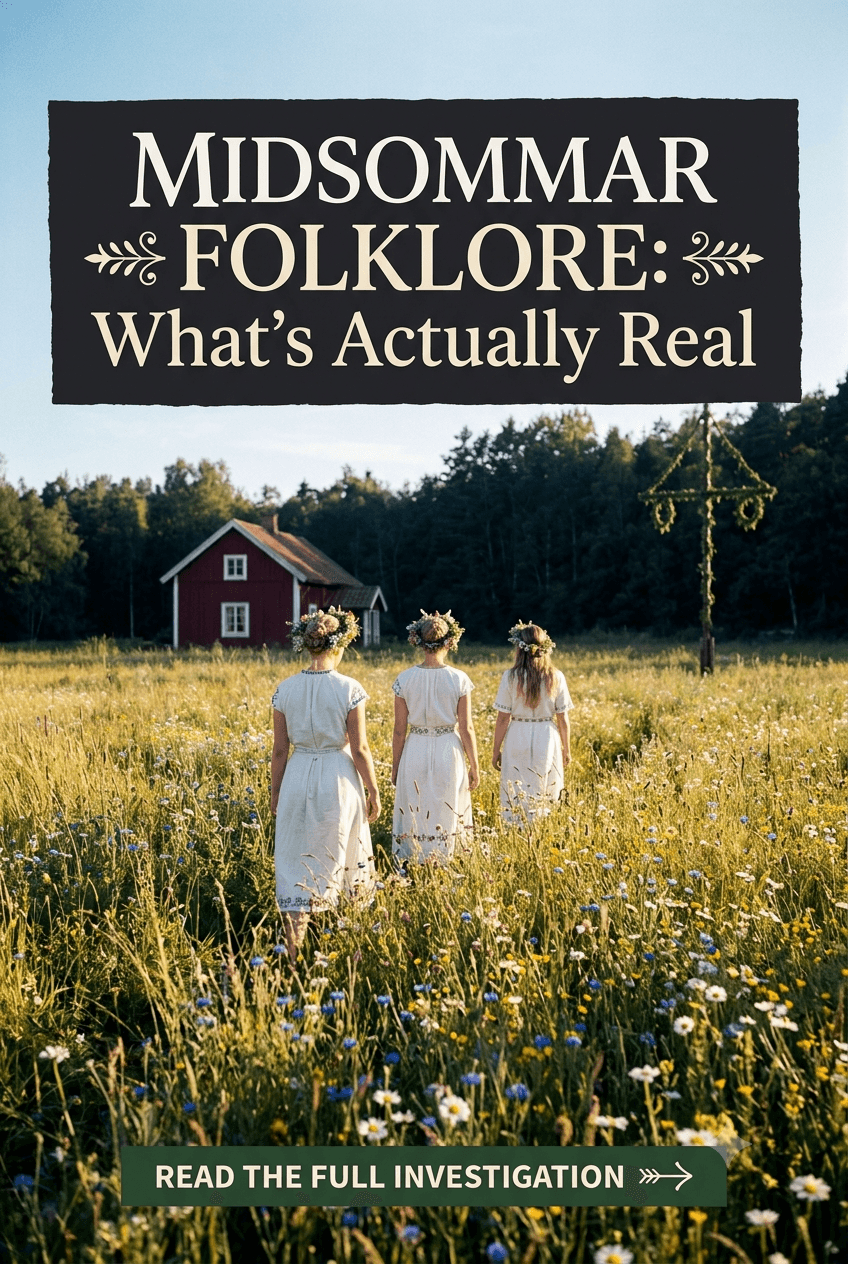
Hårga is a real place name, a small locality in Hälsingland, the Swedish province the Midsommar folklore claims as its setting. That’s as far as the documentary accuracy goes. Midsommar wasn’t filmed in Sweden at all. Production took place in Hungary, on sets built specifically for the film, which means the sun-drenched Swedish countryside audiences remember so vividly is, geographically, a different country entirely, dressed to specification. Plenty of films shoot somewhere other than their setting for budget and logistics, and that alone wouldn’t be worth mentioning. It’s worth naming plainly next to the ättestupa because the pattern is consistent: at every level, from the location to the central ritual to the visual references, the film that reads as a document of a specific place is assembled from elsewhere and relabeled.Swedish audiences, for what it’s worth, mostly shrugged. Critics there largely understood Midsommar as a horror film for an international audience rather than a claim about Swedish identity, and the response was neither offended nor especially warm, just settled. The one notable exception came from a critic at Göteborgs-Posten, who raised the question of whether the film’s warped version of a genuine national holiday amounted to a form of cultural appropriation. It’s a fair question to sit with, precisely because the film never bothered to ask it of itself. It borrowed a real holiday’s name and a real province’s geography, built a fictional atrocity out of a debunked myth, shot the whole thing in another country, and let the finished product circulate globally as if it were reporting from somewhere real.
What an Older Tradition Actually Says About Gods Like the Hårga’s
Here’s where I want to bring in something the Midsommar folklore never engages with directly, because it’s the one piece of this whole conversation that isn’t borrowed, isn’t invented, and isn’t a twentieth-century critical term. Long before folk horror existed as a genre, a much older tradition had already built an entire theological framework for exactly the kind of entity a community like the Hårga would worship, and it didn’t land on “these are just old stories people used to believe.”The position shows up repeatedly across the Hebrew Bible and the New Testament, and it’s more specific than a blanket dismissal. Deuteronomy 32:17 says the Israelites “sacrificed to demons that were no gods, to gods they had never known.” Psalm 106 describes the same pattern: people who “served their idols” and, in the same breath, “sacrificed their sons and their daughters to the demons.” The Book of Baruch accuses Israel of directing sacrifice “to demons and not to God.” And Paul, writing to the Corinthians centuries later, makes the claim explicit rather than poetic: “what pagans sacrifice they offer to demons and not to God. I do not want you to be participants with demons.” Early Church Fathers including Justin Martyr and Tertullian held the same position. The consistent claim across all of these texts treats the worship as directed at something real, receiving real sacrifice, while misrepresenting exactly what it was.It’s worth sitting with how specific this framework actually is, because it’s easy to flatten it into “the Bible says other gods are fake” and miss what it’s actually arguing. Psalm 82 depicts God addressing these lesser “gods” directly, rebuking them for injustice, a strange thing to say to something with no referent at all. Something is present in the framework across Deuteronomy, the Psalms, Baruch, and Paul, receiving the worship, benefiting from the sacrifice, while misrepresenting what it claims to be. That’s a more unsettling claim than either “paganism is superstition” or “paganism is valid,” and it’s precisely the kind of claim a film about a community organizing its entire moral universe around old gods would have to engage with if it wanted to take its own premise seriously.I’m not applying this framework because I think it settles anything about whether the entities in Midsommar are real. The film gives you a bear in a cage, a drugged tea, and a community organized entirely around control of its members’ choices; it doesn’t require the supernatural to be horrifying. I’m bringing this tradition in because it’s the actual, documented, centuries-old answer to a question Midsommar’s own marketing implies it’s asking, and the film never once engages with it. A movie built almost entirely out of borrowed folk-horror grammar and a debunked Victorian myth gestures at “old gods” and “ancient tradition” without ever touching the one body of thought that spent two thousand years actually working out what a claim like that would mean if taken seriously.
Why This Bothers Me
None of the Midsommar folklore I’ve laid out here, from the debunked cliff to the Hungarian sets, makes Midsommar a bad film. I’ve already made
the case elsewhere that it’s a genuinely devastating breakup movie wearing folk horror as its structure, and rewatching it for this piece didn’t change that. What bothers me is the same thing that bothers me about the
Conjuring Universe’s relationship to its own source material: a film builds its entire aesthetic and emotional authority on the implication of authenticity, on the audience’s assumption that what they’re watching reflects something real about a real culture’s real relationship to death and belonging, and the actual research behind it turns out to be a debunked nineteenth-century myth, a director’s own admission that he built on a genre he then claimed to be avoiding, and a set of sets built in Hungary standing in for a country the production never shot in. The film never claims to be a documentary. It doesn’t need to. The visual conviction does the claiming for it, and audiences walked out treating the ättestupa as something they’d learned rather than something they’d been shown.I keep returning to the theological angle because, unlike the rest of the Midsommar folklore this piece has covered, it’s the one part of this entire conversation that isn’t a costume. Deuteronomy, the Psalms, and Paul weren’t writing folk horror. They were making an actual claim about what happens when a community organizes its life around worship of something it can’t fully name, and that claim has outlasted every empire that has tried to stamp it out. Midsommar borrows the aesthetics of old gods and does nothing with the actual weight of that idea. A myth about a suicide cliff gets more screen time than two thousand years of people asking, in dead earnest, what it would actually mean if the old gods were still there and still hungry. That’s the actual folk horror story here, the one nobody put on screen: an entire genre, and an entire audience, content to feel the shape of that question without ever once asking it.
Frequently Asked Questions
Is the Midsommar folklore in the film based on real Swedish traditions?
Mostly no. The Midsommar folklore audiences remember most vividly, especially the ättestupa cliff ritual, is either debunked myth or borrowed from outside Sweden entirely. The film draws its real inheritance from British folk horror and a director’s own admitted influences rather than documented Swedish practice.
Is the ättestupa cliff ritual in Midsommar based on a real Swedish tradition?
No. Swedish historians and linguists, including Adolf Noreen in the late nineteenth century, have established that ritual senicide by cliff never occurred. The legend traces to a satirical passage in the medieval Gautreks saga and was later mistaken for genuine folklore by antiquarians and popular culture, including Midsommar and the Netflix series Norsemen.
Did Ari Aster base Midsommar on real Swedish pagan rituals?
Not as a folklore reconstruction project. Aster has described Midsommar as an “apocalyptic break-up movie” first, saying outright it’s “a breakup movie dressed in the clothes of a folk horror film.” On The Wicker Man, he’s said he “basically let go of” it as a conscious influence once he committed to making Midsommar, even while acknowledging he built the story on that film’s exact narrative skeleton.
Is Midsommar connected to The Wicker Man?
Yes, structurally, though Aster has said he tried to set the earlier film aside as a conscious influence once he began writing. Both films follow an outsider drawn into an isolated community, use a festival calendar as a structural countdown, and end with a sacrifice staged as celebration rather than horror.
What is folk horror, and does Midsommar belong to it?
Folk horror is a subgenre built around rural isolation, folk religion, and nihilistic endings, first defined by what critic Adam Scovell called the “Unholy Trinity”: Witchfinder General (1968), The Blood on Satan’s Claw (1971), and The Wicker Man (1973). Midsommar follows this template closely, inheriting a British cinematic tradition more directly than any specific Scandinavian one.
Was Midsommar filmed in Sweden?
No. Despite being set in the Swedish province of Hälsingland, at a location named Hårga, Midsommar was filmed on constructed sets in Hungary. Hårga is a real Swedish place name, but the commune, its rituals, and the village depicted on screen are not documented anywhere in Sweden.
Does the Bible actually call pagan gods demons?
Yes, in several places. Deuteronomy 32:17, Psalm 106:34-38, and the Book of Baruch describe pagan worship as directed at demons rather than nonexistent fictions, and Paul makes the same claim explicitly in 1 Corinthians 10:20. Early Church Fathers Justin Martyr and Tertullian held similar positions. The consistent claim treats these gods as real presences that misrepresented what they actually were.