
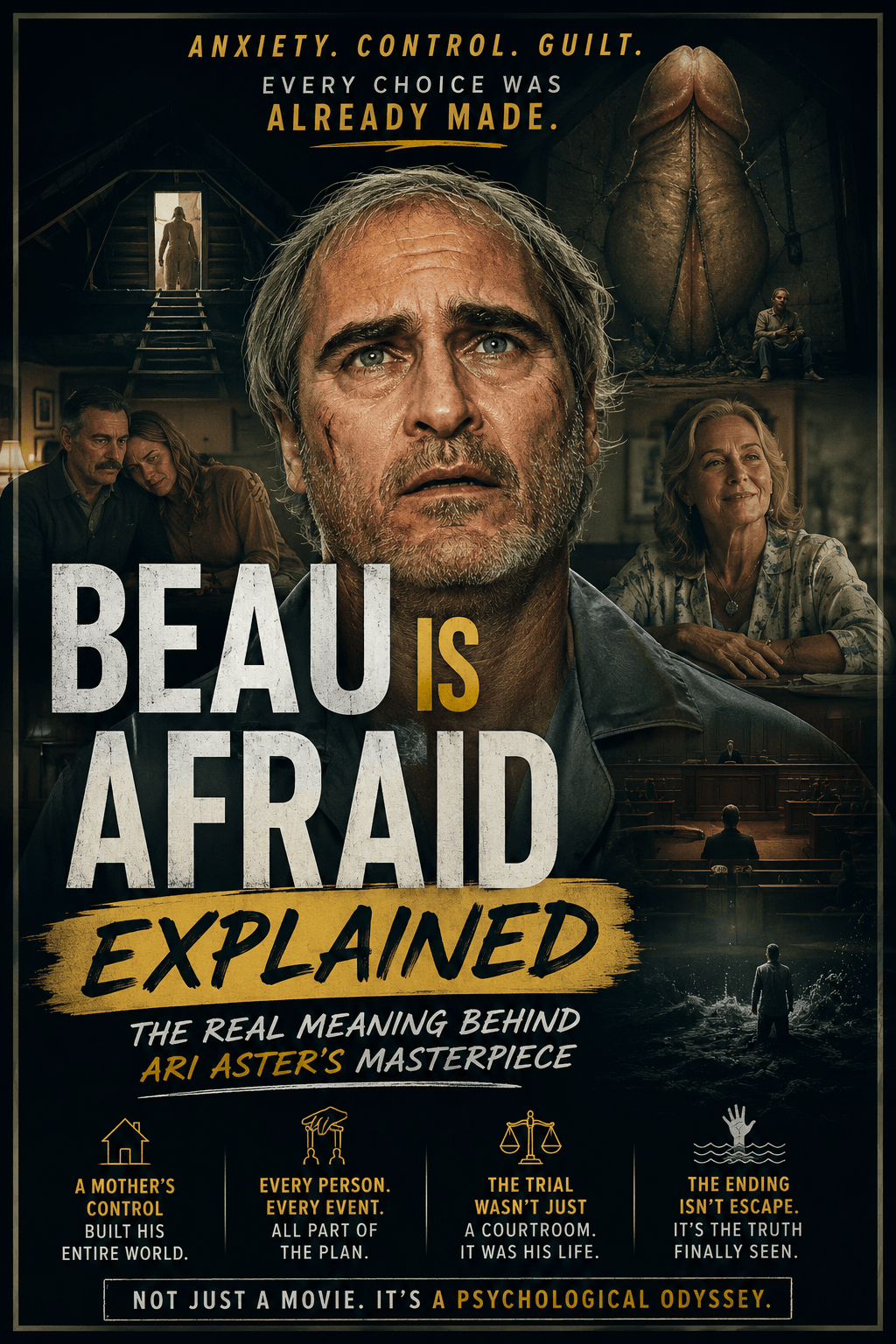
Beau Is Afraid explained, simply: Ari Aster’s three-hour 2023 anxiety odyssey starring Joaquin Phoenix builds its entire plot around Mona Wassermann’s system of control made literal, from a faked death staged to test her son’s devotion to a father kept caged in her attic as living proof that even biology answers to her. Beau spends the whole film believing he’s making choices. He isn’t. Every road he takes was already mapped before he set foot on it.
There was an ice cream truck that came down our street in Ohio every afternoon at four, and it always announced itself the same way — three tolls of the bell, a pause, three more. We heard it from the backyard and we ran. Nobody discussed it. Nobody decided anything.
The bell rang, and thirty seconds later there were six kids on the sidewalk with quarters already sweating in their fists. It took me until I was an adult, thinking about it on a run one morning, to understand that the man driving that truck had a more precise map of our street than any of us children did.
He knew which houses had a mother watching from the kitchen window and which didn’t. He knew which four-o’clock hours had traffic and which were empty enough to be safe. He had built a whole schedule around our unsupervised hour, and every one of us thought the sprint to the curb was our own idea.
The film opens with a man being born — the sound of his own birth, disoriented, someone screaming that the baby isn’t breathing — and it closes, three hours later, with the same man drowning in a stadium while a courtroom he cannot see finds him guilty of his own life.
Everything between those two points is Aster’s answer to a question he has been circling since Hereditary and Midsommar: what does it look like when a parent’s love stops being a feeling and becomes an architecture?
Beau spends the film’s entire, punishing runtime believing he is making choices — to fly home, to trust a stranger’s kindness, to finally sleep with a woman he loved as a child — and the film spends that same runtime revealing, patiently and then all at once, that none of it was his. Someone built the street. Someone rang the bell.
The marketing and the memes did the film a disservice by turning its most literal image into the whole pitch. The penis monster in Mona Wassermann’s attic is the detail everyone remembers and almost nobody needs, structurally, by the time they get to it — a punchline the film has already earned three hours of argument before it shows you.
What Aster built here is a three-hour anxiety attack shaped like a picaresque — his own description, and the right one — in which a man crosses an entire country of engineered obstacles to reach a mother whose love was never separable from her need to control the outcome.
It is the most direct thing Aster has made about guilt, and the least interested in scaring you conventionally while it does it.
Aster has described the film in interviews as personal without being autobiographical — the fears in it his own, even if the specific mother isn’t.
Aster has traced the film’s guilt-logic back to something older than his own family, telling interviewers he thought of the vengeful, easily-slighted gods of Greek mythology while writing Mona — the way those gods punished mortals for failures of tribute, of attention, of gratitude paid in the wrong amount. He’s called that impulse, only half-joking, the most Jewish thing he could imagine writing.
The film works as a diagram of a mechanism: how devotion curdles into surveillance, how a mother’s “I only want you safe” becomes, over forty years, a closed system with no exit that doesn’t loop back to her. The film’s power, and its exhausting quality, sit in the same place — it never breaks that system open to show you the outside.
There is no scene where Beau escapes and the film breathes. Every place he runs to turns out to already be inside her jurisdiction.
The Apartment Was Never Just an Apartment
The film’s first act reads, on a surface pass, like urban-nightmare satire — the crime-ridden street, the naked man loose in the building, the stolen keys, the phone call that tells Beau his mother is dead. Critics at the time reached for “anxiety comedy” and meant it as description more than complaint.
But watch the sequence again once you know what the ending confirms — that the people Beau encountered along his journey were, in one form or another, reporting back — and the apartment stops being chaos for chaos’s sake. It becomes the first room in a very large house.
The mundane cruelty layered underneath the mayhem is what actually makes this opening work: a therapist who spends the session steering Beau back toward guilt about his mother rather than his own well-being, a prescription that must always be taken “with water,” repeated so often it stops sounding like medical advice and starts sounding like liturgy.
The stolen keys land at the exact moment leaving was required of him, and the effect is precise: Beau loses his ability to leave, in a film that will spend two more hours proving he never leaves anything on his own terms. A boy runs to the curb believing the sprint is his own idea.
That belief is the whole mechanism — it never requires him to know the street was mapped.
Roger, Grace, and the Second Family That Wasn’t
Nathan Lane and Amy Ryan, as Roger and Grace, give the film its warmest surface and its cruelest reversal. They hit Beau with their car, nurse him, feed him, fold him into a household that already has the shape of a family — daughter, dead son’s absence, a wounded veteran on the property who does the family’s violence for it when asked.
For a long stretch, this section plays like relief. It is the only section of the film that resembles ordinary domestic drama, and Aster lets it breathe just long enough that you forget, almost, that you’re watching a man being kept — the same conditional warmth Minnie Castevet weaponizes in Rosemary’s Baby, relocated from a Manhattan apartment to a suburban dinner table.
Then Toni drinks the paint. It’s an act of pure, private despair dressed as spite — a seventeen-year-old choosing self-destruction in front of the man she believes has stolen her parents’ attention, and it works exactly as she intended it to, which is the film’s cruelest joke about her.
Grace’s grief turns instantly and completely against Beau, and Jeeves, medicated and half-feral with his own trauma, is sent after him with a gun.
What looked like a family that had chosen Beau reveals itself as a family that was always going to expel him the moment he stopped being useful to their own unresolved mourning — kindness with rules that only surfaced once he’d broken one he never knew existed.
The Forest and the Play That Already Knew His Life
Wounded and fleeing through the woods, Beau is found by a traveling troupe who call themselves the Orphans of the Forest, and here the film does something genuinely strange: it stops being a film about Beau and becomes, for a stretch, an animated fable about a man who looks like Beau, narrated by a godlike figure who keeps demanding the man confess to something unnamed.
The Hero of the play loses his home, builds a new one, loses that too, and eventually — old, starving — stumbles into a theater restaging his own life, reunited with sons who grew up without him.
Beau watches this and starts sobbing that he has been a coward his whole life, and it isn’t clear, in the moment, whether he’s reacting to the play or auditioning for his mother’s approval in absentia. A stranger in the crowd tells him his father might not have died the way he was always told.
Before Beau can follow the thread, the theater erupts into violence and Jeeves finds him again.
Plenty of critics read this sequence as pure detour, the film’s most indulgent stretch. I’d argue it’s doing the same work as the ice cream truck’s schedule, just with the machinery more visible: a story engineered to make Beau feel something specific, on cue, timed to land exactly when his defenses are lowest.
Even the fable he stumbles into by accident turns out to already be about guilt and fathers and the impossibility of ever coming home clean. There’s no outside the film will let him wander into. Every room, even a stranger’s forest, has already been furnished with his own psychology waiting for him.
Beau Is Afraid Explained: The Attic, the Twin, and the Monster
The film’s fourth act is where its cruelty finally organizes itself into a single, sustained argument. Beau arrives at his mother’s house believing she’s dead, sleeps — anxiously, disastrously, tenderly — with Elaine Bray (Parker Posey), the girl he loved as a child, and Mona reveals herself alive in the room, having watched all of it.
She admits the death was staged, using a member of her own household staff in her place. She admits it was a test.
And then, for what feels like forty unbroken minutes of screen time, she itemizes every small failure of Beau’s life back to him — the time he hid and let her search herself into injury, the friends who stole her underwear, the breastfeeding she never got to finish — building a case with the patience of someone who has been building it for decades and has been waiting, specifically, for an audience of one.
Patti LuPone plays this without a single moment of cartoon villainy, which is what makes it unbearable. She plays a woman who believes, entirely, that she is the wronged party — that four decades of surveillance and manufactured crisis were proof of love rather than its replacement.
When she takes Beau up to the attic and tells him the recurring nightmare was always a repressed memory — his twin brother, locked in that room for forty years for the crime of once talking back to her — the film finally names what it’s been building toward. There were two versions of Beau. One learned, early, to disappear rather than argue. The other didn’t, and was removed.
Mona kept the proof of both outcomes in the same room, along with — the film confirms without ambiguity, however absurd the image sounds on paper — Beau’s actual father, transformed by grief or punishment or something the film never fully explains into a shape too monstrous and too explicitly sexual to be anything but a metaphor for the one part of Beau’s inheritance his mother could never fully domesticate.
He is dangerous. He is caged. He is, unmistakably, still called Dad by the voice that comes out of him.
None of this works without what Phoenix is doing underneath it. He plays Beau almost entirely through the body — shoulders drawn up, breath audible, a walk that looks like a man perpetually bracing for a hand to land on him from behind — and the performance never once winks at the audience about how absurd Beau’s circumstances have become. That restraint is the harder choice.
A lesser performance plays the home invasion or the forest chaos for comedy and lets the audience off the hook; Phoenix keeps playing Beau’s terror as real, scene after scene, which is the only thing that makes the film’s final cruelty land as tragedy instead of a very long joke at one man’s expense.
You can see the whole method in the Elaine scene: a lifetime of inherited sexual dread compressed into a few minutes of fumbling, humiliating intimacy, played as the closest Beau ever gets to being an adult rather than the easy laugh the scene is technically built to deliver — and you watch that possibility collapse in real time.
There’s a specific choice in Krlic’s score worth pausing on, to my ear: even in the attic, even through the trial that follows, it never fully tips into dissonance. Something that sounds close to a lullaby keeps threading underneath the distortion, and I read that as the film’s argument in musical form — that Mona’s cruelty and Mona’s love were always the same instrument.
To my eye, Pogorzelski’s camera — restless and searching through the film’s earlier chaos — goes almost still in this section; the compositions turn formal, symmetrical, portrait-like. The house, for the first time in the film, holds its shape. It’s the only place Beau has been all movie that isn’t falling apart around him, and that stillness is the most frightening thing about it.
The Trial, the Water, and What Guilt Actually Looks Like From Inside
The ending has been argued over since the film’s release, and I don’t think the disagreement is really about plot. Beau ends up on a small boat, drifting into a vast, dark stadium filled with unseen spectators, formally charged — his full name read aloud, his birth date stated like an indictment — with the entirety of his life as evidence against him.
A prosecutor recites his failures — feeding ducks more attention than he ever gave a suffering stranger, letting friends rifle through his mother’s belongings as a teenager, delaying the drive home with Roger and Grace, sleeping with Elaine within hours of believing his mother dead — each charge trivial alone, cumulative as an indictment. A defense attorney objects and loses. The boat’s engine sparks.
It goes up, and Beau goes under, and his mother’s voice follows him down through the water, still calling him baby.
Taken as literal plot, it’s the strangest thirty minutes in a film full of strange thirty-minute stretches. Taken as a picture of what free-floating guilt feels like from inside a person who was never permitted to set his own terms, it’s the only ending the film could have had.
Every minor failure Beau committed across the film — the delay, the encounter with Elaine, the years of not visiting — gets restaged as capital evidence, because that’s what guilt does when it’s been engineered into someone since birth: it treats every offense as equally damning, forever, in a courtroom that never adjourns, rather than weighing any of them against the ordinary scale a life is actually judged on.
Beau drowns because forgiveness was never actually available to him as an outcome — the trial was never designed to reach a verdict of innocent, only to keep producing evidence. The same way the ice cream truck never had any intention of running out of the flavor you actually wanted, because scarcity kept you running to the curb faster than abundance ever could have.
Where This Sits in Aster’s Own Argument With Himself
Beau Is Afraid was a commercial disaster on release — roughly $12 million back against a $35 million budget, a 67% critics’ score that read more like respect than enjoyment. I don’t think that’s incidental. Aster made something nearly three hours long, structurally hostile to a conventional viewing experience, uninterested in giving its audience relief because its subject never gets any either.
Three years on, Beau Is Afraid explained on a message board is still one of the more common late-night searches a film this divisive generates, and Eddington’s release seems to have pushed a new wave of viewers back toward it, looking for the connective tissue between Aster’s most private film and his most public one.
Eddington traded one household’s closed logic for an entire town’s — a contested small-town election between a bar-owning mayor and a sheriff played by Phoenix again, standing in for an America where, as Aster has put it, everyone is siloed into their own small certainty and mistrustful of anything outside it.
Watching the film again now that Aster has moved on to Eddington, what’s stayed with me is how clearly this was the last film he could make about one contained anxious mind before he needed to widen the lens — the mother in the attic and a town locked in its own certainty are the same trap, built at different sizes.
Beau Is Afraid Explained: What Ethan Actually Thinks This Film Is About
Beau Is Afraid is a film about the specific horror of discovering, late and all at once, that your entire life has had a shape you didn’t design, administered by someone who insists, with total sincerity, that the shape was love. Everything people quote out of context about this film — the monster, the boat, the trial — is downstream of that one discovery.
That’s a harder thing to sit with than a creature in an attic, and Aster knows it, which is why he spends three hours making you feel Beau’s exhaustion rather than simply telling you about it. It’s an ugly, brilliant, exhausting film, and its commercial failure says more about how badly we want our anxiety stories to resolve than it says about whether the film earned its ending.
I think about that ice cream truck sometimes now, and it isn’t the innocent memory it used to be. I don’t believe the man driving it meant us any harm — he wanted quarters, we wanted popsicles, the arrangement worked for both of us in the shallow way transactions do.
But watching Beau spend three hours running toward a house that was never going to let him arrive clean, I found myself thinking less about the bell and more about the mothers at the kitchen windows, the ones who let their kids run to the curb and the ones who didn’t, and how none of us, at eight years old, could have told you which kind of house we lived in.
You only find out later, usually by accident, usually by noticing the map someone else had all along.
Beau finds out at the exact moment it’s too late to matter. That timing is the most honest thing Aster has ever put on screen.
Ethan’s Score: 8/10
Frequently Asked Questions
Beau Is Afraid Explained: What Really Happens in the Ending?
Beau ends up on a boat that drifts into a stadium, where he is formally put on trial for the failures of his life. The boat explodes and he drowns while his mother’s voice calls out from the water. It plays less like a literal courtroom than free-floating guilt made physical, proof that Beau was never going to be forgiven.
What Is the Monster in the Attic in Beau Is Afraid?
Mona Wassermann’s attic holds two things Beau believed were gone: his twin brother, locked away for forty years after once talking back to her, and his father, transformed into a monstrous, phallic creature. Both function as proof that anything in Beau’s life capable of defying his mother gets removed and hidden.
Is Beau Is Afraid Based on a True Story or Personal to Ari Aster?
Ari Aster has described Beau Is Afraid as personal without being autobiographical. The anxieties belong to him, he’s said in interviews, though his real mother, by his own account, is nothing like Mona Wassermann. The film works as a psychological diagram of guilt and control rather than a retelling of one real relationship.