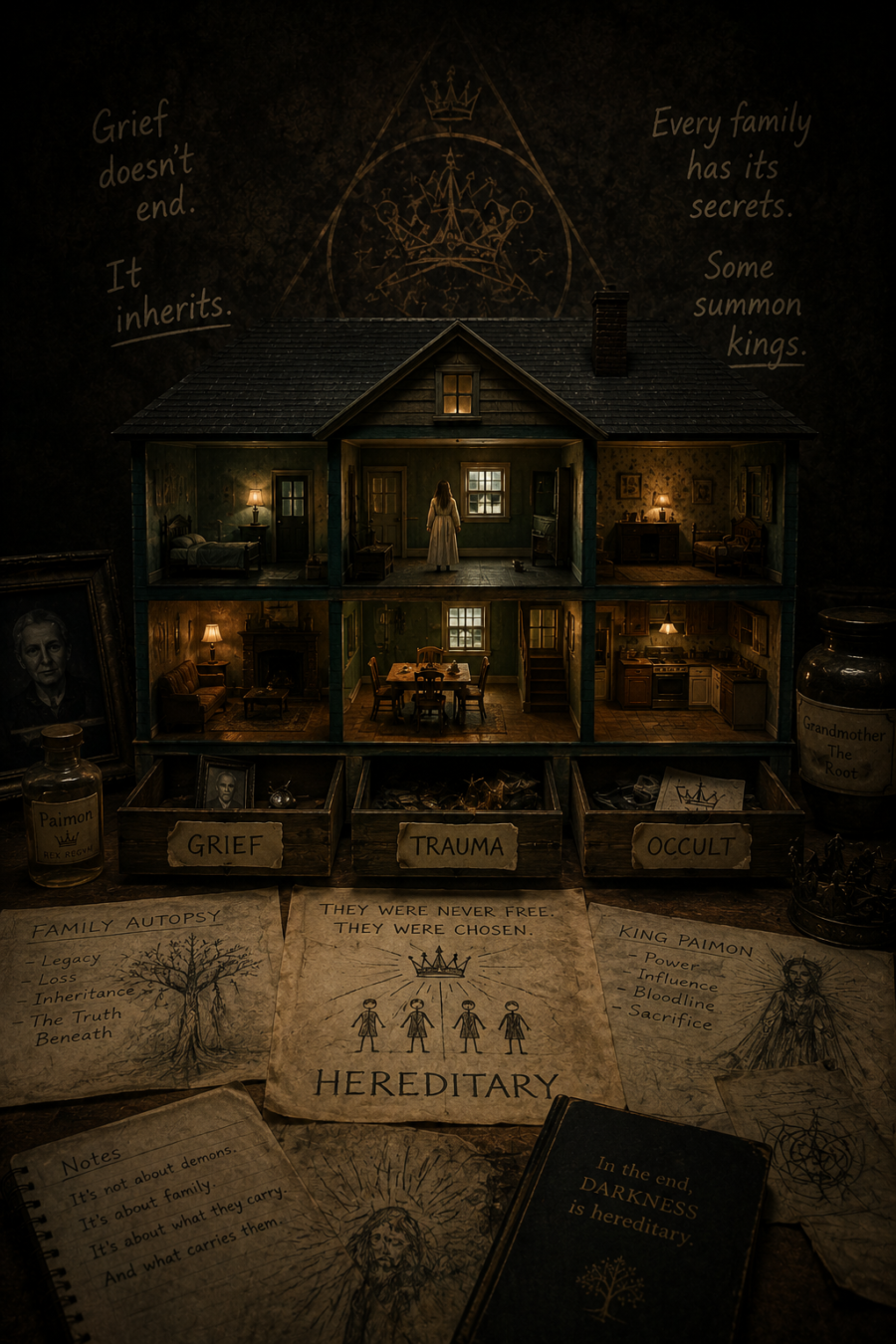
Hereditary (2018) Review — A Family Autopsy Disguised as a Horror Film
Director: Ari Aster | Year: 2018 | Runtime: 127 min | Studio: A24
Let me set the scene. It’s late 2018. I’m sitting in a nearly empty theater in Austin, a warm Shiner Bock in my jacket pocket that I absolutely did not sneak in, and within the first twenty minutes of Hereditary (2018) I am so genuinely unsettled that I forgot to drink it. That, my friend, is a rare and sacred thing. I’ve watched thousands of horror films at this point — I’ve sat through every Italian giallo, every grimy VHS-era slasher, every prestige-horror slow burn the last decade has produced. Very few of them made me forget I was holding a beer.
So yeah. We’re talking about Hereditary (2018) today because it keeps coming up — in conversations, in Reddit threads, in messages from people saying “I finally watched it and I don’t know how to feel.” And honestly? That reaction is the whole point. That confusion, that residual unease sitting somewhere between your ribs? That’s Ari Aster doing exactly what he set out to do.
The short answer: Hereditary (2018, dir. Ari Aster, cinematography Pawel Pogorzelski) is the best horror film of the last decade. A grief film using the supernatural to show damage that was always already there. Toni Collette gives the best performance in any horror film in years. Score: 9.4/10. It does not leave you.
The Grief Horror Framework — What Aster Was Actually Building
Here’s the thing about Hereditary that most horror reviews completely miss: Aster was not primarily making a movie about a demon. He was making a movie about what grief does to families. He was making a movie about inherited trauma, about the way mental illness and dysfunction move through bloodlines like a curse that predates any supernatural explanation. The demon — Paimon, the eighth king of Hell according to demonological tradition — functions, for most of the film, at a structural level.
Think about the Graham family. Annie (Toni Collette, in what I’ll die on the hill saying is the most criminally under-awarded performance in 21st century horror) is a miniaturist — she literally constructs tiny controlled worlds inside boxes. That’s her entire psychological coping architecture right there. When her mother dies at the start of the film, the boxes start coming apart. Her husband Steve (Gabriel Byrne, solid, quietly devastated) is a man who has spent his marriage learning to manage a woman who is managing everything.
Their son Peter (Alex Wolff) is a teenager who exists in a low-grade emotional coma. And then there’s Charlie.
“Charlie is the key. Charlie was never entirely Charlie. And once you understand that, the whole film reorganizes itself into something that will genuinely disturb your sleep.”
Milly Shapiro’s portrayal of Charlie is one of the most uniquely eerie performances in recent memory, and not because she’s doing anything conventionally “creepy.” It’s the wrongness of her — the clucking sound, the detachment, the way she draws caricatures of the dead and is visibly unnerved at her grandmother’s open casket — not grief, not curiosity, something that doesn’t map onto either. She’s the walking evidence that something has been wrong in this family for generations. The film is literally titled Hereditary. The horror is in the transmission.
That Scene. You Know the One. Let’s Actually Talk About It.
I’m not going to dance around it. Fifteen minutes into writing this I’ve been dreading bringing it up and I’m bringing it up anyway because any serious Hereditary analysis that avoids The Scene in the car is cowardice.
After Charlie’s death — already one of the most brutally unexpected mid-film kills in modern horror history, the kind of narrative gut-punch that made audiences physically gasp in theaters — the film does something that I think is genuinely radical. The film stays with Peter, all night, in that car. And then the next morning, it forces Annie to find what’s in the back seat, and Aster holds that shot of her face for so long that the camera itself starts to feel like cruelty.
This is grief horror at its most uncompromising. Most horror films treat death as a catalyst. Aster treats it as a wound that doesn’t close — and he makes the audience sit inside that wound with the characters. The slow cinema approach here, influenced by directors like Ingmar Bergman and Michael Haneke, refuses the audience any comfortable distance. You don’t get a cut. You don’t get a musical sting to tell you how to feel. You just sit there. In the car. With Peter.
Cinematography as Psychological Architecture
Pawel Pogorzelski’s cinematography in Hereditary (2018) deserves its own essay. The recurring motif of the miniature — the film literally opens with a slow zoom into Annie’s model of the house that seamlessly becomes the real house — establishes early that we’re inside a world where scale is unreliable, where what we think is real might be constructed, and where someone else might be moving the pieces around. The camera often frames the Grahams as if they’re specimens in one of Annie’s dioramas. Tiny. Observed. Already trapped.
The shadows in this film are doing constant narrative work. Aster and Pogorzelski use a technique of hiding figures in the darkness at the edges of frames.
The technique builds sustained, accumulating dread. The question isn’t whether something is there. The question is how long it’s been there. How many frames back did it appear? Were you paying attention? “
Paimon, Folk Horror Lore, and the Real Occult Tradition Behind the Film
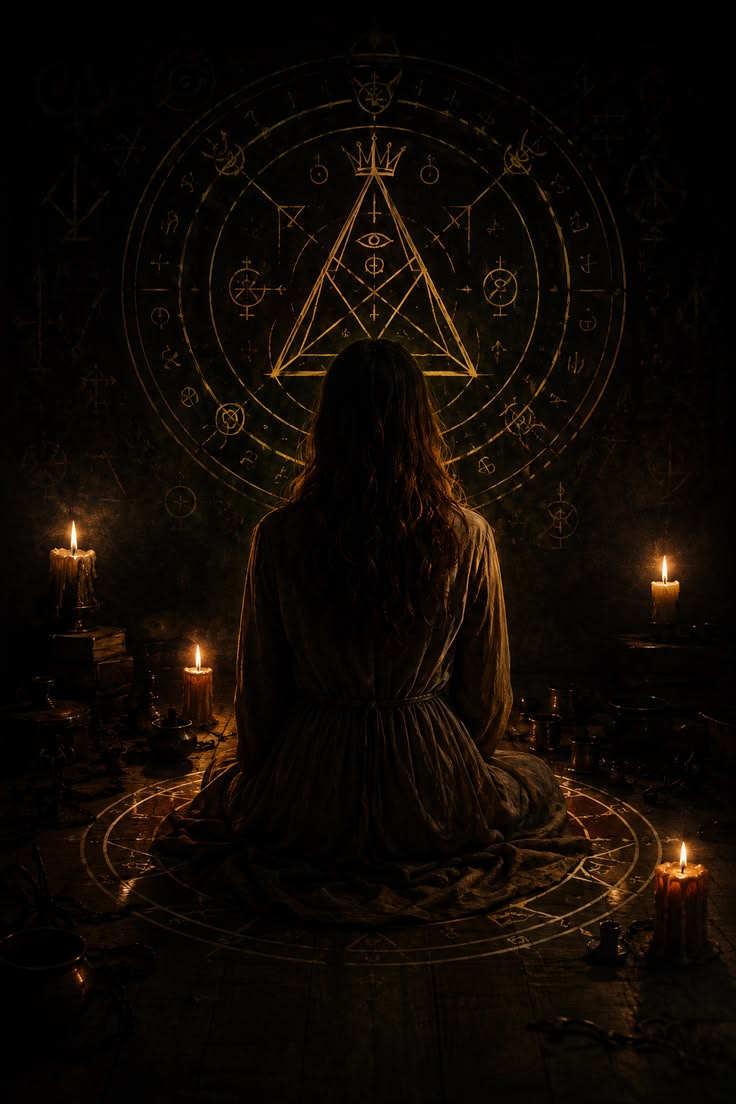
If you’re coming to Hereditary fresh or trying to piece together the film’s mythology, here’s the context Aster embedded without over-explaining: Paimon is drawn directly from the Ars Goetia, the 17th-century grimoire detailing 72 demons of the Lemegeton. In that tradition, Paimon is described as one of the eight kings of Hell — obedient to Lucifer, riding a camel, often depicted as a crowned figure with a feminine appearance.
The cult in the film — led by Annie’s mother Ellen — has spent years orchestrating the conditions for Paimon to inhabit a male host. Charlie was always the temporary vessel. Peter was always the destination.
This is what recontextualizes the entire film on a second watch. Every “accident,” every tragedy, every moment of family dysfunction — it was all managed. Ellen died of cancer and dementia — but her death was the cult’s opening move, not their doing. The invitation to the grief support group wasn’t coincidence. The friend Joan (Ann Dowd, playing warm-menace with a surgeon’s precision) was placed specifically in Annie’s path. The Grahams were not a family experiencing supernatural misfortune. They were a family that had been spiritually farmed for generations — a design Rosemary’s Baby had already made terrifying fifty years earlier.
“The most terrifying thing about Hereditary isn’t the demon. It’s the realization that free will was never part of the equation for any of these people.”
Toni Collette and the Art of Psychological Disintegration on Screen
I have to go back to Collette because I genuinely cannot overstate what she does here. The dinner table scene alone — where Annie confronts her family and the
emotional pressure of the entire film ruptures into one sustained, escalating breakdown — is some of the finest screen acting I’ve ever witnessed in a genre that Hollywood still largely treats as beneath serious consideration. She is terrifying and sympathetic and completely unhinged and completely rational all at once, because grief and trauma don’t follow the rules of “likable protagonist behavior.”
The fact that she wasn’t nominated for an Academy Award for this performance is one of the most glaring institutional failures of recent Hollywood history. I’ll die on that hill too. Consider this article the hill. I’m comfortable here.
Why the Ending Still Divides People — And Why That’s a Feature, Not a Bug
The third act of Hereditary is where a portion of the audience checks out, and I understand why even if I disagree with it. The film pivots hard into overt supernatural territory — levitation, self-harm as possession, the attic sequence that culminates in what might be the most disturbing tableau in A24’s entire filmography. For viewers who came in expecting a grounded psychological horror film in the vein of The Babadook or A Quiet Place, this shift feels like a genre betrayal.
But here’s my read: Aster earned it. The supernatural escalation doesn’t contradict the psychological horror of the first two acts — it literalizes it. The family was always being controlled by forces beyond their understanding or consent. The demon was always real. The tragedy is that even if you grant Annie her grief, her therapy, her desperate attempts to understand what’s happening — none of it would have mattered. The outcome was written before she was born. That is the film’s most devastating thesis statement.
Where Hereditary (2018) Sits in the Modern Elevated Horror Canon
The term “elevated horror” has become almost meaningless at this point — it’s been co-opted to mean “any horror film a film critic feels okay admitting they watched.” But when it was first being used around 2017–2019, it was pointing at something real: a wave of horror filmmaking that was using the genre’s mechanics to explore genuinely serious thematic territory. Hereditary, alongside Midsommar (Aster’s follow-up, essentially a breakup film disguised as folk horror), The Witch (Eggers doing Puritan dread), and Get Out (Peele operating at the intersection of social commentary and genre filmmaking), represents the genuine apex of that movement. More recently, Obsession (2026) shows the same DNA — supernatural horror as cover for a story about obsessive emotional damage — with a new generation of filmmakers who clearly studied this playbook.
If you want to go deeper, check out our Hereditary ending explained — a beat-by-beat breakdown of everything that happens in that final sequence and why — or our article on Hereditary: 10 Hidden Details You Probably Missed on First Watch for an even closer look at Aster’s layered storytelling. What separates these films from the cynical “prestige horror” cash-grabs that followed is intent. Aster wasn’t making a horror movie with themes. He was making a film about grief, inheritance, and the determinism embedded in family systems, and he chose horror as the most honest vehicle for those ideas. Because honestly? What’s more terrifying than the possibility that who you are — your mental illness, your patterns, your capacity for love or destruction — was decided before you had any say in it?
Final Verdict: Should You Watch Hereditary?
If you haven’t watched Hereditary (2018) and you’re the kind of person who found this article — yeah, obviously. Immediately. But go in knowing it’s not a comfortable experience, it’s not a fun haunted house ride, and it’s not going to give you easy resolution. It’s going to give you 127 minutes of sustained atmospheric dread, one of the greatest lead performances in modern genre cinema, and an ending that will sit in the back of your skull for days.
If you’ve already watched it and you’re here trying to understand what you felt — that discomfort, that residual wrongness — then I’ll tell you: that’s the film working exactly as intended. You just spent two hours watching a family that never had a chance, in a universe where love and grief and good intentions are completely beside the point. The demon was always winning. Ellen always had a plan. The only question was whether you were paying enough attention to see it.
I was. Warm beer and all.
Ethan’s Verdict: 9.4 / 10 ★★★★★
A near-masterpiece of grief horror and occult folk tradition. Aster’s debut feature is essential viewing for anyone serious about psychological horror cinema — unflinching, formally precise, and genuinely terrifying at the level of ideas.
Tags: Hereditary, Ari Aster, A24 Horror, Psychological Thriller, Folk Horror, Toni Collette, Grief Horror, Horror Film Analysis, Elevated Horror, Paimon