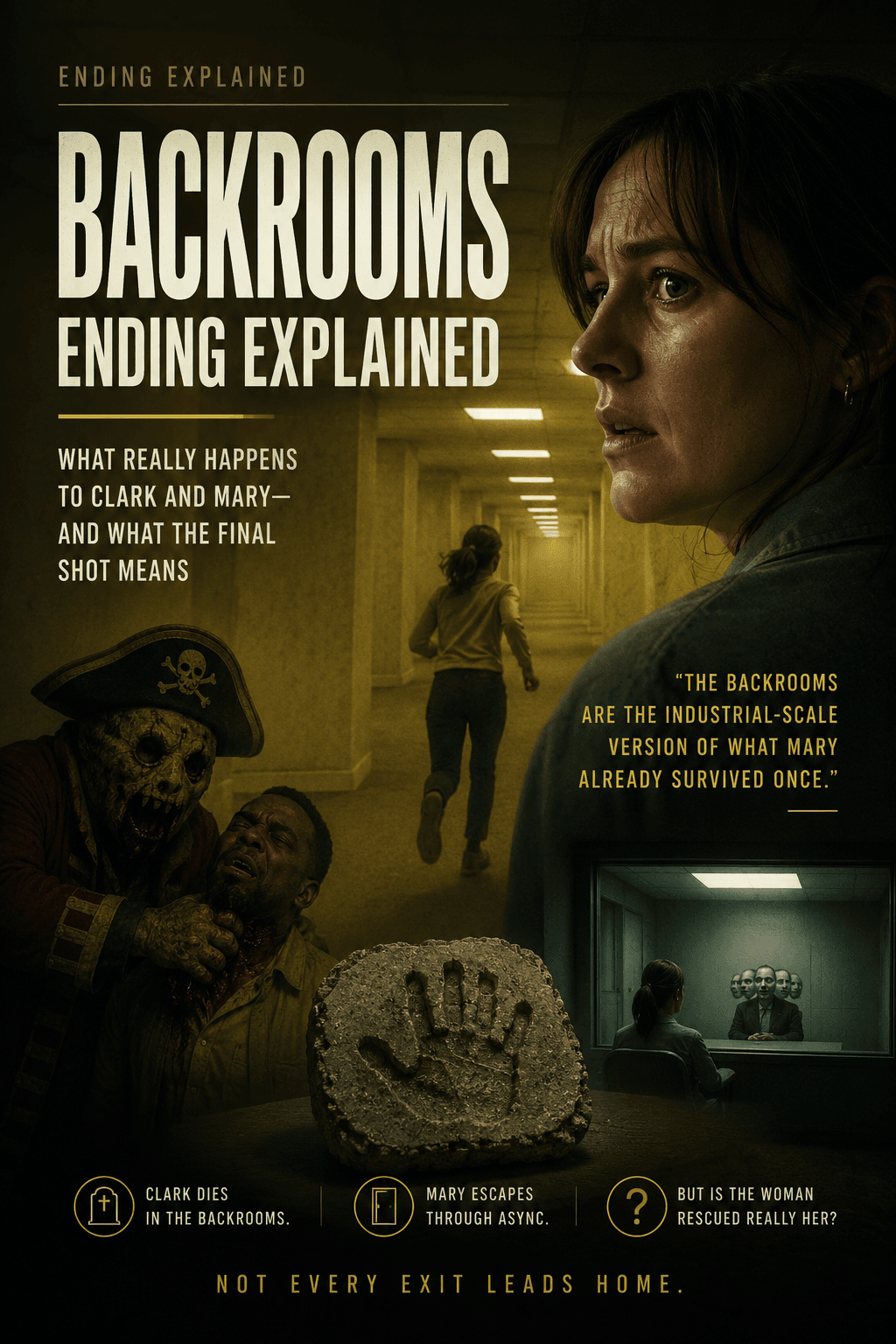
Backrooms ending explained, as plainly as Kane Parsons’ 2026 A24 horror film allows: Clark (Chiwetel Ejiofor) dies inside the Backrooms, his therapist Mary (Renate Reinsve) escapes through the Async Research Institute, and the final shot leaves open whether the woman we just watched get rescued is actually her. Here’s where working that out actually started for me, and it wasn’t with the movie.
I wrote three paragraphs once about a man who wakes up in a city that looks exactly like his own, except for details that are wrong in ways he can’t quite name at first. A newspaper box on the wrong corner. A neighbor’s dog that barks at a different pitch. I stopped after three paragraphs because I reread them and they sounded like journalism with the facts removed, which is a strange thing to realize about your own fiction, and I never deleted the file. It’s still somewhere in a folder with a name I can no longer find. I think about it more than a story that short deserves, mostly because I never figured out what was supposed to happen to the man once he understood the wrongness wasn’t going away. I didn’t know how to end it. It turns out Kane Parsons didn’t either, and unlike me, he had to end his in front of an audience large enough to hold him to it.
Backrooms Ending Explained: What Actually Happens
Here’s what actually happens at the end of Backrooms (2026), as plainly as the film allows anything to be plain. Clark, the furniture-store owner who slipped through his own basement wall into the endless yellow labyrinth the film calls the Backrooms, brought his employees Kat and a boyfriend named Bobby along early on to document the space on a camcorder, mostly out of curiosity and the specific kind of boredom that makes a man ignore every reasonable instinct he has. All three encountered something faceless and hostile during that first expedition. Kat and Bobby didn’t come back from it — Clark later shows Mary proof of what happened to at least one of them, Kat’s head kept in a refrigerator in one of the rooms he’s made into something like a home, and treats the reveal as a demonstration rather than a confession. Clark did come back, and by the time the film catches up with him again, he’s been living inside the Backrooms long enough that his sanity has come apart in a specific direction: comfort. He tells Mary he prefers his life here to the one he had outside, and he offers her a deal — he’ll let her go if she lets him stay. He means it. And while he’s in the middle of meaning it, his own copy arrives: a towering, distorted version of Clark dressed in the pirate mascot costume from his store’s television commercials, and it bites through his throat before he finishes the sentence. The copy goes after Mary instead, chasing her through rooms that are almost his furniture store and aren’t, until she manages to stun it with a piece of cement she’s been carrying since childhood. She stumbles through a portal into an Async research lab. A researcher named Phil (Mark Duplass) — who recognized Clark from his own commercials on one of the Foundation’s security feeds — questions her about what she saw. He never tells her whether she’s allowed to leave. The film’s final movement is a wordless tour of real-world locations from earlier in the story, each one rendered as its Backrooms equivalent, ending on the Async interrogation room where Phil just spoke to Mary — except this version of the room contains a twisted, multi-faced copy of Mary herself, sitting alone.
That’s the ending. Whether it’s a good one depends entirely on which of two things you decide you just watched, and the film will not help you decide.
What the Cement Handprint Actually Means
The detail that makes the ending land, if it lands for you at all, isn’t Async and it isn’t the pirate costume. It’s the piece of cement Mary uses to stop Clark’s copy in the film’s most physical moment of violence, and the film has spent its flashbacks making sure you understand exactly what that object is before it becomes a weapon. Mary’s mother, the film reveals in pieces, was very likely a woman living with untreated paranoid schizophrenia, an illness the film demonstrates through image rather than diagnosis: windows covered with newspaper, a childhood spent almost entirely indoors because her mother couldn’t tolerate the alternative. When that childhood home is eventually demolished, Mary is shown watching, and she keeps one thing: a handprint she and her mother once left together in wet cement outside the house, now a hardened, portable piece of a home that doesn’t exist anymore. She carries it. She looks at it on her desk, on her nightstand, in scenes that otherwise have nothing to do with her mother at all.
So when that same object becomes the thing she uses to survive a monster built from someone else’s unraveling mind, the film is telling you, as directly as it ever tells you anything, that Mary has spent her entire career treating patients like Clark because she has never stopped trying to treat the version of confinement she grew up inside of, and that the tool she finally uses against the Backrooms is the one physical object she has from the last time she was trapped somewhere she couldn’t leave. Async built the Complex, in the film’s account, mostly by accident, chasing a research program that outgrew its founders. Mary’s mother built a version of the same thing on purpose, out of love and fear she couldn’t separate from each other, in a three-bedroom house with the windows covered. Both women believed, or convinced themselves they believed, that confinement was a form of protection. It’s the same care-as-cage mechanism I wrote about in Rosemary’s Baby, just relocated from a Manhattan apartment to a suburban house with the windows covered. The Backrooms are the industrial-scale version of what Mary already survived once, and the film states that thesis about as plainly as it ever states anything.
Renate Reinsve plays the interrogation scene in a way worth pausing on separately from the film’s mythology. She doesn’t perform fear there so much as a very specific kind of exhaustion — the exhaustion of someone being asked to narrate her own trauma to a stranger who has already decided what he needs from the account. It’s the same posture the film gives her in early therapy-adjacent scenes with Clark, except now she’s the one being asked to perform coherence for an institution that isn’t particularly interested in whether the coherence is true. Whether or not that’s the real Mary in the chair, the performance is doing the same work either way.
What Async — “The Foundation” — Actually Wants
Onscreen, the organization Mary stumbles into is referred to as Async, and by its own researchers, more than once, as “the Foundation.” What the film confirms directly, through Phil’s own dialogue, is that Async used to manufacture MRI machines, and that its current work — mapping and researching the space it calls the Complex — grew out of that history without much further explanation offered on screen. Their access point is called the Threshold, built on distortion technology with roots in the early 1980s. Clark, during his own exploration, runs into several of Async’s “anomaly lures” scattered through the Backrooms — human-shaped cutouts paired with audio recordings that sound like they were inspired by the Voyager Golden Record, presumably meant to bait or study whatever the Complex produces. Async’s field agents show up wearing yellow protective suits in the film’s final act, and their rescue of Mary plays like retrieval, procedural and unhurried, the way you’d recover equipment rather than a person.
What the film makes unmistakable, regardless of exactly how far back Async’s history goes, is the outcome of that institutional patience: a company old enough to have stopped questioning itself, doing careful, well-funded, procedural work in a place that eats people, and debriefing the woman it just pulled out of it like an incident report waiting to be filed. That’s a familiar shape to anyone who has ever watched an institution investigate itself — the paperwork survives longer than anyone’s memory of what actually happened, and the paperwork is always, eventually, what gets believed. Phil never raises his voice at Mary once during the interrogation. He doesn’t need to. An institution that’s been doing this since before she was born has learned that patience reads as kindness to someone who’s just been pulled out of a nightmare, and that the two feel identical for exactly as long as it takes her to notice she still hasn’t been told anything.
The Still Life: What the Copies in the Backrooms Actually Are
The distorted, unmoving figures populating the Backrooms — the malformed dinner-table companions Clark keeps, the towering pirate-costumed thing that kills him — belong to a category the film’s own mythology calls the Still Life. Clark’s explanation of them, delivered somewhere past the point where anyone should trust his account of anything, is that the Backrooms “misremembers” people and places the longer they exist inside it, generating flawed copies the way a photocopy of a photocopy degrades a little more each pass. The copies can’t feel pain, he claims, demonstrating this on one of them with a knife. He also says they’re edible. Neither claim is something the film verifies through any perspective other than Clark’s own unraveling one, which is very likely the point: the most confident explanation of what the Backrooms actually are comes from the person the Backrooms has spent the most time damaging.
Longtime followers of Parsons’ original web series have floated a theory worth mentioning here as exactly what it is — a theory, not confirmed film content: that the Still Life may be a distant, more refined descendant of the “Lifeform,” the bacterial, hay-bacillus-based predator hinted at in the earliest YouTube shorts. The film never draws that line itself. It’s the kind of connection that means something if you’ve spent years in this mythology and nothing at all if you haven’t, and I’m including it here only because a Deep Dive is where that kind of speculation belongs, clearly labeled, rather than folded into what the movie actually confirms.
There’s a version of the Still Life concept that’s almost comforting, in the way explanations are always a little comforting even when they’re frightening — a discrete process, degraded copies, a name for the thing in the corner. And there’s a less comforting version sitting right underneath it, which the ending forces you to reckon with directly: if the Backrooms make Still Life copies of people who spend enough time inside them, then the movie’s final shot is showing you a forecast — what happens to anyone who stays too long, including, possibly, someone you spent the entire film rooting for.
The Final Shot, and the Two Marys You Could Be Watching
Here’s where the film declines to help you, and I think it’s the correct decision even though it cost the movie some of the goodwill it built in its first hour. The final montage shows a sequence of real-world locations transformed into their Backrooms equivalents, landing on the Async interrogation room, remade — and inside it, a twisted, multi-faced copy of Mary, alone, silent. Cinematographer Jeremy Cox handles this passage the same way he handles the film’s other best visual idea, gliding the camera down a succession of near-identical rooms that grow a little more abstracted with each cut, until the frame narrows into something closer to a held breath than a location. The technique doesn’t tell you which Mary you’re looking at. It tells you that the distance between the real version of a place and its Backrooms copy is not a wall you cross once, but a process you can drift into gradually enough to never notice the exact room where you stopped being yourself.
Read one way, Mary escaped. The scenes of Phil going about an ordinary life outside the Complex afterward support this — the film has no obvious reason to keep tracking him if the entire back half was some copy’s fantasy. Under this reading, the woman we watched get interrogated, the woman who stunned Clark’s copy with her mother’s handprint, the woman who made it through the Threshold — that’s the real Mary, and what survived isn’t her. It’s a residue. A version of her that the Complex kept because it had already started building her out of the same degraded material it built Clark’s dinner-table copies from, and that residue is what the final shot shows you: not Mary’s fate, but the fee she paid to leave. This reading is the kinder one, and it’s also the one that leaves the most room for a sequel, which may be exactly why it’s the version the marketing seems to want you to land on.
Read the other way, and the entire back half of the film — the interrogation, Phil’s non-answers, the conversation we thought was Mary’s actual rescue — never happened to the real Mary at all. We’ve been watching her copy’s version of events the whole time, a Still Life’s misremembered account of an interrogation that a version of her that no longer exists in the real world is convinced is still ongoing. Under this reading, nobody knows where the actual Mary is. Possibly nobody, including Async, ever will. It’s the crueler reading, and the one I find myself returning to at two in the morning more often than the kinder one.
I’ve turned this over more than a film with this level of narrative slipperiness usually earns from me, and here’s where I’ve landed, for whatever it’s worth: I don’t think the film wants you to resolve it, and I don’t think that’s a cop-out, this time. I wrote about a similar refusal to resolve who a woman actually becomes at the end of Midsommar’s ending, and I thought the refusal was the correct choice there too. Mary spent her childhood in a house where the version of reality she was given didn’t match the one that existed past the covered windows, and she was never given the tools to know for certain which one was true while she was living inside it. The ending puts the audience in exactly that position on her behalf. You don’t get an ending where you find out which Mary survived. You get an ending where you understand, physically, in your own chest, what it felt like to be nine years old in that house, unable to tell the difference between being protected and being erased. That’s the only ending honest to what the movie has been building for two hours.
Is There an Official Backrooms Ending Explained by Kane Parsons Himself?
Not in detail. Parsons has discussed the film’s liminal-horror lineage and his own creative process in press interviews, but as of this writing he hasn’t publicly stated which reading of the final shot is correct, or confirmed whether Mary escaped at all. The ambiguity reads as intentional, not as an oversight waiting for a future interview to clear up.
Where This Fits in Kane Parsons’ Larger Backrooms Mythology
Worth knowing, if you’re coming to the film cold: this isn’t the start of the story Parsons has been telling. His original YouTube short, “The Backrooms (Found Footage),” went up in January 2022 and made him briefly, enormously famous before he’d finished being a teenager, and the feature film’s 1990 setting actually predates the in-universe timeline of that original short, which — per the mythology Parsons has built across dozens of subsequent videos — takes place around 1996. The movie functions as a prequel to material that already existed and already had an audience, which is a strange, backward way to build a franchise, but it’s consistent with how Parsons has always worked: adding rooms to a house he started building years before anyone was paying him to.
The film’s cold open, a found-footage sequence of an Async researcher named Naren Warne (Avan Jogia) recording himself and being chased by something the camera never quite catches, functions as connective tissue to that same mythology. Warne appears to be an Async employee separated from a survey team, one small thread among many the film leaves untied on purpose. It’s the kind of detail that means very little if you’ve never touched the source material, and quite a lot if you have — a signal, mostly, that the feature film exists inside a much larger, much older story rather than starting one from scratch. If you want the full craft-and-performance case for or against the movie itself rather than its ending, that’s the Review, not this piece.
There’s no confirmed sequel as of this writing, though critics who covered the film’s opening weekend have floated the idea of an anthology approach — each future installment following a different person who stumbles across a Threshold, the way Clark did, with the mythology accumulating slowly across otherwise unconnected stories. Given the box office and the amount of unfinished business Parsons left in the frame on purpose, something is coming eventually. I’d rather say nothing than guess at a plot he hasn’t announced.
I never went back and finished that story about the man in the wrong-detailed city. I’ve thought, a few times, about what it would take to write an ending for it now, and I keep arriving at the same problem Parsons clearly ran into: the story only works as long as the man doesn’t get an answer, because the answer was never the frightening part. The frightening part was watching him notice, one detail at a time, that noticing wasn’t going to be enough. I don’t know which Mary is sitting in that room at the end of Backrooms. I’ve decided I don’t need to. I know what it’s like to leave something unfinished because finishing it would have required pretending I understood something I didn’t, and I recognize, watching this film, that Parsons — twenty years old, handed a budget large enough to force an answer out of a mystery he’s been building since he was a teenager — chose, in the one place it mattered most, not to pretend.