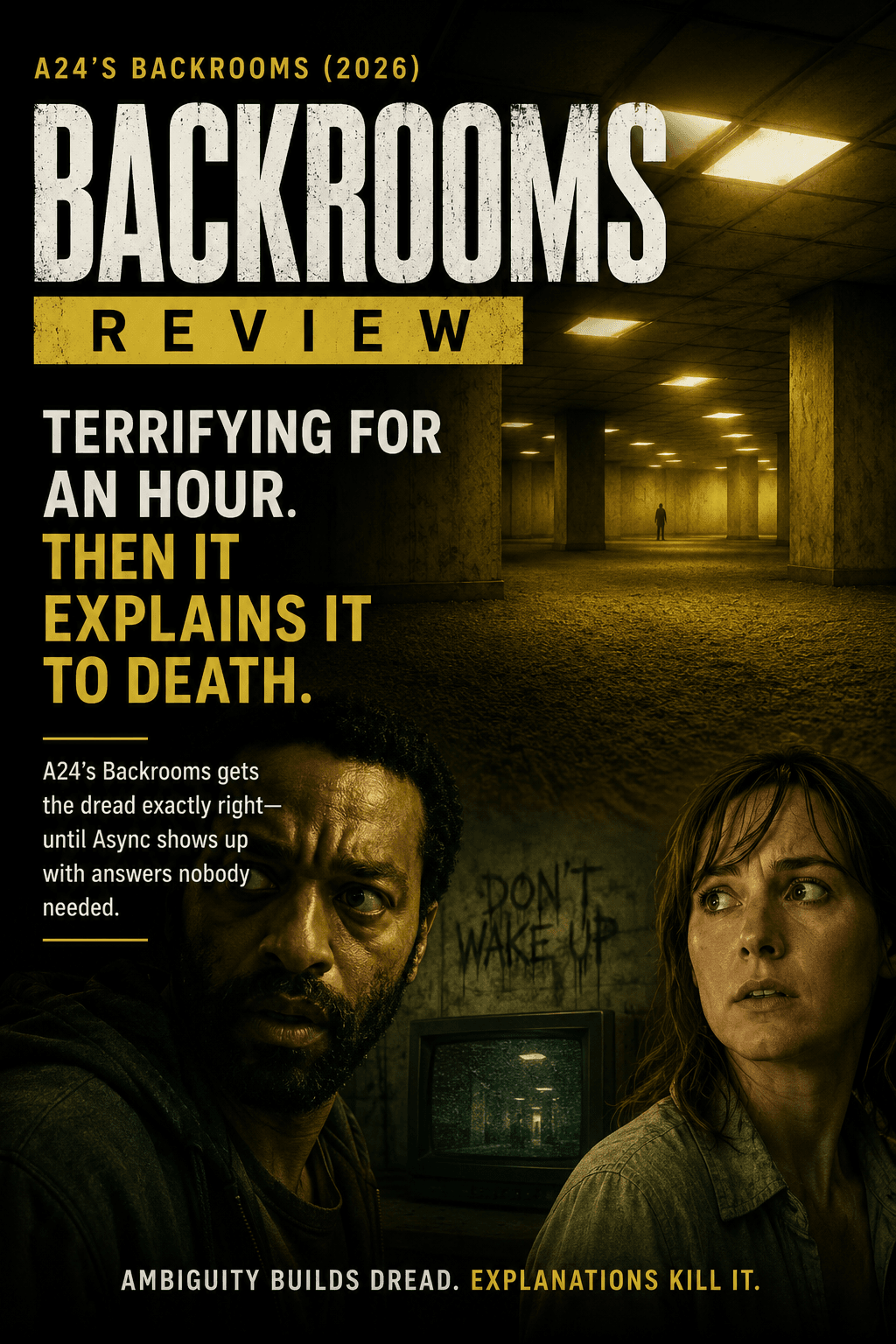
This Backrooms review is going to tell you plainly what I told myself walking out of the theater: Kane Parsons’ 2026 film for A24, starring Chiwetel Ejiofor and Renate Reinsve, gets the dread exactly right for an hour, then explains it to death. Here’s where that argument actually started, and it wasn’t in a theater.
The lawyer said “incident” seven times in forty minutes. I counted, because counting kept my hands still. Six men died when a fertilizer plant outside Tyler, Texas, came apart in a fire nobody at the company called an explosion, and the insurer settled with the families in eight weeks — faster than any investigation I ever ran. Nobody in that room said “death.” I understood, watching a light hum instead of just shine, that the speed itself was the strategy.
I thought about that room through the entire second half of Backrooms. Somewhere around the hour mark, the Async Research Institute stops being a rumor scrawled into the corners of this film and becomes its actual engine — a corporation that pried open an interdimensional wound in 1989 using hardware built for MRI machines, then looked at the incomprehensible thing it had done and asked how much square footage it could rent out.
That’s the moment the fluorescent hum in this film reached past the screen and touched something specific: the exact frequency of the light in that conference room outside Tyler. Sixty-three people are reported to have died the day Async’s Threshold opened, a number the film raises once, in passing, on its way to the next plot beat — the same register I remember from that settlement meeting, a dead man’s name reduced to a line item between two clauses.
It’s the same sincerely self-deceived architecture I found writing about the Warrens — an institution that believes its own cover story so completely it stops being a lie and starts being a worldview. I have sat in that room. I know exactly how the paperwork sounds when it’s still warm.
That’s the film I wanted more of. What Parsons and screenwriter Will Soodik actually built is a $10 million A24 production that took a mythology assembled for free, over four years, by strangers on the internet who never once agreed on a single fact about it, and gave it an org chart: a physicist credited in the film’s own lore as Lawrence Altman, a founding date, a motive.
That motive, per the film’s own mythology, is real estate — Async’s founders reportedly measured the Backrooms as the greatest real estate opportunity in human history, an infinite floor plan with no zoning board to answer to, treating the deaths inside it as an acceptable cost of doing business. A twenty-year-old director who spent his teenage years rendering these rooms in Blender because nobody had explained them yet is now the person who explained them, on a screen large enough that the explaining can’t be walked back.
Here’s the ugly part, stated plainly: Backrooms spends its first hour being genuinely, physically upsetting, and spends its second hour turning that dread into a lecture. Clark (Chiwetel Ejiofor) discovers he can slip through a basement wall in the furniture store he’s failing to keep alive, and for a while the film trusts that discovery to carry the whole weight of the story — institutional yellow light, carpet the color of nothing, a stop sign printed backward in a room no car has ever entered. Then Async arrives to answer questions nobody watching this film actually needed answered, and something that felt like it might live in your chest for a week starts curdling into a briefing document.
Ambiguity is the foundation good dread gets built on. Async spends the film’s second half pouring concrete over that foundation and calling the result world-building. Hand me a founding date instead of a mystery and I will resent you for the trade, because I already know exactly what a founding date sounds like when an institution uses one to make an atrocity look administrative.
Clark’s disintegration gets more sympathy from this film than I think it earns, and I want to be specific about why, because every review I’ve read keeps calling it “tragic” like the word does any work. He’s an alcoholic sleeping in the store his wife threw him out of. Fine. He’s a failed architect who never built the one thing he actually wanted to build. Fine. None of that earns him the choking scene.
Hearing something approach in the dark, he calms Mary (Renate Reinsve) and puts her to sleep with his hands around her throat, and the film shoots it like a rescue — like Clark, for one crucial moment, is finally the man who takes care of someone. A man who decides, unilaterally, what another person needs to survive is exercising the one skill he has left: deciding things for people who never asked him to.
The film wants me to call that protection. I call it control wearing protection’s clothes, and Clark believing the costume completely — the same care-as-cage mechanism I wrote about in Rosemary’s Baby, just relocated from a Manhattan apartment to a furniture store basement. The pirate-mascot creature that arrives later and bites Clark to death plays, by that point, as a mercy killing the film doesn’t have the nerve to name as one.
Mary gets the one idea in this film that actually earns its keep, buried under everything Async spent an hour explaining. Her fate arrives almost as an aside: she’s revealed to be one of the distorted, unmoving copies that have been populating these rooms the entire time, a version of herself replicated by whatever process built this place, apparently bound to keep returning here to relive whatever trauma the Backrooms decided was hers.
What that means for her going forward stays exactly where the film leaves it: unexplained. It’s the only moment in the back half that trusts an audience the way the first hour did, and it lands like a small, cold hand closing around something, precisely because Parsons finally shuts up.
Ejiofor is doing work here that the script barely deserves. Watch what he does at the dinner table, tied down, explaining to Mary that the malformed thing across from her is made of some edible white substance, demonstrating by stabbing it: his face carries the specific, reasonable calm of a man who has convinced himself, completely, that what he’s doing is care. That’s harder to act than terror. It’s the face of every man who has ever mistaken control for love, and Ejiofor plays it without a single wink toward the audience asking us to forgive him for it.
Reinsve takes the colder, less flattering assignment: she reacts. She refuses almost every chance the script gives her to scream on cue, goes silent, her face doing the work of a woman recalculating, scene by scene, whether the man in front of her is still safe to stand near. That’s the actual horror movie hiding inside this one, and both actors know it even when the screenplay doesn’t.
Cinematographer Jeremy Cox understands the assignment better than the writers did. Parsons told The Hollywood Reporter his team ran fifty separate wallpaper tests to land on the exact, sickly shade of institutional yellow that coats these rooms, and it shows — the color sits on the eye like a low-grade fever, something closer to a physical symptom than a design choice, a warmth that never once feels like it wants you there.
Cox also knows when to step back entirely — a stretch of the early exploration plays through the grainy, degraded lens of a VHS camcorder Bobby drags along to document the space, and the format sells the wrongness of these rooms better than any of the digital polish around it.
The best single shot in the film is a hallway of receding living-room floors, each one a little more abstracted than the last, collapsing finally into a black hole radiating out of a corner that used to just be a corner. That image makes not-knowing feel like the entire point, the way this mythology felt for four years before anyone got paid to finish the sentence.
Edo Van Breemen and Parsons’ score mostly refuses melody, sitting just underneath the fluorescent hum sound mixer Jan Hetmer built into nearly every frame, so that music and infrastructure become indistinguishable — the correct choice for a film about a place where a building and a threat are already the same thing.
Editor Greg Ng’s cut is where my anger finds its clearest evidence: an hour of accumulated dread compressed against a final twenty minutes forced to deliver chase, explanation, and twist in the runtime most films give a single act. The complaint showed up independently, worded almost identically, from viewers with no connection to each other — that the movie spent ninety minutes building a room it only gave itself twenty minutes to burn down. A theatrical reissue billed as the Everything Must Go Edition adds fifteen minutes back in as of today. Nobody outside the production has said whether that footage restores any of the film’s nerve or just extends the lecture.
2026 has been a genuinely strong year for horror willing to make its villains recognizable instead of supernatural — I said as much about Obsession back in the spring, and Backrooms belongs in that conversation even when it loses its nerve. The internet communities that built this mythology — analog horror, liminal horror photography, the entire ecosystem of unsettling nothing that thrived on YouTube while studios were still budgeting for jump scares — understood something Backrooms forgets the moment Async opens its mouth: the scariest room is the one nobody has mapped yet.
I sat through Skinamarink and found it more exhausting than frightening, and I’ll say this in its favor now, because Parsons’ film is what makes me say it: at least Skinamarink had the discipline to never once explain itself. Backrooms wants to live in that same unmapped room and also hand you the deed to it. A film gets to pick one of those things. This one tried to keep both, which is its own kind of greed — Async’s greed, dressed up as an aesthetic choice.
I keep coming back to that conference room outside Tyler — the hum of the light, the lawyer’s mouth shaping “incident” for the seventh time like the word cost him something to say and he’d decided it was worth the price. I recognized that hum the moment Clark’s flashlight caught the first flicker of institutional yellow, before I knew anything about Async, before the film handed me a founding date and a motive and asked me to feel less angry now that I understood the mechanism. I didn’t.
Understanding the mechanism never once made those six men less dead. It doesn’t make Async’s sixty-three any less dead either. It just gives the people responsible a sentence to hide inside, and hands the rest of us a runtime to sit through while they find it.
Ethan’s Score: 6 / 10
Backrooms Review: Frequently Asked Questions
Is this Backrooms review positive or negative?
Mixed. This Backrooms review praises Chiwetel Ejiofor and Renate Reinsve’s performances, Jeremy Cox’s cinematography, and the film’s first hour, but argues the back half undercuts its own mystery by over-explaining the Async Research Institute’s mythology — trading the ambiguity that earned its dread for exposition. Ethan’s score: 6/10.
What is the Async Research Institute in Backrooms (2026)?
Async is the film’s fictional corporation, credited in its lore to a physicist named Lawrence Altman, that opened the Threshold into the Backrooms in 1989 using hardware originally built for MRI machines, then pursued the space as a real estate opportunity — treating the deaths it caused along the way as an operational cost.
Is Backrooms (2026) based on a true story?
No. Backrooms is inspired by an internet creepypasta and adapted from director Kane Parsons’ own YouTube web series, “The Backrooms (Found Footage),” which began in 2022. The Async Research Institute, its founder, and its 1989 timeline are original mythology invented for the film, not documented history.
How long is Backrooms (2026) and is there an extended cut?
The theatrical cut runs roughly 110 minutes and is rated R. An extended version titled Backrooms: Everything Must Go Edition, adding fifteen minutes of previously unreleased footage, returned to theaters starting today; the contents of that additional footage haven’t been detailed publicly.