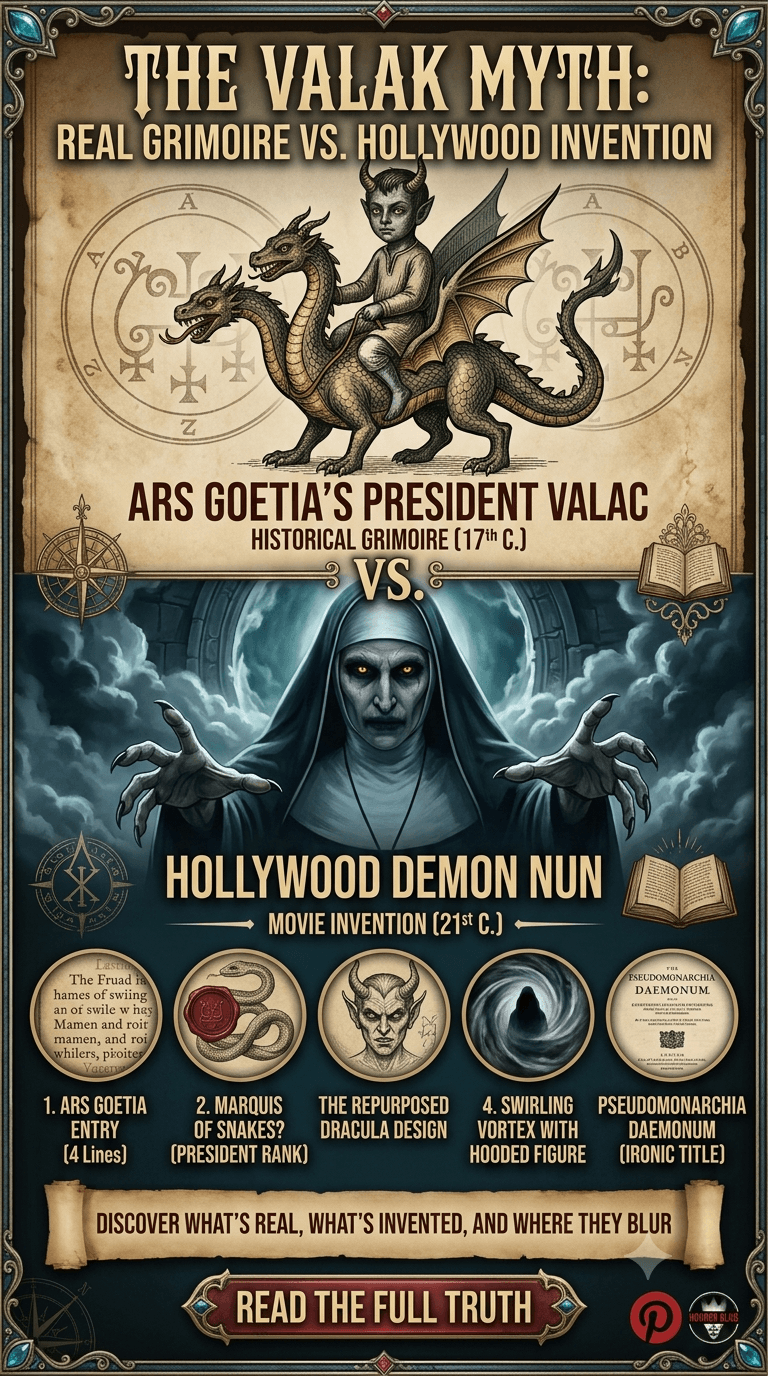
The actual entry runs about four lines in a manuscript most people will never open. A president of Hell, sixty-second in a list of seventy-two, rides a two-headed dragon, appears as a boy with the wings of a cherub, tells you where the gold is buried and makes snakes come and go without harming anyone. That’s the whole file — four lines, written centuries before anyone had heard of Romania, an abbey, or a nun.
Five films, a nine-figure marketing budget, and one of the most recognizable faces in modern horror have been built on top of those four lines. I want to be precise about what happened here, because the sloppy version of this story is “Hollywood ruins everything,” and that’s not quite it. What happened is more specific, and more irritating: a franchise borrowed the credibility of a real occult text without doing the actual work the text represents, and it has spent a decade letting audiences assume the difference doesn’t matter.
It matters concretely: a real historical document is being cited as evidence for a story that document never told. Let me walk through what’s real, what’s invented, and where the two get deliberately blurred.
The Real History of the Ars Goetia and the Lesser Key of Solomon
Valak comes from the Ars Goetia, the first section of a seventeenth-century grimoire usually called the Lesser Key of Solomon — Lemegeton Clavicula Salomonis, if you want the Latin the manuscripts actually use, since “Lesser Key of Solomon” is a title later scholars invented to distinguish it from a different, unrelated Key. The book claims Solomon himself compiled it. He didn’t. The titles of nobility assigned to the demons, the structure of the rankings, the prayers to Jesus and the Trinity scattered through a supposedly pre-Christian text — none of it existed in Solomon’s lifetime. Scholars call this kind of false attribution pseudepigrapha, and the Ars Goetia is a textbook case of it, several centuries younger than the king it claims as its author.
Here’s where it gets more interesting than the average “ancient evil” title card wants you to know. The most direct source for the Ars Goetia’s demon list is a work called Pseudomonarchia Daemonum, published in 1577 by a physician named Johann Weyer. Weyer wasn’t a sorcerer. He trained as a physician, served as personal doctor to the Duke of Cleves, and used that medical standing to do something almost nobody with his credentials was doing in 1563: arguing that accused witches weren’t consorting with the devil at all — that what looked like demonic possession was mental illness, and that the women being tortured and executed across the continent needed doctors, not inquisitors. His major treatise on the subject, De praestigiis daemonum, got him attacked by nearly every theologian of his era. Some historians who’ve studied his work closely believe the demon catalog he appended to it — the one that would eventually mutate into the Ars Goetia — was constructed with a specific irony in mind. He titled it Pseudomonarchia Daemonum. Translate that literally: The False Monarchy of Demons. A man trying to convince Europe that hell’s org chart was superstition gave his catalog of hell’s org chart a title that announces it’s fake, and four hundred and fifty years later a horror franchise is treating that same catalog as documented lore.
Most horror franchises that reach for this kind of texture don’t even go this far. A pentagram, some Latin conjugated badly, a name that sounds vaguely Sumerian — dressing pulled from nowhere in particular, credited to no tradition at all, because nobody involved expected anyone to check. Give the Conjuring Universe this much: they opened an actual grimoire and pulled a real name out of it. That’s a lower bar than it should be, and clearing it only gets you the first half of research, stopped the moment a usable name turned up.
I’m not asking anyone to take a position on whether demons are real. I’m asking the Conjuring Universe to be honest about which century its “research” actually comes from, and what the man who wrote it down was trying to say when he wrote it.
What Valak Actually Is in the Ars Goetia, According to the Text Itself
Strip away five films of production design and here’s what the primary source says. Valac — spellings vary across manuscripts, Valak is one variant among several — is the sixty-second spirit in the Ars Goetia’s list of seventy-two, ranked as a President with thirty legions of his own command. He appears as a small boy with angel’s wings, riding a two-headed dragon. His stated abilities: he gives true answers concerning hidden things, tells the seeker where treasure is buried, and brings serpents into the sorcerer’s presence, then removes them again, harmless, on command. Every serious edition of the text repeats this same short description with minor spelling variation, including Joseph Peterson’s 2001 critical edition, generally considered the standard scholarly version — four sentences of canonical material, full stop.
The convent, the suicide, the abbey, the perpetual adoration, Frenchie, the relic key made from Christ’s blood — every piece of narrative architecture the Conjuring Universe has built around this demon, the entire mythology of The Nun and most of what happens in The Nun II, is invented whole-cloth by screenwriters who owe the source tradition nothing beyond the demon’s name. This is the same grimoire I’ve traced before, when Hereditary’s King Paimon turned out to outrank almost everything the film implies about him — a pattern worth noticing once you see it the first time.
There’s also a smaller, more specific error worth sitting with. In The Conjuring 2, Lorraine identifies the entity by calling it “the marquis of snakes.” Marquis is a real rank in the Ars Goetia — Marquis Andras, Marquis Decarabia, Marquis Amon all hold it. Valac doesn’t. Valac is a President. It’s a small detail, and I’d forgive it as dramatic license if the franchise weren’t simultaneously trading on the idea that its demonology is the product of careful research. You can’t have it both ways. Either the text matters enough to get right, or it’s set dressing, in which case stop implying otherwise in every DVD extra and press junket.
Where the Demon Nun Design Actually Came From
Here’s the part that should bother anyone who’s paying attention to how “based on a true story” actually functions as a marketing phrase. James Wan has been candid about where the Demon Nun came from, and the documented version is stranger, and more revealing, than the vague myth around it. Lorraine Warren described the entity to him directly, in his account: “a swirling tornado vortex with this hooded figure in there.” That’s the real quote, and it’s vague enough to describe fifty different things, or a bad dream, or nothing at all.
What Wan and concept artist Aaron Sims actually built first wasn’t a nun. It was a horned demon, repurposed from an unused Dracula design the two of them had developed years earlier for a Castlevania film adaptation that never got made. That version stayed in the film through most of production, filmed and edited into rough cuts. Wan pulled it in the editing room, decided a horned demon read as too disconnected from the story he was telling, and only then, by his own account, thought back to how much Lorraine had loved and respected the nuns in her life, and rebuilt the antagonist around that image instead. The single most iconic face in the Conjuring Universe, the image now licensed onto masks, action figures, and an entire spinoff trilogy, was assembled during post-production from a repurposed vampire design and a director’s memory of an offhand comment about Lorraine’s friends.
Every serious account of the actual Enfield investigation — Maurice Grosse and Guy Playfair’s original case notes, the skeptical follow-ups, even the Warrens’ own version of events — describes a poltergeist: furniture moving, doors banging, a teenage girl named Janet producing a guttural male voice that investigators found genuinely unsettling in the moment. Ventriloquist Ray Alan later listened to the recordings and concluded Janet was doing exactly what ventriloquists do, using a technique that doesn’t require moving your lips, no possession required. Ed Warren’s own visit to the house was brief enough that one of the original investigators, Guy Playfair, remembered him mostly as someone more interested in book and movie rights than in the phenomenon itself. Nothing in any of that involves a habit, a convent, or a name out of a seventeenth-century grimoire. The demon nun enters the story only in the screenplay, decades later, attached retroactively to a case that never produced one.
The Nun takes this one step further. The entire backstory — Abbey of St. Carta, a Duke who opened a gateway to Hell, a nun’s staged suicide to prevent a demonic vessel from taking her soul, a relic containing Christ’s blood sealing a portal beneath a Romanian abbey — is manufactured for a 2018 spinoff with no claimed source in the Warrens’ actual casework at all. Nobody involved in making it has ever suggested otherwise. It doesn’t need to pretend. And yet it exists inside a franchise built almost entirely on the promotional value of the phrase “based on true events,” released alongside real photographs of Ed and Lorraine, real quotes from real interviews, real case names attached to entirely fictional demons.
What The Conjuring Universe Actually Got Right About Valak
I want to be fair here, because the alternative is the same lazy overcorrection I’d criticize in anyone else. The production side of this franchise has, at points, actually opened the text. The snake imagery scattered through The Nun — the throne carved with serpents, the visions ending in snakes pouring from a dead boy’s mouth, the demon striking at a priest’s eye — tracks directly back to Valac’s actual attribute of commanding serpents. It’s a small, specific detail, the kind that’s easy to fake badly and easy to skip entirely, and most productions reaching for this kind of texture do exactly that — skip it. Someone on that production read past the demon’s name and pulled a real detail into the visual design, and I’ve catalogued the rest of what they built around it elsewhere, Easter egg by Easter egg. That’s more effort than most horror productions bother with when they reach for a Latin phrase and a pentagram and call it done.
But pulling one accurate detail out of a four-line grimoire entry and then building five feature films’ worth of invented mythology around it amounts to set dressing with a bibliography, deployed specifically so the marketing can use words like “authentic” and “based on documented demonology” in the same sentence as a plot about a Romanian nun-suicide portal that nobody, anywhere, has ever claimed really happened.
Why the Valak Mythology Still Bothers Me
The invention itself doesn’t bother me. Horror has always built monsters out of borrowed parts, and that’s the genre working exactly as intended. Robert Eggers invented dialogue for The Witch that sounds more authentically period than most of what actually survives from the era, and nobody reasonably accuses him of fraud, because The Witch announces itself as historical fiction built with historical care, a period piece rather than a transcription. The Conjuring Universe does something different. It wants the emotional and commercial benefit of “this really happened” attached to material its own creators freely admit, on the record, was invented in a production meeting and revised again in an editing bay.
I spent a decade in journalism learning to ask who benefits from a story being told one way instead of another, and I’ve said elsewhere that I think James Wan is a gifted technician with very little to say once the mechanics are running. This is exactly the mechanism I mean. The demon nun is a genuinely effective piece of horror iconography. I won’t pretend otherwise; the image works, and Bonnie Aarons’ physical performance in that habit is doing real craft. But effectiveness and honesty are two different currencies, and a franchise that keeps one foot in “inspired by true events” while inventing ninety percent of its central mythology from nothing is asking its audience to do the sorting work that the marketing has every incentive to keep blurred. The Warrens themselves earned that same scrutiny long before Valak ever showed up in a script.
Weyer wrote his catalog of demons specifically to expose how much of the hellish hierarchy Europe believed in was invention dressed up as authority. Four hundred and fifty years later, a studio took his joke, gave it a nun’s face, and sold it back to us as documented history. I don’t think Weyer would find that funny. I think he’d recognize exactly what it was.
Frequently Asked Questions
Is Valak a real demon from historical texts?
Valac appears in the Ars Goetia, part of the seventeenth-century grimoire the Lesser Key of Solomon, ranked as the sixty-second of seventy-two spirits and holding the title of President. The text describes him as a boy with angel wings riding a two-headed dragon who reveals hidden treasure and commands serpents. There is no historical or textual basis for the nun form, the Romanian abbey, or any of the Conjuring Universe’s invented backstory.
Did the Warrens ever document a case involving Valak?
No. James Wan has said the Demon Nun design replaced an earlier horned-demon concept during editing, inspired partly by Lorraine Warren’s description of a “swirling tornado vortex with this hooded figure in there” and partly by his memory of her affection for real nuns. No documented account of the actual Enfield investigation, which The Conjuring 2 is nominally based on, describes a demonic nun.
Why does The Conjuring 2 call Valak “the marquis of snakes” if he’s ranked President?
Marquis is a genuine Ars Goetia title, but it belongs to other spirits in the text, such as Andras and Decarabia. Valac’s actual rank in every standard edition of the Lesser Key of Solomon is President. The line appears to be a dramatic simplification rather than an accurate citation of the source material.
Where did the Ars Goetia’s demon list actually come from?
The most direct source is Johann Weyer’s 1577 Pseudomonarchia Daemonum, appended to his treatise arguing that accused witches were mentally ill rather than genuinely allied with the devil. Some historians believe Weyer’s title, which translates to “The False Monarchy of Demons,” was intended ironically, cataloging a hierarchy he considered superstition rather than endorsing it.
Does any of this make The Nun or The Conjuring 2 bad movies?
Not on its own. Craft and honesty are separate questions, and a film can be well made while still misrepresenting its own sourcing. Inventing a mythology is standard practice; every horror franchise does that. What’s specific to this one is the marketing borrowing the credibility of “true events” and “documented demonology” for material everyone involved knows was built in a writers’ room.