You watched The Nun (2018) for the jump scares, because that’s what the trailer promised, and the trailer wasn’t lying. Somewhere around the second viewing — the one you didn’t plan on, the one that happened at 1 AM because sleep wasn’t happening and the film was already queued up — you started noticing things. A word on a chalkboard that didn’t belong there. A license plate the camera held on half a second too long. A face carved into stone that looked, if you squinted, disturbingly specific. The film was shot entirely on location in Romania rather than on a studio backlot dressed to look Eastern European — a production decision that’s invisible in any single frame and cumulative across all of them, since the stone in this movie has actually been outside for centuries.
That’s the thing about Corin Hardy’s The Nun (2018), the fifth entry in the Conjuring Universe and the film that finally gave Valak — the demon James Wan and Lorraine Warren spent The Conjuring 2 chasing — an origin story. I’ve been hard on Wan’s producing hand before: a gifted technician, in my accounting, with very little to say once the mechanics are running. Hardy directed this one, not Wan, and it shows in the density of what got buried in the frame. Somebody on this production cared enough to hide a decade’s worth of detail into shots most audiences will only see once, in a dark theater, distracted by their own pulse. That effort deserves an honest accounting, even from someone who still finds the mythology underneath it thinner than the studio wants you to believe.
The film also became the highest-grossing entry the Conjuring Universe had produced at the time of its release — $366 million worldwide off a $22 million budget, per Wikipedia’s sourced figures. That kind of return usually buys a franchise permission to stop trying. This one kept doing Ars Goetia research and hand-molding death masks anyway.
The Nun hidden details below are confirmed and cross-checked, not guessed at.
How Valak’s Name Is Hidden Throughout The Nun (2018)
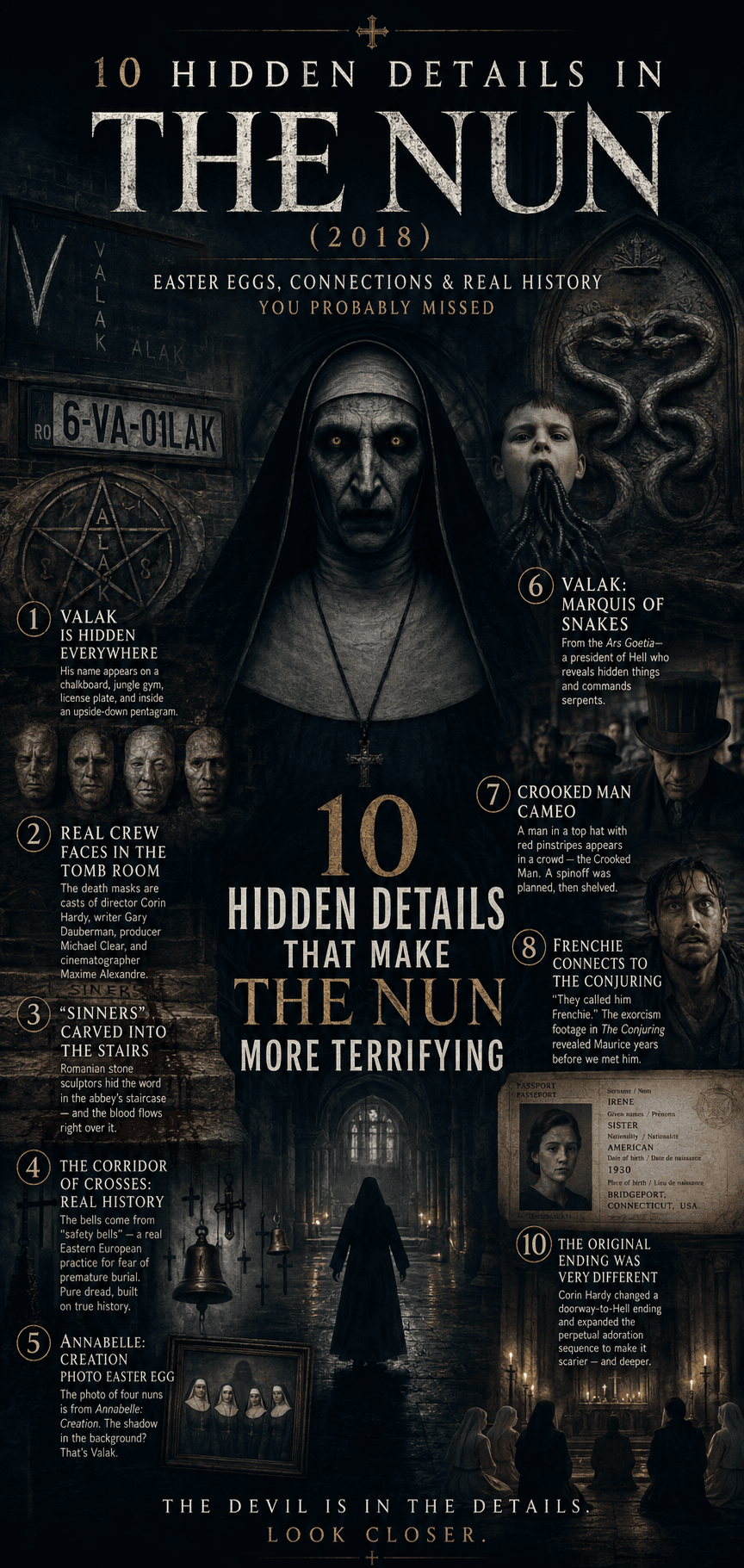
Before Sister Irene ever leaves for Romania, the film has already told you who’s coming. In the classroom where she teaches children about dinosaurs and the limits of biblical literalism, the word VALAK sits spelled out vertically and upside-down on the chalkboard behind her. A V-shaped chair completes it, positioned just before the letters “ALAK” on the right side of the frame.
The pattern continues once the story moves to Biertan. The jungle gym at Irene’s school traces the same five letters in its bars. When Father Burke loads his bags into a Romanian pickup truck, the license plate reads 6-VA-01LAK — remove the middle digits and you’re left with VALAK, sitting in plain sight on a piece of set dressing nobody in the scene acknowledges. Inside the abbey, the name reappears again inside an upside-down pentagram. Corin Hardy told Digital Spy there are a few of these hidden throughout the film, including one he called “a really subtle one” that he was proud of and declined to point to directly — which means there’s at least one confirmed Easter egg in The Nun that nobody has definitively cracked in the years since.
This isn’t unique to The Nun. The Conjuring 2 hid Valak’s name across the Warren household — the kitchen windowsill, a bead bracelet, a bookshelf — before Lorraine ever consciously identifies it. What’s worth sitting with is the logic underneath the trick: the demon’s name exists in the environment long before any character speaks it aloud, already furniture in these rooms, the kind of thing you walk past without reading.
The Real Crew Faces Hidden in The Nun’s Tomb Room
One of the best hidden details in the film sits in the scene where Irene, Burke, and Frenchie move through the abbey’s crypt, staged like a gallery — rows of tombs, each crowned with a molded death mask. Those faces are plaster casts of the actual crew: director Corin Hardy, screenwriter Gary Dauberman, executive producer Michael Clear, and cinematographer Maxime Alexandre all had their faces molded and cast as the dead of St. Carta.
I find this detail more interesting than it has any right to be, mostly because of what it reveals about how physical this production insisted on being. Alexandre — who also shot The Crazies in 2010 and would later shoot Annabelle: Creation, the film that supplies one of this article’s other entries — spends most of The Nun working in near-total darkness lit by torch and window, a style that depends on knowing exactly how much shadow a frame can hold before it stops being readable. Casting his own face into a prop he then had to light convincingly is the kind of in-joke that only makes sense to someone who trusts his own craft enough to put himself literally inside it.
The Hidden Word Carved Into The Nun’s Bloody Staircase
The abbey’s stone staircases weren’t built on a soundstage. Hardy brought in Romanian stone sculptors to carve them by hand, and let those sculptors hide words inside the stonework — words the camera never directly frames, words a viewer has to already be looking for. During the sequence where blood pours down the stairs, the carved word “Sinners” sits directly beneath the flow, so the blood runs over the letters as it descends.
It’s a small piece of production design doing the job a line of dialogue would otherwise have to do. Whoever the blood belongs to, morally speaking, the stairs answered that question before anyone walked down them.
The True History Behind The Nun’s Corridor of Crosses Scene
Corin Hardy has said, more than once, that he considered the corridor-of-crosses set genuinely haunted during production — the kind of claim a director makes to promote a horror film, or the kind of claim a director makes because something actually happened on that set, and I have no way of confirming which from here. The sequence where Irene walks a gauntlet of hanging crucifixes is the film’s clearest attempt at pure sustained dread, built on a piece of real history most viewers won’t clock. The bells audible in that scene are modeled on “safety bells” — a genuine Eastern European practice, dating back to eras when premature burial was a real enough fear that coffins were sometimes rigged with a bell and a string, so someone buried by mistake could signal from underground. Hardy has talked about wanting the abbey’s history to feel physically true rather than invented for the occasion, and this is where that intention actually lands. The bells are a documented historical anxiety, repurposed as sound design. Editors Michel Aller and Ken Blackwell let the sequence run longer than the film’s average scare rhythm elsewhere, a pacing choice that gives the bell detail time to register as history rather than noise — most horror edits would have cut two seconds before the sound had a chance to mean anything.
Some viewers have reported hearing a further layer in that same sequence — the words “the nun” repeated underneath the score at a slowed, warped tempo, buried low enough in the mix to register as unease before it registers as language. I’ll flag this one honestly: it’s the kind of claim that spreads through horror forums faster than it gets verified, and I can’t confirm it with the same certainty as the visual Easter eggs above. I can’t point to an interview where composer Abel Korzeniowski describes this choice directly, but the score throughout the film does lean on exactly this kind of subliminal texture — you register the wrongness in a scene before you could say what caused it. Whether that specific phrase is really buried in the mix, or whether enough people convinced themselves they heard it, is something I genuinely can’t settle from here. Headphones and your own judgment are the only tools available.
The Nun’s Annabelle: Creation Photo Easter Egg Explained
Midway through the film, a photograph hangs on the abbey wall showing four nuns — Sisters Maria, Ana, Lucia, and Charlotte — none of whom appear anywhere in The Nun’s actual story. The photo is borrowed, frame for frame, from Annabelle: Creation, where Sister Charlotte shows the same picture and can’t explain the shadowy figure lurking behind her fellow sisters. That figure is Valak. Cinematographer Maxime Alexandre shot both films, which may be part of why the image drops into The Nun’s frame so seamlessly — it isn’t just borrowed continuity, it’s the same eye behind the camera both times.
Annabelle: Creation is set in 1955, three years after The Nun’s 1952 timeline. The photograph isn’t a coincidence or a recycled asset — it’s a small piece of internal chronology, confirming that Charlotte visited this specific abbey before whatever happened to Maria, Ana, and Lucia happened. I’ve written separately about the doll at the center of that other franchise entry, and how far the mythology around it actually holds up. The photograph hangs on the wall regardless of whether anyone in either film explains what became of the three missing sisters, trusting you to do the math or trusting that you won’t — either way, the mythology holds together in the background.
Valak as the Marquis of Snakes: The Ars Goetia Connection
Valak’s iconography throughout The Nun draws directly from the Ars Goetia, the section of the seventeenth-century grimoire The Lesser Key of Solomon that catalogs seventy-two named spirits. I’ve gone deep on how this same grimoire tradition shows up in Hereditary’s King Paimon, and the pattern holds here too: in the Goetia, Valac — spellings vary — is described as a president of Hell who appears as a small boy riding a two-headed dragon, associated with revealing hidden things and commanding serpents. In the Lesser Key of Solomon, this spirit ranks as the sixty-second of the text’s seventy-two named entities, holds the title of President, and commands thirty legions of his own — credited with revealing hidden treasure and giving honest answers about things concealed, abilities that have nothing to do with snakes or Romanian hallways, which makes the franchise’s borrowing a genuine adaptation rather than a wholesale invention. The Conjuring 2 named this directly when Lorraine identifies the entity as “the marquis of snakes.” The Nun leaves the reference unexplained and simply keeps returning to snake imagery until the pattern is impossible to miss: the demonic Mother Superior’s throne is carved with two serpents devouring each other, Father Burke’s visions of the boy Daniel end with snakes pouring from his mouth, and in the final confrontation a snake wraps around Burke and strikes at his eye.
A lot of horror cinema reaches for demon names and Latin phrases as pure texture — crosses and incantations deployed by people who never opened the source material they’re borrowing from. This is one of the few places in the Conjuring Universe where the visual mythology actually tracks back to a documented text instead of something invented on a whiteboard and dressed up as ancient. I’ll credit that specifically, coming from someone who still finds this franchise’s mythology thinner than the marketing suggests.
The Crooked Man Cameo Hidden in The Nun (2018)
After Frenchie learns that a local family has lost their twelve-year-old daughter to suicide, the camera briefly pans across the mourners gathered outside. Among them, facing down, is a man wearing a battered top hat with a distinctive red pinstripe pattern — the exact silhouette later associated with the Crooked Man, one of Valak’s assumed forms in The Conjuring 2. At the time The Nun was released, this read as a seed for an entire spinoff film that Warner Bros. and James Wan had in development. That project was eventually shelved. The cameo remains, a costume choice built for a sequel that never happened, sitting quietly in a crowd scene most people scan past in under two seconds.
How The Nun Connects Frenchie to The Conjuring (2013)
The reveal that Frenchie’s real name is Maurice lands as a minor character beat if you haven’t seen the original Conjuring. It lands very differently if you have. In my review of that film, I called it James Wan’s best work as a director, and this is one of the small pieces of craft that supports that case: in The Conjuring (2013), Ed and Lorraine Warren show a college lecture hall grainy footage of an exorcism — a French-Canadian farmer, possessed, speaking fluent Latin he’d never learned, an upside-down cross rising visibly under his skin. Ed’s dialogue in that scene includes the line “they called him Frenchie,” delivered five years before The Nun would give that nickname a face and a story.
The production went further than matching a name. The actor who played Maurice in the 2013 footage, Christof Veillon, was replaced by Jonas Bloquet for The Nun’s continuity, so the man you spend two hours liking and rooting for is visually the same man whose failed exorcism you may have already watched play out as background footage in an earlier film. Frenchie survives The Nun. The epilogue makes clear he doesn’t survive what comes after. The film lets you meet someone fully — jokes, a motorcycle, an actual arc — before revealing he’s already a footnote in a story whose ending you may have seen first.
None of this cleverness would land without Demián Bichir and Taissa Farmiga underplaying it. Bichir gives Father Burke the specific fatigue of a man who has run this exact arithmetic before and lost the bet at least once — his stillness in the scenes where Burke explains his own failed exorcism does more work than the flashback itself. Farmiga plays Irene’s visions as clinical observation rather than mystical rapture, a choice that keeps the film’s grimoire research from tipping into self-parody the moment someone says the word “Vatican” out loud. Two performers refusing to oversell a screenplay that occasionally wants them to is its own kind of hidden detail. You don’t notice restraint until you imagine the version of this film where everyone plays every reveal for maximum volume.
The Nun’s Passport Clue Linking Sister Irene to Lorraine Warren
Taissa Farmiga and Vera Farmiga are sisters in real life, and casting them as Sister Irene and Lorraine Warren generated exactly the kind of fan theorizing you’d expect — related in the story, the same bloodline, maybe even the same person refracted across timelines. The Nun answers the question by hiding the evidence in a passport instead of anyone’s mouth.
When Irene’s passport briefly appears onscreen, her birth year reads 1930, and her birthplace is listed as Bridgeport, Connecticut. Lorraine Warren was born in 1927 — in Bridgeport, Connecticut. Both women are established, within their respective films, as having experienced visions since childhood. Irene and Lorraine share no scene together, and no character remarks on the resemblance. The film simply lets two matching facts sit in two separate documents, years and a franchise apart, daring someone to notice. The Nun II would later gesture toward a shared bloodline more directly, but the seed was planted here first, in a passport shot that lasts less than two seconds.
The Nun’s Original Ending: What Corin Hardy Changed
According to Corin Hardy, the film’s climax didn’t always resolve the way it does now. He has discussed pushing back on an earlier version of the ending that resolved through a literal doorway to Hell, arguing that a gate like that needs to register as a transformation the characters pass through rather than a physical prop the story walks past — part of why the finished film resolves its confrontation through water and ritual instead.
The perpetual adoration sequence — the nuns praying in rotating shifts to hold the abbey’s evil at bay — went through a similar evolution. Gary Dauberman’s script referenced the concept, the idea that the convent’s prayer never stops, day or night, for centuries, but the practice existed more as backstory than as something the camera actually showed happening. Hardy staged it as a real, visible sequence, which is why one of the film’s most unsettling stretches is just women praying in a chapel on rotation, refusing to let the silence break. It’s a rare case where a decision made after the script was finished turned out scarier than what was originally written.
The Nun Hidden Details — What They Say About the Franchise
The Nun hidden details covered here, stacked together, suggest something I don’t say often about this particular franchise: somebody on this production was working harder than the final product strictly required. The Conjuring Universe, as a business model, doesn’t need Ars Goetia research or hand-carved Romanian staircases or a composer burying half-audible phrases under a string arrangement. It needs a demon nun, a jump scare every eleven minutes, and a post-credits tease. James Wan’s fingerprint is on that business model more than Hardy’s; franchise restaurants survive by repeating what already worked last time. What The Nun got, apparently, was a director and a crew who embedded actual craft into the margins anyway.
I remain unconvinced this franchise has said anything as serious as it thinks it has about faith, or evil, or the women who keep getting possessed by both. That opinion holds. The craft underneath it, though, has earned more patience from me than it used to. A film that hides its own crew’s faces in a crypt, that trusts a viewer to notice a passport detail two sequels before it matters, that spells a demon’s name into a jungle gym nobody in the scene ever looks at twice, is a film made by people who respected an audience willing to look closer than the trailer asked them to. I’d rather have that, even from a franchise I mostly distrust, than another haunted house that explains itself twice just to be sure you were paying attention.
Frequently Asked Questions
What does VALAK spell out among The Nun hidden details?
Valak’s name is hidden in the background of several scenes: the classroom chalkboard where Sister Irene teaches, a V-shaped chair beside the letters “ALAK,” the bars of a school jungle gym, Father Burke’s truck license plate (6-VA-01LAK, with the middle digits removed), and an upside-down pentagram inside the abbey. None of these are acknowledged by any character on screen.
Is the Tomb Room death mask scene in The Nun based on real crew members?
Yes. The death masks lining the abbey’s crypt were molded from the actual faces of director Corin Hardy, screenwriter Gary Dauberman, executive producer Michael Clear, and cinematographer Maxime Alexandre. The casts were then used as physical props in the finished scene, confirmed in press coverage of the film’s production design.
Are Frenchie and Maurice from The Conjuring the same character?
Yes. Frenchie reveals his real name is Maurice late in The Nun, connecting him to the exorcism footage Ed and Lorraine Warren show a lecture hall in The Conjuring (2013). The production replaced the original actor, Christof Veillon, with Jonas Bloquet to keep the character visually consistent across both films.
How is Sister Irene connected to Lorraine Warren in The Nun?
The Nun never confirms a direct relationship, but Irene’s passport lists her birth year as 1930 and her birthplace as Bridgeport, Connecticut — the same city where Lorraine Warren was born in 1927. Actresses Taissa Farmiga and Vera Farmiga are sisters in real life, which fueled fan theories the film never resolves outright.
How successful was The Nun (2018) at the box office?
The Nun earned $366 million worldwide against a $22 million budget, making it the highest-grossing entry the Conjuring Universe had produced up to that point. It went on to spawn a direct sequel, The Nun II, in 2023, along with the connective tissue to Annabelle: Creation and The Conjuring 2 detailed throughout this piece.
Are there more hidden details in The Nun beyond the ten covered here?
Almost certainly. The Nun hidden details don’t stop at ten — Corin Hardy has confirmed at least one Easter egg he deliberately left unidentified in interviews, and the Conjuring Universe’s habit of retrofitting connections into later installments means new ones keep surfacing years after release, including several confirmed only once Annabelle: Creation and The Nun II had already come out.