There’s a moment in the Lesser Key of Solomon where the instructions for summoning King Paimon specify that the conjurer must face northwest. Most versions of the text say west; this compass bearing comes from one specific manuscript — the Sloane 2731 copy, a single variant among many — and whoever compiled it thought the detail mattered enough to get right.
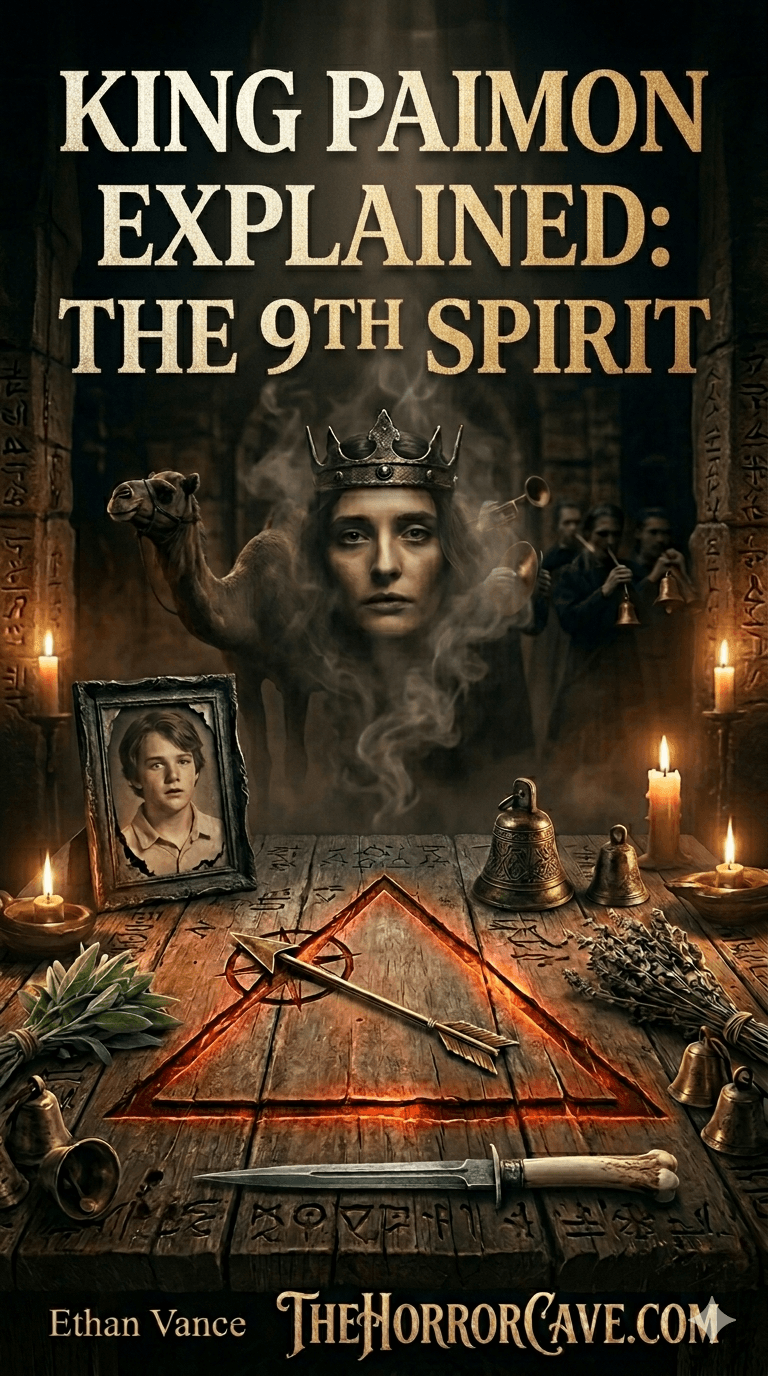
In Hereditary, Annie Graham discovers a table in Joan’s apartment with a large triangle carved into it, pointing to the northwest. A photo of Peter rests in the center. An athame. Herbs.
Ari Aster read the right manuscript. The King Paimon Hereditary chose as its ritual villain is drawn from real grimoires — and what Aster kept versus what he invented tells you something important about both the demon and the film.
The Ninth Spirit of the Ars Goetia
The Lesser Key of Solomon — also called the Lemegeton, the Clavicula Salomonis Regis — was compiled anonymously in the mid-17th century from earlier sources stretching back at least to the 1500s. Its first section, the Ars Goetia, catalogs 72 spirits with the precision of a bureaucratic field guide: rank, appearance, powers, number of legions commanded, method of summoning. Entry number nine is King Paimon.
He appears as a man on a dromedary camel. Crowned. Preceded by a host of spirits playing trumpets and cymbals and what the text calls “all other sorts of Musical Instruments.” The Goetia itself is silent on his face; Weyer’s Pseudomonarchia Daemonum from 1563 and the Liber Officiorum Spirituum add the detail — effeminate, beautiful, distinctly strange on a figure otherwise described as a powerful king. He speaks with a hoarse voice. He will speak his own language until you command him to speak yours.
Every grimoire puts him in the same category: a being of knowledge, of dignities, of secret arts. The Goetia specifies what he offers: he “can teach all Arts and Sciences and other secret things. He can discover unto thee what the Earth is, and what holdeth it up in the Waters.” He grants dignity. He reveals hidden treasures. He binds any man to the magician’s will. The Book of Abramelin extends the list into the genuinely strange: the ability to reanimate the dead for several years, indefinite submersion underwater, flight.
King Paimon, ninth spirit of the Ars Goetia, commands 200 legions — some of the Order of Angels, the rest being Powers. He is, according to both Weyer and the Liber Officiorum Spirituum, more obedient to Lucifer than any of the other kings. He is former Dominion, or possibly former Cherub — the texts disagree, and Weyer notes the confusion without resolving it. He is one of nine demonic kings in the Goetia, alongside Bael, Beleth, Purson, Asmoday, Vine, Balam, Zagan, and Belial. His name likely comes from the Hebrew paamon (פַּעֲמֹן) — a tinkling sound, a small bell. The name appears in Exodus 28:33, in the description of bells attached to the High Priest’s garments.
A small bell. The demon who arrives with a brass section.
What Ari Aster Got Right
When Ari Aster was developing Hereditary, he told Vulture he “didn’t want to do the Devil again.” Satan had been done. He went looking for something else, found the Ars Goetia, and King Paimon struck him as the right fit. He told Vox that digging into King Paimon’s history informed how he constructed the ritual logic of the film.
The research shows. Joan’s invocation in the film — “give us your knowledge of all secret things and all mysteries of the Earth; bring us honor, wealth and good familiars; and bind all men to our Will” — is a direct translation of the Goetia’s description of King Paimon’s powers, turned into a prayer. Aster read the text carefully enough to reverse-engineer its descriptive grammar into ceremonial speech.
The physical description he puts in Ellen’s grimoire — a hulking body with a strangely effeminate face, a crown, a dromedary, a procession of musicians behind him — maps closely onto Weyer and the Liber Officiorum Spirituum. The compass direction (northwest) comes from the Sloane manuscript specifically. The invocation language, the triangle of evocation, the general ritual architecture — all of it has genuine grimoire precedent.
What Aster invented is something else entirely.
What the Texts Don’t Say
Annie finds a highlighted paragraph in Ellen’s grimoire: “When successfully invoked, Paimon will possess the most vulnerable host. Only when the ritual is complete will Paimon be locked into his ordained host. Once locked in, a new ritual is required to unlock the possession.” Underlined in pencil beneath it: “Paimon is Male, thus covetous of a male human body.”
None of this is in any grimoire.
The possession mechanic — Charlie as a temporary vessel, the body transfer to Peter and the entire arc that drives the film’s horror — exists in none of the source texts. The Ars Goetia, the Pseudomonarchia Daemonum, the Book of Abramelin, the more than a dozen grimoires where Paimon appears: all silent on body possession, on covetousness of a male host. Collider confirmed this in their coverage of the film: there is “no mention of taking a male host body in The Goetia.”
The illustration caption in Aster’s script labels the page “King Paimon (God of Mischief).” No grimoire gives him this title. In every text, Paimon is dignified, formal, a teacher — a being of considerable rank who demands respect and provides knowledge in return. Every text places him in a different tradition entirely: formal, kingly, the kind of entity a Renaissance magician would address with elaborate ceremony. The “mischief” framing has no precedent in any grimoire.
These aren’t minor inaccuracies. They’re the load-bearing inventions. The entire film’s mechanics depend on things Aster created from scratch.
The Demon of Knowledge
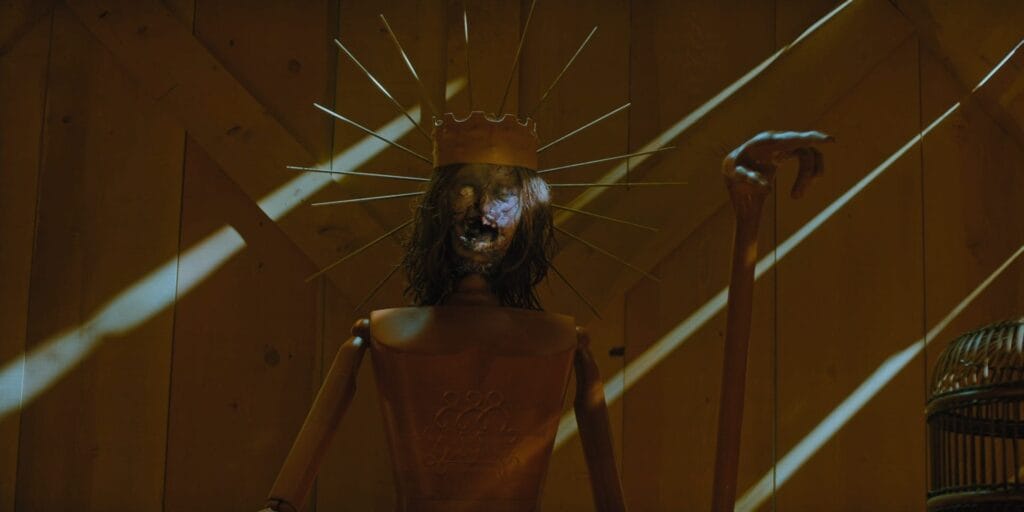
His choice of what to invent says something about what he was actually building.
The real King Paimon — teacher of arts and sciences, granter of dignities, keeper of secret things — fits Ellen Leigh’s character better than the grimoire ever gets credit for. What King Paimon offers in every text is exactly what Ellen spent decades pursuing: knowledge, influence, the capacity to shape outcomes from behind the scenes. The cult’s multi-generational patience, the secretive arrangements, the careful positioning of people — all of it looks, in the real grimoire tradition, less like demonic possession and more like a very dedicated patronage system.
But that version of King Paimon doesn’t give you a film like Hereditary. A demon who teaches arts and sciences doesn’t produce the horror in Annie’s attic. What Aster needed was a demon with a body problem — a reason why Charlie had to die, why Peter had to be preserved, why the family had to be dismantled in that specific order. The possession mechanic gave him the mechanics his film required. He built it with enough plausible-sounding specificity (the “ordained host,” the “ritual to unlock the possession”) that it reads as genuinely occult rather than invented.
The grimoire served as scaffolding. Everything visible in the film is Aster’s construction.
The Gender Question
The gender question gets more complicated the further back you go.
Every version of the grimoire tradition describes Paimon as male — “his” throughout, kingly, addressed with masculine titles. And yet the face, across Weyer, de Plancy, and the Liber Officiorum Spirituum, is explicitly beautiful, effeminate, strange on a figure otherwise described as a powerful king. Some scholars of pre-Islamic Arabian mythology argue that entities like Paimon descend from a tradition of djinn — supernatural creatures from before the period when Islamic and later Christian demonologies systematically assigned them gender. Den of Geek’s 2018 coverage cites occult practitioner Greg Bismarck: “Paimon is a ‘demon’ only to those who demonize him. He is one of the 72 spirits written about in The Goetia. He’s actually a Djinni.”
This is one interpretation, not academic consensus. What it does, if you take it seriously, is make the effeminate face less of an anomaly and more of a trace — something left over from a different tradition, before the masculine reframing. Aster took that trace and made it structural: the film’s Paimon arrived in a female body, spent most of the film in one, and required elaborate ritual engineering to transfer to the male host the cult had prepared. Whether Aster’s research went as far as the djinn interpretation is not confirmed in any interview. But the fit is close enough to be deliberate or to look like it — a subject traced through the film’s visual grammar in our Hereditary hidden details breakdown.
The grimoire tradition, whatever else it is, runs on that kind of care.
The Northwest
My father used to say you can’t see the framing once the drywall goes up, but it has to be right anyway. He built things that way — correctly, invisibly. The structure underneath holds whether or not anyone’s looking.
The Lesser Key of Solomon is full of that kind of specificity. Compass bearings. Exact invocation language. The names of the two sub-kings who must be summoned if Paimon arrives alone (Labal and Abalam). Procedures that assume the spirit is real and demand precision accordingly. Whether or not any of it works in any verifiable sense, the care is apparent. Whoever wrote these entries believed the details mattered.
Ari Aster believed the details mattered too. He got the northwest right. He got the invocation language right. He got the procession of musicians and the effeminate face and the direction the conjurer should face.
Then he built something on top of the structure that the text never imagined: a demon who engineers a family across three generations, who needs a specific body, who has been waiting patiently inside a little girl since before she could speak. A demon who, as Joan finally intones over Peter’s occupied body, has been “corrected” from his first host.
The Ars Goetia’s Paimon and the film’s Paimon share an appearance, a direction, and a handful of invocation phrases. Everything that makes the film’s version frightening — the hunger for a male body, the generational patience, the possession that requires a ritual to unlock — Aster built from nothing the text provides.
The northwest stays. The hoarse voice. The brass section. Four hundred years of someone insisting the compass bearing had to be right.
Frequently Asked Questions
Who is King Paimon in the Ars Goetia?
King Paimon is the ninth spirit listed in the Ars Goetia, the first section of the 17th-century grimoire known as the Lesser Key of Solomon. He is ranked as a King and described as more obedient to Lucifer than any other spirit. He appears as a crowned man riding a dromedary camel, preceded by musicians playing trumpets and cymbals. He commands 200 legions of spirits and is associated with teaching arts and sciences, revealing secret knowledge, granting dignities, and binding men to the magician’s will. His name likely derives from the Hebrew paamon, meaning a small bell or tinkling sound.
Is King Paimon’s appearance in Hereditary accurate to the original texts?
Partially. Ari Aster correctly depicts King Paimon’s crown, his dromedary camel, and the procession of musicians that accompanies him — all confirmed in Weyer’s Pseudomonarchia Daemonum and the Liber Officiorum Spirituum. The effeminate face on a male body is also documented in several texts (though notably absent from the Goetia itself). The invocation language Joan recites in the film is a near-direct translation of the Goetia’s description of King Paimon’s powers. However, the film’s central mechanic — King Paimon possessing bodies, preferring a male host — does not appear in any grimoire. This was Aster’s invention.
Did Ari Aster research the real King Paimon for Hereditary?
Yes. Aster told Vulture he chose King Paimon specifically because he “didn’t want to do the Devil again,” and told Vox that researching King Paimon informed how he constructed the film’s ritual logic. The evidence is in the film: the use of the northwest compass direction (from a specific manuscript variant of the Goetia), the invocation language drawn directly from the Goetia’s descriptions of King Paimon’s powers, and the physical description of the figure Annie finds in Ellen’s grimoire. Aster researched accurately and then invented what his story required.
What powers does the real Paimon have?
In the Ars Goetia and related grimoires, Paimon teaches all arts and sciences, reveals secret knowledge about the Earth and its waters, grants dignities and lordships, reveals hidden treasures, provides familiars, and can bind any man to the magician’s will. The Book of Abramelin extends this further: knowledge of past and future events, the ability to reanimate the dead for several years, flight, and the capacity to remain underwater indefinitely. Body possession is not listed among his powers in any of these texts.