
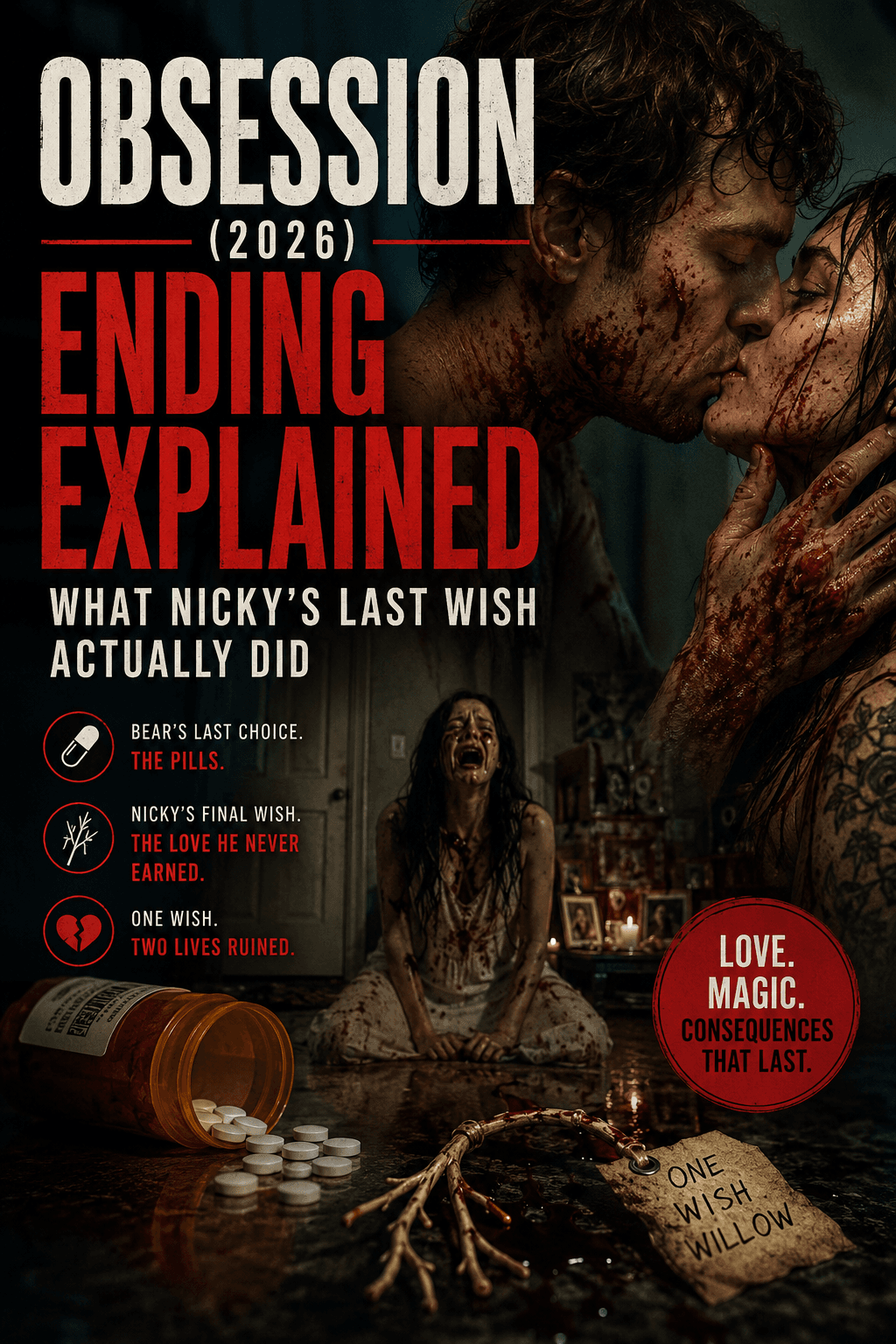
The film opens with pills on a kitchen floor.
Bear Bailey, 25, has been crying. His cat is dead. Pills scattered around a straw basket, candle wax on the tile. He scoops them back into the bottle, one by one, puts the bottle in the medicine cabinet, shuts it. Then Obsession (2026) moves on.
You do too. You almost have to, because Curry Barker gives you 108 minutes of dark comedy, body horror, and Indi Navarrette doing things with a human face that require no supernatural explanation before you remember that medicine cabinet. By then it’s too late. The pills have been waiting.
Obsession (2026) ends with Bear dying from a self-administered overdose. In the final sequence, Nikki uses a second One Wish Willow — Bear loves her, briefly and genuinely — and then the pills take him. With Bear’s death, the original wish breaks. The Nikki who was fighting to get out from inside the possession finally gets free, into the worst room imaginable.
This is a full Obsession (2026) ending explained. Complete film spoilers follow.
If you haven’t read our Obsession (2026) review yet, start there. You may also want to check out our audience guide for a breakdown of who the film is and isn’t for. This piece is about what happens in those final ten minutes and what it means.
What Bear Does in the Bathroom
Obsession (2026) ends where Bear belongs: locked inside the one room with a door that closes.
He’s convinced Nikki they’re about to shower together. The last 48 hours have included Sarah’s murder, Ian’s murder, a shrine built from Bear’s childhood photos with their faces cut out, and Nikki in Sarah’s dress with Sarah’s tattoos crudely copied onto her own arm and chest. Bear has run out of moves. He has one left.
In the bathroom, he considers the gun first. Points it at his chest. Something feels wrong — the angle, the certainty, something about the specific permanence of it. He puts the barrel in his mouth, tilts it upward, aims for the brain.
NO.
He puts the gun in his pocket. Then he opens the medicine cabinet.
That pill bottle has been waiting 108 minutes for this moment. Bear takes as many as he can, then one more for good measure. Sits on the toilet. Understands there is no way back.
The opening scene placed those pills on a kitchen floor before any of this began — before Viola’s crystal shop, before trivia night, before the wish. Bear was already at the edge of this cabinet. The Willow found him there.
What Nikki Did While Bear Was in the Bathroom
While Bear is locked in the bathroom, Nikki uses the last One Wish Willow from the table.
When Bear emerges, his entire bearing shifts. In the screenplay, Barker writes this as an internal transformation — “a spark ignites within him, the world snapping into focus… it’s as if a SPELL has been cast” — internal direction conveying what Michael Johnston and Navarrette’s performances must show on screen. Bear walks out of the bathroom with an urgency that wasn’t there when he went in. He sees Nikki across the house, smiling. He smiles back — genuinely. They laugh together. Barker’s screenplay labels this beat “a total Rom-Com moment… minus the blood, wounds, and terrifying undertones.” Bear approaches. She extends her arms. He kisses her.
His face becomes covered in blood as he kisses her broken jaw.
Then the camera pans to the table.
A freshly used One Wish Willow. “We can tell by its placement that NIKKI used it.”
This is what the film withheld. Nikki used the Willow while Bear was dying in the bathroom. The timing is the trap: she got exactly what she wanted in the last ninety seconds of his life.
What specifically did she wish for? The film doesn’t give you the words — Barker withholds them the same way he had Bear whisper his original wish in the dark, half-joking, head on the steering wheel. But the evidence lands in one place. Nikki spent the entire second half screaming “WHY CAN’T YOU LOVE ME?” She killed Sarah in a parking lot while Sarah was mid-sentence. She shot Ian in the head without looking at him first. Her wish was the mirror of Bear’s — a loophole past the work of actually being chosen. She wished that Bear loved her.
She got it while he was dying in the bathroom.
“In This Life and the Next”
The film opens on a small TV. A man says: “Even if the world lost its color, if hope faded into the night, my love for you wouldn’t falter. It’s unwavering and enduring.”
Bear watches this alone in his yellow-walled house, dead cat on the floor, crying. He wants that. The entire film is him wanting that.
“In this life and the next” are his final words. Weak. He says them while collapsing, Nikki cradling him. The phrase is what’s left of that TV speech after 108 minutes of damage — the dream condensed to four words and the breath it takes to say them.
Nikki’s Willow activated something real in Bear. The spark, the smile, the voluntary kiss, the words he means when he says them. Barker lets the love be genuine. Bear means the kiss. The pills are also killing him.
Two readings coexist without resolution. Bear’s final moment is the love he always wanted — mutual, real, arrived at last. Or: Bear is a man dying under the influence of magic, saying words that are true the same way Nikki’s love for him was always true — produced by a mechanism, indistinguishable from the genuine article once you’re inside it.
Obsession (2026) holds both. It has to.
What the Film Does to Nikki
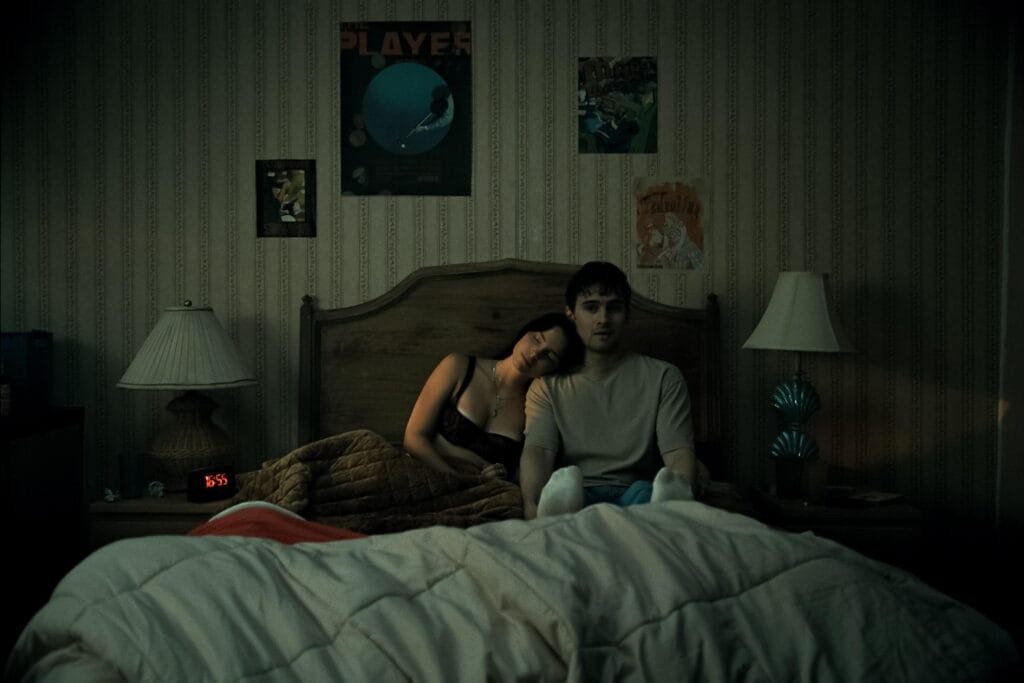
The screenplay gave Nikki an exit.
Bear collapses from the pills. In the original version, Nikki picks up the gun and uses it. Two people destroyed by wishes they both made — the symmetry is bleak, but it’s symmetry. They built this together, the logic goes, and they leave together.
The theatrical cut is crueler. When Bear dies, the original wish breaks.
Nikki comes back.
She’s been trying to come back all film. “Kill me, Bear. Please.” The flash at the party — a girl inside the possession, throwing herself against the walls of it, screaming that this isn’t her. “I’ve never been with you, Bear.” These weren’t signals for the audience to decode. They were Nikki, conscious somewhere inside the wish, fighting to get out of something she couldn’t get out of because the wish was still running.
The only exit was Bear’s death.
So she gets free — finally, genuinely free — into the worst possible room to be free in. Sarah somewhere in the house. Ian in the hallway. The shrine built from Bear’s childhood photos with the faces cut out. The understanding, arriving in full consciousness for the first time, that she did all of this — without having chosen it, used by it, the mechanism through which it moved — but her hands were there. She remembers.
The screenplay treated death as an equivalent exit. The theatrical cut decided it wasn’t. Bear made the wish and died from the consequences of making it. Nikki was the instrument through which it ran — present for every act, responsible in the eyes of the world, and now free in the worst possible room.
Barker holds on her: crying, screaming, completely herself, surrounded by everything. The horror isn’t in dying. The horror is in waking up.
What Neither Wish Could Do
Both wishes failed — and the specific way they failed is the thing the film is actually about.
Bear’s wish was acquisition. He wanted Nikki’s love as a possession: guaranteed, permanent, not subject to her choosing otherwise. The Willow delivered it. He got her devotion, her complete orientation around him, everything he asked for. The Willow is literal that way. Bear asked for Nikki’s love. He got it. He wanted evidence that he was worth loving. Those were different requests, and the gap between them is where all the damage lives.
Guy Woodhouse, in Rosemary’s Baby, makes the same trade in a different register — his wife’s body and autonomy exchanged for career advancement, dressed as devotion. The mechanism differs. The architecture of the decision is identical.
Nikki’s wish was a counter-move. She’d watched Bear try to undo his own wish, try to escape back to the life he had before she became this. She used the last Willow to make him feel what she felt — to collapse the distance between them by manufacturing in him what the first wish had manufactured in her.
And here’s the question Obsession (2026) asks in its last thirty seconds that it couldn’t ask before: is what Nikki produced in Bear actually different from what Bear produced in Nikki?
If the answer is no — if manufactured love and genuine love are functionally indistinguishable — then the whole film’s moral certainty starts to bend. Was there ever a version of Bear’s love that was clean, before the Willow? The opening scene shows him in despair, aching for Nikki, unable to confess directly. The wish found his feeling for her already there. It took away the only thing stopping him — the chance she might say no. Is that different from love? Is what Nikki felt, before her own wish, real — or was she already under a different compulsion, one the Willow just made legible?
The film doesn’t answer. Bear says “In this life and the next” and the pills take him. The wish breaks with him. And Nikki is left standing in a room full of evidence that this question — whether her love was real before the Willow distorted it — is now the rest of her life to figure out. With full consciousness. In that house. Alone.
Obsession (2026) Ending Explained: Frequently Asked Questions
What did Nikki wish for at the end of Obsession?
The film shows Nikki used the last One Wish Willow while Bear was in the bathroom but doesn’t state the wish directly. The evidence points one way: Bear emerges with a completely changed bearing, smiles genuinely, kisses her voluntarily, says “In this life and the next.” Given what she’s wanted throughout — for Bear to love her back, genuinely — she almost certainly wished exactly that. She got it in the last ninety seconds of his life.
Did Bear actually love Nikki at the end, or was it the wish?
The film refuses to separate them. Nikki’s Willow activates something that functions as real love — genuine feeling, voluntary behavior. But it’s produced by the same mechanism that made Nikki love Bear in the first place. Barker’s position seems to be that manufactured love and genuine love become indistinguishable to the person experiencing them. It’s the same question Midsommar’s ending raises with Dani’s final smile — whether what you’re feeling is liberation or capture, when the answer is both and the distinction has stopped mattering. That’s not a reassuring answer, and Obsession (2026) doesn’t mean it to be.
Does Nikki survive at the end of Obsession (2026)?
Yes. In the theatrical cut, Nikki survives. When Bear dies from the overdose, the original wish loses its hold — and with it, whatever has been controlling her. She comes back to full consciousness inside the wreckage she was used to create. The film ends on her: crying, devastated, completely herself for the first time since the wish was made. The theatrical ending differs from the screenplay’s, where Nikki picks up the gun after Bear collapses. Barker chose the crueler option — survival with full memory of what was done through her.
Why does Obsession (2026) open with the pills?
Bear picking pills off his kitchen floor in the opening shot establishes that his ideation predates everything that follows — the wish, Nikki’s transformation, all of it. He’d already been at that medicine cabinet once. The Willow found him there. The ending is him going back.
What happened to Ian at the end of Obsession?
Nikki shot him in the head during the final confrontation at Bear’s house. Ian had wasted his own Willow on a billion dollars — a joke wish, said while laughing, right as Bear was trying to find a way out. The money materialized from the ceiling. Ian didn’t survive long enough to spend it.
What happened to Sarah in Obsession (2026)?
Nikki killed her in a parking lot, smashing her head through the car window while Sarah was mid-sentence. Bear helped move the body. Nikki later brought it back to Bear’s living room as part of a shrine — photos of Bear and Nikki, Ian’s and Sarah’s faces cut out. What Nikki did with the body in the hours between disposal and the shrine is left deliberately unresolved.