Is Obsession (2026) Worth Watching? An Honest Guide
Whether Obsession (2026) is worth watching — the short answer is yes.The useful part is what “yes” comes attached to — because Obsession (2026, dir. Curry Barker) nearly received an NC-17 rating, runs on body horror and moral discomfort, and whose marketing makes it look approximately thirty percent lighter than what it actually is. So before you commit 108 minutes: specifics.
What Obsession (2026) Actually Is
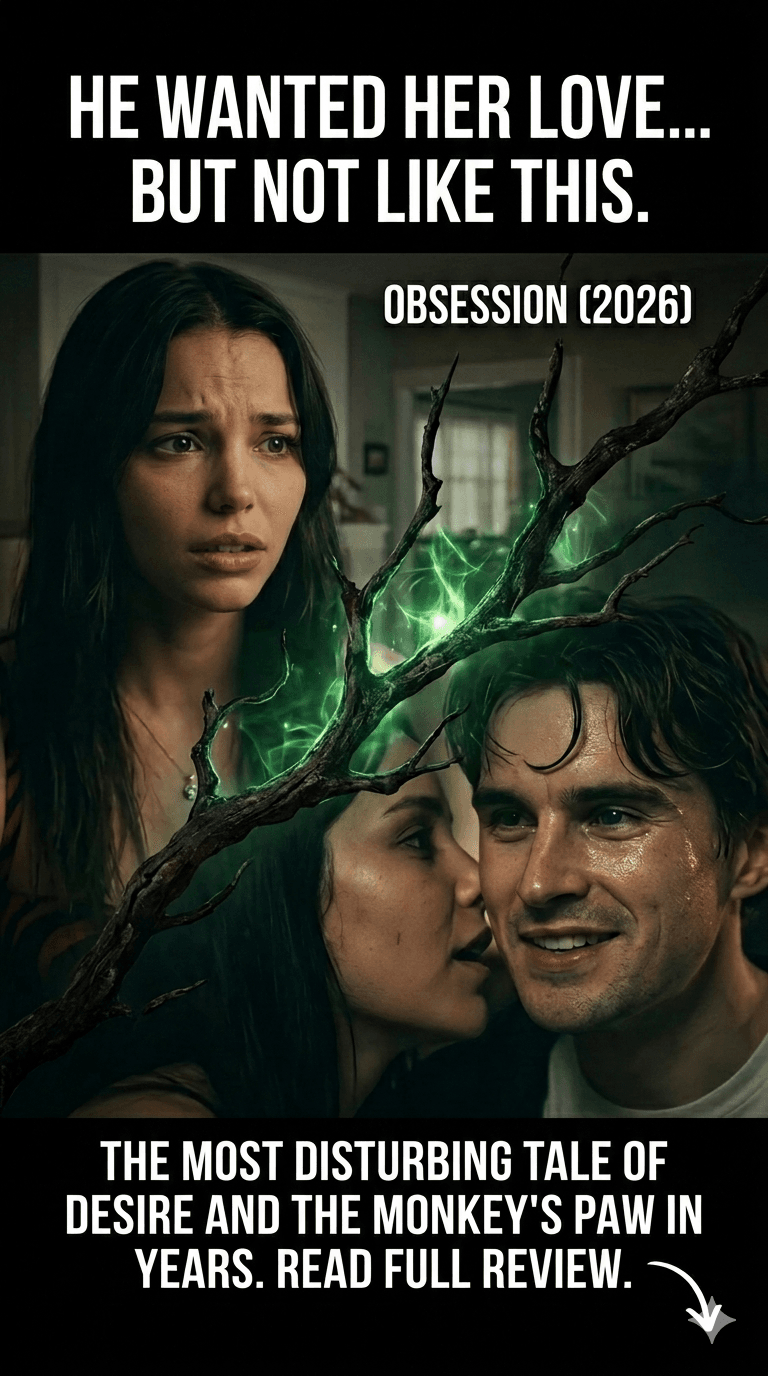
The promotional material suggests a cursed-love-story with dark-comedy packaging. Both things are technically true. The trailer is approximately as accurate as a floor plan is about whether you’d be comfortable living somewhere.What Barker made is a Monkey’s Paw film. W.W. Jacobs built the template in 1902, and the mechanism has outlasted every trend in horror since: wishes granted literally are wishes destroyed. You get exactly what you asked for. The gap between what you asked for and what you actually wanted is where all the damage lives.The subgenre has a long shelf. Drag Me to Hell (2009) ran it through Raimi’s carnival-horror instincts. The Box (2009) pushed it into science-fiction moral philosophy. Wishmaster (1997) made it explicit and operatic. The through-line in every version: the person making the wish is where all the damage originates — what they wanted, what they were unwilling to earn.Obsession takes that framework and applies it to something quieter and more familiar than cursed buttons or djinn. Bear wants Nikki’s love. He can’t ask for it directly. He can’t survive the possibility that she’d say no. So he finds a shortcut — a novelty trinket from an occult shop, a wish whispered half-jokingly in the dark with his head on the steering wheel. The supernatural element that follows is real in this film. It is also a demonstration of something that requires no supernatural mechanism to function: that the desire to possess someone, absent the willingness to be refused by them, is already a form of violence. The One Wish Willow just turns the volume up until everyone in the theater has to confront it.For the full analytical breakdown — Curry Barker’s background, what Taylor Clemons does with the camera, what Inde Navarrette is doing that’s making people grab their friends’ arms in theaters — read our Obsession 2026 review. This piece exists for a different question: whether you, specifically, should be in that film.
Obsession (2026) Content Warnings: What the R Rating Doesn’t Tell You
Rated R for strong bloody violence, grisly images, sexual content, pervasive language, and brief graphic nudity.That rating is accurate. It is also incomplete in ways that matter before you sit down.The scene in the second act — the parking lot — involves a character’s head being impacted against a surface so many times that Focus Features had to make cuts before the MPAA would approve an R. What remains is among the most viscerally graphic sequences in a 2026 theatrical horror release. The body horror that follows is practical, biological, and extended. A cat dies onscreen. Suicide is structural to this film — written into its opening frames, running as a current beneath the second act, resolving in the final ten minutes in a way the film has been building toward from the first scene. One character engages in extended self-harm. Each of these is load-bearing — structural to what Barker is arguing, present in the frame for reasons that matter.He earns every frame of it — there’s purpose in every piece of damage the film inflicts. It will still leave some people staring at the dashboard on the drive home.
The First Act Problem — And Why You Should Push Through It
The first thirty minutes of Obsession play in dark-comedy register. Barker is clearly enjoying the genre rhythm — setup, tension, release — and there are early scenes where the comedy runs a beat longer than the unease building underneath it can afford. The film occasionally seems to be having more fun with Bear’s situation than it should, given what’s coming.This is deliberate. Barker is establishing a register so the second act can dismantle it. The problem is structural: the gear change, when it arrives around the forty-minute mark, arrives hard — and people who bounce before then never see what the film becomes. Commit to thirty minutes before you decide anything. If the tonal register in those opening scenes can hold your attention, stay. What the second act does with what the first act built earns back every minute of patience it cost.
Who Should Watch Obsession (2026)
If you sat through Hereditary’s third act, Obsession is inside your range. If Midsommar’s emotional brutality disturbed you more than its gore, this film runs the same frequency — obsession and control as the true horror, with the supernatural as the instrument that makes them impossible to ignore.There’s a lineage worth naming here, and I think Obsession earns its place in it more directly than most recent entries manage. Rosemary’s Baby (1968) used the supernatural to expose what a husband’s ambition does to a wife’s autonomy. Hereditary runs a version of the same argument through grief and cult mechanics — which gives it distance, a kind of remove that lets audiences engage analytically before the horror lands. Barker closes that distance completely. Bear’s love is recognizable before it’s monstrous, which is a much shorter trip than most horror films are willing to make — and the shorter the trip, the harder it lands. For more on that lineage, the Hereditary review traces the thread through Aster’s work.People who watch horror for relationship accuracy — for films that name the damage obsessive love does with precision rather than metaphor — will find Obsession doing that work and refusing every comfortable exit.People who can sit with body horror when it’s purposeful. The violence in the second act is Barker showing you what the argument looks like when it reaches the body — practical effects that leave no interpretive distance. It’s uglier than most warnings prepare you for.If your preference sits closer to atmospheric dread — The Witch, Lake Mungo, Pontypool — Obsession has that emotional intelligence alongside considerably more blood. Calibrate accordingly.
Who Should Skip Obsession (2026)
People who need horror to follow genre survival logic. Obsession makes its own decisions about who gets out and what the ending means, and the final act owes the audience nothing in the way of comfort.People for whom suicide as subject matter requires advance warning: this is the warning.People who find the Monkey’s Paw subgenre morally unsatisfying — who watch a character make a foolish wish and feel contempt where the film is asking for recognition. Obsession requires you to understand Bear well enough to find him familiar. If that’s not a transaction you’re willing to make, this is not the film for you.And — practically — people watching with someone who narrates their discomfort during difficult scenes. That’s a them problem that will become yours during the parking lot sequence. Watch it alone first.
Where to Watch Obsession (2026) and How
Runtime: 108 minutes.Streaming: Prime Video and Apple TV, digital release June 30, 2026.Best viewing conditions: night, volume up, alone or with one person you trust to sit in silence. The sound design in the second act is doing specific work that a daytime watch with ambient noise will bury. Obsession runs on sustained attention — a phone on the couch is the wrong choice for this film. Give it the darkness it’s asking for.
FAQ: Obsession (2026) for the Undecided
Is Obsession (2026) actually scary?
The dread Obsession builds is sustained wrongness — the feeling of watching something emotionally true being run at a frequency too high to dismiss. Jump scares appear occasionally, as punctuation. What lives between them is what stays with you two days later. If that registers as scary, yes. If you need your horror delivered on a schedule, the film will frustrate you.
How graphic is Obsession (2026)?
Hard R. The parking lot sequence required cuts before the MPAA approved the rating. Body horror in the second act is extensive and practical. If that’s your threshold, the film will find it.
Can I watch Obsession (2026) alone?
Yes. Preferred, actually. Horror without someone to dilute the discomfort is more honest about what the discomfort is pointing at.
Is the first act actually a dark comedy?
Substantially. Barker uses the comedy register deliberately — he’s establishing a tone so the second act can take it apart. The shift happens around forty minutes in and it doesn’t apologize for the distance it covers. Give it the thirty minutes.
How does Obsession (2026) compare to other wish-horror films?
It’s the most morally serious entry in the subgenre in years, and the most uncomfortable — because Barker isn’t interested in wish-horror as genre exercise. Drag Me to Hell is funnier and more kinetic. The Box is colder and more detached. Obsession stays close enough to Bear that you can’t put distance between yourself and what he does. That’s a different kind of difficult than either of those films.
Do I need to watch anything before Obsession (2026)?
No prerequisites. If you want context for the emotional lineage — the way this film connects to a tradition of horror about obsessive love and the supernatural as moral accelerator — the Midsommar ending explained picks up one of the same threads, and our Hereditary review traces the Ari Aster lineage in full. Obsession stands alone. Those pieces deepen it.