Hereditary Ending Explained: What Really Happens to Peter Graham
Most people who watch Hereditary for the first time don’t understand the ending because they’re too shocked to read it. By the time Annie is floating in the attic and the naked worshippers materialize in the treehouse, the film has been operating for 127 minutes in a grammar that only fully reveals its organizing principle in the final twenty. The pieces were always visible. The structure they form becomes clear exactly when you no longer have the option of not seeing it.
To help piece together this complex puzzle, here is the comprehensive hereditary ending explained, beat by beat — and why each specific detail was required.
What Triggers the Final Sequence in the Hereditary Ending
Annie grabs Charlie’s drawing pad — the one filled with sketches of Peter with his eyes crossed out — and throws it into the fireplace. This is the action that activates everything that follows. The drawing pad is, within the film’s internal logic, the object tying Annie to the ritual. She already tried to burn it once and her arm caught fire instead. When Steve refuses to do it for her, she does it herself. It doesn’t destroy anything. It completes a condition.
Steve Graham ignites. Standing at the foot of the stairs, not touched by anything visible, he catches fire. Gabriel Byrne plays the Graham family’s center of gravity throughout — the man who absorbs Annie‘s collapse, who keeps trying to locate the floor under everyone’s feet, who watches what’s happening to his family with the particular exhaustion of someone who has run out of explanatory frameworks. Byrne underplays everything, which is the right choice. The script gives him less to work with than it gives everyone else. Steve is the film’s most underdeveloped major character — present enough that his absence registers, not present enough to fully earn the grief it should produce. Byrne does more with the material than the material gives back.
His death is structural. Within the ritual logic the cult has been executing, Steve is the last stabilizing element in the Graham family system. He had to be removed before the transfer could complete. Fire, in the ceremonial traditions Aster researched, carries associations with purification — the clearing of what stands between the plan and its conclusion.
The Hereditary Ending: What Happens in the Attic, Beat by Beat
Most breakdowns of the hereditary ending explained stop here — at the shock of what you see. What follows is what you actually need to understand it. Peter runs upstairs — away from something. The cultists are in the house. The attic is where the terror drives him, not where it invites him.
What Peter finds: black candles arranged throughout the attic. In a chalk-etched triangle in the corner, a photograph of Peter with his eyes crossed out. And then the sound — piano wire being pulled through flesh, dragged, repeated.
Annie is floating weightlessly in the air. She has looped piano wire around her own neck and is sawing through it. Peter screams. He turns, sees a figure near him, smiling. He runs straight for the window and jumps through the glass.
He should die. He doesn’t — and this detail in the hereditary ending explained most clearly tells you the rules of what you’re watching. Paimon, already in the process of transfer, will not allow the vessel to break itself. The jump reads as the body evacuating itself from a space it can’t survive, with something else beginning to make the decisions.
Peter lands outside and lies motionless. Then a streak of light — the same one that entered Annie in the living room — drifts across the ground, steadies on Peter’s back, and disappears into him. Peter’s head rises. His eyes are strangely calm. Clouded. He clicks his tongue — the same clicking sound Charlie made throughout the film — and walks toward the treehouse.
Why Annie’s Death Had to Happen That Way
The decapitation is a ritual requirement in the hereditary ending explained, and the film plants the logic for it long before the attic.
The scene where Charlie cuts the head off a pigeon in the schoolyard — fishing the scissors from her pocket, fitting the blades around the bird’s neck — is the film’s clearest early signal that something inside her already operates on a grammar the family cannot read. For a deeper breakdown of how these small visual cues set up the finale, check out our list of Hereditary: 10 hidden details you probably missed. The Paimon illustration Annie finds in Ellen’s books describes a figure who rides a dromedary, wears a crown, and has severed heads tied to his hip. The crowned, decapitated structure runs through the entire film as a ritual preparation.
That moment with the pigeon becomes retroactively legible as rehearsal once you understand what was already using Charlie’s body. Annie completing the act on herself is that grammar reaching its terminal expression — the ritual’s final requirement met through the body that served it longest.
I’ve watched this sequence eight or nine times and I still can’t decide whether Annie is somewhere behind what’s using her body in those final moments — present, compressed, aware of what’s happening. The film leaves it open. In every interview I’ve been able to find, Aster has declined to resolve it. I find myself wanting a cleaner answer than the film is willing to give, and then I circle back to wondering if that refusal is exactly the point.
Colin Stetson’s score during the attic drops almost entirely to breath and friction — the sound of something straining through a medium that resists it. The effect registers in the body before it registers as music. By the time Annie reaches the wire, the score has already primed the body. The image then confirms what the body already suspected, which means the confirmation arrives as dread rather than surprise.
The Cultists: Who They Are and How Long They’ve Been There
The naked figures in the treehouse are Ellen’s congregation. What the hereditary ending explained reveals is that they’ve been waiting — for this specific night, this specific ceremony.
The treehouse is dressed: black candles, Charlie’s decomposing head mounted on a wooden manikin figure and fitted with a silver crown, a scepter, Annie’s headless torso bowing at its feet alongside Ellen’s headless corpse. Someone prepared this space in advance — which means the cult knew the timeline of the ritual well enough to arrange a throne room before the night began. These are people with hierarchy, practice, and investment in a completion that has been running for at least two generations.
Joan is among them, her forehead pressed to the floor with the others. Her function in the film was specific and executed without visible seams: make contact with Annie in the weeks following Ellen’s death, provide the framework of shared grief as cover for what she was actually doing, teach the séance ritual under the guise of helping a woman in pain. Ann Dowd plays the warmth without a crack in it, which is what makes the role work. Joan was genuinely present for Annie in her worst period. The care was real. The function it was serving was something Annie was never invited to know.
Joan and the Séance: What She Actually Opened
The séance Joan teaches Annie at her apartment accomplishes two things. It reopens a channel to Charlie, giving Annie the grief-contact she came for. It also reopens a channel to whatever was using Charlie — which is what the procedure was actually for.
Joan mirrors Annie throughout their interactions — her breathing, her cadence, her emotional register — in a way that reads as empathy and is also a technique. This kind of mirroring creates a sensation of being deeply understood. It lowers defenses precisely because it feels like being seen. Joan gave Annie the experience of being genuinely witnessed in her grief. And then she handed her a ritual.
Ellen’s Timeline: The Full Scope of What Was Planned
This is where the hereditary ending explained becomes unsettling in a register that goes beyond the visual horror of the attic.
Ellen needed a male host for Paimon. Annie tells her grief support group early in the film that her mother was manipulative, controlling, that she refused Ellen access to Peter when he was born. Ellen’s workaround: wait, maneuver, and use Charlie instead as a temporary vessel while the plan for Peter was executed across years. Charlie’s strangeness throughout the film — the clicking, the pigeon, the dioramas, the way she moves through the world at a slight remove from everyone in it — reads differently on rewatch. She was never fully Charlie.
The mental illness in the Graham family. The father who starved himself. The brother who hanged himself in Ellen’s bedroom at sixteen, leaving a note accusing her of putting people inside him. Annie’s own dissociative episodes. The entire psychological history of the family exists within a system being managed from outside, from Ellen’s project, for decades before the film begins.
Everything that happened to the Grahams — including Charlie’s death, which registered as an accident — was either caused by the apparatus, allowed by it, or exploited by it. The ending just shows you the harvest.
What the Hereditary Ending Does to Peter Graham
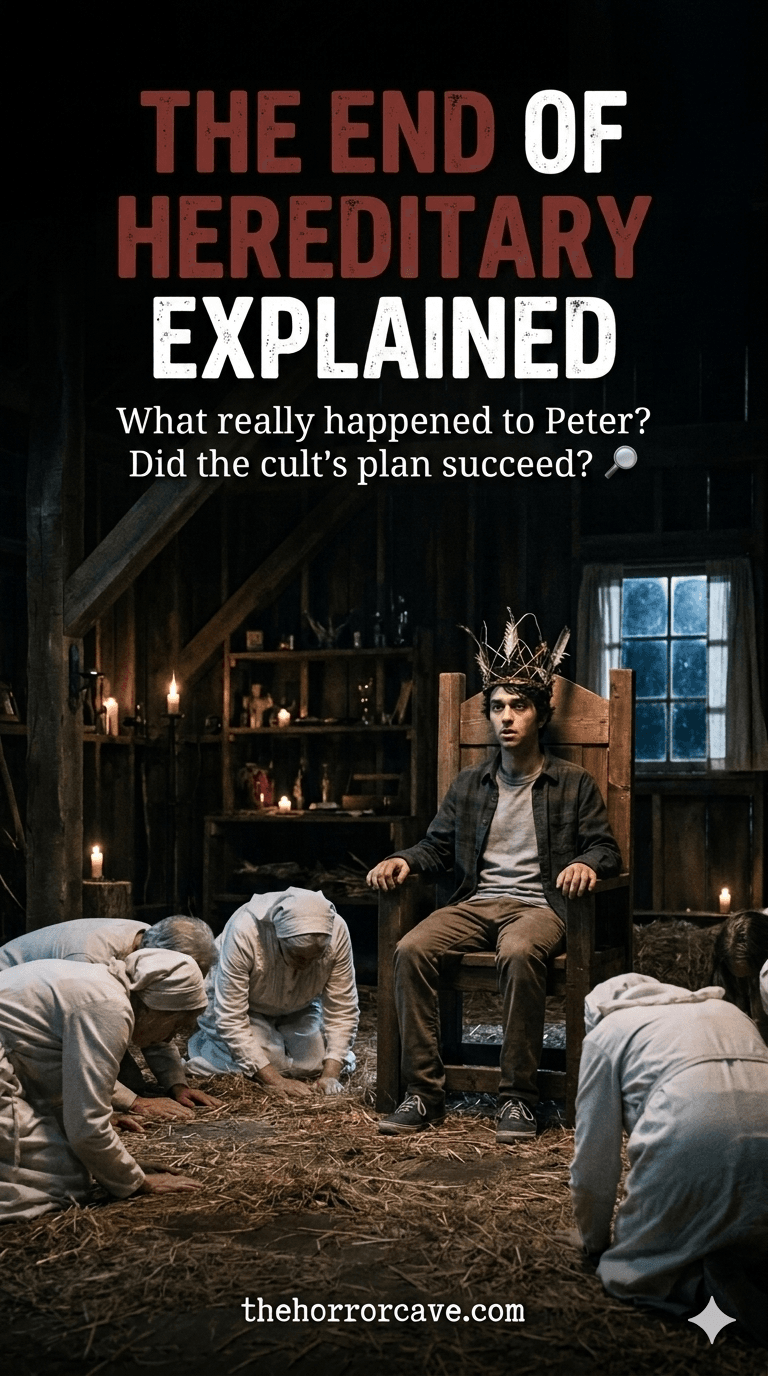
In the treehouse, Joan lifts the silver crown from Charlie’s decomposing head and places it ceremoniously on Peter’s. The worshippers bow. Joan speaks. Peter — as Peter — is gone, or close enough to gone that the distinction doesn’t help him.
Joan tells him he is Paimon, one of the eight kings of Hell. She describes how the cult corrected his first body — Charlie’s, the wrong vessel — and gives him now a healthy male host. She asks for knowledge, wealth, and good familiars in exchange.
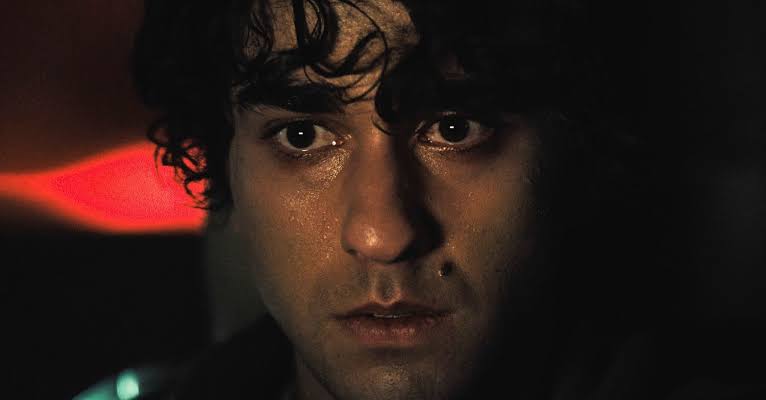
Alex Wolff carries something throughout the runtime worth naming precisely: a quality of graduated absence. On first watch it reads as teenage dissociation, as the numbing that follows grief, as the blankness of a kid who can’t process what happened to his sister. On rewatch, you recognize it differently. The guilt, the collapse, the nights he can’t sleep — these were the process. A self in sufficient distress vacates itself in ways that make what comes next easier. Wolff plays this without signaling it, which is the only way it could work. He looks like a grieving teenager right up until he doesn’t.
What the Hereditary Ending Really Means
The first shot of Hereditary pushes into Annie’s miniature of the Graham house and dissolves — almost invisibly — into the real thing. From frame one, the film tells you this family is inside someone else’s construction. That someone has already placed the pieces. To see how this thematic trap compares to the director’s broader filmography, you can read our comprehensive Hereditary (2018) review.
The ending completes that opening statement. Everything the Grahams did — the grief work, the therapy, the séance, the desperate attempts to understand and protect each other — was movement within a designed space. What the ritual required from them was simpler and more chilling than obedience — just life, lived normally, in a house someone else had already mapped.
That is the specific chill the ending produces, making any detailed hereditary ending explained breakdown colder than fear itself. Fear assumes the threat is external and the self is intact. What Hereditary (2018, directed by Ari Aster) leaves you with is something different: the retrospective understanding that the decisions that felt like yours were decisions inside a space you didn’t design.
This devastating sense of inescapable family trauma became a structural hallmark for the director; if you want to explore his next major psychological nightmare, check out our Midsommar review: Ari Aster’s break-up movie.
Ultimately, the film is honest about its inevitable trap from the first shot. It just waits until the last one to let you see what you were looking at, cementing its status as a modern horror masterpiece and earning its place as a massive critical success on Rotten Tomatoes. That is the hereditary ending explained, fully decoded — and it was never going to resolve cleanly, because that is exactly the point.