I watched Don’t Look Now in November 2009, three weeks after my father died. Nicolas Roeg’s film is about a man so saturated by grief that he stops being able to read the world clearly — everything bends toward what he’s lost. The Venice labyrinth, the red coat, Donald Sutherland’s certainty that he knows what he’s seeing. He doesn’t. And the film spends two hours building toward the moment that proves it.
Annie Graham is not the character most people leave Hereditary thinking about. Peter has the body horror. Charlie has the mythology. The film carries Paimon’s architecture in its bones, and most conversation about it ends there — at the demon, the ritual, the transfer.
Annie is where the actual horror lives.
She is, in the most precise sense, the one the film was built around — designed for a specific function before the story even starts. Ari Aster gives her a rich interior life, genuine grief, real artistic ambition, a complicated marriage, and a son she can’t reach — and then reveals, piece by piece, that every one of those elements was positioned there by someone else. Her mother. The cult. The thirty-year architecture that predates Annie’s knowledge of it.
Toni Collette understood this. The Oscar committee did not. That remains one of the more instructive disagreements in recent awards history.
The Support Group Scene Is Not a Backstory Dump
It runs about four minutes. Annie has never been to this group before. She is visibly reluctant to speak, then visibly unable to stop.
Her father died of starvation before she was a year old — psychotic depression, self-inflicted. Her brother was schizophrenic; he hanged himself at sixteen in their mother’s bedroom. His suicide note accused their mother of “putting people inside of him.” Her mother had Dissociative Identity Disorder and dementia. Annie lived through all of this inside the same house.
The speech is delivered by Collette in fragments, with the quality of someone reciting damage they’ve memorized because repeating it is the only way to keep it organized. There’s a terrible fluency to it. She’s said some version of this before — not to groups, Annie has “a lot of resistance to things like this” — but to herself, in whatever private accounting she keeps.
What the scene is doing is establishing the terms of Annie’s inheritance. Her family line runs through D.I.D., schizophrenia, psychotic depression, suicide, and manipulation so comprehensive it shaped every generation downstream. Ellen Leigh’s “private rituals, private friends, private anxieties” — the phrase Annie uses in the film’s opening eulogy — weren’t idiosyncrasies. They were operational. Ellen was running something her daughter knew nothing about while standing next to her for forty-five years.
The support group doesn’t know what to do with Annie’s speech. The group leader nods carefully. The other members look like they’ve heard things they can’t process. Which is exactly the right response. Annie has just described a family system so comprehensively broken that grief, in the ordinary sense, barely applies. She is mourning a woman who was never quite her mother and also the mother she never had. She ends the speech with “so anyway, everything’s disappointing, so here I am” — and forces a laugh that also becomes a cry — and that sentence contains the whole film.
The Two Calculations Annie Made About Her Children
Annie made one calculation she was proud of: she kept Peter away from Ellen. “I didn’t let her near me when I had my first,” she tells the support group. She understood, on some level, that her mother was a vector for something she couldn’t name. She built a wall around Peter.
Then she got pregnant with Charlie, and Ellen was dying, and guilt did the rest. “I gave her my daughter,” Annie says, “who she immediately stabbed her hooks into.”
The film confirms what this means. Ellen shaped Charlie from infancy — feeding the baby black herbs in her bottle, marking her for the cult’s purpose. The ending makes explicit what Charlie was being prepared for — she was always a temporary vessel, never intended to survive into adulthood. Annie understood none of this. She thought she was managing a difficult grandmother’s access to a grandchild. She thought guilt was the only mechanism involved.
The second calculation — protecting Peter — she also got wrong, but differently.
The sleepwalking incident is two years before the film begins. Annie woke standing beside Peter and Charlie’s shared bed. Both children were covered in paint thinner. She was holding a box of matches. She woke herself by striking one.
She tells Joan about this in the only honest conversation she has in the film, inside Joan’s apartment, over tea. “It was impossible to convince them that it was just sleepwalking,” she says. “Peter and I had already fallen into this stupid quarrelling phase — and that’s when the incident happened.”
The incident permanently ended whatever equilibrium remained between Annie and Peter. He locked his door after she said goodnight on the film’s first night. She noticed. The locked door tells her everything and gives her nothing to say back.
She has been trying to cross that distance ever since. She never does.
The Miniatures as Evidence
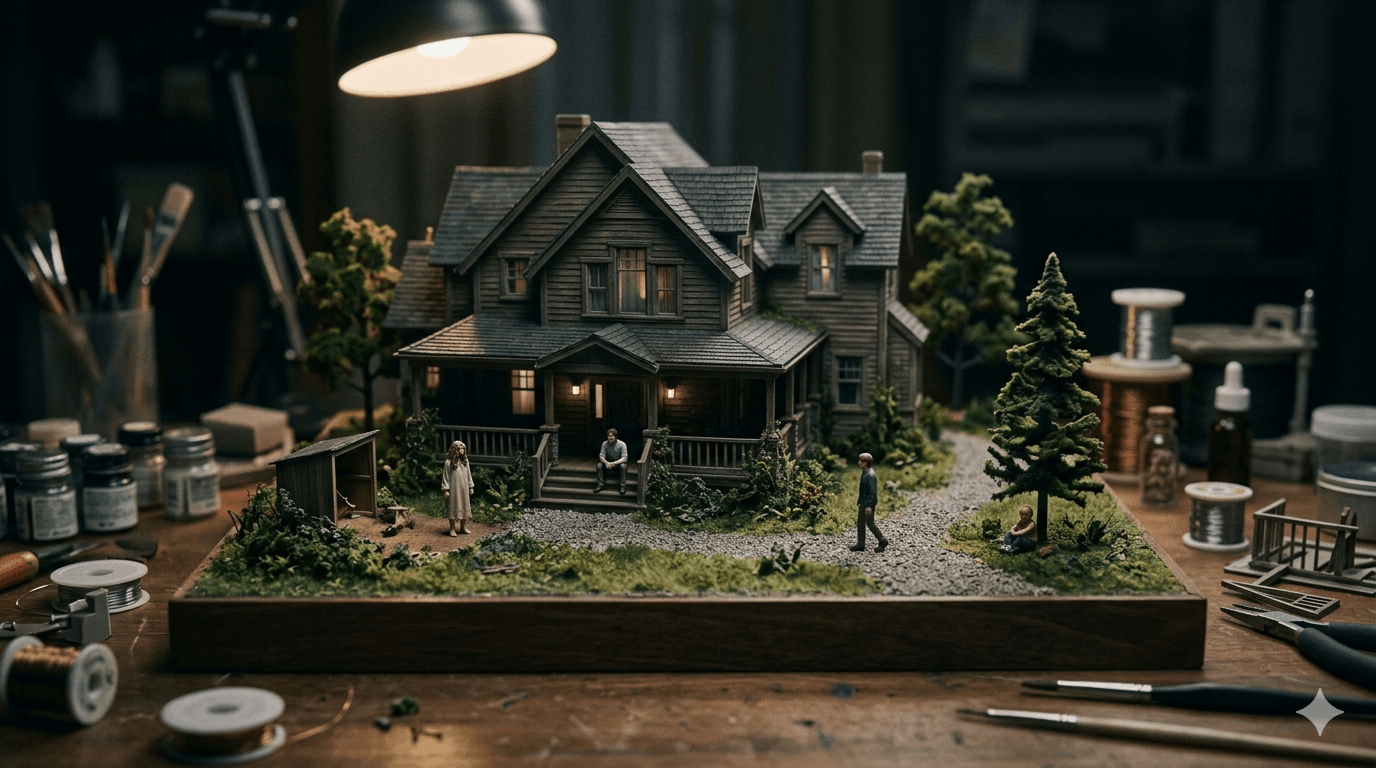
The hidden detail work in Hereditary’s miniature sequences is substantial and worth the examination it’s received. But the miniatures also tell a simpler story about Annie as a person: she processes what she cannot say by building it.
The workshop is her only space. She works there in a nightgown because she’s been there since before anyone woke up. She misses meals. She ignores the gallery’s emails. She builds miniatures of the hospice room where her mother died, a replica of the accident scene with Charlie’s decapitation in careful scale, and a replica of the Graham house where her family figures sleep in bed.
Steve confronts her about the accident piece. “Are you planning on letting him see that?”
“It’s not about him,” Annie says, with the specific tone of someone who knows exactly how that sounds and doesn’t have the capacity right now to explain it differently.
The miniatures are the closest Annie can get to understanding what she can’t hold in language. She is an artist making work about her own disintegration in real time — under gallery deadline, while her son won’t look at her and her husband is beginning to treat her like a liability. The answering machine message from the Asher Gallery — cheerful, oblivious, nine weeks out, no pressure — comes in while Annie is applying pressure to a glued wall. The wall breaks. Then she destroys the miniature. Then she destroys all of them.
All except the Graham House replica. Which is where, that night, she discovers figurines she didn’t build: a headless figure in Peter’s bed wearing Peter’s clothes, and an Annie-figurine in the attic with a blood-covered nightgown.
That is the moment the film stops being about grief.
Toni Collette and the Thing Awards Bodies Get Wrong
Collette was not nominated for an Academy Award for this performance. The standard explanation is that the Academy doesn’t take horror seriously. That’s accurate as far as it goes, and it stops short of describing what the omission actually costs.
Collette’s performance in Hereditary is a technical document of psychological collapse that most actors don’t attempt and most who attempt it don’t complete. The dinner table scene — Annie erupting at Peter, “your sister is dead, she’s gone forever, and what a waste, if it could’ve maybe brought us together, if you could have just said I’m sorry or faced up to what happened” — is the most cited moment. The more precise work happens in smaller beats.
The way she downs a pill when Steve hands it to her, without asking what it is. The way she goes white when she hears clicking from the empty back seat of the car. The way she apologizes to Peter at 3am before the séance — “I’m so, so sorry for everything, please, please forgive me, I can’t stand the things I said” — at the register of someone who has been holding that sentence for weeks and can no longer contain it, because she believes she’s about to give her family something that will fix everything.
What Collette tracks is Annie’s self-awareness collapsing in real time. She knows, periodically, that she is not behaving in ways that will hold the family together. She cannot stop. Collette makes you feel the specific texture of watching yourself cause damage you can’t prevent. It’s a performance with no gap between the performance and the character — which is, in fact, the hardest thing to do.
Joan, meanwhile, is working with surgical precision on exactly the gap Annie can’t close.
The Engineer of the Final Act
“You didn’t kill her, Annie. She isn’t gone.”
That is the sentence Joan delivers in the parking lot of the grief supp
ort group. Aimed at the precise wound Annie disclosed inside — the guilt about the party, the calculation she got wrong, “she begged me not to go.” Joan was there to hear it. Or she already knew where to aim.
The séance at Joan’s apartment is choreographed manipulation. The physical cold, the moving glass, the hair brushing Annie’s cheek, the chalk writing in a child’s hand — all of it is theater, produced by people who have been practicing for thirty years. What makes it work on Annie is that Annie is trying desperately to believe something other than an accident killed her daughter. Joan offers her that. Joan says: she was taken, and she can be reached. Here is a candle. Here is a prayer. Here is a way to bring her back.
Annie performs the family séance that night, waking Steve and Peter at 3am, and the film from that point forward operates as a controlled demolition. Every decision Annie makes in the final third is the decision of someone who has found a purpose. She’s going to fix what she broke. She’s going to use the tools she’s been given. The horror of the final act is that Annie is still fighting for her family — begging Steve to throw the sketchbook into the fire, because she believes it will save Peter — even as she has been converted into the instrument of his possession. The ritual’s final stage requires Annie’s body to be hollowed out and used.
The Discovery That Came Too Late
The boxes from Ellen’s room have been in the workshop the whole time.
Inside: a grimoire titled Invocations, filled with ritual imagery — passages on Paimon’s requirement for a male host highlighted and underlined in pencil, Ellen’s annotations throughout. A handwritten note from Ellen to Annie tucked into the title page asking forgiveness for what she couldn’t say, assuring her daughter that the losses would prove worthwhile, that the sacrifice would pale next to what came after. A mother’s note. Written to a daughter she spent a lifetime using.
And photographs. Ellen and Joan, twenty years younger, both wearing the Paimon necklace. Ellen feeding baby Charlie black herbs in a bottle. The necklace Annie was given as a gift from her mother — the one she compulsively touches for the entire film.
She has been wearing the sigil of Paimon around her neck for years without knowing what it was.
When Annie understands what her mother arranged — what her entire family was structured to accomplish — she enters her last register. She is someone who has arrived at full knowledge and found she cannot use it. She races to Joan’s apartment, finds the ritual space already built, understands the welcome mat embroidered with “JOANIE” because her mother had one embroidered “ANNIE.” She knows everything. She runs to find Steve.
Steve is already past saving because the sketchbook is already in the fire.
What the Ending Takes
The film’s grief horror framework gets subverted in the end
ing — the demon was always incidental to the family damage. What the ending takes from Annie specifically is harder to articulate, because the film takes it almost silently.
She is on the ceiling of Peter’s room when he wakes from surgery. She scrambles away so he won’t see her. Something inside the body that was Annie is still trying not to frighten her son.
Then she is in the attic. Then she saws through her own neck.
Whatever remains of Annie Graham in those final minutes — if anything does — watches the body she built over forty-five years complete the ritual she was designed to complete. The treehouse sequence puts her headless body bowing before Paimon’s manikin, beside her mother’s headless body. Three generations in the same frame. Ellen arranged this. Annie was always the material.
The film is careful to make sure you understand she fought anyway. All the way through. With the tools her mother put in her hands, toward the end her mother spent thirty years building, Annie Graham spent her final hours trying to save her son.
She never stopped trying, and she never had a chance — Ari Aster holds both of those things in the same frame without flinching, which is what makes the ending impossible to shake. Toni Collette played all of it. The Academy looked somewhere else.
Frequently Asked Questions
What is the significance of Annie Graham’s necklace in Hereditary?
The necklace Annie wears throughout Hereditary bears the sigil of King Paimon — the demon the cult has been orchestrating across three generations. Ellen gave it to Annie without explanation. Annie compulsively touches it for the entire film. When she discovers her mother’s photo albums, she finds that Ellen and Joan wore identical necklaces for decades. The necklace establishes that Annie was marked before she understood what any of it meant.
Why does Annie Graham sleepwalk in Hereditary?
Two years before the film begins, Annie woke standing beside Peter and Cha
rlie’s shared bed with both children covered in paint thinner and a box of matches in her hand. She tells Joan this during their apartment scene. The incident is best understood as an early failed attempt by the cult to use Annie’s body against her children — the mechanisms of possession were already active, though Annie had no awareness of them. The incident permanently destroyed her relationship with Peter.
Did Annie Graham know she was being used by the cult?
Not until the final act. The discovery scene — when Annie opens Ellen’s boxes in her workshop — is the moment she understands the full scope of what was arranged around her. She finds the grimoire, the photo albums showing Ellen and Joan together, and Ellen’s letter explicitly referencing sacrifice and rewards. By the time Annie understands what was done to her, the ritual is nearly complete. She knows but cannot use the knowledge.
Why wasn’t Toni Collette nominated for an Oscar for Hereditary?
The Academy’s failure to nominate Toni Collette for Hereditary reflects a longstanding institutional bias against horror as a genre. Collette’s performance tracks Annie Graham’s psychological collapse with technical precision that most awards-recognized performances don’t approach — the dinner table scene is the most cited, but the work in smaller beats is where the performance lives. The omission belongs to the history of what awards bodies have consistently missed about horror.