Who is the real Adelaide in
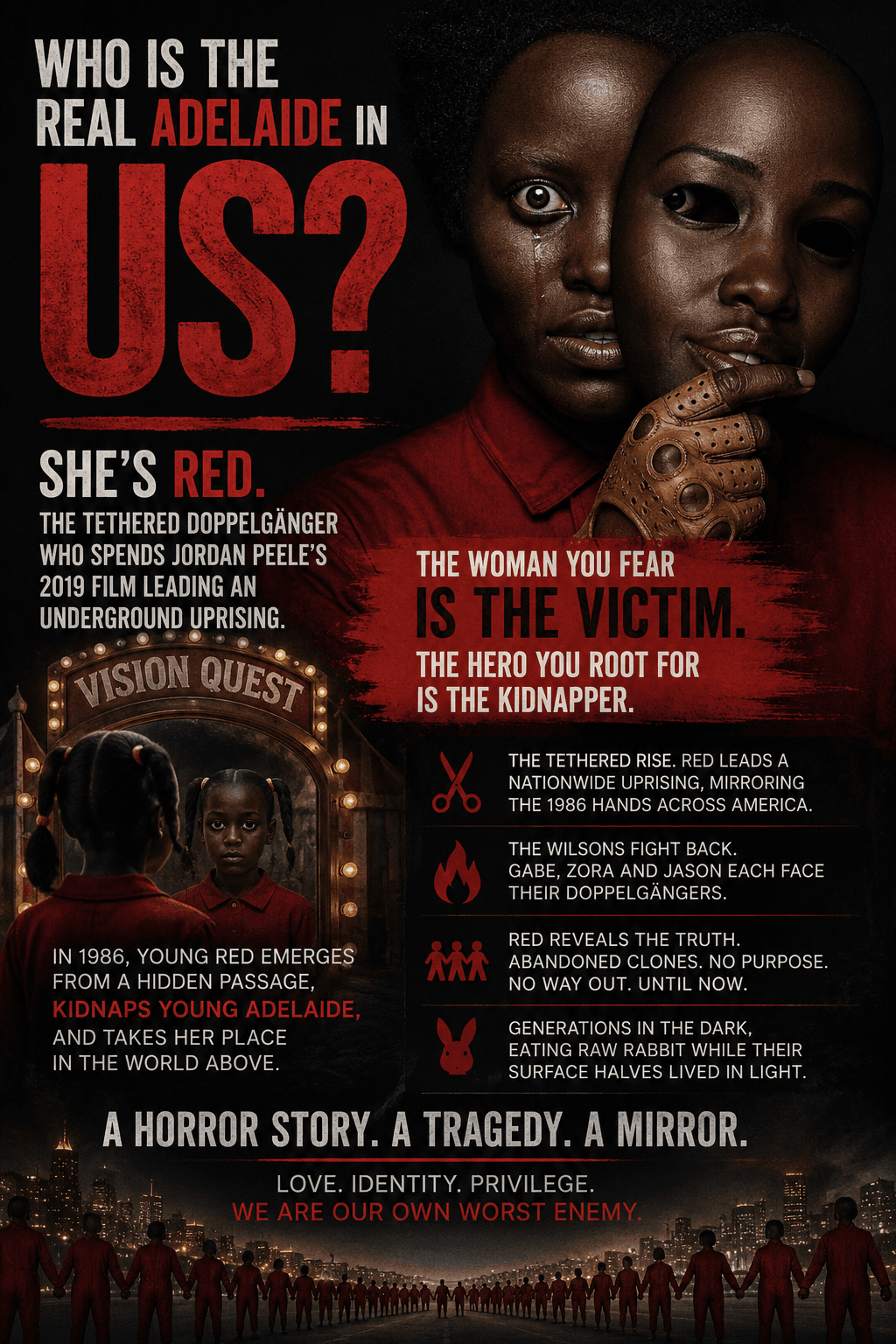
Us? She’s Red — the Tethered doppelgänger who spends
Jordan Peele’s 2019 film leading an underground uprising. She kidnapped the real Adelaide Wilson in a boardwalk hall of mirrors back in 1986, taking her place in the world above.The woman leading the invasion, the one the whole film trains you to fear, is the original victim. The final girl you’ve spent two hours rooting for — the one Lupita Nyong’o plays as the protagonist — is the one who did the kidnapping, and has spent thirty-three years since making sure nobody found out.I’ve sat with this ending longer than I’ve sat with most twists this decade. The mechanics are simple enough to explain in a sentence. What lingers is everything the reveal does retroactively to the tender moments that came before it.The bedtime scene where Adelaide promises Jason she’ll always keep him safe. The basement where she watches her younger self dance and looks like she’s grieving something she can’t name. All of it was genuine. That’s the uncomfortable part. Love assembled on a foundation the person offering it can’t fully account for is still love, and still worth calling by its name.
What Actually Happens at the End of Us
By the time
Us reaches its final act, the Wilson family has survived a home invasion by their own Tethered doubles — Red, Abraham, Umbrae, and Pluto — and fled across a Santa Cruz under full siege. The “Untethering,” Red’s decades-planned uprising, has broken out nationwide. Doppelgängers in red jumpsuits are rising from underground tunnels everywhere, murdering their surface counterparts and joining hands in a human chain that stretches across the country — an intentional, monstrous echo of the real 1986 charity event Hands Across America.Gabe kills Abraham on the open water after a prolonged, exhausting struggle, muttering “I’m done with boats” as he limps back onto dry land. Zora, thirteen years old and armed with nothing but instinct and a fire poker, kills Umbrae twice — once by running her over with the Tylers’ car, and again in the woods, finishing what the car started with something close to mercy.Jason escapes Pluto by turning his own magic trick, a spark-shooting snap he’s been failing at all movie, into a functioning weapon. He later lures Pluto into a burning car, where Pluto dies mirroring Jason’s own retreating footsteps, unable to stop copying him even as the flames close in.Between the home invasion and the underground confrontation, the Wilsons take shelter at the Tylers’ house next door and find Josh, Kitty, and their twin daughters already dead, replaced by their own Tethered. A local news broadcast catches up to the scale of what’s happening while the family watches in shock: reporters describe attackers emerging from the sewers with scissors, and grainy footage from Chicago shows a line of bloodied doppelgängers joining hands in the street.It’s the first confirmation that whatever is happening to the Wilsons is happening everywhere at once. Gabe’s response — “that would take a shit load of coordination” — undersells what the film is actually showing you: a plan Red has apparently been organizing for years, executed simultaneously across the entire country the same night she comes for her own family.That leaves Red. She grabs Jason during the chaos at the flaming car and drags him underground, into the tunnel network Adelaide calls “the Underpass.” Adelaide follows — cuffed at one wrist, armed with the fire poker she pried loose from her own living room table, alone.What follows is the film’s real climax, and the fight is almost secondary to it. The true climax is the monologue Red delivers before either woman throws a single blow.
Red’s Monologue and the Origin of the Tethered
Standing in an abandoned underground classroom, snipping a chain of red paper cutouts into the shape of linked figures, Red tells Adelaide what the Tethered actually are. Her voice, the script notes, sounds “quiet and craggy like it’s never been used” — because for most of her life underground, it was.Somewhere, the government built a means of cloning the country’s population. “I believe they figured out how to make a copy of the body,” Red tells her, “but not the soul.” The clones were meant to function as puppets, controlling the people above through some psychic tether neither science nor the film ever fully explains. The experiment was abandoned mid-project, the tunnels sealed, the doubles left to exist in parallel with no purpose and no way out.For generations they ate raw rabbit while their surface halves ate hot meals. They played with toys sharp enough to cut their hands while their surface halves unwrapped soft ones at Christmas. And then, Red says, there was us — meaning her, meaning Adelaide, meaning the one pairing in this whole abandoned system where something went differently.That difference is the hall of mirrors. In 1986, Young Adelaide wanders away from her bickering parents at the Santa Cruz boardwalk and into a funhouse called Vision Quest, where a power outage traps her in a room lined with mirrors. What she finds is Young Red, who has found her own way up through a hidden passage in the mirrored wall behind her.Young Red overpowers her, drags her below, and cuffs her to a bed in the tunnels before returning to the surface wearing Adelaide’s face, her clothes, and eventually her whole life.Everything the film showed you about Adelaide’s later childhood — the years of therapy, the refusal to speak, the diagnosis of PTSD after “getting lost for fifteen minutes” — happened to an impostor learning, in real time, how to perform being a person she wasn’t.The ballet obsession Kitty brings up at the beach, the recital where fourteen-year-old Adelaide dances a solo instead of the scripted pas de deux because there’s no partner who knows the steps: none of it is a hobby picked up naturally. It’s a girl who spent her childhood underground finally being handed a body that could move the way she’d always wanted to move, and using it like she was making up for lost time. Because she was.
Why the Ballet Scenes Are the Key to the Twist
Peele intercuts the underground fight between Adelaide and Red with matched flashbacks of both girls dancing at different ages — Adelaide on a lit stage in front of an audience, Red performing the same choreography in the tunnels in front of a crowd of silent, reaching Tethered. It’s the most quietly devastating structural choice in the film, because it makes the same argument twice at once: both girls could dance. Only one of them ever got a stage.When Red tells Adelaide, mid-fight, “if it weren’t for you, I never would’ve danced at all,” the line lands as grief — the only mourning the film ever lets Red have, for a life she was born into and never got to keep.The real Adelaide’s talent didn’t disappear when she was taken underground. It had nowhere to go, until she clawed her way back into a body that already knew what talent felt like, and used it to build a marriage, two children, and fourteen years of ordinary life she was never supposed to have.The film asks you to hold both facts as true simultaneously: she stole a childhood that wasn’t hers, and she spent it becoming someone genuinely worth loving. A person, formed entirely by theft, who turned out to be a good mother anyway, is a harder thing to sit with than any monster in a mask.Adelaide kills Red in the barracks, strangling her with her own handcuff chain. Multiple accounts of the sequence describe her weeping curdling into laughter mid-strangulation — not relief that the ordeal is over, but the sound of a woman realizing she’s won, and gotten away with it. Whatever this woman has spent thirty-three years building, some part of her is still capable of that.
Jeremiah 11:11 and a God Who Doesn’t Answer
The number recurs across the film with a persistence that stops being coincidence somewhere around the third appearance: a digital clock reading 11:11, a homeless man’s cardboard sign reading Jeremiah 11:11, a scoreboard, a coincidence Kitty jokes about on the beach.The verse itself is ugly and specific: “Behold, I will bring evil upon them, which they shall not be able to escape; and though they shall cry unto me, I will not hearken unto them.” It’s God promising punishment with no mercy attached, no matter how loudly the punished beg.Red frames her own uprising in exactly that language. She tells the Wilsons that God showed her a vision of blood on the soil and told her “the only way for a soul to truly be free is to sever the tie.” She believes it, sincerely, and the sincerity is what makes it monstrous — much the way
Midsommar’s ending reframes a ritual as a kind of liberation only once you stop expecting the film to condemn it. Peele lets Red’s conviction sit there unmocked, uncorrected by irony.The numeral’s palindrome structure, the same forward and backward, does the same work visually that Red and Adelaide do as characters: a shape that mirrors itself and offers no way to tell, just by looking, which direction is the true one.
What the Final Shot Actually Tells You
The ambulance pulls away from Santa Cruz carrying the Wilson family, and the film cuts back one last time to 1986 — to Rayne driving Russell and young Adelaide home from the boardwalk in the rain, the two adults still arguing, the girl in the backseat slowly, quietly starting to smile.The screenplay is direct about what that shot means, spelling out in its own stage direction that this is not the real Adelaide in the car — it’s the other girl, the one who spent that same night crossing from the tunnels into a stranger’s family. The reveal doesn’t rest on Red’s monologue alone. The film confirms it a second time, visually, in the very last flashback it shows you, in case any doubt survived the fight scene.Back in the present, the ambulance carries the family toward the countryside as Jason watches his mother’s face from across the vehicle. Neither the dialogue nor the direction tells you what he’s thinking.He’d seen Pluto mirror his own movements exactly, all night, and he’s spent the whole film being the one character sharp enough to notice things the adults around him miss — the drawing of two stick figures facing away from each other, the insistence that the man on the beach felt wrong before anyone else registered why.Peele has said in interviews, including on the Empire Podcast, that he left Jason’s expression deliberately vague — “a lot of things,” he called it, both a flicker of recognition and a quiet acceptance that whatever happened, his family is still his family. The film leaves that tension unresolved on purpose, and asks you to sit inside it the way Jason has to.Peele has also been direct about why he built the twist at all, rather than leaving Adelaide as a straightforward survivor. Talking about the choice, he said the protagonist functions as “a surrogate for the audience,” and that revealing her as the film’s actual villain was the only way to make good on the movie’s whole argument: “I wasn’t doing my core theme any justice if I wasn’t revealing that we have been the bad guy in this movie. We’ve been following the villain.”
Us spends its whole runtime pretending to ask who’s out there in the tunnels. Its actual question is what you’d become, given thirty-three years and a stolen body, to make sure you never went back.
Who Is the Real Adelaide in Us? The Clues Hidden in Plain Sight
Watch
Us a second time knowing who the real Adelaide is, and the film stops being a mystery and starts being a confession, delivered in plain sight the entire runtime. Adult Adelaide’s dread about the trip to Santa Cruz isn’t the ordinary anxiety of revisiting a childhood trauma. It’s the specific fear of someone returning to the scene of a crime she committed, worried the evidence is still down there waiting.She tells Gabe early on that she sometimes has “a hard time talking” — a strange thing for a grown woman to confess to her husband unprompted, and a much less strange thing for a woman who spent her childhood learning language from scratch, underground, from nobody.The frisbee that lands on the exact matching polka dot of Kitty’s beach towel, the moment Kitty calls it “so many weird coincidences happening lately” — these read as generic horror-movie omens on a first watch. On a second watch, they’re Adelaide’s own paranoia externalized onto the world, because she is the one person on that beach who understands, on some level, that the universe keeps a ledger.Jason’s drawing of two stick figures facing away from each other isn’t a random kid doodle. It’s a child processing something he’s picked up about his mother without being able to name it, months or years before Pluto ever mirrors his movements in that hallway closet.The clearest clue of all is one Peele hands you twice, in the exact same words. Early in the film, in the flashback to the psychiatrist’s office, Russell and Rayne describe a daughter who “wasn’t in Nam’,” who “got lost for fifteen minutes,” who won’t talk, and Dr. Foster suggests encouraging her to draw, write, or dance to help her tell her story.In the film’s final minutes, as the ambulance carries the Wilsons away from Santa Cruz, that same conversation plays back over the images almost word for word. The first time you hear it, it sounds like backstory. The second time, once you know who was actually sitting in that office, it sounds like a diagnosis nobody in the room was equipped to make.
Hands Across America and the Meaning of the Ending
The final image belongs to no single character. A bird’s-eye shot pulls up and away from the ambulance, drifting inland until it finds the human chain the Tethered formed during the Untethering, hand in hand, stretching toward the horizon under “Les Fleurs” by Minnie Riperton.It’s the same visual the film opened with — grainy 1986 footage of the real Hands Across America campaign, roughly five million people linking hands from coast to coast for a charity that, in reality, cost nearly as much to produce as it raised, and never came close to forming the unbroken chain it promised.The Tethered’s uprising completes what the surface world’s version of the gesture never could: an unbroken line, coast to coast, made real by the people the country built and then forgot underground. It’s a bleak note to end a film on, and Peele doesn’t undercut it with hope. The line just goes on, and on, toward a rising sun that isn’t promising anything.
Craft Notes: How the Ending Was Built to Be Missed on First Watch
Cinematographer Mike Gioulakis shoots the underground fight in tighter, more claustrophobic compositions than anything in the aboveground half of the film. The classroom chase stops feeling like an action climax and starts feeling like two people trapped inside the same small, airless idea.Composer Michael Abels scores the ballet-intercut sequence with the same choir motif that opens the film over shots of caged rabbits, so that even before you consciously register the reveal, the music has already told you these two girls have always been part of the same composition, long before Red says a word about souls or tethers. Whoever cut that sequence together resisted the urge to explain it. The images carry the film’s thematic argument on their own, with no line of dialogue doing the work for them.None of it works without Nyong’o building two physically distinct people from the inside out — Adelaide’s guarded, watchful stillness against Red’s ragged voice and animal economy of movement, different enough that the twist plays as a genuine rewiring of everything you thought you’d watched. It’s the same kind of transformation that made
Mia Farrow’s performance in Rosemary’s Baby so unsettling — a mother figure whose reality quietly comes apart while she keeps performing normalcy for everyone around her.The New York Film Critics Circle named it the best performance of the year, the SAG voters nominated her, and the Academy nominated her for nothing, a decision that became its own minor controversy in the following awards season. Watch the barracks scene once more with the reveal in mind and that snub gets considerably harder to defend.
The Ending’s Real Weight
What makes the ending of
Us land as tragedy rather than shock is that it refuses you a clean villain to blame once the truth comes out. Red spent thirty-three years underground for a swap she committed as a nine-year-old, a child too young to understand what she was taking or what it would cost the girl she left behind.Adelaide — the real Adelaide, formerly Red, currently and permanently “Adelaide” to everyone who loves her — built an entire, genuinely loving family out of a life that was never legally hers to build. It’s a family held together by a secret at its center, the same structural trick that makes
Hereditary’s ending land so hard once you see the whole shape of it.Somewhere beneath Santa Cruz, in a system nobody above ground ever chose to acknowledge, is the woman who would have raised Zora and Jason if a hall of mirrors had gone dark ninety seconds later than it did.
So, Who Is the Real Adelaide in Us?
The real Adelaide is the woman the film calls Red: the child taken underground in 1986, who spent thirty-three years as a Tethered before leading the Untethering to reclaim what was taken from her. The character the film follows as its protagonist and mother figure is the Tethered impostor who swapped places with her that same night, in the Vision Quest hall of mirrors.Even the title stops being simple once you know how the ending works. “Us” reads first as a pronoun — the family, the country, all of it plural and collective. Red says it herself, underground, describing the one pairing in the whole failed experiment where something didn’t go according to the original design: “and then there was us.”By the time the credits roll, the word has folded in a second, quieter meaning too. U.S., the country, standing on a human chain built from the people it manufactured and then abandoned without ever explaining why.
Us doesn’t ask you to forgive that. It asks you to notice that you already had, for two hours, before you knew there was anything to forgive.