There’s a specific kind of anger that doesn’t come from being hurt. It comes from being made to ask permission for something you already had every right to. I got pulled over on a Texas highway once, well past midnight, nothing wrong with the car, nothing wrong with how I was driving. The officer was polite. I was polite, because politeness was the only tool available in that situation. License, registration, where are you coming from, where are you headed. Ten minutes, released, no ticket, no violation.What stayed with me was the specific indignity of having to justify my right to keep doing something I was already doing, having done nothing wrong — an irritation that settled entirely on the logic that put me there, an impersonal policy with no single author I could actually be angry at.Elisabeth Sparkle gets pulled over for the same reason. Her traffic stop just lasts the rest of her life, and the officer is an entire industry, and the offense is turning fifty.Coralie Fargeat’s film is not subtle about this, and it doesn’t need to be. Within the first ten minutes, a TV network executive named Harvey — mid-conversation, unbuttoning his pants at a urinal, barely aware he’s still on a call — explains the exact mechanism to an assistant who isn’t really listening: “People always ask for something new. Renewal is inevitable. It’s nature’s way. You either renew or you disappear.” Then, almost as an afterthought, still mid-piss: “At fifty, it stops. And that’s not me saying so.That’s biology.” He fires Elisabeth Sparkle from the aerobics show she’s hosted for years over one fact alone: she had a birthday. Her ratings hadn’t dropped. She hadn’t done anything wrong. The film’s entire moral architecture is contained in that bathroom scene, and everything that follows is what happens when a person accepts that logic instead of questioning it.What follows is The Substance (2024) ending explained in full — the mechanics of what happens in the final ten minutes, and the reasoning underneath it that makes the finale feel earned instead of shocking for its own sake. This is a film built on a rule, and understanding the rule is the only way the ending means anything more than a very well-executed gross-out.
The Substance (2024) Ending Explained
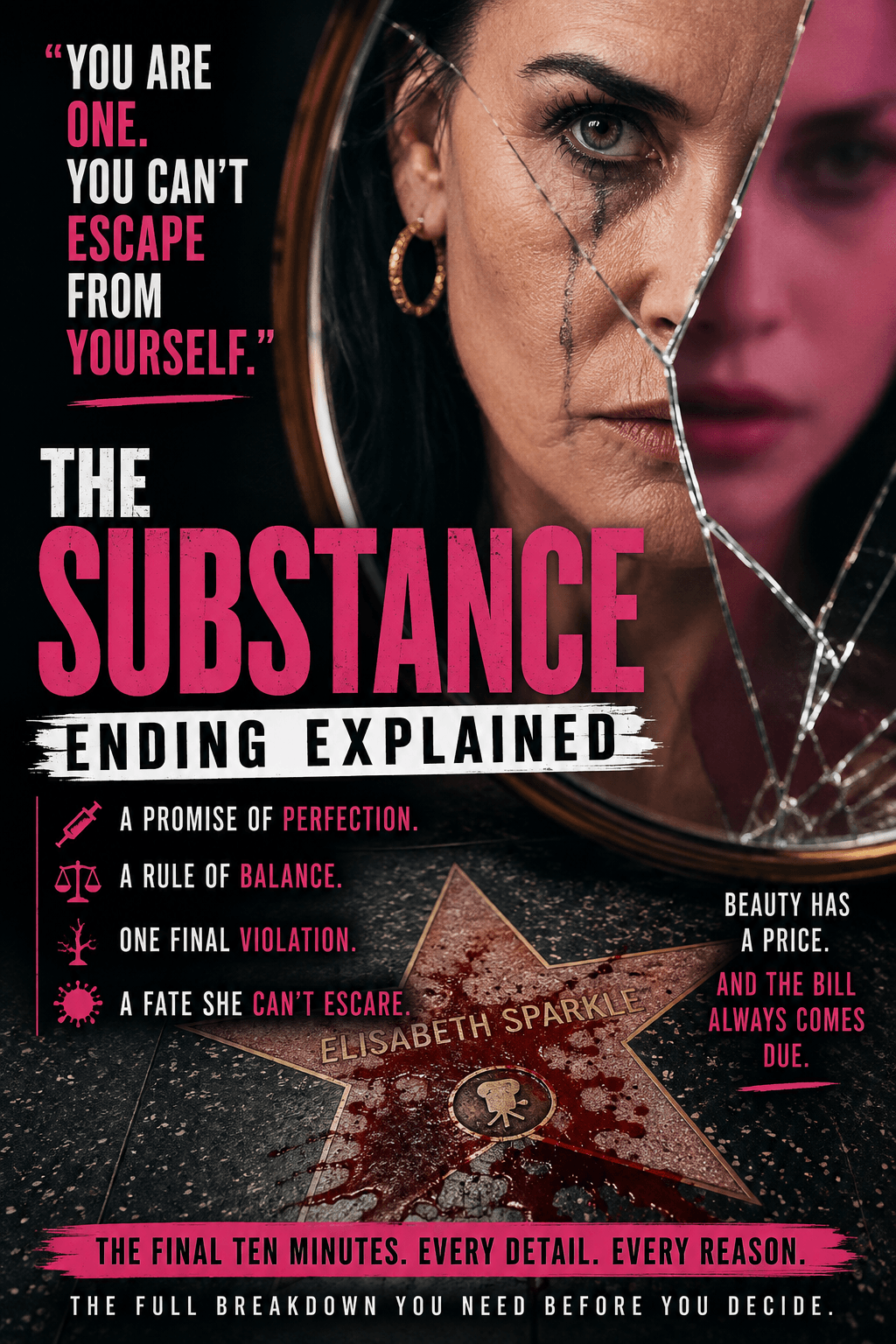
The short version: Sue breaks the balance rule one final time by injecting the stabilizer into herself instead of Elisabeth, and the two fuse into Monstro Elisasue — a single grotesque body that still goes on stage for the New Year’s Eve broadcast anyway. The crowd panics, calls her a monster, and attacks her.She flees, deteriorating with every step, and drags what’s left of her body onto her own star on the Hollywood Walk of Fame, where she dissolves into a bloodstain that a street-cleaning machine wipes away at sunrise — the same visual fate as the ketchup stain the film opens on. The rest of this piece walks through how the film earns that ending, beat by beat.
What “The Substance” Actually Does
After Harvey fires her, Elisabeth gets into a car accident. In the hospital, a strikingly handsome young male nurse — blue eyes, a small strawberry birthmark on his forearm, a detail the film returns to later — performs an unnecessary “one last exam,” presses a stethoscope to her spine, and slips a USB drive into her coat pocket without her noticing.On it: an offer for something called “the substance,” a black-market product with a promise scrawled on a folded note — “it changed my life.” The commercial that plays when she watches the drive is styled like an infomercial for a supplement, narrated over closeups of DNA-helix visuals: “One single injection unlocks your DNA, starting a new cellular division that will release another version of yourself… This is simply a better version of yourself.You just have to share.” Then the rule, stated flatly, twice, so there’s no ambiguity about whether it’s optional: “One week for one and one week for the other. A perfect balance of seven days each. The one and only thing not to forget: you are one. You can’t escape from yourself.”That last part is the whole film, if you’re listening. You are one. Not two people sharing a body. One person, temporarily wearing two.Elisabeth injects herself. Her spine splits open along her back, and a second body claws its way out of the wound — younger, smoother, engineered to be, in the script’s own word, “more perfect.” This is Sue, played by Margaret Qualley, and for the first seven days, Sue gets to be Elisabeth in every sense that matters to the industry that discarded her: she auditions for Elisabeth’s old show, she gets it, she’s an instant sensation.Elisabeth’s dormant body stays behind, unconscious, fed through a tube, kept alive by a daily dose of stabilizer fluid that has to be extracted from Sue’s spine and injected into Elisabeth’s. Every seven days, whoever is “out” has to switch back — inject the stabilizer, fall unconscious, let the other body take over. The film is very deliberate about showing this exchange as a genuinely equitable arrangement at first. Sue doesn’t cheat immediately. The corruption is gradual, which is what makes it recognizable instead of cartoonish.
The First Violation, and What It Costs
The rule breaks the way most rules break: quietly, with a good excuse, one time, as an exception. Sue is having a good night. There’s a man. There’s an opportunity she doesn’t want to leave in the middle of. She injects extra stabilizer fluid — siphoned straight from Elisabeth’s spine, more than the daily dose calls for — and stays out past her seven days.When she finally switches back, Elisabeth wakes up and finds a body that has aged catastrophically overnight: a finger seized up into something closer to a claw, joints that won’t move right, a face that looks decades older than it did a week earlier. The film doesn’t explain this with dialogue. It just shows you what stolen time costs the person it’s stolen from, in a single unbroken image of Elisabeth’s hand curling into something no longer entirely hers.This is the moment the film stops being a cautionary premise and becomes a machine that can’t be shut off. Elisabeth tries to end the arrangement — there’s a real scene, later, where she sits with the kit and seriously considers terminating the substance for good, and a voice (the substance’s own recorded warning) tells her plainly: “Once you stop, you can’t go back. You will simply remain on your own.” She doesn’t stop.Every violation that follows is smaller and more human than the last one, which is exactly why they accumulate instead of resolving: Sue steals a day here, an extra dose there, always for a reason that sounds, in the moment, completely reasonable. She’s a person who got a taste of being wanted again and can’t make herself give it back on schedule — the ordinary selfishness of someone who liked how it felt to matter. Elisabeth, meanwhile, retreats. She stops leaving her apartment during her weeks.She eats alone, watches Sue’s show on television, and — in one of the film’s most quietly brutal scenes — gets dressed for a date with a man from her old high school, applies makeup with real care and hope, and then, catching her own reflection at the wrong angle, wipes it all off and cancels, because some version of herself has already decided she isn’t allowed to want anything anymore. Nobody made her cancel that date. That’s the part worth sitting with. The industry didn’t have to keep punishing her once she’d started punishing herself.
Monstro Elisasue
By the time the film reaches its New Year’s Eve special — the one Sue has been building toward the entire back half, the one meant to relaunch her permanently into the kind of fame Elisabeth never fully had — the balance between the two of them has collapsed completely. Sue, desperate to stop Elisabeth’s failing body from ending her own borrowed time on stage, injects the stabilizer directly into herself in a panic, not into Elisabeth.It’s the final violation, the one that breaks the arrangement for good, and what it produces is a fusion: a single grotesque body built from both women at once, referred to in the screenplay simply as Monstro Elisasue, Elisabeth’s face partially visible and still trying to speak from somewhere inside the mass.She goes to the studio anyway. She’s spent the whole film absorbing the idea that missing your moment is unforgivable, and that belief doesn’t leave her just because her body has stopped cooperating with it. Backstage, crew members greet her with the exact affirmations Harvey’s industry has been feeding her the entire film — “you’re irreplaceable,” “we could never do it without you” — delivered with the same hollow warmth as every compliment that came before it.She glues a photograph of her own younger face over the ruined one, applies lipstick on top of the paper, and walks onto a live broadcast in front of Harvey, the shareholders, and a studio audience expecting Sue.The mask doesn’t hold. On stage, mid-broadcast, the paper face detaches, and the crowd sees what’s actually underneath. The reaction is immediate, literal, and entirely unmetaphorical — the panicked response of people who believe they’re looking at a monster: “The monster!” “Shoot the monster!” “It’s a freak!” Someone strikes her with a microphone stand.She flees the stage, leaving a trail of blood down the same backstage corridor she’s walked a hundred times as a star, and the film lets you watch her body come apart as she runs — legs dislocating, joints giving out, until what’s left of her is no longer capable of standing at all. She keeps moving anyway, dragging what remains of herself down the street in the dark.She’s heading somewhere specific, dragging what’s left of her body with the clear intent of someone reaching the one destination that still means anything to her: her own star on the Hollywood Walk of Fame, the one with her name on it, the one the film opened on decades earlier being installed with ceremony and abandoned within a single unbroken shot to years of foot traffic, gum, and a dropped hamburger smearing ketchup across her name. She settles into the center of the star.Gold confetti begins to fall, and for a moment the film lets her believe — and lets you halfway believe alongside her — that she’s finally arrived at the ovation she spent the entire film being told she no longer deserved. She is, by every reading the film allows, happy in that moment.Then she keeps dissolving, past the point where there’s a face left to be happy with, until what remains is a dark, spreading stain that looks exactly like the ketchup stain from the film’s opening images — the exact visual rhyme the film has been building toward since its first minute. A street-cleaning machine rolls across the frame at sunrise and wipes it away, leaving only the star and the name stamped into it — the two things Elisabeth spent the entire film trying to protect, and the only two things that were ever going to survive her.
What the Ending Is Actually Arguing
The easy reading of the finale is punishment — Elisabeth reached too far, wanted too much, and the film kills her for it, in the old tradition of horror films moralizing about female vanity. The ending is built to survive that reading and argue past it. What destroys Elisabeth is a system that made being seen the only form of worth available to her in the first place, and then revoked it on a schedule she had no say in setting; nobody in the film ever tells her to stop wanting that.Harvey’s monologue in the men’s room is a man reciting a policy he didn’t invent and doesn’t examine, the way a person might recite a company’s return policy. It’s a milder cousin of the same care-as-cage mechanism running underneath
Rosemary’s Baby, where kindness and control turn out to share an address.“That’s biology,” he says, about a decision that has everything to do with what a television network has decided a fifty-year-old woman’s face is worth and nothing to do with actual biology. The film’s real subject is the machinery that manufactured Elisabeth’s vanity as the only currency she was ever offered, then discarded her the moment the currency expired.The ending forces a reckoning with what Sue actually is, once “you are one” stops being an instruction and starts being the plot: Elisabeth’s own hunger, wearing a body the industry finds acceptable to look at. Every cruelty Sue commits against Elisabeth’s aging flesh is Elisabeth committing it against herself, at one remove, with just enough distance to pretend otherwise.That’s the real horror engine of this film, more than the practical effects — a woman who has fully internalized an industry’s verdict on her own worth, given that verdict a separate body, and watched it eat her alive one stolen week at a time. The traffic-stop analogy I opened with only goes so far, because a police officer eventually drives away and leaves you alone with your irritation. What Elisabeth is dealing with never leaves, because she built it out of herself and gave it a face she used to love.
Craft Notes: What Makes the Machine Work
Benjamin Kračun’s cinematography earns a lot of the credit for how the film’s argument lands as feeling rather than lecture. The film opens on a raw egg being injected with a fluorescent yellow substance, watching in unbroken close-up as a second yolk detaches and grows beside the first — “rounder, shinier, fleshier… more perfect,” per the script’s own description — before the title has even appeared.That single image is the whole plot, told in fifteen seconds, and Kračun shoots the rest of the film the same way: extreme close-ups on skin, food, mirrors, and surfaces that make flesh look increasingly like meat long before the film asks you to see it that way consciously. The recurring visual grammar of the Walk of Fame star — installed with ceremony, worn down by indifferent foot traffic, stained by a dropped hamburger — bookends the entire film and tells you, before a single word of dialogue, exactly how this story ends.Raffertie’s score leans into pulse and pressure rather than traditional horror stings, closer to a body under strain than a jump-scare cue, which suits a film where the dread is almost entirely physical and internal rather than supernatural.Demi Moore carries the film’s emotional weight in scenes that ask for almost nothing but her face — the cancelled date is the clearest example, an entire arc of self-erasure performed with makeup remover and a bathroom mirror, no dialogue required.Margaret Qualley’s job is harder to get right than it looks: Sue has to be genuinely likable, genuinely hungry, and genuinely a version of Elisabeth’s own worst instincts, all without ever tipping into camp villainy, and Qualley plays the character’s escalating selfishness as something closer to appetite than malice, which is exactly what keeps the “you are one” reveal from feeling like a twist instead of an inevitability.Dennis Quaid’s Harvey is a small, precise performance built almost entirely out of the character’s inability to stop talking — a man who fills every silence with sales language because sincerity would require him to notice what he’s actually saying.
Context: What the Film Sits Inside
The Substance premiered at Cannes in May 2024 and won Best Screenplay, a rare honor for a body-horror film at a festival not historically generous to the genre. It went on to earn five Oscar nominations the following year — Best Picture, Best Director, Best Actress for Moore, and Best Original Screenplay among them — before winning exactly one: Best Makeup and Hairstyling, for Pierre-Olivier Persin, Stéphanie Guillon, and Marilyne Scarselli.Their practical effects work on Monstro Elisasue is the only place in the film’s entire awards run where the industry fully agreed to reward the artifice on-screen rather than the woman behind it. Moore won the Golden Globe, the Critics’ Choice Award, and the SAG Award for Best Actress that season, arriving at the Oscars as the presumed frontrunner, and lost the category to Mikey Madison, a generation younger, for Anora.I want to be careful about how I frame that, because it would be cheap to claim the film predicted its own reception — Fargeat’s script carries a May 2022 draft date, years before either actress was cast in anything related to it. What’s harder to shake off is watching a film this explicit about an industry’s appetite for what’s new, then watching its lead actress lose the one prize built around that exact theme to a significantly younger performer.It reads less like prophecy than like the film being accurate about something that was never going to stop being true just because a movie said it out loud.The film made a $17.5–18 million budget back roughly four times over at the worldwide box office and holds an
89% score on Rotten Tomatoes, numbers that tell you a specifically female-authored, purposefully repulsive film about the cost of being discarded found an audience willing to sit through it — which, given what the film is actually arguing about who gets permission to be looked at, feels like its own small, complicated victory.
Where This Leaves Elisabeth
I keep returning to the traffic stop, because the thing I never resolved about it was who to be angry at. The officer didn’t design the law he was enforcing. Harvey is just as much a mouthpiece, reciting an industry logic he didn’t invent in a public restroom without once questioning it — the same kind of nobody-built-this-on-purpose machinery I found in
Weapons, another film where every individual is doing something survivable and the damage still adds up.The substance itself states its terms upfront and never lies about them. Sue, in the end, is just Elisabeth’s own hunger wearing a younger face.The rule that destroys Elisabeth doesn’t have a single author standing behind it anywhere in this film, which is exactly why the anger it leaves you with has nowhere clean to land — and why that’s the correct anger to end on. I was let go after ten minutes with no ticket and no lasting harm, and it still took me years to stop being irritated by the logic that put me on that shoulder in the first place. Elisabeth never gets let go.She gets confetti, for about four seconds, on a star with her own name on it, and then a street sweeper takes even that. The film doesn’t ask you to decide whether she deserved better. It already knows the answer. It’s asking you to notice how long you were willing to watch the system convince her she didn’t.
Frequently Asked Questions About The Substance (2024) Ending Explained
The Substance (2024) Ending Explained: What Happens to Sue?
Sue doesn’t survive as a separate person. When she injects the stabilizer into herself instead of Elisabeth during the New Year’s Eve broadcast, the two fuse into Monstro Elisasue. The film never shows Sue existing independently again — her disappearance into that fused body is treated as final and irreversible, not a setback either woman recovers from.
The Substance (2024) Ending Explained: What Does the Final Shot Mean?
The last shot shows a street-cleaning machine wiping away the bloodstain left where Elisabeth’s remains dissolved on her Hollywood Walk of Fame star, visually echoing the ketchup stain from the film’s opening minutes. It suggests the industry’s cycle — discover, use, discard, clean up, repeat — continues exactly as it did before Elisabeth ever existed.