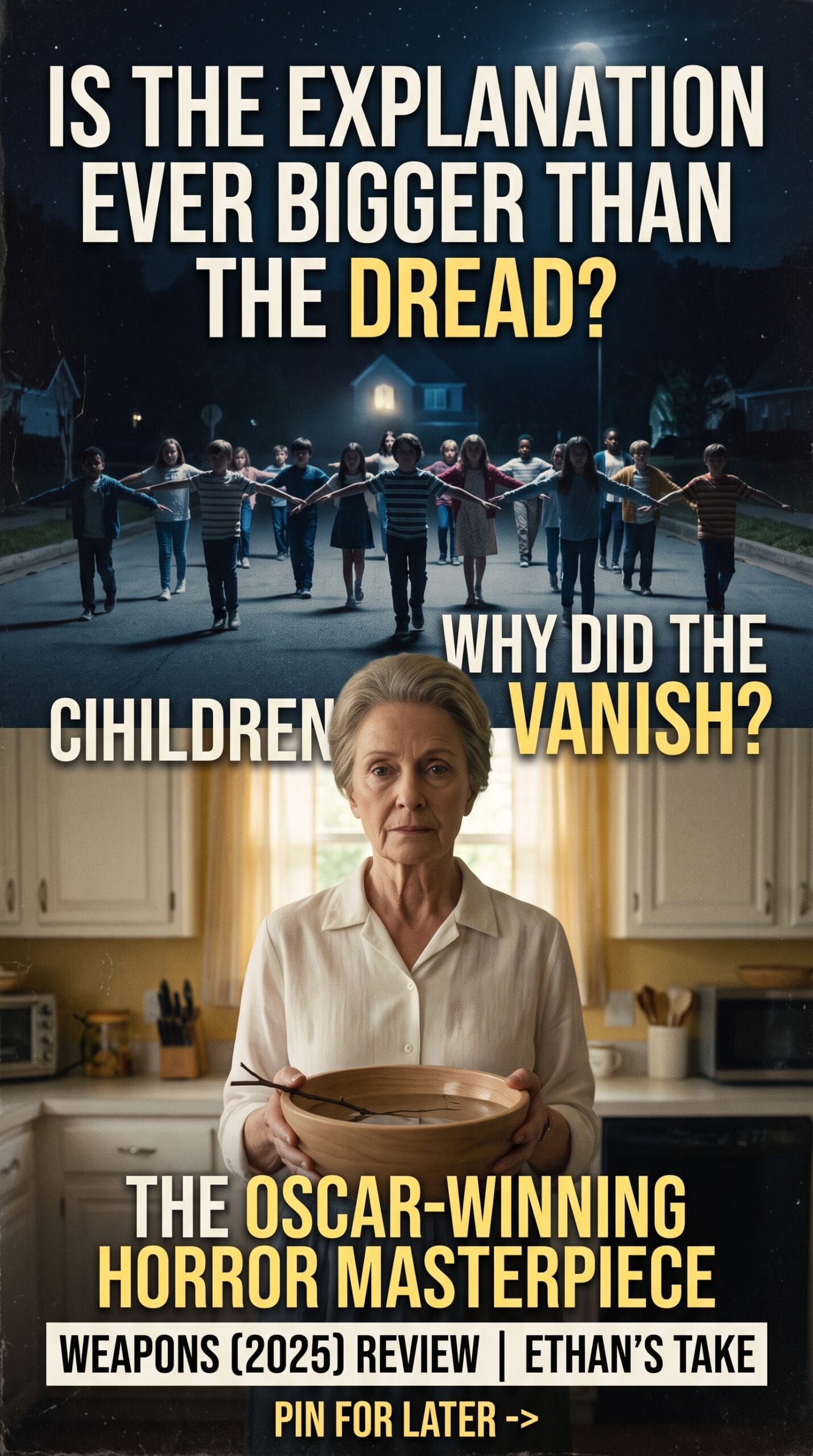
Seventeen third-graders leave their houses at 2:17 in the morning, arms out at their sides like they’re holding their balance on a beam that isn’t there, and none of them ever explains why. That’s the image Zach Cregger’s Weapons opens on and the one it keeps circling back to, and by the time the film finally tells you what happened, the explanation is almost beside the point.
I’ve been sitting with this one for a few days now, and I keep landing on the same question rather than an answer: what is a mystery movie actually for, once you already suspect the solution will be smaller than the dread it produced?
That’s the question sitting underneath this Weapons (2025) review before we even get to Cregger’s mechanics for withholding the answer.
A Structure Built to Withhold
Weapons is structured the way Cregger structured Barbarian — not as a single throughline but as a set of overlapping chapters, each one following a different resident of Maybrook, Pennsylvania through the same stretch of days from a different vantage point. The teacher whose entire class vanished except for one boy. The father convinced the school covered something up. The cop with his own reasons to avoid scrutiny. The principal trying to keep a wellness check from becoming a headline.
Cregger and his cinematographer, Larkin Seiple, shot the whole thing on an Alexa 35 with a custom LUT built to force the exposure up by nearly a full stop while still holding the shadow detail — which sounds technical until you notice what it does on screen: the film is bright in places you’d expect a horror movie to go dark, and the dread comes from what’s sitting in plain daylight rather than what’s hiding in it.
Seiple has talked about prioritizing an eye light for every actor in every scene, on the logic that if you can’t read what’s happening behind someone’s eyes, the performance stops working. That choice matters more here than in most horror films, because Weapons is a movie about what people’s eyes do when they’re lying to themselves.
Editor Joe Murphy, cutting his second Cregger film after Barbarian, keeps the chapter transitions abrupt on purpose — a door closing in one character’s timeline lands you inside a completely different room, days earlier, before you’ve had a chance to finish processing what you just watched. The disorientation is the point. It’s the same withholding Seiple builds into the frame, just done with time instead of light.
Weapons (2025) Review: Ethan’s Take
Here’s my position on it, stated plainly rather than saved for a tidy final paragraph: this is a genuinely well-made film that’s more impressive as a structure than as a story, and the structure is impressive enough that I don’t think that’s a real problem. The chaptered format is the argument, built directly into the structure rather than decorating a straightforward plot.
Every character in Maybrook is working from partial information and defending a version of events that lets them sleep at night, and Cregger’s choice to withhold the wide shot — to make you live inside one person’s blinkered certainty for twenty minutes before cutting to someone whose certainty contradicts it — puts you in the same position as everyone in the film. You think you understand what’s happening in that house on the edge of town.
You’re wrong in a slightly different way every twenty minutes, right up until you’re not wrong anymore, and the relief of finally having a stable picture is smaller than you’d expect, because a stable picture was never really what the film was selling you.
The Performances That Carry Weapons
Julia Garner as Justine Gandy
Julia Garner plays Justine Gandy, the teacher whose entire third-grade class disappeared except for one student, and the performance is built almost entirely out of the specific exhaustion of being punished for something you didn’t do and can’t explain.
There’s a town meeting early on where Justine tries to offer condolences to a room full of parents and gets shouted down before she finishes a sentence — one of them, in his grief, informs her flatly that she should be locked up until she talks — and Garner plays the moment without indignation, which is the choice that makes it land. She doesn’t defend herself, because she’s already worked out that defending herself will read as evidence.
What Garner is doing across the film is tracking what it costs a person to keep being reasonable in a room that has already decided her reasonableness is a performance. It’s a quieter register than the premise would suggest a movie like this needs, and it’s the register that makes the film’s second half hit as hard as it does, because you’ve spent an hour watching Justine absorb blame that belonged somewhere else entirely.
Josh Brolin as Archer Graff
Josh Brolin gets the harder assignment, and it’s worth naming because it’s easy to undersell. Archer Graff is a father whose son vanished in the same wave as everyone else’s, and Brolin plays him as a man running an investigation he has no authority to run, using grief as a credential nobody actually gave him.
There’s a moment where he shows up at a stranger’s door asking to see private doorbell footage, certain he’s owed it, and Brolin doesn’t play the certainty as villainy — he plays it as the last functioning part of a man who has otherwise stopped working. It’s a smaller performance than Garner’s or Madigan’s, more reactive by design, but it’s doing the same job the editing is doing: showing you how far a reasonable person will travel once reason stops being useful to them.
Amy Madigan’s Oscar-Winning Turn as Aunt Gladys
Amy Madigan, as Aunt Gladys, is doing the opposite kind of work, and it’s the reason this film has an Oscar attached to it now. Gladys is introduced the way this genre usually introduces its harmless old relatives — over-affectionate, a little odd about her water bowls, prone to describing herself as “on the verge of collapse” while asking for things nobody would refuse a sick old woman. Madigan plays every one of those beats completely straight, with no visible wink to the camera, which is what makes the character so unsettling once you understand what she actually is.
It never announces itself as a mask. She isn’t performing sweetness badly — she’s performing it well enough that an entire household reorganizes itself around her illness without ever getting a straight answer about what that illness actually is. The needy, apologetic register never breaks, even once the film has shown you exactly what’s underneath it, and that refusal to modulate is the whole performance: the monstrousness was always sitting inside that same soft, wheedling voice, unchanged by the reveal, which means everyone in that house who found her charming was responding to something real.
What they misjudged was what the charm was covering.
What Weapons Is Really About
What Weapons is actually about, underneath the disappearance-mystery machinery, is how a community organizes its need for someone to blame. Justine gets blamed because she’s an easy target — a teacher without institutional protection, already flagged in her file for a DUI and a prior complaint about overstepping with a student, which the parents treat as confirmation rather than context. The police treat the case as closed the moment procedure has technically been followed. The school principal’s primary concern, in one meeting after another, is keeping the district from being sued rather than finding the children.
Nobody had to be evil for this to work. Cregger writes each of them the same way: doing the specific, survivable thing that lets them believe they’ve done their job, and the horror of the film’s back half is the realization that every adult institution in Maybrook had a chance to look directly at the thing in that house and chose the version of looking that required the least of them. Gladys isn’t hiding from the town. She’s hiding in the town’s willingness to not ask the second question.
There’s a doubling in that setup that the film never spells out, and I think it’s smarter for leaving it alone. Maybrook spends the entire runtime looking for a witch and finds one twice — first in Justine, a woman blamed on nothing but proximity and an old complaint in a personnel file, and then, much later, in Gladys, who actually deserves the word. Both accusations run on the same fuel: a town that needs a single figure to hold responsibility so the rest of it doesn’t have to. One of those accusations happens to be true.
The film doesn’t ask you to feel good about how close it came to landing on the wrong one.
Weapons (2025) Review: Box Office Numbers and the Road From Barbarian
Before wrapping up this Weapons (2025) review, it’s worth pausing on the fact that this got made at all, and at this scale, the way it did. Weapons opened at number one, went on to gross around $270 million worldwide against a $38 million budget, and left with a 93% score on Rotten Tomatoes and Amy Madigan carrying home the Academy Award for Best Supporting Actress the following spring — a real, non-technical Oscar, for a horror movie built around a witch drinking children’s life force out of a bowl of water.
I don’t bring this up to argue box office or awards attention proves quality, because it doesn’t, ever. I bring it up because original horror — no franchise, no existing IP, an unranked cast of “that guy from” faces rather than a single above-the-title star carrying the marquee — getting to open number one in a summer built for sequels is rare enough that it says something about what audiences were actually hungry for: a movie willing to sit in a feeling before it explained itself.
The Ending Cregger Almost Kept
Cregger has said in interviews that he didn’t set out to write social commentary, that the film came out of him processing something difficult in his own life rather than building a metaphor on purpose, and I believe him, mostly because the film doesn’t feel like it’s pointing at anything with a message attached. It feels like it’s circling a shape it can’t quite name, which is a more honest way to make a movie about grief than handing the audience a thesis.
The Holladay brothers’ score backs that reading up — it moves between long, textured stretches of near-silence and short, orchestral-electronic bursts that don’t resolve the way horror stings usually resolve, closer to a held breath than a scare. There’s a track on it, layered around a harp, that plays less like a musical cue than like the sound of something continuing to happen after you’ve stopped watching it.
Here’s where the reflective part of this actually has to sit with something uncomfortable: Cregger originally cut the film to end on a single shot of Matthew’s face, no narration, credits straight after. He’s talked about a test screening where the lights came up on total silence and one woman in the audience said, out loud, what the fuck. Audiences didn’t accept it.
He added the closing narration — the one that tells you which kids got their voices back, which parents never came back from wherever the spell put them, where Alex ended up — specifically so people wouldn’t feel cheated walking out. I understand why he did it.
It’s the one moment where the film blinked, worth naming not to punish Cregger for listening to a test audience, but because it’s the clearest evidence in the movie of exactly the thing the movie is about: even the person telling this story couldn’t resist the pull to give people an answer they could live with, instead of the one that was actually true to what he’d built.
I don’t know that Weapons needed a witch at the bottom of it, honestly. The mechanics of Gladys’s spell — the twig, the hair, the bowl of water — are the least interesting part of a film built almost entirely out of more interesting things: institutional cowardice, the specific cruelty of communal grief looking for somewhere to land, a structure that makes withheld information feel like a moral position rather than a screenwriting trick.
But I keep thinking about the shot Cregger wanted to end on, the one the test audience rejected, and I keep wondering what it would have felt like to leave that theater without the reassurance the narration gives you. Sometimes the version of a story that refuses to resolve is the more honest one, and sometimes it’s just the version that trusts you a little less than the finished product ended up needing to. I’m still not sure which one this was, and I think that’s the correct way to leave a film like this.
Ethan’s Score: 8.3 / 10
Frequently Asked Questions About Weapons (2025)
Is Weapons (2025) Connected to Barbarian?
Not through story or characters, but through the people making it. Weapons shares its director, Zach Cregger, and its editor, Joe Murphy, with Barbarian, and it uses the same chaptered, vantage-point structure that made Barbarian’s midpoint swerve work. If you liked how Barbarian withheld information by cutting between timelines, that’s the same muscle Weapons is flexing, just stretched across a whole film instead of one act.
Does This Weapons (2025) Review Cover the Ending?
Yes, in broad terms. Aunt Gladys is revealed as the source of the disappearances, and the film closes with added narration explaining what happened to the missing children and their families. That narration wasn’t in Cregger’s original cut, which ended on a silent shot of Matthew’s face with no voiceover at all — he added it after a test screening audience reacted badly to the ambiguity, a change he discussed in an interview with Inverse.