The Exorcist (1973) Ending Explained: What Happened to Father Karras
Father Damien Karras dies at the bottom of the M Street steps in Georgetown, having thrown himself out Regan MacNeil’s bedroom window rather than let the demon possessing her take control of his own body. That’s the ending of William Friedkin’s The Exorcist (1973) — and it’s the piece of the film that Friedkin and screenwriter William Peter Blatty spent decades afterward disagreeing about, on the record, about what it actually means.
I’ve watched this film enough times to know its rhythms by heart, and I still find the last twenty minutes of The Exorcist’s ending cold in the specific way a coroner’s report is cold. A fourteen-year-old girl gets possessed by something ancient. An old priest and a young one try to remove it. The old priest’s heart gives out. The young one gets angry, does something reckless, and dies for it.
The girl wakes up and remembers none of it. Everyone else has to live with all of it. If that sounds like a plot summary rather than a triumph, that’s because one of the two men who made this movie thought it should feel exactly that ambiguous, and fought the other one to make sure it did.
The Exorcist (1973) Ending Explained: What Actually Happens at the End of The Exorcist
By the time Merrin arrives at the MacNeil house, Regan has already killed Burke Dennings — pushed him from her bedroom window during a night Chris left her alone with him, a confession Chris makes to Karras directly, in a whisper, over Scotch: “She killed Burke Dennings. She pushed him out her window.” Karras has already been vomited on, mocked in his dead mother’s voice, and played a tape of Regan speaking English backward, repeating one word over and over: Merrin.
Merrin himself arrives having spent the film’s opening minutes half a world away, at an archaeological dig near Nineveh, staring down a statue of the demon Pazuzu with an expression that reads less like scholarly interest and more like recognition. He’s already fought this thing, or something like it, “in Africa,” a decade earlier, in an exorcism that reportedly lasted months and nearly killed him. He does not want the backstory when Karras offers it. “Why?” is his entire response.
The ritual itself runs the two priests through the Roman Ritual almost verbatim — the actual liturgical text — while Regan’s body breaks the laws of physics around them: the bed levitating, her head rotating a full half-turn, green bile arcing across the room. Merrin takes a break partway through, alone in the bathroom, dosing himself with nitroglycerin for a heart condition the film never explains but never lets you forget either.
Karras, left alone with Regan, gets baited by an apparition of his dead mother pleading with him in Greek — “Dimmy, why you do this to me?” — until Merrin has to physically remove him from the room.
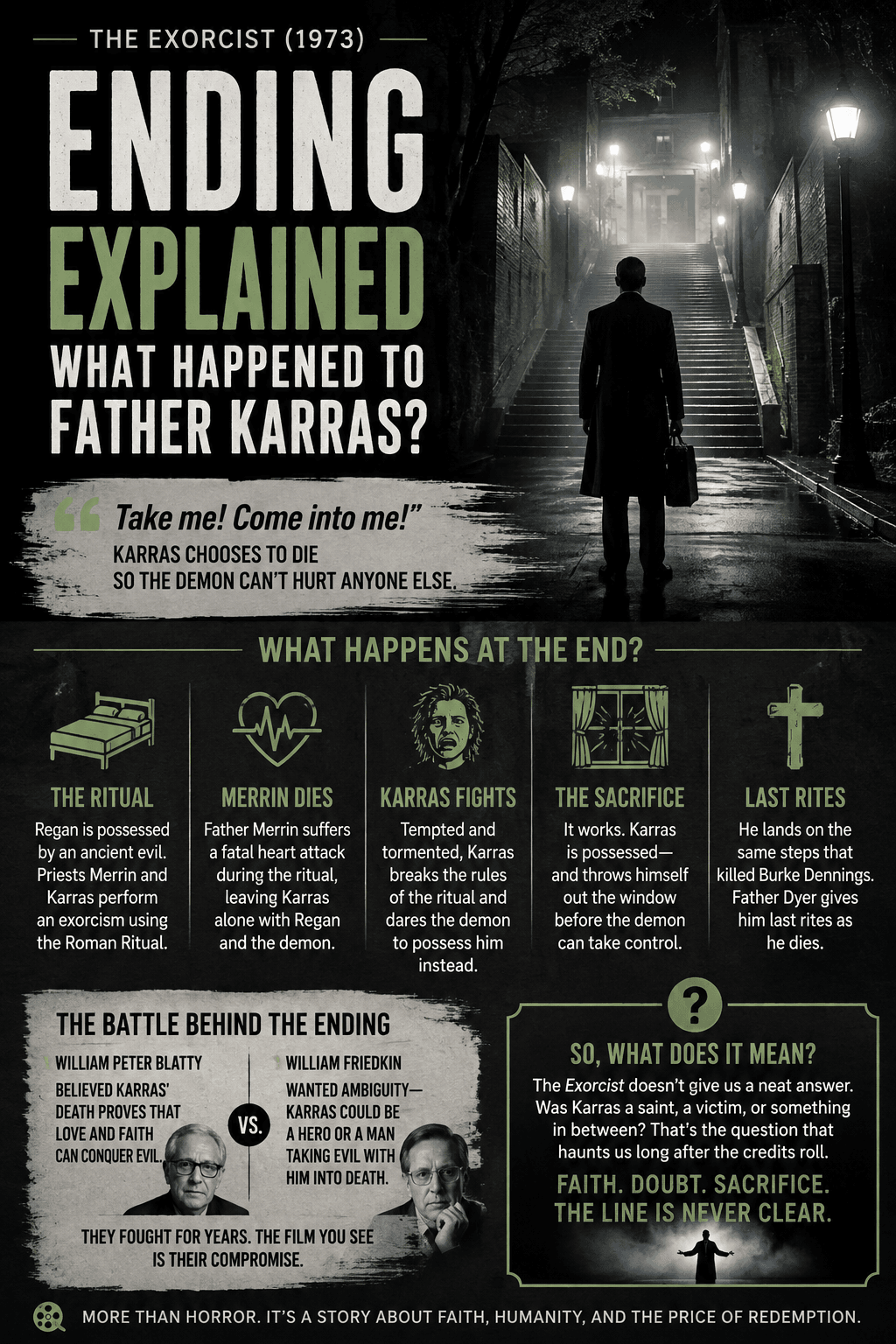
When Karras goes back in, Merrin is face-down on the bed. Dead. Heart attack, alone, mid-ritual, off camera. Karras tries CPR, fails, and turns to find Regan giggling at him. What happens next is the hinge the entire film swings on: Karras attacks her, screaming “Take me! Come into me!” — abandoning the ritual entirely and daring the thing to leave the girl and possess him instead.
It works. His face changes. His eyes change. And for a few seconds, an ordinary human man is fighting his own body for control of it, in real time, with no ritual language left to help him.
He wins the fight the only way the film allows him to: by throwing himself through the window before the demon can use his hands on anyone else. He rolls down the same steps that killed Burke Dennings. Father Dyer reaches him first, gives him last rites at street level, in public, surrounded by strangers who think they’ve just watched an accident.
The Two Men Who Wrote This Ending Didn’t Agree on What It Means
Blatty adapted his own 1971 novel and has been unambiguous, in interviews given across decades, about what Karras’s death is supposed to accomplish: a man who told his best friend he’d lost his faith gets it back at the exact moment he chooses to die for a stranger’s daughter. Blatty framed the entire film as an argument for that possibility — that love “as a God would love” is real, evidenced by the fact that a burned-out Jesuit psychiatrist would trade his life for a twelve-year-old girl he’d known for a matter of days.
Friedkin, who has described himself as agnostic, wanted none of that certainty on screen. His objection to the climax, in his own account, was theological as much as artistic: Blatty wrote Karras choosing to go out the window with the demon still inside him, which reads less like triumph and more like a man taking evil down with him on his own terms — a considerably darker note than “faith restored.” Friedkin cut Blatty’s more expository dialogue throughout the back half of the film specifically to keep that ambiguity intact, over Blatty’s repeated objections.
That fight left physical evidence, visible in what audiences were and weren’t allowed to see for the next twenty-seven years.
The “Real” Ending Doesn’t Actually Exist Anymore
Compare the shooting script to what played in theaters on December 26, 1973, and one scene is simply missing. In the script, Kinderman catches up to Father Dyer outside the MacNeil house after Chris and Regan have driven off. They talk about movies, the same running bit they’ve had all film.
Then Kinderman says: “I’m reminded of a line in the film Casablanca. At the end, Humphrey Bogart says to Claude Rains, ‘Louie — I think this is the beginning of a beautiful friendship.’” Dyer tells him he looks a little like Bogart. Kinderman says, “You noticed.” They walk off arm in arm. Fade to black.
None of that made the theatrical cut. The film you saw in 1973 — and the one on most home releases for decades after — ends on “Had your lunch? No.” Two men making small talk, then nothing. Blatty was furious about the omission specifically, calling it the loss of the film’s spiritual and theological center: the moment where good triumphs cleanly enough that two strangers form a friendship over it, proof that Karras’s death actually changed something in the world he left behind.
Friedkin restored the scene for the 2000 rerelease, marketed as “The Version You’ve Never Seen.” Here’s the part I can’t get past: by the time Warner Bros. went looking for the original audio to properly remaster it, the dialogue masters for that specific scene couldn’t be located, and Lee J. Cobb — who played Kinderman — had been dead for over twenty years.
The full scene exists on an earlier DVD as a stray extra. It has never been fully, properly reintegrated into a theatrical cut since. The ending Blatty considered essential to the film’s actual meaning is now permanently, technically unrecoverable in the form he wanted it seen. Two credited writer-and-director geniuses spent decades litigating what this movie is supposed to say, and the tiebreaker turned out to be a missing tape and an actor’s death certificate.
The Casablanca scene wasn’t the only footage Friedkin dug back up for that 2000 cut. He also reinstated the spider-walk — Regan crab-walking backward down the staircase on all fours, spitting blood, a shot that had existed for decades as unfinished test footage with the rigging wires plainly visible, before CGI cleaned it up for the rerelease.
He’d pulled it from the theatrical version for a different reason than the Kinderman scene: he thought the effect landed too early, arriving in the same stretch of film where Chris first learns Burke Dennings is dead, and worried it would front-load spectacle before the story had earned it. Unlike the Casablanca ending, this one came back clean. No dead actors, no lost audio — just forty years of wire removal finally catching up with an idea Friedkin had liked all along.
Merrin’s Actual Thesis, Delivered Before He Dies
If you want the film’s own answer to “why this girl” — and Karras asks that exact question, on the stairs, mid-exorcism — Merrin gives it to him directly, and it’s the closest thing to a mission statement this movie has: “I think the point is to make us despair. To see ourselves as animal and ugly. To reject the possibility that God could love us.”
Merrin is naming the actual mechanism of the attack here, and it has nothing to do with Regan personally or with the demon’s immediate tactics. Pain, desecration, the vomit, the crucifix — all of it is aimed at a single target: the idea that a person could still be worth loving after everything that’s been done to and through them.
Karras spends the whole film privately convinced he’s failed his mother, failed his vocation, failed the specific job of being a good priest. That conviction was already sitting in him, fully formed, long before Regan’s bedroom. The demon just knew exactly where to press. It’s a mechanism worth comparing to how Hereditary’s ending works the same trick on Peter — the horror finds the guilt that was already there and simply organizes around it.
The Household Atheist Was the One Who Believed
Chris MacNeil spends the whole film as the household’s only atheist, which the story treats as its own kind of joke. She doesn’t believe in God or the Church, and ends up begging a psychiatrist-priest for an exorcism anyway, because the medical establishment has run out of tests to run on her daughter.
Karras, meanwhile — an actual ordained priest — spends the same stretch of film telling Chris that most of his own Church no longer takes demonic possession seriously, that what’s happening to Regan reads as almost certainly psychiatric. The film hands its skepticism to the priest and its desperation to the atheist, and never resolves which one of them turns out to be right.
Ellen Burstyn reportedly pushed back on an early version of Chris’s final line to Dyer, one where the exorcism leaves her a believer in the devil while her faith in God stays exactly where it started. She felt it played as too clean a punchline for a woman who’d just watched an exorcism kill two priests in her own house, and the line got softened before release.
What’s left is a mother who says a quick, awkward goodbye and drives out of Georgetown having gained no faith at all, just a daughter with no memory of any of it. It’s the same bind Rosemary Woodhouse gets left in at the end of Rosemary’s Baby — belief without comfort, proof without peace.
The Priest at the Bottom of the Stairs Was a Real Priest
Father Dyer — the one who kneels beside Karras on M Street and administers last rites in the film’s most sincerely tender scene — is played by William O’Malley, an actual working Jesuit priest with no professional acting background before this film. He got the part because he wrote Blatty an unsolicited critique of the novel, the two struck up a friendship, and Blatty pushed for him to play Dyer specifically because he found the character underwritten on the page and wanted someone who could bring real priesthood to it instead of a performance of one.
That’s the detail I keep circling back to. The film’s single most explicitly sacramental moment — a dying man’s confession, absolution administered on a public sidewalk — was performed by someone actually authorized to do it, for real, outside the fiction. Friedkin’s ambiguous, agnostic cut and Blatty’s redemptive intentions both got funneled through a scene where the ritual on screen wasn’t fully theater. That’s either the film’s most honest moment or its best-disguised bit of stunt casting, and I’ve never fully decided which.
It’s also worth noting what the ending does with Regan herself. She remembers nothing of the exorcism, the murder, or Karras’s death. On her way out of the house for good, she catches sight of Father Dyer’s collar, pauses, and kisses him on the cheek — a gesture the film never explains and Regan herself couldn’t account for if you asked her.
Chris hands Dyer the St. Joseph medal Karras never took off, found under Regan’s pillow. Whatever survived in that house, it apparently didn’t need a memory to recognize a priest.
The Real Case Blatty Never Fully Left Behind
Blatty didn’t invent the premise from nothing. As a Georgetown undergraduate in 1949, he heard about a Maryland teenager whose family had reportedly sought the Church’s help after months of unexplained phenomena, and whose exorcism was eventually documented in a priest’s private diary. I’ve covered that actual case, and the man behind the pseudonym, in its own piece — this article isn’t the place to re-litigate it.
Blatty’s most memorable plot beats are entirely his own invention: the dead director, the possessed murder, the rooftop suicide. All three came from his imagination, layered onto a family exhausting every rational explanation first and a Church whose skepticism gives way slowly.
Craft Notes: What the Camera and the Cutting Room Actually Did
Owen Roizman shoots the possession scenes with the same flat, overlit clinical light he uses for the hospital scenes earlier in the film — the arteriogram, the pneumoencephalogram, Regan strapped to a table getting a needle in her neck. That choice is deliberate. The same visual register gets applied to a spinning head and a levitating bed, which is exactly the argument the film is making with its structure: medicine failed first, on camera, in comparable procedural detail, before religion got a turn.
The editing credits list four names — Evan A. Lottman, Norman Gay, Bud S. Smith, and Jordan Leondopoulos — on a production famously difficult to finish on schedule, and it shows in the film’s willingness to sit inside a single unbroken ritual sequence for minutes at a time rather than cutting for pace.
The score has its own small disaster behind it. Friedkin commissioned Lalo Schifrin for an original score, asked for something that barely sounded like music at all, hated what came back, and threw the tape out of a studio window. He spent three days combing the Warner Bros. music library for something closer to a lullaby before landing on a record from a label he’d never heard of, by a twenty-year-old English musician nobody outside prog-rock circles had heard of either.
Mike Oldfield’s “Tubular Bells” became the sound now permanently associated with demonic possession in American culture by accident, because a professionally commissioned score got thrown out a window and somebody needed a replacement fast. Jack Nitzsche gets the score credit for what he contributed after Schifrin was let go, but the film’s most recognizable cue was never written for it at all.
The demon’s actual voice belongs to Mercedes McCambridge, an Oscar-winning actress who prepared for the role by swallowing raw eggs, chain-smoking, and drinking whiskey until her voice shredded into something usable. Warner Bros. left her off the credits entirely, betting audiences would assume Linda Blair had done her own guttural line readings.
McCambridge sued, and got her name added to every print after the first thirty — credited generically, with the specific role she’d played left off the card. It’s a strange footnote for a film built on Catholic ritual: its most inhuman sound came out of a very human contract dispute.
Friedkin also buried a face in the film that most audiences never consciously registered until home video let them freeze the frame. For roughly an eighth of a second, a chalk-white face flashes across the screen during Karras’s nightmare — leftover makeup tests for Regan’s possessed look, recut into the scene almost as a dare. Fans nicknamed it Captain Howdy, after Regan’s invisible friend from earlier in the film.
Friedkin has said the trick worked exactly as long as the technology allowed it to: theatrical prints and VHS tape moved too fast for anyone to catch the frame, and DVD ended the secret the moment viewers could pause on it.
What The Exorcist Actually Leaves You With
The Exorcist was, briefly, the highest-grossing movie ever made, until Jaws took the title two years later. It remains the highest-grossing horror film in history, adjusted or not. Audiences fainted in theaters, vomited in aisles, and the film became cultural shorthand for “thing so frightening it physically overwhelms you,” which is a strange fate for a movie whose actual climax is two men reciting Latin liturgy at a fourteen-year-old until an old man’s heart gives out and a young one throws himself out a window.
It also became the first horror film ever nominated for Best Picture, racking up ten nominations total: Picture, Director for Friedkin, acting nods for Burstyn, Blair, and Miller, cinematography, editing, art direction. It won two — Best Sound, and Best Adapted Screenplay for Blatty, for the same script Friedkin spent the shoot trimming down against its author’s wishes.
Friedkin lost Best Director to George Roy Hill for The Sting. Blatty walked home with the statue for the version of the ending he’d fought Friedkin over for two years. The Academy, in its own small way, ruled on the argument before the two men ever fully settled it themselves.
The fight between Friedkin and Blatty reads less like a production footnote and more like the whole film, condensed into an argument that never resolved: one man who needed the ending to mean Karras got his faith back, and one man who needed the audience to sit with the possibility that it might not mean anything that clean at all. The theatrical cut sided with the agnostic.
The restored cut tried, imperfectly, to give the believer his scene back, and lost the tape trying. It’s the same unresolved argument that makes Midsommar’s ending such a persistent fight among people who’ve seen it — a film built to be read two contradictory ways at once, on purpose.
Regan doesn’t remember any of it. She kisses Father Dyer’s collar on the way out the door for no reason she could explain if you asked her, gets in the car, and leaves Georgetown for good. Chris hands Dyer the St. Joseph medal Karras never took off, the only object left connecting anyone to what actually happened in that room.
Kinderman invites a priest to the movies. That’s the whole ending. Whatever you decide it means, you decided it — the film, famously, still won’t.
For more on the real 1949 case that inspired the novel, see our full write-up on the exorcism behind The Exorcist. Full cast, crew, and production details are available on IMDb.