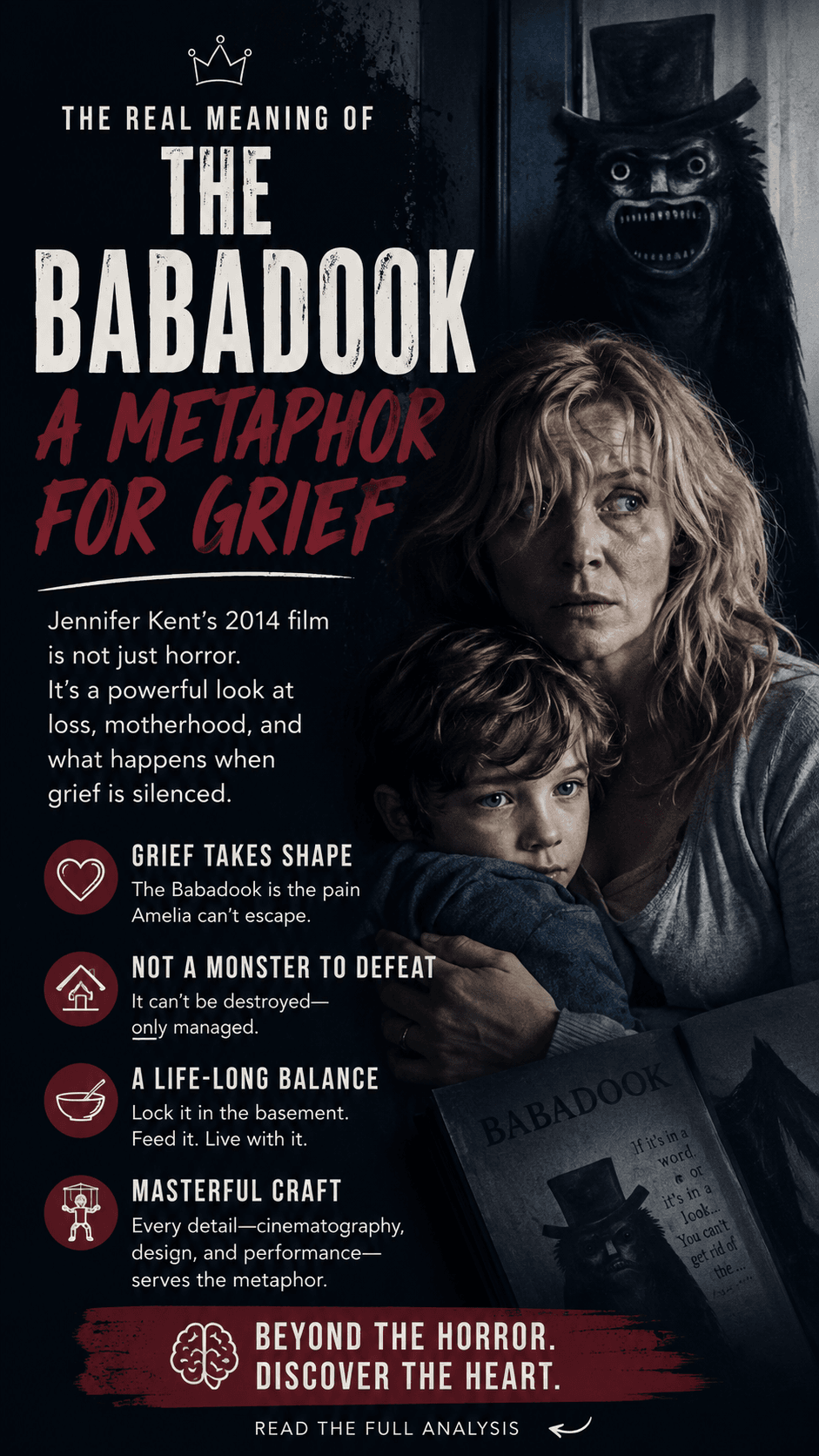
The Babadook grief metaphor, in Jennifer Kent’s 2014 film, works like this: the top-hatted creature terrorizing single mother Amelia Vanek (Essie Davis) is grief itself, given a body, after years of being denied release. Kent has confirmed that reading herself, more than once, in interviews about the film. Somewhere between December 2016 and the summer of 2017, though, the internet did to that metaphor what it does to anything that actually costs something to sit with: it found the exit.
A Tumblr screenshot of Netflix’s algorithm mis-filing the film under LGBT content turned into a joke, the joke turned into a mascot, and by Pride season the top-hatted thing Kent built out of her own father’s death was selling itself back to people as a rainbow-flagged plush toy.
Anyone is welcome to claim the character. What should trouble people more is the speed of the adoption, and everything it required forgetting along the way. The internet needed about six months to shrink a woman’s grief, wearing a coat and a top hat because she had no other way left to carry it, down to a shape you could print on a mug.
What the Babadook Grief Metaphor Actually Means
Amelia Vanek is a widowed single mother coming apart under the weight of a book she doesn’t remember buying, one that arrives on her son’s shelf the night before his birthday and announces, in rhyme, exactly what it intends to do to her family. Kent spends very little time on the haunted-house version of this story.
Samuel is already unmanageable by the end of the first act — expelled, medicated, feared by his own aunt — and Amelia is unraveling under a specific, bodily exhaustion the film tracks with more precision than most family dramas manage, let alone horror films. What follows plays like a confession the house has been sitting on: the thing terrorizing this family was inside it long before the book turned up.
Kent has said, plainly and more than once, that she wrote this in the wake of losing her own father, working from what grief actually felt like in her body while she was carrying it, week after week. The reading she has offered publicly is almost embarrassingly direct: the Babadook grief metaphor is a symbol for what happens when loss stays unprocessed — when it gets pushed down far enough, it gains a mass and an appetite of its own, and comes back as something monstrous.
What keeps that idea from curdling into an illustrated pamphlet is the ending Kent commits to. Amelia locks her grief in the basement and feeds it worms once a day for the rest of her life, and the film closes on that arrangement looking, if not happy, at least survivable. There is no exorcism. There is no villain left standing to defeat. There is a basement, a bowl of worms, and an ordinary Tuesday, repeated for as long as Amelia lives.
The Craft That Makes the Metaphor Work
Radek Ladczuk shoots the Vanek home in scope, 2.35:1, wide enough that the domestic clutter never feels contained, and he and Kent stripped the palette down to steel blue, burgundy, and a sickly teal that makes the daylight scenes look barely less oppressive than the night ones.
Kent handed Ladczuk a list of roughly twenty films before production — Méliès, Murnau’s Faust, American horror of the twenties and thirties — and there’s a stretch of the film built almost entirely from an old Méliès reel playing on Amelia’s television during her worst night of insomnia, cutting between her hollowing face and a century-old trick-film full of severed heads and swapped bodies.
Kent has said she considered shooting the whole picture in black and white, and decided against it once she felt the effect tipping toward pastiche. The desaturated color does quietly what monochrome would have announced too loudly, turning a suburban house into the exact visual register the Babadook grief metaphor needed: halfway inside somebody’s silent nightmare, without ever tipping into spectacle.
How the Creature Reinforces the Babadook Grief Metaphor
The creature itself was built by the Australian effects house Anifex out of puppetry and stop-motion, in-camera, with almost nothing added digitally, and the choice shows in how the Babadook moves: jerky, weighted, resistant in a way CGI never quite manages to fake. Kent has spoken about the visceral quality of effects built in-camera, the sense an audience gets that there was actually something there on set, and she’s right — the thing’s presence in the frame has mass even when the film barely lets you see it.
She modeled the figure partly on the Man in the Beaver Hat from Tod Browning’s 1927 London After Midnight, by way of Méliès. Alex Juhasz — the same artist who built the pop-up book — designed the creature with a specific description in mind: “Mister Babadook is a monster playing at being human. Along with his costume, he wears a mask with a fixed expression, a misguided approximation of what it thinks a man is.”
Swap “mother” for “man” in that sentence and you have the most precise description of Amelia’s own transformation the film ever offers. Fixed expression. Costume. An approximation, going through the motions, with a terrible and unearned calm.
Essie Davis carries almost the entire film on a body that keeps failing her in small, specific ways before it fails her completely. Watch what she does with the toothache — a rotting molar Amelia keeps worrying with her tongue and her fingers through the film’s first half, an ordinary, undramatic pain that becomes the pressure valve for everything she isn’t allowed to say out loud.
When she finally rips the tooth out with her bare hand in the basement, mid-transformation, it plays like relief, one of the only moments in the film where Amelia is the one acting on her own body, on her own terms. Davis plays the possession as a full physical vocabulary: the jaw clicking sideways, the spider-jointed sprint up the stairs, the flat reptilian patience in her eyes right before she tells her son she’s wished, more than once, that he had died instead of his father.
Noah Wiseman has the harder job, because Samuel is written to be genuinely difficult to love. He builds weapons in the basement. He screams at strangers. He breaks his cousin’s nose against a fence and never once reads as a victim asking for the audience’s sympathy — which is exactly the point, and exactly what makes the performance land.
Kent and Davis reportedly spent real time together off-camera before shooting so the relationship would carry weight it hadn’t yet earned on the page, and it shows in the specific way Wiseman calibrates Samuel’s need for his mother against his fear of her.
He performs a very particular terror: the terror of a kid who has already figured out, before the adults around him have, that the person meant to protect him might not be able to. The scene where he tells her — knife already drawn, having just stabbed her leg — “Sorry, Mummy,” is the whole film in four words.
Jed Kurzel’s score does something I haven’t heard another horror film attempt with quite the same nerve. He recorded his own four-year-old daughter’s voice and cut it, looped it, and delayed it until it stopped sounding like a child and started sounding like something trying to remember what a child sounds like, surfacing under Amelia’s insomnia sequences like a symptom of her own exhaustion, a sound that seems to originate inside her skull.
Script vs. Screen: What Changed Before Release
I went back to Kent’s screenplay — Draft 6.3, September 2011 — against the released film, and every change tells you something about what she decided the story could and couldn’t afford.
In the draft, Ruby loses a tooth falling from a treehouse after Samuel pushes her during an argument neither child fully understands; in the finished film, her nose is broken in two places and may need surgery, tightened into a single ugly consequence delivered off-screen in one beat. A fall reads as an accident with a monster nearby. A broken face reads as exactly what a frightened, cornered child does to another child, no metaphor required.
The bigger change is the television broadcast Amelia watches on her worst night. The script has a teenager beheading his sister and being shot by police. The film Kent actually released describes a mother who stabs her son to death in the basement of their house and is then killed by police after she comes at them with the knife — a woman, a domestic space, a maternal weapon, a child victim, on his birthday.
That is a rewrite with real weight behind it: Kent deciding, sometime between 2011 and the shoot, that the story needed to look Amelia directly in the face and tell her exactly what she was capable of becoming. It is the single best piece of evidence in the film that every unsettling choice here was made on purpose, each one sharpening the same Babadook grief metaphor Kent had already committed to on the page.
Where Kent’s Babadook Grief Metaphor Came From
Kent came to this from an unusual apprenticeship. Before she wrote a feature of her own, she spent three and a half months attached to Lars von Trier’s directing department on Dogville, watching a filmmaker strip his own leading actress down to almost nothing on a bare soundstage in the name of getting at something true.
The theatrics of Dogville — the chalk-outline set, the Brechtian distance — have no place in this film. What Kent carried out of that apprenticeship was a directing instinct: a willingness to let a woman look genuinely unbearable on screen for as long as a scene requires it. A lesser director gives you a mother who stays sympathetic even at her worst. Kent gives you one who says the worst thing you can imagine a parent saying to a child, and holds the shot.
I resisted this connection for a long time, the first few times I heard someone draw a line from Dogville to what Davis does here — it felt too tidy, an apprenticeship story doing the work a real explanation should do. I don’t think that anymore. I think it’s just true.
Why the Internet Missed the Babadook Grief Metaphor
Nobody can turn “I am going to manage my grief forever, in a locked room, one bowl of worms at a time” into a punchline that holds up past the first year. Eventually you have to actually watch the movie again, and when you do, the fury I started this piece with is exactly what’s waiting for you, aimed at how little it actually takes to convince a whole culture that something devastating was just cute all along.
The people who made the original joke barely register in that math — most of them were having genuine fun, and I doubt many of them meant any disrespect to the film itself. What bothers me is less the joke and more everyone who repeated it for three years without ever once going back to check what the Babadook grief metaphor was actually asking of them.
The film premiered at Sundance’s midnight section on January 17, 2014, was picked up by IFC Midnight, and went on to a 98% critical score that undersells how strange its reception really was: a film that briefly had two of horror’s most credentialed skeptics, William Friedkin and Stephen King, publicly conceding that it had gotten to them.
Friedkin, who directed The Exorcist, called it the most terrifying film he had ever seen. King called it “deeply disturbing” and meant it as the highest compliment he had available. Kent made it for around two million dollars, padded out by a thirty-thousand-dollar Kickstarter campaign, built from a short film called Monster she had made nearly a decade earlier, and it swept the AACTAs that year — picture, director, screenplay, and a Best Actress win for Davis that remains, a decade on, undervalued relative to what she is actually doing in every frame of this thing.
Every grief-horror film released in the decade since — the ones that get the “important” write-ups, the ones people cite when they want to sound serious about the genre — is working in a house Kent built first, in 2014, four years before anyone was calling that kind of film a movement.
The credit for that rarely reaches her. Most of the culture’s attention went to a Tumblr meme, and its critical respect to directors half a decade younger, doing in prestige packaging what she had already done on a fraction of the budget. It is still down in that basement, patient, fed, and not going anywhere.
Babadook Grief Metaphor: Quick Answers
What does the Babadook actually symbolize?
The Babadook grief metaphor represents unprocessed loss. Jennifer Kent has said the creature stands in for grief Amelia refuses to confront after her husband’s death — grief that stays unprocessed long enough gains its own mass and appetite, and comes back as something monstrous. The film’s ending, in which Amelia locks it in the basement and feeds it worms for the rest of her life, reinforces that reading directly.
Why did the Babadook become a “gay icon” online?
A December 2016 Tumblr post showed Netflix mistakenly filing the film under its LGBT category. The screenshot spread as a joke, and by Pride month 2017 the character had become an internet mascot, covered by outlets including Newsweek and the BBC, unrelated to the film’s actual subject matter.
For more on how Kent has described writing the film in her own words, her 10th-anniversary interview with the Sundance Institute is worth reading in full. Readers who want the grief-horror lineage this film sits inside can go to our Hereditary review, our piece on Midsommar as a breakup movie, or our look at Rosemary’s Baby and the horror of not being believed.