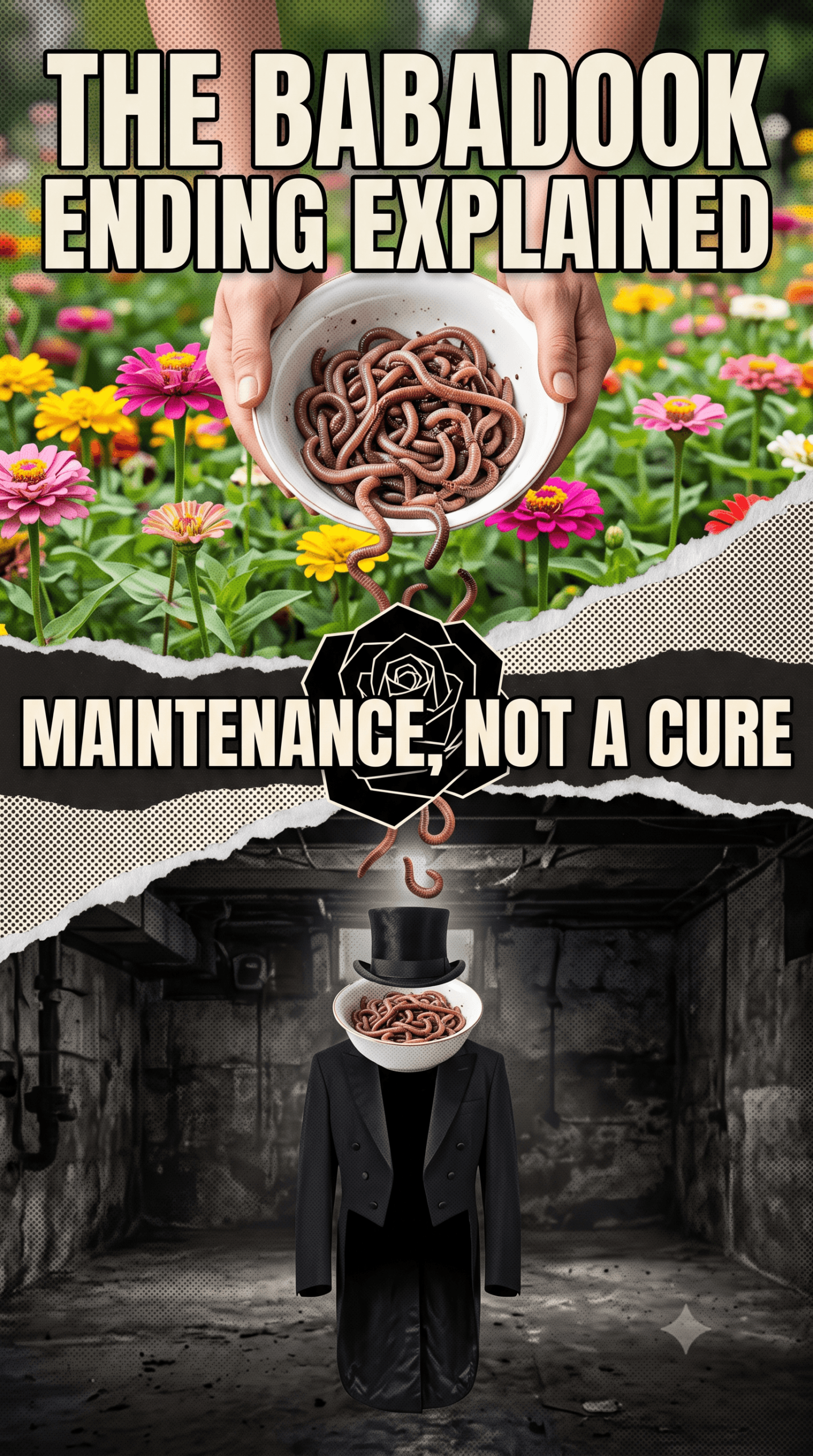
At the end of The Babadook (2014, dir. Jennifer Kent), Amelia Vanek does not kill the creature living in her basement. She confronts it, forces it back down into a shrunken husk of coat and hat, locks it behind a door, and then spends the rest of the film’s final scenes feeding it a bowl of worms once a day for the rest of her life. That is the Babadook ending explained in one sentence: not a cure, not an exorcism, a maintenance agreement she renews every morning in the garden.
I watched Don’t Look Now alone in 2009, a few weeks after my father died, and I have never watched it again. Nicolas Roeg’s film ends in a Venice alley with a small figure in a red coat that Donald Sutherland has spent the entire runtime chasing, certain it’s the ghost of his dead daughter. It isn’t.
I won’t say what it is, in case you haven’t seen it, but I will say that the moment his premonitions turn out to have been accurate in every way except the one that mattered has stayed with me longer than almost anything else I watched that year. I told myself I’d go back to it once I was in better shape to receive it. Sixteen years later I still haven’t. I used to think that was avoidance. I’m no longer sure it was.
The Babadook Ending Explained: What Amelia Chooses
The Babadook ends in a basement, not an alley, and the thing waiting there runs on a different logic than Roeg’s red coat. Everyone already knows exactly what it is by the time the confrontation arrives. The trick here was never about identity. It was always about what you do with a monster you can name from the first act onward.
Amelia Vanek spends the last twenty minutes of Jennifer Kent’s film in a state that looks, from the outside, exactly like the psychotic break the plot has been building toward — jaw distended, eyes gone black, hunting her own son through the house with a kitchen knife. And then the film does something almost no horror movie of the last fifty years has had the discipline to do: it lets her come back from it, lets her win the confrontation, and refuses to give her a single one of the rewards that victory is supposed to buy.
She gets a locked door, a bowl of worms, and a version of Tuesday she will have to keep having for the rest of her life. That is the entire resolution the film is willing to offer, and it holds.
Most write-ups of the Babadook ending stop at “grief is something you manage, not something you defeat,” which is true and also not quite the film Kent actually made. The management reading treats the last ten minutes as a thesis statement. What’s actually on screen is closer to a negotiation, conducted in three distinct stages, each with its own logic, and each of them worth taking further apart than the tidy version usually allows.
The Oskar Hallucination: The Real Turning Point
The first stage is the one most people undersell, because it isn’t loud. Before Amelia ever confronts the Babadook directly, the film gives her a vision of her dead husband Oskar standing in a basement flooded with a warm, impossible light. He’s whole. He’s real enough that she runs to him.
And then he asks her, gently, reasonably, in the tone of a man asking for nothing at all, to bring him the boy. Not Samuel. “The boy.” Amelia catches the wrongness of the phrase before she catches anything else — “Stop calling him the boy” — and only once she’s said it does she notice that Oskar’s sleeves end in nothing, that a thin line of blood is opening across his throat exactly where the accident cut him. This is the real hinge of the ending, and it happens a full act before the physical confrontation everyone remembers.
It’s worth remembering that the book Samuel first pulls off the shelf already told them how this would go, if anyone had been able to read it as prophecy instead of threat. Its later pages, the ones Amelia can’t finish reading aloud, don’t show a monster attacking a stranger. They show the monster’s target changing shape until she looks like the mother, and a line of text that reads less like a threat than a description of a mechanism: the more she denies it, the stronger it gets.
Kent is stating the actual rules of engagement early enough that the audience has the same information Amelia does and, like Amelia, mostly chooses not to look at it directly until there’s no version of the story left where they can avoid it. Grief works like a salesman in this scene, offering Amelia the one thing she has spent the entire film refusing to admit she wants — Oskar back, whole, warm, undemanding — and the price is her son, dressed down into an object, a transaction, “the boy” instead of Samuel. She refuses.
That refusal is the actual climax of the film. Everything after it, the screaming, the knife, the basement standoff, is Amelia’s body catching up to a decision she’d already made in a hallucination nobody else in the house even witnessed.
Why Samuel’s Weapons Never Work
The second stage is the one the marketing and the memes both remember best, and it’s the one I think gets misread most often, because it looks like an action climax and isn’t. Samuel spends the entire film building an arsenal against exactly this moment — nail guns, a catapult, a slingshot, a baseball bat he swings at his own mother’s knees hard enough to put her down. Every weapon in that arsenal works, mechanically. The nails draw blood. The bat drops her. And none of it touches the thing wearing her.
What actually breaks the possession is Samuel refusing to leave and refusing to hate her back, telling her — while she is actively trying to strangle him — that he loves her and always will. Kent cut a line from her own screenplay here: in the draft, Samuel also tells her his father died because he died, not because of anyone, a small absolution offered alongside the love. The finished film keeps only the love and drops the argument. That choice matters.
What reaches her in that moment is presence, offered without conditions and without a case being made for her own innocence — closer to what you’d say to someone mid-breakdown who can only hear the one true thing that doesn’t ask anything of them in return. Amelia’s actual return to herself, the black tear, the vomiting-up of whatever has been living in her, happens only after Samuel stops trying to defeat the Babadook and starts refusing to abandon his mother instead. The distinction matters.
The film draws a hard line between fighting the thing and out-loving it, and it comes down decisively on the side that doesn’t involve weapons.
This Is My House: How Amelia Actually Wins
The third stage is the one that actually resolves the plot, and it takes place almost entirely offscreen, in a single line. Amelia gets up. The Babadook, now fully manifest, drives her son into the walls of her own bedroom, and Amelia — for the first time in the entire film — stops asking it what it wants and starts telling it what it can’t have.
“This is my house. You are trespassing in my house. If you touch my son again, I’ll fucking kill you.” It shrinks the moment she stops sounding like she’s asking it anything and starts sounding like someone who owns the room she’s standing in. She hasn’t grown stronger than it. She hasn’t found some hidden reserve of magic. She’s found a position that isn’t a question, and that turns out to be the one thing it can’t survive.
Every other time the Babadook appears in this film, Amelia is asking it something — what do you want, why are you here, what will make you stop — and a thing that lives on unresolved feeling gets fed by exactly that kind of asking. The moment she stops interrogating it and starts asserting ownership over her own house and her own son, it has nothing left to answer, because it was never actually a separate entity capable of negotiation. It only ever had the authority Amelia’s uncertainty gave it.
Every Horror Ending This Film Refuses to Give Her
It helps to say plainly what kind of ending this isn’t, because the shape of the absence is doing real work in the Babadook ending explained above. The standard horror climax gives its protagonist a ritual: a priest reciting the rite in The Exorcist, a relic or a name or a fire that banishes the thing for good, a final girl who puts a blade through whatever’s chasing her and gets to walk into the daylight changed but finished with it.
The Conjuring, made the year before this one, ends its haunting with an actual exorcism performed by people whose entire professional authority rests on being able to cast something out. The Babadook offers Amelia none of that machinery, and it isn’t an oversight. Kent builds an entire arsenal of horror-movie solutions into the film specifically so she can watch them fail one by one — the nails, the bat, the burned book, the police report nobody takes seriously, the pills prescribed by a doctor who has never once seen what Amelia is describing.
Every institutional and physical remedy the genre usually reaches for gets offered to her and taken away. What’s left when all of them fail isn’t nothing. It’s a much smaller, much less cinematic answer, and the film’s nerve is in trusting that smaller answer to be enough to end on.
The Medication Subplot Is the Wrong Answer, Rehearsed
The medication subplot earlier in the film is easy to treat as a detour, but it’s really the film rehearsing the wrong answer before it commits to the right one. A doctor examines Samuel after his seizure in the car, calls it a febrile convulsion, and prescribes a short course of sedatives so the household can get some sleep while they wait for a referral that will take weeks. It works, briefly, exactly the way suppressing anything works briefly.
The pills don’t address what’s actually happening in that house; they just lower the volume on it until the Babadook starts appearing in daylight, in the kitchen, in a stranger’s rearview-mirror reflection, because quieting the symptom did nothing to the cause. The ending is in direct conversation with this earlier failure. Feeding the thing worms every day isn’t a cozier version of medicating it into silence — it’s the opposite move, a refusal to suppress paired with a refusal to let it run the house.
Amelia’s final relationship to her grief is maintenance without denial, which is precisely the one option nobody offers her in the film’s first half.
The Empty Coat and the Jungian Shadow Self
That’s the part of the Babadook ending that the Jungian reading gets right, and it’s worth being specific about which Jungian reading, because there’s a real one underneath the pop-psychology version that gets thrown around.
Carl Jung’s idea of the Shadow is specific, and gets flattened when people shorthand it as a metaphor for “bad feelings.” It’s the part of a person that gets exiled from conscious identity because acknowledging it would cost too much — and Jung’s specific warning was that the Shadow doesn’t go away when it’s suppressed, it just stops being something you can negotiate with, because you’ve stopped admitting it’s yours.
Kent has said, in comments collected in Rikke Schubart’s book on women and horror, that this was the actual design brief for the film: “I think we all have to face our own darkness, whatever that entails. Beyond genre and beyond being scary, that’s the most important thing in the film — facing our shadow side.” That’s not incidental set dressing. It explains why the creature collapses into an empty coat and hat the moment Amelia stops being afraid of it as an intruder and starts recognizing it as something that was never outside her to begin with.
A monster you can kill has to have a body. A monster that’s actually an exiled piece of yourself just has nothing left to hold its shape once you stop refusing to look at it.
The Garden, the Worms, and the Black Rose
Which brings us to the basement, and the part of the Babadook ending everyone quotes and almost nobody sits with long enough. The final scenes show Amelia in her garden — calm, sunlit, dirt under her fingernails in a way that reads as ordinary instead of deranged for the first time in the film — collecting worms into a bowl before carrying them down to feed whatever is still living behind that locked door.
Samuel asks, with the same bright curiosity he’s had about the creature since the book first showed up: “How was it?” Amelia’s answer is the whole film compressed into three words: “Pretty quiet today.” Quiet, on this particular day — the way a chronic condition can be quiet on a good day without ever being cured.
In the film’s very last shot, the garden Amelia tends is in full, almost aggressive bloom — every flower open, the kind of color the movie has denied itself for ninety minutes — except for a single black rose sitting plainly among the rest, the one dark thing the frame doesn’t ask you to look away from.
I want to be careful here, because the screenplay stages this more literally than I can confirm the released cut does: Kent’s draft describes the garden bed growing directly out of ground where the family dog, killed during Amelia’s episode, has been buried, the rot feeding the roses in a single continuous image. Whether that exact cause-and-effect survives intact on screen, frame by frame, I can’t swear to. What I can confirm, because it’s there in the final frame itself, is the rose. Kent didn’t need the audience to trace the soil back to the dog to make the point.
The black flower blooming alongside the healthy ones does the entire job on its own.
The Magic Trick Bookend
There’s a smaller image in that same last stretch of the film that I think does even more quiet work than the rose, and it’s easy to miss because it’s structured as a callback rather than a revelation. Samuel opens the film performing magic tricks that don’t work — “nothing in my hands, nothing in my hands” — palming coins, missing his own cues, a kid using stage magic to manage a house that has no room left in it for wonder that isn’t also a form of vigilance.
In the final scene, he performs the same trick, the same patter, and this time it works. A bird appears where there was nothing. Amelia laughs — a real laugh, unguarded, the first one in the film that isn’t covering for something — and asks him how he did it. He doesn’t answer. He just gets to keep the secret, the way children are supposed to get to keep secrets that are just delightful, nothing more. That’s the actual measure of what’s been repaired by the end of this film.
The movie never promises Amelia’s sanity has been fully restored, and it stays explicit that whatever’s in the basement hasn’t been removed. What’s been repaired, specifically, is the family’s capacity to be surprised by something good. That’s a smaller repair than “healing,” and I think it’s the more honest one.
Critics have traced the film’s visual DNA partly to Jean Epstein’s 1928 adaptation of The Fall of the House of Usher, an unusual reference for a horror film to reach for — Epstein’s Usher is barely a haunting at all, more a study of a house and a family that have started decaying in sympathy with each other, the architecture itself absorbing the illness inside it.
That’s a stranger, slower model of horror than most of what shares a shelf with this film, and it explains why the Vanek house gets to end the story looking healthier along with its occupants. The building was never just a setting for someone else’s haunting. It was symptomatic the way Amelia was symptomatic, and it recovers, unevenly and only partway, on the same schedule she does.
Kent, the Meme, and What I Got Wrong
I need to say something here that complicates the version of the Babadook ending argument I made when I reviewed the film for this site, and I’d rather do it than pretend I didn’t come across it. Kent has been asked, more than once, about the internet’s habit of treating her creature as a queer icon, and her answer isn’t the wounded-artist response I assumed it would be when I wrote about the meme with real irritation a few weeks ago.
She’s said, in an interview with Bloody Disgusting, that she loves it — that the Babadook is “that bastard,” that he “doesn’t want to die, so he’s finding ways to become relevant.” I still think most of the people who made the joke never sat with what the film is actually doing.
But Kent’s response reframes something I hadn’t considered: a creature that keeps resurfacing in whatever shape culture will let it take, refusing to disappear even when it’s misunderstood, refusing to die even when it’s reduced to a sticker on a laptop, is not a betrayal of the ending she wrote. It’s a version of it. The Babadook was never going to be killed. Kent built a monster that survives by adapting to whatever room it’s allowed into, and then watched it do exactly that to her own film’s afterlife.
I don’t think that’s the whole story either — a meme that never once mentions Oskar or grief or that basement isn’t doing the same work the ending does, no matter how much Kent enjoys the joke — but I owe the argument this much honesty: the woman who wrote the ending is on record finding some genuine, complicated pleasure in her creature’s refusal to stay dead, and I didn’t know that when I wrote my fury about it.
I think about that basement door, and the whole Babadook ending, the way I think about the tape of Don’t Look Now still sitting unwatched. Amelia opens that door on a schedule she sets herself. Keeping something alive on your own terms, in a room you control, at a time you choose, is its own category of act, distinct from defeating a thing and distinct from being consumed by it, and the film seems to genuinely believe that this third option is the only honest one available to someone carrying what she’s carrying.
I don’t know if avoiding Don’t Look Now for sixteen years is resistance or respect. I said that in this same piece a few paragraphs ago and I still mean it, but the film I’ve just spent three thousand words taking apart has made me suspect the question is built wrong. Maybe it doesn’t have to be one or the other. Maybe you just feed the thing on a schedule you can live with, and you call the days it stays quiet a good day, and you don’t ask it to be anything more final than that.
The Babadook Ending Explained: Quick Answers
The Babadook Ending Explained: Does Amelia Kill It?
No. This is the center of the Babadook ending explained plainly: Amelia subdues the creature by asserting ownership over her house and refusing to keep asking it questions, and it shrinks into an empty coat and hat. She locks it in the basement and feeds it worms daily instead of destroying it.
Is the Babadook real, or is it all in Amelia’s head?
The film deliberately keeps this ambiguous. Every appearance of the creature can be read as Amelia’s grief and exhaustion externalized, and the ending supports a psychological reading — Jennifer Kent has said facing “our shadow side” was the design brief for the whole film.
What does the black rose at the end of The Babadook mean?
In the film’s final shot, Amelia’s garden is in full bloom except for one black rose growing among the healthy flowers. It reads as the visible trace of what she’s still carrying — present, tended, not hidden — inside a life that has otherwise recovered its color.
For the craft and grief-metaphor reading this piece builds on, see our Babadook review. Kent has spoken about facing “our shadow side” in more depth in her 10th-anniversary interview with the Sundance Institute. Readers working through the same grief-horror territory can also go to our Hereditary Ending Explained or our Midsommar Ending Explained.