
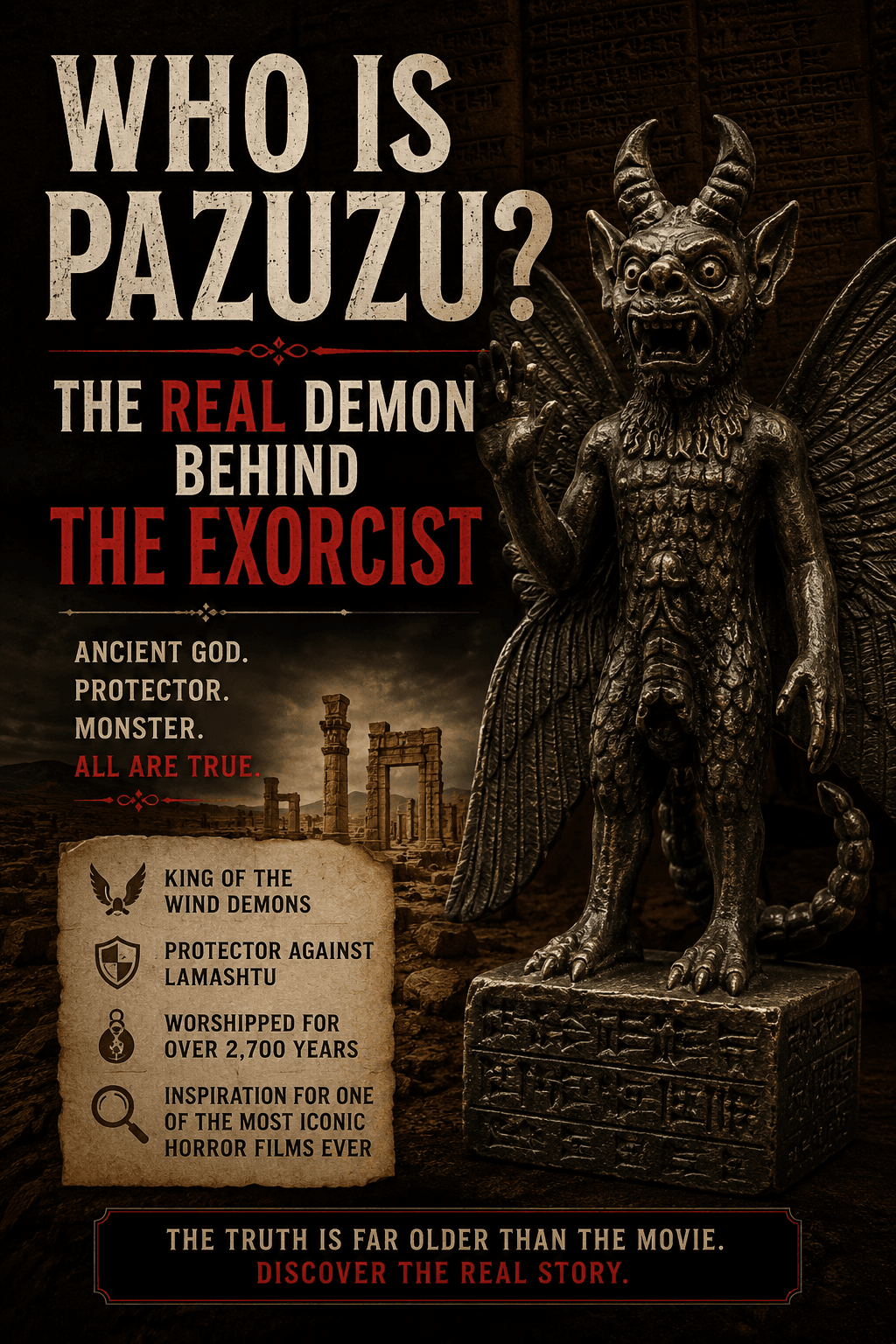
Pazuzu is a real demon from ancient Mesopotamian religion — a Neo-Assyrian and Neo-Babylonian wind god documented as far back as the 8th century BCE, worshipped across the ancient Near East as a protector against a far more dangerous demon named Lamashtu, and later adapted by novelist William Peter Blatty as the entity that possesses twelve-year-old Regan MacNeil in The Exorcist (1973), William Friedkin’s film adaptation of Blatty’s novel. The demon has a documented biography older than most religions practiced today. The film never once says his name.
Almost nobody who has seen The Exorcist could tell you that name, because Friedkin’s screenplay drops it entirely — Blatty’s novel mentions Pazuzu once, in passing, and moves on as though the reader already knew. I went back to the film this month with a specific question: how much of what audiences believe about that opening Iraq sequence is actually in the film, and how much has been filled in afterward by decades of secondhand summary. The answer surprised me. Friedkin gives you almost nothing. An old priest on a dig. A small stone amulet pulled from the dirt. A statue, ruined, standing against a burnt sky, and Max von Sydow’s face doing more work than any line of dialogue in the scene. Friedkin withholds the explanation entirely. What most people know about that object arrived decades later, secondhand, from readers of the novel — and the story that got passed down flattened something that was never simple to begin with.
Who Is Pazuzu, the Real Demon Behind The Exorcist?
Pazuzu belongs to the Neo-Assyrian and Neo-Babylonian periods, roughly 911 to 539 BCE, though the earliest confirmed archaeological trace of him is older than that window suggests — a small figure recovered from the grave of a royal woman at Nimrud, near modern Mosul, dated to the 8th century BCE. The surviving texts describe him as the king of the demons of the wind, son of the god Hanbi. The winds he commands are specific and seasonal: the west and southwest winds that carried famine in the dry months and locusts and storm in the wet ones. Pazuzu is a functionary with a jurisdiction — two winds, a defined enemy, a defined clientele. Mesopotamian religion rarely dealt in abstractions, and Pazuzu is a good example of why.
The best surviving physical description of Pazuzu comes from a bronze statuette housed today at the Louvre, fifteen centimeters tall, found somewhere in Assyria — the exact site was never recorded, only that it was acquired in Alexandria in 1872. The figure compresses several kinds of predator into one body: a dog’s snarling face with bulging eyes, wings and talons taken from a bird of prey, a goat’s horns, a scorpion’s tail, a scaled torso ending in a serpent-headed phallus. It is a design built for discomfort. On the back of that statuette, carved into the bronze, is a sentence written in the demon’s own voice: I am Pazuzu, son of Hampa, the king of evil spirits of the air who violently emerges from the mountains raging; it is I.
That inscription is the closest thing we have to Pazuzu introducing himself. The demon announces himself plainly. Everything that happened to his story afterward involved someone else deciding what he was on his behalf.
The Metropolitan Museum of Art, which has studied his iconography extensively, frames him under a title that could serve as the epigraph for this entire piece: Pazuzu, Beyond Good and Evil. Curatorial framing rarely lands this precisely. It’s the most accurate short description available for a figure the ancient scribes themselves refused to file neatly under either heading.
Why Pazuzu Was Also a Protector
Here is the detail that the film’s marketing, and decades of pop culture summary, leaves out entirely: people in the ancient Near East did not only fear Pazuzu. They asked for him. Households kept his statuette by the door. Pregnant women and small children wore his face as an amulet, the ugliest object in the house pressed against the most vulnerable body in it, because Pazuzu’s specific enemy was Lamashtu — a demoness who preyed on infants and pregnant women, who caused miscarriage and crib death and fever, and who could reportedly be driven off by nothing except something more frightening than she was. Pazuzu was the thing you put between your child and the dark precisely because he was worse than what he was guarding against. That was the entire point of hiring him.
I keep returning to that arrangement because it’s documented practice, repeated across centuries, in a culture with no illusions about what it was doing. They understood exactly what they were inviting into the nursery — an ugly, dangerous, genuinely frightening figure — and made the calculation anyway, because the alternative was worse. This was a considered decision about which evil to live with, made by people with clear eyes about both options. There is a kind of bargaining here that I don’t see much of in contemporary horror, where evil tends to arrive as pure antagonist, with no negotiated relationship to the people who suffer it. The Assyrians who carved Pazuzu’s face onto a child’s amulet understood exactly what they were carrying.
Pazuzu amulets weren’t rare or reserved for the wealthy. Archaeologists have recovered his likeness worked in terracotta, bronze, iron, gold, glass, and bone — materials spanning the full range of what an ancient household could afford, from a poor family’s cheap clay pendant to a noble’s cast bronze figurine. Fear of Lamashtu wasn’t a problem only the rich could solve with imported magic. It was universal, and Pazuzu’s face got mass-produced, in whatever material was on hand, because every household needed the same thing standing at the door.
That is the demon Blatty picked, a figure whose relationship to human fear was already complicated before Hollywood touched it — protector and predator sharing one face, because in that theology the two were never fully separable. It’s the same instinct Ari Aster’s team followed when they built Hereditary’s King Paimon out of real Ars Goetia demonology instead of inventing something from nothing. The weight only works if the source is real.
The Real 1949 Case vs. William Peter Blatty’s Pazuzu
The novel and film draw, loosely, on a real 1949 case: a Maryland teenager, publicly known for decades only by the pseudonym Roland Doe, later identified as Ronald Hunkeler, who underwent a series of exorcisms conducted by Jesuit priests in Maryland and Missouri after months of disturbances that began not long after the death of an aunt who had taught him to use a Ouija board. Priests reported convulsions, scratched marks appearing on his skin, furniture moving, Latin phrases from a boy with no Latin training. It is one of the better-documented American exorcism cases of the twentieth century, with priests’ diary entries surviving as the closest thing to a primary source the story has.
The entity in that actual case identified itself, according to the priests’ own record, as Legion, the name from the Gospel of Mark, and never as Pazuzu. Blatty knew this. He had researched the case directly, and he made a deliberate substitution — he went looking through Assyriology and demonology texts for something with more weight than a borrowed New Testament reference, and he came back with an ancient, specific, physically describable figure that nobody in 1949 Maryland had actually invoked. Blatty was doing exactly what a novelist should do with source material — improving on the parts that were vague. But it means the most commonly repeated claim about this film’s demon, that he’s simply “the real one” pulled from the actual case, doesn’t hold up. Two different kinds of “real” are being confused. Pazuzu is real in the narrow, documented sense — an actual religious figure, actual archaeology, an actual inscription. The entity from the 1949 case never used his name; the priests called it Legion, and Blatty imported Pazuzu afterward, on purpose — a choice about what he wanted the book to feel like, made independent of anything that happened in that house.
And having gone to that trouble, the film barely uses the name he chose. Pazuzu appears once in the novel and is dropped by the screenplay entirely — the demon is never called Pazuzu in the dialogue of the 1973 film. He is only confirmed by name four years later, in Exorcist II: The Heretic, a film with a reputation bad enough that Friedkin’s own achievement usually gets discussed as if the sequel doesn’t exist. For most of the audience that made this film a cultural landmark, the demon has functionally been anonymous the entire time — a face and a function, no name attached, exactly the way the amulets worked three thousand years earlier. You didn’t need to know the theology to understand you should be afraid of the object.
Filming the Pazuzu Prologue in Hatra, Iraq
The prologue was shot on location in northern Iraq, in and around the ancient ruined city of Hatra, near Mosul, at a moment when the United States had no formal diplomatic relationship with the country. Friedkin negotiated the access directly with local Ba’ath Party officials, who required him to hire local crew and personally teach them filmmaking as part of the arrangement. Temperatures on set reportedly reached 130 degrees Fahrenheit. Shooting was restricted to dawn and dusk. No crew shorthand exists for that kind of heat. There happened to be a German archaeologist running an active dig at Hatra at the time, and when Friedkin asked whether he could film there, the archaeologist said yes — which means the excavation Max von Sydow walks through in that opening sequence is largely a real one, mid-excavation, with Friedkin’s camera dropped into the middle of it.
That decision is consistent with what Friedkin does everywhere else in the film, and it’s the reason I still consider The Exorcist the benchmark for supernatural horror built on a realist foundation. Owen Roizman’s photography treats the Iraq sequence with the same flat, observational patience it later gives Georgetown — static compositions, natural light, a tired old man walking through actual ruins in actual heat, framed the way a documentary crew would frame him. Friedkin understood something most possession films still haven’t figured out: the demon is not what makes this frightening. What makes it frightening is that everything around the demon — the archaeology, the medicine, the church bureaucracy assessing Regan case by case, refusing to move faster than its own procedures allow — behaves with total, unhurried credibility right up until it can’t explain what it’s looking at anymore. Jack Nitzsche’s original score barely exists; it surfaces only in scene transitions, deliberately withheld everywhere else. The theme audiences actually remember, licensed from Mike Oldfield’s Tubular Bells, was found rather than composed — Friedkin discovered it in his studio’s music library after describing to an executive that he wanted something with “a kind of childhood feel,” closer to a lullaby than a horror cue. Even the sound of the film waits before it announces itself as a horror sound.
There’s a footnote to the Hatra shoot that I can’t stop turning over. In 2003, after the invasion, Friedkin got a call from a lieutenant colonel — David Petraeus, at the time commanding the 101st Airborne into Mosul — telling him that soldiers watching The Exorcist on video in the field had recognized the ruins around them as the same ones from the movie’s opening. Local residents, decades on, still remembered Friedkin’s crew. A city built by people who once carved a wind demon’s face onto amulets to keep their children safe became, within one human lifetime, a film location, and then a war zone, and the same ground held all three of those meanings without any of them canceling the others out.
What The Exorcist Leaves Out About Pazuzu
The version most people carry around — a vague, ultimate evil dredged up from real occult history to make the movie scarier — undersells Pazuzu completely. He was a specific, describable, thoroughly documented figure who commanded two particular winds, whose enemies had names, and who did his most important work standing in doorways, guarding children, wearing a face designed to be worse than whatever he was keeping out.
The film takes that entire architecture and keeps only the fear, discarding the function. Understandable, dramatically — a possession story has no use for a demon who moonlights as a nursery guard. But something is lost in that discarding, and it’s the same thing that gets lost every time a religion three thousand years dead gets strip-mined for its scariest image and nothing else. It’s the same instinct that reduced Valak to wallpaper for jump scares across the Conjuring universe — take a name with real theological weight and keep only its face. The Assyrians who wore Pazuzu’s face against their chests weren’t naive about what they were carrying. They knew exactly what they were asking to stand at the door. The audience watching Regan MacNeil’s bed shake in 1973, or on a laptop fifty years later, has never been asked to hold that same knowledge — that the thing on the amulet and the thing at the foot of the bed were, once, the same figure, doing the same job, for people who understood the bargain better than we do.
It’s a pattern I keep finding on this site. The real doll behind Annabelle was scarier than Hollywood’s version for the same reason Pazuzu is scarier once you know his whole story: the truth doesn’t need embellishing. It needs context.
Pazuzu doesn’t get his name said out loud in the film that made him famous. Maybe that’s fitting. The people who carved his face into bronze weren’t naming him for an audience either. They were naming him for whatever was already in the room.
Frequently Asked Questions About Pazuzu
Is Pazuzu a real demon?
Yes. Pazuzu is a documented demon from Neo-Assyrian and Neo-Babylonian religion, dated as early as the 8th century BCE. He appears in surviving inscriptions, amulets, and a well-known bronze statuette at the Louvre. William Peter Blatty adapted him for The Exorcist; the historical figure predates the novel by roughly 2,700 years.
Why does The Exorcist never say Pazuzu’s name?
Blatty’s novel names Pazuzu once, briefly. Friedkin’s 1973 screenplay omits the name entirely — the film only implies his identity through the amulet and statue Father Merrin finds in Iraq. Pazuzu isn’t spoken aloud on screen until the 1977 sequel, Exorcist II: The Heretic.
Was the real 1949 exorcism case connected to Pazuzu?
No. The entity in the real case, later called the Roland Doe case, identified itself as Legion, according to the priests’ own records. Blatty researched Mesopotamian demonology separately and chose Pazuzu deliberately for the novel, unconnected to what the real case actually reported.
What was Pazuzu the god of?
Pazuzu ruled the west and southwest winds, associated with famine and storms. Paradoxically, he was also invoked as a protector — people wore his image as amulets to guard pregnant women and children against Lamashtu, a demon believed to kill infants.
How is Pazuzu different from invented movie demons like Bughuul?
Pazuzu has a continuous archaeological record — inscriptions, amulets, a self-naming statuette — stretching back nearly 3,000 years. Many horror-film demons, including Sinister’s Bughuul, are original creations by screenwriters with no equivalent historical record. Pazuzu’s fear factor comes from documentation, not invention.