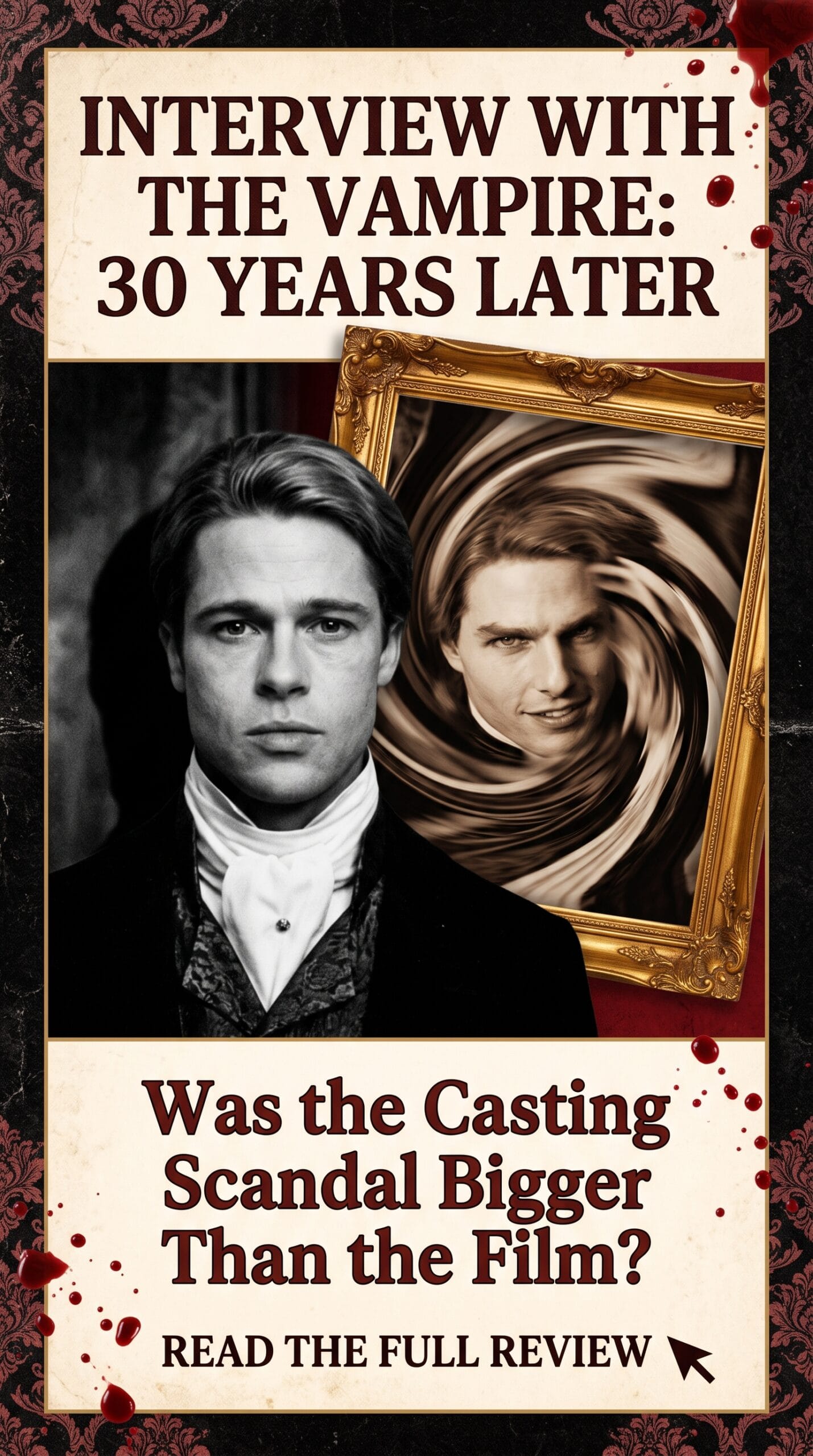
This Interview with the Vampire 1994 review makes the case for a film that’s better than its own casting scandal and smaller than its reputation as a horror landmark: an overwrought, gorgeously mounted gothic melodrama, directed by Neil Jordan from Anne Rice’s own script for her 1976 novel, that earns its most memorable moments and stumbles through some of its quietest ones. Anne Rice’s novel sat unfilmable for eighteen years, stalled by something far more specific than a lack of interest.A Paramount executive reportedly told her outright, sometime in the AIDS-anxious climate of the 1980s, that the project was politically impossible — a story built on an intimate, physically dependent bond between two men, dressed up as vampirism so the metaphor could survive the trip past a studio note. Rice herself spent part of that decade trying to launder it into something sellable, rewriting Louis as a woman in a draft said at the time to have Cher attached, hoping that swapping the gender would let the story keep everything else.It took the runaway success of two sequel novels and producer David Geffen’s insistence on a version faithful to the book before Warner Bros. finally fast-tracked it in the early 1990s. All of which makes it a little absurd, in retrospect, that the loudest fight the finished film actually generated turned out to be about something much smaller: whether Tom Cruise had the right cheekbones for the part.Neil Jordan’s film doesn’t waste much energy pretending it’s a horror picture. There’s blood, and a fair amount of it — Stan Winston’s makeup team built teeth and pallor convincing enough that test screenings ran hot enough on violence that something like twenty minutes were cut before release. Actors reportedly spent stretches hanging upside down so makeup artists could trace the vein patterns that would show through their skin once inverted — a level of physical commitment to the illusion that test audiences apparently found more convincing than comfortable.But the temperature of the thing sits closer to a family drama that happens to have fangs: people trapped in a house together for decades, performing loyalty they don’t feel and love they can’t act on directly.Louis narrates two centuries of his life to a journalist with a cassette recorder in a bare San Francisco room, and what he describes isn’t predation so much as a string of domestic arrangements gone wrong — a maker who won’t explain himself, a child who never stops being furious about the body she’s stuck in, a Parisian coven that runs itself like a community theater troupe with strict bylaws about killing your own kind. The story’s real interest sits inside the household: what vampires do to each other, decade after decade, in rooms their victims never see.That’s worth saying plainly, because it’s the film’s actual subject, dressed in enough velvet and blood to distract from how nakedly it says so: this is a story about the cost of hiding what you are. The eighteen years the novel spent stuck in development weren’t bad luck; they were the industry recognizing, correctly, that the material’s real content — a bond it couldn’t name directly — needed disguising to get financed at all.So the confession gets displaced onto vampirism itself: a species living secretly among mortals, recognizable to each other by scent, terrified of exposure, capable of loving each other in ways daylight life has no vocabulary for. The family Lestat builds with Louis and Claudia even borrows the shape of chosen family under duress — three people bound by a secret that would get them destroyed if it surfaced, performing domestic normalcy because the alternative is exposure. Call that on-the-nose, or call it exactly the kind of on-the-nose a story needs when the industry won’t let it say the actual thing.Whether that counts as subtext or just a badly kept secret depends on how charitable you feel toward 1994 studio filmmaking. Either way, it’s the engine running under everything else here, including the parts that look, on the surface, like they’re just about coffins.
Tom Cruise’s Lestat and the Casting Controversy
Cruise is the reason to actually watch the film, and the fight over his casting undersold him almost as badly as it oversold the danger. Rice had wanted Alain Delon, or Julian Sands, or John Malkovich, or Jeremy Irons, or Rutger Hauer — a list that reads like a casting director’s fantasy roster for European menace — and told the press at the time that Cruise was no more her Lestat than Edward G. Robinson was Rhett Butler.Then she saw the film, took out an eight-page magazine advertisement to walk the whole thing back, and reportedly called Cruise directly to tell him he’d been Lestat from his first appearance on screen. Watch the film and the reversal makes more sense than the outrage did: Cruise plays seduction as a performance Lestat is fully aware he’s putting on, all warmth and generosity right up until the moment the trick reveals itself as cruelty.There’s a scene where he backs Louis into admitting he wants death, and Cruise runs the whole exchange like a salesman who’s already identified the mark’s pressure point and is simply waiting for the sale to close itself — no urgency, because he already knows how it ends. It’s the least movie-star thing Cruise had done to that point in his career, and letting his own natural, slightly manic charisma curdle into something genuinely unpleasant, without ever asking him to stop being charismatic, is a harder note to hit than pure menace.It earned him a phone call and an apology, which is a review in itself.
Brad Pitt’s Louis: A Flat Performance, or the Correct One?
Pitt gets the harder assignment, and depending on which afternoon you catch him, either pulls it off or simply surrenders to it. Louis narrates almost the entire film, and Pitt plays him at a near-permanent flatline — muted, recessive, visibly uncomfortable in nearly every scene. Pitt has since described the shoot itself as close to miserable, six months of near-total night photography through a freezing London winter.Whatever his mood on set, the flatness happens to land correctly for a character defined by his refusal to fully inhabit his own choices: Louis kills and narrates the guilt at a safe remove, never quite working through it, watches Claudia and Lestat build an entire monstrous domestic fiction around him and mostly just absorbs it, spends two centuries being talked into things by more decisive men and cataloguing his own passivity afterward, in voiceover, from a safe distance. A more expressive Louis would have played like someone with an inner life he’s willing to act on.What Pitt actually gives the camera is a man with an inner life who has trained himself, for two hundred years, not to.
Kirsten Dunst’s Claudia, and the Christian Slater Story Behind the Cast
Kirsten Dunst, eleven years old during filming, does something neither of her co-stars quite manages: she plays the film’s whole argument in miniature. Claudia is a child’s mind welded permanently into a child’s body, and Dunst finds the specific, terrible comedy in that — a five-year-old’s tantrum delivered with an adult’s vocabulary and an adult’s capacity for violence, dolls arranged around a coffin with the same fussy attention she brings to arranging her own murders.The scene where she cuts off her hair and watches it grow back by morning is the film’s cleanest visual argument for what eternal life costs someone who never got a say in accepting it, and Dunst plays the aftermath — the screaming, the demand to know which of her two fathers did this to her — without a trace of sentimentality. It’s the performance that most earns the film’s Golden Globe nomination.One piece of the film’s cast history rarely gets its due next to the Cruise fight: Christian Slater took the role of the journalist, Malloy, only because River Phoenix — originally cast, dead of an overdose outside the Viper Room roughly a week before filming began — never got to play it. Slater has said stepping into that specific vacancy felt genuinely awkward, and he donated his full salary to two of Phoenix’s preferred environmental charities.The film carries a dedication to Phoenix in its closing credits, a quiet footnote the Cruise-versus-Rice circus mostly buried at the time, sitting oddly alongside a movie that also happens to be about how uncomfortably grief and permanence overlap.
The Cinematography, Score, and Production Design
Credit belongs everywhere else too, and the film wears its craft more visibly than its psychology. Philippe Rousselot shot almost the entire picture at night — by his own account, the hundred-day schedule allowed for something like two half-days of actual daylight photography — and he and Jordan deliberately avoided the visual grammar of earlier vampire cinema, trading the shadow-play of Murnau or the stark contrast of Dreyer for a lusher, saturated, candlelit palette that makes New Orleans and Paris both look like rooms nobody has opened the curtains in for a century.Dante Ferretti’s production design earned one of the film’s two Oscar nominations, and the underground Parisian catacomb ballroom — walled with actual coffins, painted with copies of Bruegel and Bosch depictions of death — is the single most fully realized location in the film, arguing for the vampires’ entire worldview through set dressing alone. Sandy Powell dresses everyone in period-accurate mourning wear that reads as funeral and seduction simultaneously, and Elliot Goldenthal’s score, the film’s other nomination, mostly skips the obvious gothic-organ cues in favor of mournful, almost operatic string writing that treats the vampires’ condition as outright tragedy.The film is completely unsubtle about all of it, calibrated component by component to a story that decided melodrama, played straight, is the correct register for this material — and craft this coordinated is rare enough that it deserves the credit even where the storytelling around it sags.
Box Office, Reception, and Where It Sits in Vampire Cinema History
Historically, the film lands in a stranger spot than its box office suggests. It opened to the fifth-highest three-day gross of its era, went on to earn just over a hundred million domestically and more than double that worldwide, and — a widely circulated claim this review can’t pin to a single primary source — reportedly sent Oprah Winfrey out of an early screening after ten minutes.That anecdote tells you more about the film’s temperature than most of the actual reviews did — the film settled at a
66% approval rating among contemporary critics, and the complaint that recurs most, Roger Ebert’s included, that “not very much happens, in the plot sense,” is fair: entire stretches exist to let Cruise or Pitt work a scene, independent of whether the story is actually moving forward.It arrived after a decade that had spent itself making vampires younger, scrappier, and more punk about the whole enterprise, and Jordan pointed the genre in the opposite direction on purpose: back toward the
Old World gothic register — velvet and candelabra and doomed aristocrats mourning their own immortality at length — that
Robert Eggers would push even further three decades later.That’s a hard sell to audiences who’d just spent years watching vampires ride motorcycles, and it’s part of why the film reads, thirty years on, like a Merchant Ivory production that wandered into the wrong section of the video store. It never spawned the immediate sequel a modern studio would have contracted for — nobody in 1994 was locking actors into multi-picture deals the way a decade later they would — and the franchise’s fuller second life came only after Rice’s death, when a television adaptation finally got to say directly what this film could only gesture at through metaphor.
Interview with the Vampire 1994 Review: Final Verdict
None of that changes what’s actually on screen, which is the whole point of this Interview with the Vampire 1994 review: a handsomely mounted, thoroughly overwrought piece of gothic melodrama, better than its casting scandal, smaller than its reputation as a horror landmark, and strongest exactly where it commits hardest to being neither of those things and just being sad. Scares were never really the point.It’s a story about men who can’t say what they are to each other directly, dressed as a monster picture because that was the only costume the material was ever allowed to wear, and it succeeds in the moments — Cruise’s hospitality curdling into cruelty, Dunst’s fury at the body she’s stuck in, that columbarium lined with coffins — where the costume and the confession finally line up. It sags in the stretches where Pitt’s flatness plays as simple checked-out absence, and those stretches show up more often than the film can comfortably afford.Call it a handsome, occasionally moving mess that turned out to be smarter about its own casting scandal than anyone involved seemed to realize at the time. Ethan digs into the bridge scene’s two contradictory endings in
Interview with the Vampire 1994 Ending Explained, and into the production history hiding underneath the finished film in
Interview with the Vampire 1994 Hidden Details.
Ethan’s Score: 7 / 10Interview with the Vampire 1994 Review — Frequently Asked Questions
What’s the Verdict of This Interview with the Vampire 1994 Review?
Interview with the Vampire (1994) earns a 7/10: a handsomely mounted gothic melodrama carried by Tom Cruise’s against-type Lestat and Kirsten Dunst’s Claudia, undercut by Brad Pitt’s flat, recessive Louis and a plot that spends long stretches standing still.
Was Tom Cruise Really That Controversial as Lestat?
Yes. Anne Rice publicly opposed the casting, favoring actors like Alain Delon or Jeremy Irons, and called Cruise wrong for the role before release. After seeing the finished film she reversed course completely, taking out an eight-page ad to apologize.