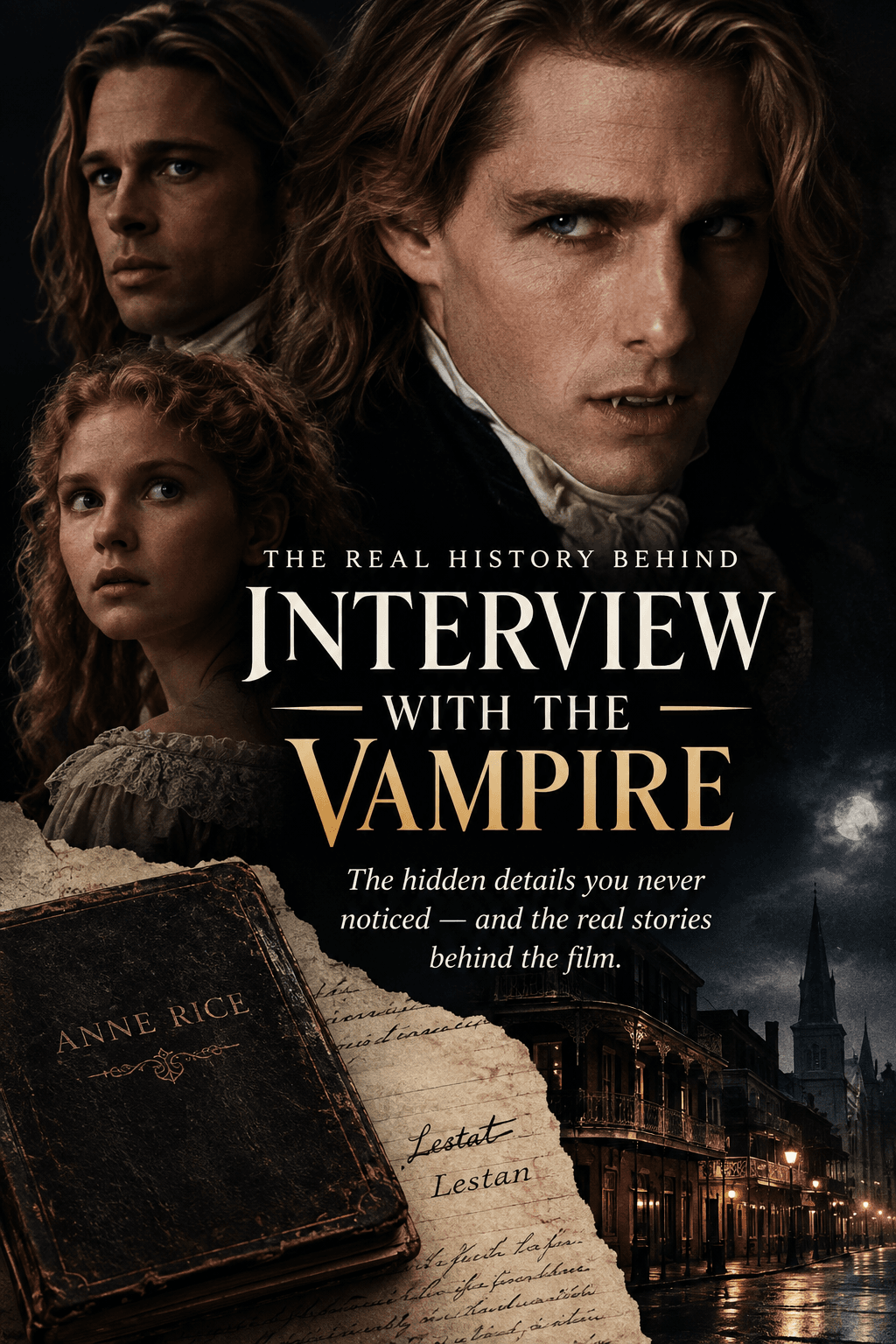
This Interview with the Vampire 1994 hidden details breakdown collects the real history sitting underneath Neil Jordan’s film adaptation of Anne Rice’s 1976 novel — facts about the book, its author, and its real filming locations that never make it into the finished movie itself, from a vampire’s name that started as a spelling mistake to the actual buildings standing in for fiction. Most “hidden details” pieces go looking for something buried inside the frame — a prop in the background, a line delivered too fast to catch, a reference planted deliberately for the people paying closest attention.This film hides its most interesting material somewhere else entirely, in places no amount of pausing and rewatching would ever surface: in the eighteen years before a camera ever rolled, in a manuscript that no longer exists in its original form, in three real buildings standing in for fiction that carry their own unrelated histories nobody in the audience is told about. None of it was hidden on purpose. Nobody involved was playing a game with the audience the way a director sometimes does with a background detail.It’s simply the kind of information that never makes it into a finished film, because a finished film has no obligation to explain where it came from — and a viewer has no way of knowing any of it just by watching closely, no matter how many times they rewind.
The Real Story Behind Lestat’s Name
Start with the name. Lestat de Lioncourt is, by now, one of the most recognizable vampire names in American fiction — distinctive enough that it never gets mistaken for anyone else’s creation. Anne Rice has said, in a 2014 interview, that she believed she was drawing on an authentic old Louisiana name when she wrote it. She wasn’t. The actual name, the one she thought she was using, is “Lestan.” She misspelled it, didn’t catch the error for years, and by the time anyone might have corrected it, the misspelling had already become the character.There’s a version of this story where a careful copy editor catches a spelling mistake in 1976 and the most famous vampire of the back half of the twentieth century gets a slightly different name — one nobody would recognize the same way. That correction never happened, for no more dramatic reason than nobody flagged it in time.The film never explains this, obviously, because there’s no reason it would — Lestat’s name isn’t a plot point, it’s a fact about the novel’s own production history sitting underneath the finished object. But it’s worth knowing precisely because of how the name functions once you do: every time Tom Cruise’s Lestat introduces himself with that particular weight and precision, the specificity is an accident wearing the costume of intention.Rice spent decades building an increasingly elaborate mythology — family lines, French aristocratic lineage, an entire etymology fans have debated for years — around a word that started as a spelling mistake she didn’t notice.
Claudia Was Built Out of a Real Loss
Claudia’s hidden history is harder, and it earns a more careful pace than the name did. Rice’s five-year-old daughter, Michele, died of leukemia in 1972. Rice has said she wrote the novel roughly six weeks later, in a five-week burst, and has been direct about what the book actually was underneath the vampire premise: “it was all about my daughter, the loss of her and the need to go on living when faith is shattered.”Rice has connected the character to Michele explicitly and by name, describing Claudia’s fate in the same terms she used for her own daughter’s: “I felt that Claudia had really been meant to die at the end of ‘Interview’ the way Michele had died.”That reframes a specific, familiar detail differently than performance analysis alone can.
Kirsten Dunst’s Claudia performance is usually discussed, correctly, as a technical achievement — an eleven-year-old finding the specific comedy and horror of a child’s mind locked permanently in a child’s body. What the film doesn’t disclose, and can’t disclose within itself, is that the character predates any script, any casting call, any decision about who would play her.Claudia existed first as a private act of grief, written at speed, by a woman who has described herself, at the time, as “a sad, broken and despairing atheist,” working through a period of heavy drinking and genuine collapse. The film’s insistence on Claudia’s permanent, arrested unchangingness — the doll comparisons, the horror of a body that will never again match an interior life — carries weight the finished film never announces, because that weight belongs to Rice, not to the production.She wasn’t in the room for any of the film’s eighteen years of development, and none of the people who eventually were had any way of accessing what she’d actually built the character out of.
How the Novel Interview with the Vampire Actually Began
The novel itself started smaller than the finished book eventually became, and smaller still than what this film had to adapt. Rice had written a short story on the same premise years earlier, in 1968 — thirty pages, told entirely from the interviewer’s point of view rather than the vampire’s. It sat unfinished until 1973, when, at the encouragement of one of her husband’s writing students, she went back and expanded it into a full novel in five weeks, arriving at 338 pages. What sold to Knopf wasn’t even quite that version.After early rejections, staffers at the 1974 Squaw Valley writers’ conference championed the manuscript directly to an editor there, Victoria Wilson, who acquired it for a $12,000 advance — a modest number next to what came next.
Ballantine Books paid $700,000 for the paperback rights alone, reportedly $300,000 more than Stephen King’s Carrie had fetched not long before.A story that began as a short piece narrated by a mortal stranger, expanded once by a first-time novelist working through grief in real time, became one of the more lucrative paperback deals of its decade before most readers had ever heard the name Lestat.
Lestat Almost Died: The Ending That Got Rewritten
Lestat himself very nearly didn’t survive to be in this film at all — not in the ambiguous, open-ended way the actual ending on the bridge leaves things, but in the flattest, most permanent sense. In the novel as Rice first sold it, Lestat dies in the fire. The Théâtre des Vampires sequence — the entire Parisian coven, Armand, the elaborate underground catacomb ballroom this film’s own production design leans on so heavily — wasn’t in that version either.Both were added during the roughly two years between the manuscript’s sale in 1974 and its publication in 1976, once Rice went back in and added close to two hundred pages to what she’d originally written in five weeks.Which means the film’s entire back half — the Paris scenes, the coven’s laws, Armand’s seduction of Louis, and eventually the very existence of a Lestat capable of climbing into the back seat of Daniel Malloy’s convertible thirty years later — rests on a decision made after the book had already sold, not before. The story as first written ends with its most charismatic character dead.Everything that makes a franchise, a sequel, a Broadway musical, an AMC television series, and this film’s own final scene possible was a second thought, arrived at during revision, not part of the original design.It’s worth being honest about what this detail is and isn’t. It doesn’t change the meaning of anything the released film actually does — Lestat’s survival is simply the version of the story that exists, the only one the film adapts, and nothing about
his mansion confession or his bite on that bridge reads differently for knowing an earlier draft killed him off. What it does change is the sense of inevitability the film’s mythology tends to project.A creature this immortal, this thoroughly worked out across decades of sequels, feels like he was always going to outlast the story. That feeling is a trick of hindsight. He only outlasted it because someone went back into a finished manuscript and gave him a second draft’s worth of survival he hadn’t earned in the first one.
The Rutger Hauer Myth, and Where Lestat Really Came From
There’s a persistent piece of fan mythology worth clearing out plainly, since it circulates as fact often enough to have calcified: Lestat was not modeled on Rutger Hauer. Rice has denied this directly and specifically — “I didn’t encounter [Hauer] till after I’d written Interview” — and has said Lestat “sprang to life pretty much on his own.” The confusion likely comes from Hauer’s own performances in the same general register Cruise eventually finds in this film: beautiful, articulate, capable of real menace without losing charm.But the resemblance is coincidence, or at most convergent casting instinct decades apart, not lineage.A related myth matters more than the Hauer confusion, because it touches the genre’s actual founding text. Rice has said she hadn’t read Bram Stoker’s Dracula when she wrote the novel this film adapts. Her vampire vision came instead from a much stranger source: the 1936 Universal film Dracula’s Daughter, seen as a child, which shaped her sense of vampires as, in her own words, “elegant, tragic, sensitive people” — a description built around dignity and sorrow, closer to court portraiture than to a threat assessment.That’s a genuinely useful thing to know about this film’s whole emotional register — the melancholy, the theatrical grief, the sense that being a vampire here is closer to a curse of refined sensitivity than a horror-movie affliction. It didn’t come from the genre’s
most famous novel. It came from a lesser-known 1936 sequel most audiences have never seen, filtered through a child’s memory of it, arriving at this film sixty years later almost entirely intact.
What the Film Leaves Out of the Plantation Metaphor
There’s a piece of academic reading worth folding in here, since it locates the story’s real wound earlier than the vampire premise even starts, and it comes with a caveat worth stating plainly: the sharpest version of it lives in the novel, not in this film.One scholarly analysis of the book argues that Louis’s identity as a plantation owner — a man whose entire sense of himself rested on absolute, unquestioned authority over people who had none of their own — was already a kind of rehearsal for what vampirism later makes literal, and that the novel is interested in the futility of that authority long before Lestat ever appears at his door.The book makes this connection explicit at one point, with Lestat describing new vampires as something increased “through slavery” — a line that never made it into this film’s dialogue at all, absent from both the shooting script and the released cut. What survives on screen is the plantation itself, the ownership, the guilt Louis narrates without ever naming its source this precisely. The film inherited the wound without inheriting the sentence that names it.
Interview with the Vampire 1994 Hidden Details: The Real Filming Locations
The film’s physical locations carry their own layer of unrelated history, none of it disclosed on screen, some of it genuinely strange to sit with once you know it. Louis’s plantation exteriors were shot at Oak Alley Plantation in Vacherie, Louisiana — an antebellum mansion built in 1839, decades after the film’s own 1791 setting, famous for the avenue of twenty-eight live oaks leading up to the house and, today, open to the public as a museum, a plantation that once ran on forced labor now standing as a place people pay to walk through and photograph.The interiors were shot elsewhere, at Destrehan Plantation, a structure that actually predates the film’s timeline: built in 1787, four years before the story opens, and described as the oldest documented plantation surviving in the lower Mississippi.Destrehan holds a second, heavier fact that deserves to be named directly. Roughly two decades after this film used the property as the interior of a fictional slaveholder’s home, the same plantation became a filming location for 12 Years a Slave, a film about the actual, undisguised horror this film only ever approaches through metaphor — the one the previous paragraph traces back to Louis’s own pre-vampire life. A real building where that metaphor was staged later hosted a film with no metaphor left in it at all. Neither production owes the other anything.The overlap is coincidence of Louisiana’s limited supply of intact antebellum architecture, nothing more calculated than that. But it’s the kind of coincidence that says something true anyway, about how much unexamined weight the state’s surviving plantation houses are still being asked to carry, on screen, for very different stories that all eventually need the same kind of building.
The Paris Opera House Hiding in Plain Sight
Paris has its own borrowed history built into it. The elegant staircase Louis and Claudia ascend on arrival — the film uses it as a hotel lobby — is the real grand staircase of the Palais Garnier, the Paris Opera House. It’s the same building whose architecture and substructure inspired Gaston Leroux’s Phantom of the Opera decades earlier, meaning this film’s vampires climb the same stone steps that, in a different story entirely, lead toward a man living in the walls beneath a theater. Nobody involved in either production intended the echo.The building was simply available, photogenic, and willing to double as whatever a film crew needed it to be that week. But once you know it, the two stories sit oddly close together: one about a monster who lives underground and controls a theater from the shadows, one about vampires who eventually build their own underground theater in Paris and control it the same way. The Palais Garnier apparently has the right architecture for both.
The Cinema Where Louis Finally Sees the Sun
London contributes the film’s quietest, least ornamental location, and arguably its most important one dramatically. The sunrise Louis watches at a movie theater — his first exposure to real daylight in decades, filtered safely through a screen — was filmed at the Phoenix Cinema in East Finchley, which claims to be the oldest purpose-built cinema still in continuous use in the United Kingdom, opened in 1910.There’s something almost too tidy about that fact, the kind of detail that would read as overwritten if a novelist invented it on purpose: a two-hundred-year-old vampire experiencing sunlight for the first time inside one of the oldest surviving buildings ever purpose-built for watching light projected onto a wall. The film doesn’t appear to know this about its own location. The coincidence exists whether or not anyone on the production noticed it.
What Anne Rice Herself Said About the Film
One more piece of hidden material comes directly from Rice herself, in a statement she gave about watching the finished film. She was honest that the adaptation couldn’t do everything her prose did — “this movie obviously did not go into the heads of the vampires,” she said. “It really didn’t go into the swoon as they experience it in my novel or script.” That’s a real limitation, and Rice named it without softening it.But she also singled out what the filmmakers substituted for that interior experience, and found it effective on its own terms: extreme close-ups on the vampires’ eyes during an attack, and a levitation sequence, standing in for sensory description no camera can fully replicate from the inside of someone else’s head.The same statement singled out two specific moments as proof the substitution could still land completely on its own terms — Pitt’s reaction on finding the ashes in the airwell, which she called “absolutely masterly acting,” and Cruise’s horseback scene, which she read as capturing something essential and defiant about Lestat that no line of dialogue delivers as cleanly. Neither moment needed access to anyone’s internal monologue to work. They’re purely external, purely visual, and the author of the internal version approved of them anyway.That’s worth sitting with as its own kind of hidden detail, because it’s an admission from the one person with total authority over what this story is actually supposed to feel like, about the exact place where film and prose stop being able to do the same job. A novel can put a reader directly inside a vampire’s sensory flood — the heightened hearing, the vertigo of drinking, the swoon Rice describes and the film, by her own account, doesn’t attempt.A film has eyes and gravity instead: an extreme close-up standing in for interiority, a body lifted off the ground standing in for a feeling no lens can actually photograph. Neither is a failure exactly. They’re just different tools solving the same problem from opposite directions, and the gap between them is the closest thing this film has to an admitted limitation, confirmed by the one person who’d know.
Interview with the Vampire 1994 Hidden Details: What It All Adds Up To
None of these details change a single line of dialogue or a single frame of the released film. That’s exactly what makes them worth holding onto — the kind of material easy to file under trivia and forget, and worth resisting that filing system for. A name that started as a mistake. A child character built directly out of a mother’s specific, named grief. A villain who was originally supposed to die and only survives because of a decision made after the manuscript had already sold. Two plantations doing double duty for two very different stories about ownership, decades apart.An opera house lending its staircase to vampires the same way it once lent its architecture to a phantom. A cinema built to project light hosting a scene about a creature finally seeing daylight again. None of it is visible in the finished film. All of it is sitting directly underneath it, the way a foundation sits underneath a house nobody built to show off its foundation.What’s left, once you’ve collected all of it, amounts to a harder question than a different reading of the movie would — a question about where a story like this one actually starts. A screenplay is the wrong place to look, and so is a director, and so, it turns out, is the year the novel was published.The real starting points sit earlier and stranger than any of those: a misspelling nobody caught in time, a five-week manuscript written in the exact shape of a mother’s grief, a plantation house built decades after the year it’s pretending to represent, an opera house that happened to already know how to look haunted. The film sits on top of all of it without ever needing to mention any of it, which is true of most films built on real locations and older source material.What’s unusual here is how much of it there turns out to be, once someone actually goes looking, and how little of it was placed there on purpose. Rice was writing her way out of a specific grief in five weeks flat. Nobody involved was building a monument. The monument got built anyway, out of a spelling error, a dead daughter, a rewritten fire, and whatever buildings happened to be standing and available when a production needed somewhere real to point a camera.
Interview with the Vampire 1994 Hidden Details — Frequently Asked Questions
Interview with the Vampire 1994 Hidden Details: Is Lestat’s Name Really a Mistake?
Yes. Anne Rice has said she believed “Lestat” was an authentic old Louisiana name. It wasn’t — she misspelled it. The real name she was thinking of was “Lestan,” and she didn’t catch the error until years after the character had already become famous under the misspelled version.
Did Anne Rice Base Claudia on a Real Person?
Yes. Rice’s five-year-old daughter, Michele, died of leukemia in 1972, and Rice wrote the novel roughly six weeks later. She has said directly that she felt Claudia was “meant to die at the end of ‘Interview’ the way Michele had died,” making the character a direct fictional response to that loss.