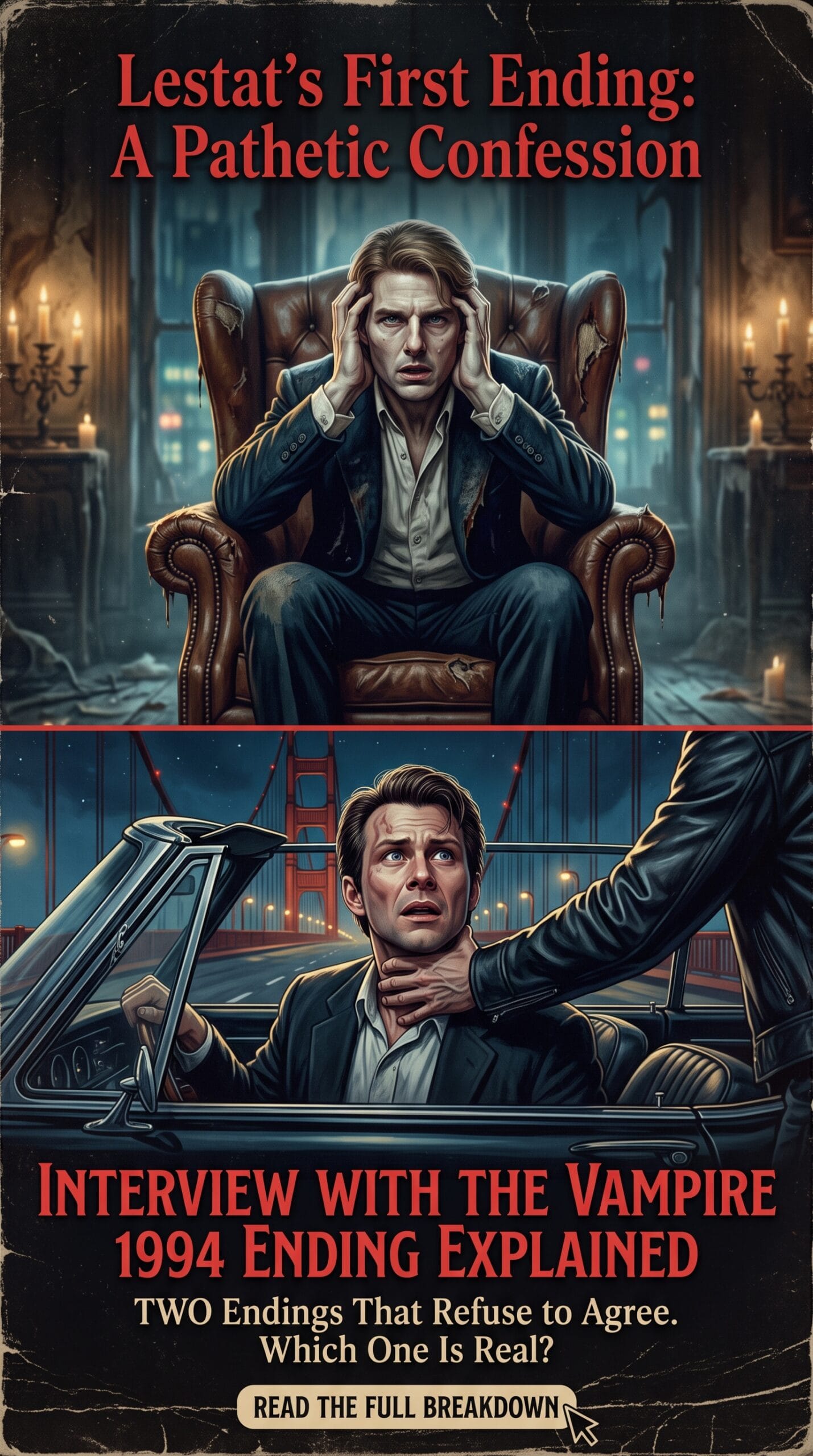
This Interview with the Vampire 1994 ending explained breakdown untangles both of the film’s closing scenes: Lestat’s private, sorrowful confession to Louis in a ruined mansion, and the far more violent, ambiguous attack on journalist Daniel Malloy on a bridge minutes later. Directed by Neil Jordan from Anne Rice’s own screenplay adaptation of her 1976 novel, the film never confirms what happens to Malloy after that final cut to black — and that ambiguity, this piece argues, is the entire point. Interview with the Vampire doesn’t actually end once.It ends twice, in two different rooms, and the two endings don’t agree with each other. The first happens in a ruined mansion outside New Orleans, private, almost tender, and resolves nothing. The second happens on a bridge, in a stranger’s convertible, and resolves even less. Most films that do this are being sloppy. This one seems to be doing it on purpose, and the longer you sit with both endings side by side, the less sure you become about which one the film actually wants you to believe.The first ending belongs to Lestat. Louis, narrating his story from a nearly empty San Francisco room to the journalist Daniel Malloy, has already told us he went looking for whatever became of his maker and found him decades later, alive, in the wreck of the Pointe du Lac house — starved down to a skeleton in beautiful rags, terrified of a modern city he can no longer tolerate. What Louis actually walks into is smaller and sadder than a monster’s lair. It’s an old man in a chair, flinching at sirens.
The First Ending: Lestat’s Confession at the Mansion
Lestat’s first words to him sound like relief: “I’m so glad you are here. I’ve dreamed of this moment.” He brings up Claudia only once, obliquely — “she never should have been one of us” — and Louis shuts the subject down flat: “That’s all past, Lestat.” Past is the word Lestat repeats back to him, quietly, like he’s trying to believe it. Then he asks the only question that actually matters to him: “You’ve come home to me then?”What follows is the closest thing to an apology this film ever produces, and it’s worth sitting with exactly what Lestat admits and exactly what he doesn’t. He tells Louis he remembers what kind of vampire he used to be, and then says something that deserves more attention than it usually gets: “No one could refuse me. Not even you.”He puts himself at the center of that sentence — not the dark gift, not fate, not some impersonal force nobody escapes, just him, specifically, claiming credit for his own will overriding someone else’s, dressed up as an observation about the nature of vampires in general. Louis answers “I tried,” and Lestat, almost gently, tells him that trying only made him want him more. It is, without any of the film’s usual theatrical cruelty, a description of possession mistaken for love, delivered by someone too far gone to notice the difference.He can’t tolerate the modern city outside his own walls anymore, either — sirens send him into a genuine panic, and at one point he grips his own ears against some passing sound and says, of the ambient glow of a city that never fully goes dark, “such lights, and that noise — they make the night brighter than the day.” Louis’s response is almost tender: “It’s false light. It can’t harm you.” Which carries its own quiet irony.The one kind of light actually capable of killing Lestat is the only kind he isn’t afraid of anymore, mostly because it’s been decades since he was strong enough to go looking for it.
What “Become the Old Lestat” Really Means
Then he asks for the thing he actually wants: Louis’s presence. “If you stay with me, Louis, I could venture out again. Become the old Lestat.” That’s the whole pitch: not companionship for its own sake, but Louis as a kind of battery, a way back into a world Lestat is now too fragile and too frightened to survive alone. Louis doesn’t argue with him. He doesn’t even really refuse him. He just says “I must leave now,” and leaves. No confrontation, no final judgment delivered to the man who made him.Just an exit, and a piece of narration a moment later that functions as the closest thing to a verdict Louis ever gives on his own life: “Whatever happened to Lestat, I do not know. I go on, night after night. I feed on those who cross my path. But all my passion went with her golden hair. I’m a spirit of preternatural flesh. Detached. Unchangeable. Empty.”That’s the first ending. A story about a monster who begs to be let back into the world by the one person he ever genuinely wanted there, and who is refused quietly, by omission, never once confronted directly — and a story about the person doing the refusing, who describes his own resulting existence in four words that sound less like grief and more like a diagnosis he’s stopped fighting. If the film stopped there, it would already be a complete, quietly devastating ending. It doesn’t stop there.
The Second Ending: Daniel Malloy Refuses to Let the Story Stop
The second ending starts the moment the film cuts back to the San Francisco room, and it starts with the person listening to all of this refusing to accept it as a stopping point. Malloy has been mostly a passive presence for two hours — a tape recorder with a face — and here, for the only time in the film, he pushes back. “No, it can’t end like that,” he says, and when Louis tells him there’s nothing more to tell, Malloy doesn’t back down: “There must be more to tell. You don’t understand yourself. You’re not empty.”It’s a strange thing to watch a mortal, twenty-some years old, contradict a two-hundred-year-old vampire’s own account of his interior life, and Ethan thinks it’s the most quietly aggressive line in the film — Malloy has just spent an entire film learning exactly what wanting more from a vampire costs the people who ask for it, and asks anyway.What he asks for, specifically, is the thing the whole film has spent two centuries warning him against: “What I wouldn’t give to be like you, to have your power, to have seen the things you have seen.” Louis’s answer — “do what you want with it, give it to others, learn what you can” — is Louis trying to hand him the only gift he actually has to offer, which is the story itself, secondhand, survivable. Malloy doesn’t want secondhand. “There’s only one way I’ll truly learn, and you know it.You brought me here for a reason, didn’t you? You want a companion. You want a link to the outside world. That’s me. Take me. That’s what I want.”Christian Slater — cast only after River Phoenix’s death forced a late replacement,
a casting story worth its own space — plays the pivot inside that single confrontation with more control than the role usually gets credit for. Malloy goes from performing bravado — “take me, that’s what I want” — to genuine, unrehearsed terror in the space of about four seconds, and the fear reads as real specifically because everything before it reads as performed. He’s spent two hours playing interviewer, adopting whatever posture keeps Louis talking.The one moment he stops performing is the one moment nobody could blame him for it.
Why Malloy’s Request Mirrors Lestat’s
It’s worth noticing what Malloy is actually doing in that moment, because it’s the same thing Lestat just finished doing in the mansion twenty minutes of screen time earlier: asking to be made necessary to an immortal, dressing the request up as insight into what the immortal secretly needs. Lestat told Louis he could be the reason he ventures back into the world. Malloy tells Louis he could be his link to the outside world. Neither man is wrong about the loneliness underneath the offer.Both are proposing themselves as the cure for it, which is a very different thing from actually being one.Louis’s response to being asked this a second time, by a mortal who has no idea what he’s actually requesting, is not measured. He grabs Malloy, bares his teeth, and asks him three questions in quick succession that aren’t really questions: “Do you like this? Do you like being food for the immortals? Do you like dying?” Malloy’s only answer is “Stop!” — genuine terror, the first honest reaction he’s had all night — and Louis lets him go. The film doesn’t linger on an aftermath.There’s a long, unscored gap in the released cut, close to a full minute of screen time with no dialogue at all, and then we’re somewhere else entirely: Malloy’s convertible, crossing the Golden Gate Bridge in the dark, one of his own cassette tapes running in the deck.
The Bridge, the Tape, and the Attack
What plays on that tape is Louis’s voice, and it’s not random — it’s the exact first line of the entire film, looping back on itself: “1791 was the year it happened. I was twenty-four, younger than you are now. But times were different then. I was a man at that age. The master of a large plantation, just south of New Orleans. I had lost my wife in childbirth.”That’s the story restarting, word for word, the same account of an unwilling, uninvited turning that the whole film has just spent two hours unpacking, now playing as ambient sound in a stranger’s car while that stranger drives toward whatever is about to happen to him. If you’re looking for the moment this film tells you plainly what it thinks it’s actually about, it’s here, underneath everything else that’s happening in the scene: the story of how somebody was taken without being asked, replaying itself as background noise for what looks very much like it’s about to become another one.Underneath Louis’s recorded voice, some other broadcast keeps bleeding through the car speakers — fragments of a completely unrelated, utterly banal exchange, someone saying “it’s good stuff,” someone asking for a fresh pair of shorts, mundane noise indifferent to the fact that a two-hundred-year-old confession is playing on top of it. It could be a pure sound-design accident, except the film has spent its entire two hours training you to notice exactly this kind of gap between what’s being said out loud and what’s actually happening in the room — or, here, the car.Then a voice cuts through both layers at once, dry and impatient in a register that sounds almost like the old Lestat again: “Still whining. I’ve had to listen to that for centuries.” It’s close to the only joke in the film’s final ten minutes, and it lands precisely because nobody else in the scene is in any position to find it funny.What happens next is fast, and the film keeps its camera closer to Malloy’s terror than to any clear geography of the attack. A hand reaches from the back seat. It’s Lestat — alive, mobile, nothing like the starving wreck in the mansion twenty minutes earlier — and he sinks his teeth into Malloy’s neck while the car swerves through traffic, nearly clips a truck, and gets yanked back into its lane by Lestat’s own hand on the wheel before he climbs fully into the front seat.Somewhere in the middle of this, still mid-bite or just after it, he says the thing this film chooses to end on, and it’s not a threat, and it’s not the cruelty you’d expect from a man who has just ambushed someone in a moving vehicle. It’s almost soft. “Don’t be afraid,” he tells Malloy. “I’m going to give you the choice I never had.”
Interview with the Vampire 1994 Ending Explained: What Actually Happens
And then the film ends. Not on the result of that sentence — not on Malloy transformed, not on Malloy’s body, not on Lestat driving alone into the sunrise with anything resolved — just on the promise itself, mid-delivery, cutting to black before we learn whether Lestat means it, whether he’s capable of meaning it, or whether “choice” is simply the word a two-hundred-year-old predator has learned works better than force.Multiple critics writing about this ending have landed on the same word Ethan would use: the film “never confirms whether Daniel will become a vampire, whether Lestat truly intends to make him his new protégé, or what Louis’s fate will be,” as
one recent breakdown of the ending put it — deliberate, structural ambiguity, not an accident of editing.
The Script’s Original Ending vs. the Released Film
An earlier draft of the shooting script — dated the same winter the film went into production, and worth naming plainly as what it is, material the released film ultimately rejected — never anything audiences actually saw — tells a different story here entirely.In that draft, Lestat drains Malloy openly and completely while the car swerves through traffic, wrestles the wheel back from a near-collision with an oncoming truck, throws Malloy’s body — the script’s own word is corpse — into the passenger seat, and drives on alone, closing not on any mention of a choice but on a different, far more finished line: “Dear Louis… will I ever forget?” There’s no ambiguity in that version at all. Malloy is dead. Lestat has him. The sentence is a period, not a question mark.Somewhere between that page and the released cut, the filmmakers changed their minds, and they didn’t just trim the scene — they reversed its entire emotional logic, trading a clean, cruel resolution for an open one built around the word choice, with no body left on screen to settle the question. That’s not a small revision. It’s the difference between a film that tells you exactly what happened and a film that hands you the last five seconds and asks you to sit with not knowing.
What Lestat’s Final Line Really Means
Here’s what makes that final line worth more attention than “creepy closing dialogue” usually gets: it directly answers something Lestat said twenty minutes earlier, in a completely different register, to a completely different man. In the mansion, describing his hold over Louis, Lestat said “no one could refuse me. Not even you” — framing his entire relationship to consent as a closed question, something that was never actually available to the person on the receiving end. Now, with Malloy, he reframes the exact same act — turning a mortal into what he is — as its opposite.Not an inevitability nobody escapes. A choice. Somebody actually gets offered a choice in this film for the first time in two centuries of story, and it’s not Louis, who never had one, and not Claudia, who never had one either. It’s a stranger Lestat met an hour ago, on a bridge, mid-assault.Whether that’s meant to land as growth, as manipulation with better vocabulary, or as something Lestat genuinely believes about himself in a way that isn’t actually true, the film refuses to say, and Ethan isn’t convinced it’s supposed to be answerable from the text alone. Predators learn language. That’s not a cynical reading forced onto the scene; it’s the plainest one available. A creature old enough to have watched consent become a subject people actually discuss, decade after decade, from the outside, would eventually learn which words make prey stop struggling.“I’m going to give you the choice I never had” is, among other things, an extremely good line to say to someone you’re currently killing. It doesn’t need to be sincere to work. It only needs to sound sincere for the length of a bite.And yet — this is the part that keeps the ending from resolving cleanly into cynicism, and the part Ethan keeps circling back to without landing anywhere solid — Lestat has just spent an entire scene, minutes earlier, admitting things he had no strategic reason to admit to a man who’d already made clear he wasn’t staying. Nobody manipulates an audience of one who’s already walking out the door.If that confession in the mansion was real, if the fear and the loneliness and the “I need your forgiveness” were the truth and not performance, then it’s at least possible the man in the car isn’t performing either — that two centuries of being told, by himself and by Louis both, that he never gave anyone a real option has actually gotten under whatever passes for his conscience, and that offering Malloy the word “choice,” true or not, is the closest thing to penance a creature like this has left available to him.The film gives you both readings and declines to referee between them, which feels less like indecision and more like the actual point: nobody in this story, including the audience, ever gets to fully verify anyone else’s intentions from the outside. That was true of Lestat turning Louis in 1791. It’s still true here, with the bridge lights sliding past the windshield and the tape still playing.
What Happened to Daniel Malloy? The Sequel Never Said
What happens to Malloy afterward is a question this film asks and then, deliberately, walks away from. The industry built to answer it never did, either. Queen of the Damned arrived eight years later, in 2002, loosely stitching together material from Rice’s second and third novels — one entry in a lineage of
essential vampire movies this film helped anchor — and it dropped this entire thread on the floor — no Christian Slater, no Daniel Malloy, no acknowledgment that a cliffhanger involving a specific named mortal on a specific bridge had ever existed.The choice Lestat promises never gets confirmed, denied, or followed up on by the only story positioned to do it. It’s not that the sequel resolved the ambiguity and disappointed people with the answer. It’s that the built-in next chapter simply never showed up to answer anything at all, which means the last thing this franchise ever said about Daniel Malloy is a vampire’s hand on his throat and a sentence that might be a gift and might be exactly what it looks like.
Interview with the Vampire 1994 Ending Explained: Final Verdict
Louis’s own self-assessment, delivered minutes before any of this happens, is the quietest and possibly the truest thing in the entire film: detached, unchangeable, empty. It’s tempting to read Lestat’s ending as the film’s answer to that — proof that change is still possible, that even the worst of these two men can learn something across two hundred years of ruining people. Ethan traces where some of that darker material actually comes from — a misspelled vampire name, the author’s own private loss inside Claudia’s character — in
Interview with the Vampire 1994 Hidden Details.It’s just as easy to read it as the same hunger wearing better manners, a predator who has finally figured out that “choice” is a more efficient word than force, applied to someone too flattered and too frightened to notice the difference until it’s already happening to him. Ethan has watched this ending more than once trying to decide which reading he actually believes, and he still isn’t sure that’s a question the film is interested in letting anyone answer. Some stories end.This one just stops talking, mid-sentence, with the tape still running and the choice still hanging there, unconfirmed, exactly like every other choice this story has ever pretended to offer.
Interview with the Vampire 1994 Ending Explained — Frequently Asked Questions
Interview with the Vampire 1994 Ending Explained: What Happens to Daniel Malloy?
The film never confirms it. Lestat bites Malloy in his convertible and promises him “the choice I never had,” then the film cuts to black mid-scene. Whether Malloy becomes a vampire, dies, or survives untouched is left deliberately unresolved, and no sequel ever picked the thread back up.
Is the Ending of Interview with the Vampire 1994 the Same as the Script?
No. An earlier draft of the screenplay has Lestat kill Malloy outright and drive off alone, closing on the line “Dear Louis… will I ever forget?” The released film replaced that clean resolution with the open-ended “choice” line instead.