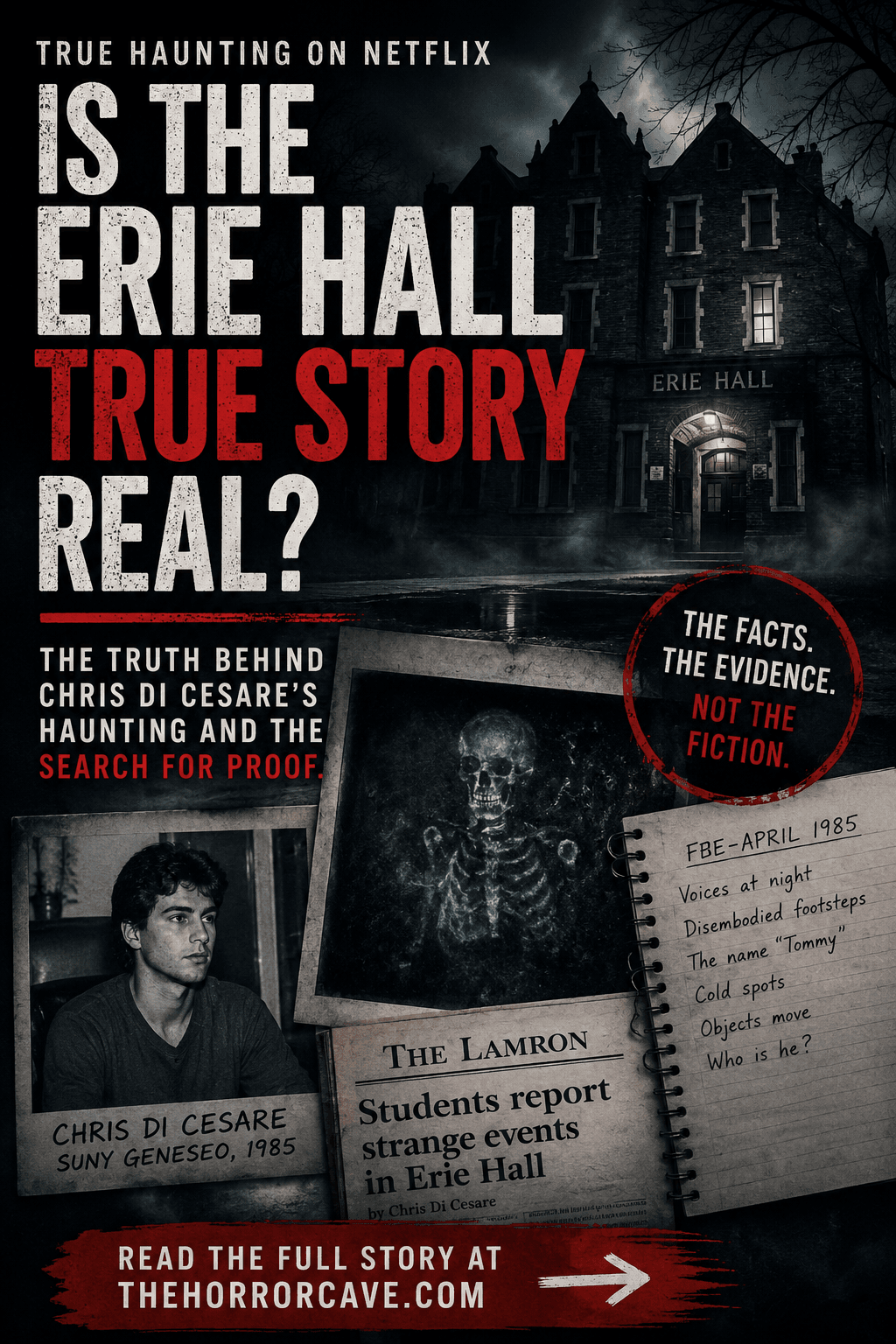
Is the Erie Hall true story behind Netflix’s True Haunting real? Chris Di Cesare, a SUNY Geneseo sophomore in the winter and spring of 1985, is the source for every version of it — there’s no independent corroboration, no period record of the ghost he named “Tommy,” and no forensic review of his own evidence photo, only forty years of the same account resold across SyFy, a bestselling memoir, Coast to Coast AM, the Travel Channel, a second memoir, and now James Wan’s five-episode Netflix docuseries, which premiered October 7, 2025.
In my third year as a reporter, at a small regional paper that no longer exists under that name, an editor handed me a filler assignment for the October issue: three columns, a cover photo, a haunted house. The house wasn’t interesting. The family behind it was. The mother had died of an overdose five months earlier and left a teenage son alone in a house he had no way to leave, hearing things at night that a grief counselor could have explained in one sentence and a horror segment could not. I wrote it that way — a kid processing loss with nobody left to sit with him.
My editor read it standing at my desk and said, “where’s the chill? This reads like an obituary.” He wanted more atmosphere. More doubt, planted deliberately. Less orphaned teenager, more is-the-house-really-haunted.
I rewrote it twice trying to find some version that gave him what he wanted without selling the kid’s grief as a seasonal attraction. On the third pass I understood there wasn’t a version like that. There was only the version where I did it, and the version where I didn’t. I told my editor there was no story there, just a nineteen-year-old with no support system, and that I’d fill the space with something else. He wasn’t happy. I didn’t care, or told myself I didn’t, which at twenty-six amounts to roughly the same thing.
A colleague two desks over, a couple of years ahead of me and hungrier than I’d clocked at the time, picked the assignment back up the following week. He gave the editor exactly what he’d asked for — flickering lights, “residents report,” a quote from the kid sliced out of context until it read like a confession of haunting. It ran in three local outlets, got picked up as a radio segment, and six months later he had the state desk job I’d also been chasing.
I never told anyone at that paper what I thought of how he got there. I stayed quiet, and the quiet never felt like pride, only like arithmetic — there was nowhere for that anger to go, because no rule had technically been broken. Just a man deciding his own character wasn’t for sale, watching someone else get promoted for selling his.
I think about that arrangement every time a documentary, a podcast, or in this case a five-part Netflix docuseries decides that somebody’s worst year needs more atmosphere. Villains, in the version of this business I actually worked in, rarely get a bad ending. Usually they get a development deal, a poster, and a premiere date.
The Erie Hall True Story Behind Netflix’s True Haunting
True Haunting is James Wan’s paranormal anthology for Netflix, five episodes, and it opens with three episodes called “Eerie Hall” — an extra vowel bolted onto a real building at a real university for the sake of a spookier title card. The actual building is Erie Hall, at SUNY Geneseo, a public college in upstate New York, and the man at the center of the Erie Hall true story is Chris Di Cesare, class of 1987, who in the winter and spring of his sophomore year — February through April 1985 — reported one of the most extensively documented hauntings on record for a state school dormitory. Di Cesare wasn’t a stranger to the campus paper. He was its comic editor.
Worth sitting with, before anything else: the man whose “unretouched” evidence photo would later be described, admiringly, as detailed enough to “label all of the bones,” made his living at the time drawing pictures for a living.
How Ed and Lorraine Warren Started the Erie Hall Haunting
Here is what happened, according to Di Cesare himself, corroborated by his own contemporaneous account in Geneseo’s student newspaper, The Lamron, and repeated with only minor variation across every outlet that has covered this since: in early February 1985, Ed and Lorraine Warren came to campus for a paid lecture on the paranormal, complete with EVP recordings and career highlights. Di Cesare stayed for the meet-and-greet afterward.
Lorraine, he says, declined to shake his hand. “I won’t shake your hand,” she reportedly told him, “because I don’t want to know my future.” Ed, by his account, then had him removed from the stage. Eleven days later, a disembodied voice started calling his name from inside his dorm room — the moment the Erie Hall true story actually begins.
I’ve read the Warren case files — not summaries of them, the files, the ones journalists before me spent years pulling out of estates and archives to check against the legend Ed built one paid lecture at a time. I know what a Warren appearance is built to do to a room, and I know what it’s built to do to an audience member singled out in front of that room. It’s not subtle.
A refused handshake and a line like “I don’t want to know my future,” delivered to a college sophomore in front of his classmates, reads exactly like a hook, set with the precision of someone who has set thousands of them. Eleven days is the precise gestation period for a suggestible, singled-out nineteen-year-old, freshly told by a paid celebrity that his future is too dark to look at, to start hearing his own name in an empty room. Lorraine Warren didn’t warn Chris Di Cesare about anything. She primed him, then walked off with her fee, and let the story do what stories like that always do once you’ve planted one.
The Evidence for the Erie Hall True Story, Examined
What follows in the show, and in Di Cesare’s own retelling of the Erie Hall true story, escalates the way these things escalate: the disembodied voice, a roommate who starts corroborating noises and then flees entirely, a February 14 attempt to photograph the presence that produces — after the entity allegedly knocks Di Cesare to the ground for the failure of an earlier shot — a photograph of what he describes as a skeletal figure hovering over his bed, detailed enough for his neighbor to trace and label every bone in it. That photograph exists.
It circulates online to this day, cited by both believers and the people trying to talk them down. I looked at it the way I look at every piece of “evidence” that arrives already captioned with the conclusion it wants you to reach, and I’ll say what a British entertainment writer already said in print in October, with less patience for euphemism than most of Di Cesare’s champions have managed: I’m not buying it. Nobody with actual forensic training has ever been asked to weigh in, as far as the record shows, which tells you something about how badly anyone involved wanted a real answer.
Then comes March 13 — a shower, three claw marks, a confrontation with something Di Cesare says he addressed directly: “Who are you? God? The Devil? Show yourself!” Then mid-April, and a priest, and a blessing that supposedly ends the haunting for the rest of the semester. Di Cesare says he’s stayed in touch with that priest ever since.
I don’t doubt the wounds were real. People do that to themselves under enough sustained psychological pressure, and people also get hurt in dorm rooms for reasons that have nothing to do with pressure and everything to do with two kids scaring themselves into a genuine crisis they didn’t have the tools to name. What I doubt — what I flatly reject, on a record that offers me nothing but Di Cesare’s own account and the accounts of the people who love him — is the leap from “something frightening and unresolved happened to a nineteen-year-old” to “a specific dead teenager named Tommy did it.”
Somewhere in that timeline is a psychology professor who loaned Di Cesare and Ungar a camera to keep documenting the entity, and I want to sit on that detail longer than the show does, because the show treats it as a charming footnote and I think it’s closer to the whole disease in miniature. A university employee, trained in the mechanics of the human mind under stress, was told by two sophomores that something in their room was terrorizing them badly enough to leave physical wounds, and the only documented response on record is a camera loan — no mention, in any account I found, of a referral, or a colleague from student health walking down the hall.
Maybe that conversation happened off the record. What’s on the record is a crisis that got better documented, on its way to becoming folklore, than it ever got treated. That’s the institutional failure sitting underneath the ghost story, and it’s the one nobody’s marketing department has ever had a reason to mention.
Because that’s the detail nobody upstream of me seems to have checked, and I did: I couldn’t find a record. My own search through period newspapers, campus archives, and coroner’s logs from that era turned up nothing contemporaneous that puts a student named Tommy in a noose anywhere on the Geneseo campus before 1985, and neither has anyone else who’s looked. The name arrives exactly the way names arrive in every haunting that needs one — assigned by the frightened people experiencing the event, in the moment, with nothing behind it but the shape of their fear.
Decades later, once the story needed a second act, Di Cesare floated something even better: that “Tommy” was actually Lieutenant Thomas Boyd, an actual historical figure, an actual Revolutionary War officer who really did die on the land that later became the Geneseo campus, connected to a twentieth-century dorm-room haunting by the fact that soldiers under his command apparently called him Tom. A documented eighteenth-century death, borrowed for its documentation, grafted onto an undocumented one for the credibility transfer. It borrows the paperwork of a real death to cover for the absence of paperwork on a fictionalized one, and nobody making the show seems to have asked the question out loud.
None of this makes Chris Di Cesare a con man, and I want to be exact about that, because exactness is the entire argument I’m making here. I believe he was frightened. I believe something happened in that room that a scared nineteen-year-old couldn’t process and a camera loan couldn’t fix. What I don’t believe is that “something happened that scared two kids badly” is the same claim as “a documented, verifiable haunting occurred, complete with an identified ghost, and now belongs on your Halloween watchlist as a true story.” Those are two different sentences. The entire machine that has kept the Erie Hall true story alive for forty years depends on nobody noticing they’re different sentences.
Forty Years of Selling the Erie Hall True Story
Because here is the part the Netflix synopsis skips, and here’s where my cold fury actually starts, at the mechanism rather than at a scared kid I’ve never met: this was never a raw discovery. Netflix didn’t stumble onto an untold story and give a survivor his first platform. Di Cesare has been selling this exact Erie Hall true story, in escalating formats, since 2012. SyFy’s School Spirits ran an episode called “Dorm Room Nightmare” on June 27, 2012.
His self-published memoir, Surviving Evidence: Memoir of an Extreme Haunting Survivor — co-credited to his old neighbor Jeff Ungar and a third writer named William J. Edwards, because even the ghost story needed collaborators by then — became an Amazon bestseller in June 2015, the week after Di Cesare went on Coast to Coast AM and told George Noory the story in front of a national paranormal-radio audience built entirely on the premise that skepticism is the enemy of a good time. The Travel Channel picked it up again in 2019.
Four different formats, four different audiences, one unchanging haunting — the story never got smaller or less certain of itself; it only got better produced. And in September 2025, thirty days before True Haunting premiered, Di Cesare published a second memoir, The Ghost Boy of Erie Hall — a window too tight to be anything but a marketing calendar dressed up as catharsis.
That is a man who has never stopped telling this story, packaged fresh for whatever platform will pay the most for the current version, with James Wan’s name now doing the heavy lifting that Coast to Coast AM‘s late-night audience used to do for free. Wan is credited as executive producer, not director — Neil Rawles actually directed “Eerie Hall,” Luke Watson directed the Warren-adjacent second half, “This House Murdered Me” — but his name is the one on every headline, because his name is the brand, and the brand is the entire product. That’s the whole pitch.
I’ve said this before about the Conjuring universe and I’ll say it again here with a straight face: James Wan is a genuinely gifted technician attaching his name to material with nothing to say, and True Haunting imports the exact same move his Conjuring films perfected — take a story nobody can verify, hand it to Ed and Lorraine Warren’s estate for a credibility loan, the same instinct that’s kept a haunted doll touring the country decades after the people who made her famous died, film it with the polish of something that respects its audience, and let the audience mistake production value for evidence.
There’s a specific piece of craft here worth naming, because it’s doing more work than the marketing wants you to notice. Wyatt Dorion plays Di Cesare in the dramatized sequences, and Nicola Hadjis plays April Miller in the second half. Actors, cast and lit and blocked with the same care a prestige drama gets, reenacting testimony that was never filmed as it happened, standing in doorways real cameras never occupied in 1985. Every reenactment is a translation, and every translation is a decision about what to leave out.
The show doesn’t dramatize Di Cesare’s two memoirs, his SyFy appearance, his Coast to Coast AM slot, or the fact that his second book hit shelves a month before the cameras rolled on his story as new. It dramatizes a scared kid in an empty dorm room, because a scared kid in an empty dorm room is what sells, and forty years of packaging experience is what nobody wants playing under the opening credits.
The Warrens Are in True Haunting Too — And So Is the Pattern
Because the Warrens are in this show too, literally, investigating a Salt Lake City Victorian home in the second story, “This House Murdered Me,” beyond whatever fingerprints they’ve already left on the marketing — the same two people who told a nineteen-year-old his future was too dark to touch and then let a haunting start eleven days later like clockwork. I’ve read the case files.
Most of what Ed and Lorraine Warren “solved” over four decades falls apart under the kind of scrutiny their estate has spent just as many decades making sure never gets applied while the cameras are running. True Haunting doesn’t investigate that pattern. It monetizes it a second time, using the same two names as a stamp of authenticity on a story that has already changed shape four times since 1985 to fit whatever container was paying that year.
And the Erie Hall true story worked anyway, which is the actual horror of this, if you’re looking for one that isn’t a dead teenager who may never have existed. True Haunting hit Netflix’s global top five within a day of release and sat in the top ten in sixty-two countries.
Critics, given an actual chance to evaluate it as a piece of work rather than a claim, gave it a thin, unenthusiastic 67% on a sample of only six reviews — barely a passing grade from an audience too small to matter — and the people who actually watched it all the way through, the ones with no professional obligation to finish, rated it 5.6 out of 10, a number with nowhere respectable to hide.
Sixty-two countries watched anyway, because “good” was never the metric this thing was built to hit. “Believable enough for a Tuesday night” was the metric, and on that metric it performed exactly as designed, the same way my old colleague’s flickering-lights rewrite outperformed my honest one, the same way it always does when the version that respects the audience loses to the version that flatters what the audience already wants to feel.
What Actually Haunts Erie Hall
I keep going back to that kid in my own filler assignment, the one I refused to sell, because the two stories run on the same rails even though nobody in mine got a Netflix deal. An institution needed atmosphere more than it needed accuracy. Somebody in genuine distress became the raw material.
And the person willing to keep supplying whatever the format demanded, indifferent to whether any of it was true, got rewarded — repeatedly, for forty straight years in Di Cesare’s case, six months in my old colleague’s. I turned down my version once, at twenty-six, and I’ve never regretted it, and I’ve also never once seen the machine punish the people who said yes. It promotes them. It gives them memoirs and radio slots and, eventually, if the story survives long enough and picks up the right producer’s name, a Netflix logo and sixty-two countries of viewers who never asked to see the receipts.
Chris Di Cesare was afraid in that dorm room in 1985, and I take that fear at face value — real in the only sense that matters to a nineteen-year-old alone at 2 a.m., real as an experience, whatever its actual cause. What I refuse to extend him, or Netflix, or James Wan’s name on a poster, or Ed and Lorraine Warren’s estate collecting a fee on a legend forty years after their first paid lecture primed the whole thing into motion, is the credulity the marketing demands as the price of entry.
A frightened college sophomore, a skeletal photograph with every bone helpfully labeled by a comic artist, and a Revolutionary War officer’s real death borrowed for a fake one’s credibility add up to exactly one thing: an audience’s appetite and an industry’s considerable talent for feeding it. Four decades of increasingly professional packaging is a business model, not a body of evidence.
What actually haunts the Erie Hall true story, if you want my honest verdict after all of this, is an appetite that never once had to prove itself to keep getting fed — an appetite that took a scared kid’s worst semester and has been reselling it for forty years to bigger and bigger rooms, and that will keep doing it long after this docuseries is buried under next October’s new content, because nothing in the entire chain, not one person from the paid lecturer, to the professor who reached for a camera instead of a phone, to the executive producer, has ever had a reason to stop.
I know that appetite. I turned it down once, on a Tuesday, for three columns and a byline nobody remembers. It didn’t cost the appetite anything. It just found someone else, the way it always does, the way it’s about to do again the moment somebody pitches season two, and the season after that, for as long as there’s a scared kid somewhere willing to let the story keep being told about them instead of by them.
Is the Erie Hall True Story in True Haunting Real?
The Erie Hall true story starts with something real: something frightening happened to Chris Di Cesare and his roommate at SUNY Geneseo in 1985 — that part is credible. What isn’t verified is the specific claim that a dead teenager named Tommy caused it: no period record confirms his existence, the photographic “evidence” is unreviewed by any expert, and the account has been commercially repackaged five times since 2012.
Who Is Chris Di Cesare, the Real Erie Hall Ghost Boy?
Chris Di Cesare is a SUNY Geneseo alumnus, class of 1987, who was the college newspaper’s comic editor when he reported a haunting in his dorm room, Erie Hall C2D1, from February to April 1985. He has retold the story on SyFy (2012), in a bestselling memoir (2015), on Coast to Coast AM (2015), on the Travel Channel (2019), and in a second memoir released a month before True Haunting premiered.
Did a Student Named Tommy Really Die at SUNY Geneseo?
No period newspaper, campus archive, or coroner’s record from the era confirms a student named Tommy died by suicide at SUNY Geneseo before 1985. The name originated with Di Cesare and his roommate during the haunting itself. A later theory linking “Tommy” to Revolutionary War officer Lieutenant Thomas Boyd rests on a nickname coincidence, not documentation.