The Conjuring: First Communion and the Years Before Anyone Was Watching
Nicolas Roeg’s Don’t Look Now gets the mechanism exactly right. Donald Sutherland’s John Baxter walks through Venice following a small red coat because grief does something specific to perception — it sharpens it in a single direction, to the exclusion of everything else. The diagnosis Roeg builds into every frame is precise: grief sharpens attention catastrophically in the direction of the person you lost. Sutherland’s John Baxter follows that coat through Venice with complete internal consistency. He sees it because his daughter wore a coat like that. He sees it because she drowned. The visual acuity is real. What that acuity is aimed at is the problem.
I watched it for the first time in November 2009, weeks after my father died on a rural highway in Ohio. I was not in good shape and I knew it. What I did not anticipate was how accurately the film would describe what had happened to my attention. The world had become a texture. Certain things in that texture stood out with a precision I couldn’t explain. I didn’t understand until much later that this was the film’s thesis: grief doesn’t make you irrational. It makes you hyperrational in the wrong direction. You perceive patterns. The patterns mean what you need them to mean.
This is the mechanism the young Ed and Lorraine Warren were operating with in the years before anyone was paying attention to them.
Warner Bros. confirmed The Conjuring: First Communion in January 2026, with Raphael Huart directing — a prequel set in the founding years of the Warren partnership, before the New England Society for Psychic Research, before the lecture circuit, before The Amityville Horror or Annabelle or the Enfield Poltergeist, before any of the apparatus that turned two Connecticut believers into the most famous paranormal investigators in American history. Release date: September 10, 2027. Plot details are locked. The premise is stated: this is where it began.
The question is what “began” actually means.
What the Title “First Communion” Is Doing in a Conjuring Prequel
The Catholic sacrament of First Communion is the first time a baptized child receives the Eucharist. It requires instruction, preparation, a limited understanding of what you are consenting to participate in. The theology is exact on this point: full comprehension is not demanded. What a First Communion requires is limited understanding — enough to consent, enough to participate, enough to make the act meaningful within the tradition. You are not asked to know everything. You are asked to know enough.
As a title for a prequel about the young Warrens, this is doing something deliberate. Ed Warren was twenty-two years old in 1948 and already investigating hauntings. He had no training, no institutional affiliation, no methodology developed under supervision. He had conviction and a wife who said she saw things others didn’t. He had a car and a Connecticut full of old houses and families who were frightened and had nowhere else to take their fear.
“First Communion” frames this as an initiation — a first act of participation in something larger than the participant yet fully understands. Whether the film intends that framing as tribute or interrogation — whether it sees the Warren genesis as beautiful or as the beginning of a particular kind of closed system — is the question Huart will have to answer.
The franchise has not historically been interested in that question. The previous Conjuring films treat the Warrens’ certainty as evidence of their authenticity. They see, therefore they are right. First Communion is being handed an opportunity to go somewhere the franchise has never gone: to ask what it looked like when the certainty formed, and whether what formed it was contact with the supernatural or contact with grief and terror and human beings in desperate need of an explanation.
Those are different films. I want to know which one this is.
Ed and Lorraine Warren’s Early Cases: What the Real Record Shows
Here is what the historical record contains for the period between 1947 and 1952: very little that can be independently verified.
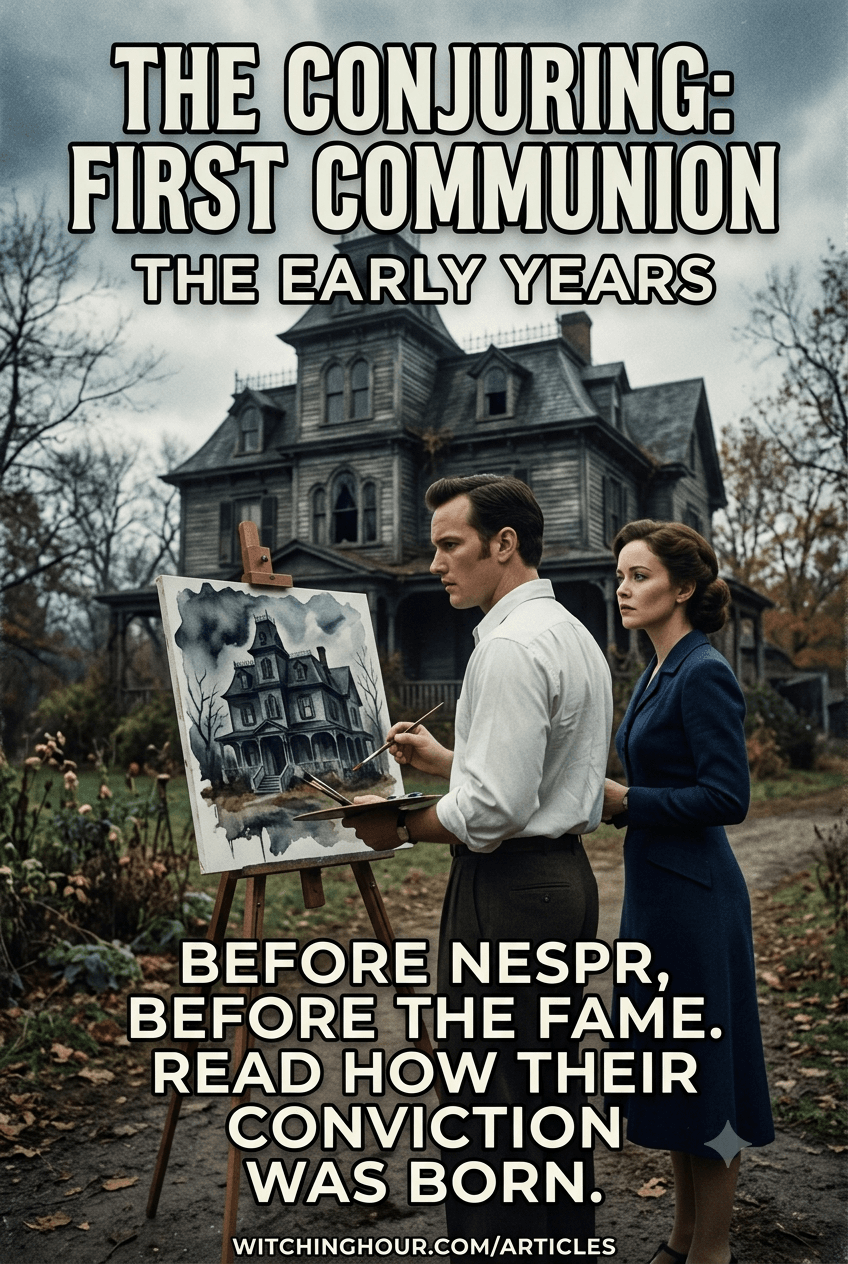
Ed Warren was discharged from the Navy after World War II and returned to Monroe, Connecticut with Lorraine, whom he had married in 1945 when she was eighteen. He had always been interested in the supernatural — his childhood home in Bridgeport, he would later claim, was haunted. He began investigating local houses, accompanying Lorraine, who described herself as a clairvoyant and light trance medium. He painted in those early years: watercolor studies of allegedly haunted New England homes, which he and Lorraine sold door-to-door to the families in those houses.
That last detail matters more than it sounds. The revenue model from the beginning was the haunting itself. They would identify a house, investigate, and then sell the painting back to the family who lived there. Ed Warren discussed this in interviews. He was proud of it. He described it as a way of supporting the work.
What the work produced during those years — case files, client correspondence, independent witness accounts, any documentation generated outside the Warrens themselves — is substantially absent from the public record. The New England Society for Psychic Research, the institutional home of the Warren archive, was not founded until 1952. Everything before that date exists primarily in what the Warrens themselves said happened.
I’ve examined the evidentiary record against the Warrens at length in this space. The specific problem with the pre-NESPR period is distinct from the fraud question: it is the absence of any external record at all. There are no surviving case files from 1947 to 1952 that have been independently examined. There are no client testimonies from that period collected at the time. There is the archive, controlled by Tony Spera, the Warrens’ son-in-law, which has never been made available for independent scholarly review.
This is what First Communion is being asked to dramatize: a period of the Warren story that exists almost entirely inside the Warren story.
What Made Ed and Lorraine Warren Believe: The Architecture of Conviction
I want to be precise about what I find genuinely interesting here, because it is the question of conviction rather than the question of fraud.
Ed Warren was not performing belief. The people who knew him and worked alongside him have consistently described a man who was constitutionally incapable of doubt about the supernatural. He investigated because he already knew. The knowing came first. The investigation was confirmation.
There is a specific architecture to this kind of certainty, and it is the architecture of a closed epistemic system — one where everything that enters gets processed through a framework that confirms the premise, and nothing from outside can enter on its own terms. I find this uncomfortable to sit with, because I know what it produces. I’ve watched it in other contexts. A man who has examined the evidence and concluded is a different creature from a man for whom the conclusion is the evidence. Ed Warren, by every account, was the second kind.
Lorraine Warren’s response to skeptics was always a variation of the same thing. What she said, across decades of interviews, was: “They don’t base anything on a God.” The implication was that skepticism was itself a form of spiritual blindness — that people who couldn’t confirm what she and Ed experienced were missing the prerequisite for perceiving it. This is theologically coherent, as a position. It is also completely unfalsifiable. An epistemic system that defines its critics as categorically unable to see is a system that cannot, by its own design, be wrong.
The distinction between this and fraud matters, and I want to be clear about it. Fraud requires the fraudster to know the truth and conceal it. What the Warrens appear to have been doing was something more human and more frightening: they built a world in which their truth and their perception of truth were the same thing. When Ed Warren told a family their house was haunted, he believed it. When Lorraine said she felt a demonic presence, she felt something. The question of whether what they felt corresponded to anything outside themselves is the question the franchise has spent twelve years refusing to ask.
First Communion is set in the years when that system was being built. When Ed was twenty-two and Lorraine was twenty-one and they were driving through Connecticut with no institutional backing and complete conviction, selling paintings of haunted houses to the families who lived in them. The period when two people decided together what they were seeing — and then spent the next sixty years seeing it.
That is the film I want Huart to make.
What The Conjuring: First Communion Needs to Reckon With
The Conjuring universe has a structural problem that a prequel either solves or deepens. Every film in the franchise is narrated from the position that the Warrens were right. The demons are real. The possessions happen. The houses are haunted. Genre logic requires this — you cannot make a haunted house film and withhold the haunting — but the cost is that the Warrens’ certainty is never examined. It is simply confirmed by events.
A film set in the founding years of that certainty could do something different. It could show us conviction forming in real time: two young people in postwar Connecticut encountering families who are frightened and suffering and looking for an explanation, and two people who have an explanation to offer. It could ask what it means to make that offer in good faith, before you know the scale of what you are beginning. It could attempt something the franchise has never attempted — letting the Warren certainty be sincere and worth questioning simultaneously, inside a system that was making doubt structurally impossible.
The Conjuring franchise has not historically been capable of this kind of moral complexity. The Warrens in these films are genre instruments — they arrive, they investigate, they confirm, they face the darkness and survive it. What they cost the families they worked with, what they cost cases that got distorted in the retelling, what they cost the public understanding of mental illness and grief and fear in the decades they spent on the lecture circuit — this has never been the franchise’s concern.
Whether Huart is making that film, or another mythology delivery mechanism with better photography, is what September 10, 2027 will answer.
I never went back to Don’t Look Now.
I promised myself I would, once I was in better condition. That was 2009. I am in considerably better condition now. The film is available on three streaming services. I have never pressed play.
I think I understand the Warrens better for not having done it. There is a kind of knowledge that arrives through grief-sharpened attention — pattern recognition running at full speed in exactly the wrong direction — that cannot be examined from inside. You can only see its architecture clearly from outside, looking back at what you were certain about and asking how certain you actually were.
Ed Warren never got outside it. By all accounts he didn’t want to. He built an institution, a methodology, an archive, a family legacy all predicated on the certainty being permanent. He died in 2006 still absolutely sure.
I’ll watch The Conjuring: First Communion when it comes out in September 2027. I’ll bring the same attention I bring to everything they’ve built — the same attention I brought to the case files and the debunked claims and the archive that nobody outside the family has reviewed. I’ll watch Huart’s version of the young Warrens driving through Connecticut in 1948 with no institutional backing and complete conviction, selling paintings of haunted houses door-to-door, and I’ll try to hold both things at once: the sincerity and the cost of the sincerity, the belief and what the belief cost the people who were inside it.
I’m still not going back to Don’t Look Now. Some things you understand better by not returning to them. A door. Ed Warren at twenty with a canvas under his arm, about to knock. Lorraine beside him.
Frequently Asked Questions About The Conjuring: First Communion
What is The Conjuring: First Communion about?
The Conjuring: First Communion is a prequel in the Conjuring universe set in the early years of Ed and Lorraine Warren’s paranormal investigation career — the period before the New England Society for Psychic Research was established in 1952. Directed by Raphael Huart, it releases September 10, 2027.
What did Ed and Lorraine Warren actually do in their early years?
Ed and Lorraine Warren began investigating allegedly haunted homes in Connecticut in the late 1940s after Ed’s Navy discharge. They supported themselves by selling watercolor paintings of the houses they investigated. No independent case files from this period have been made publicly available; the archive, controlled by their son-in-law Tony Spera, has not been examined by outside researchers.
Is The Conjuring: First Communion based on a true story?
Like the previous Conjuring films, First Communion will be based on the Warrens’ accounts of their own experiences. The early Warren cases — predating the founding of NESPR in 1952 — exist almost entirely in the Warrens’ own testimony. No independent records from that period have been verified or made available for independent review.