
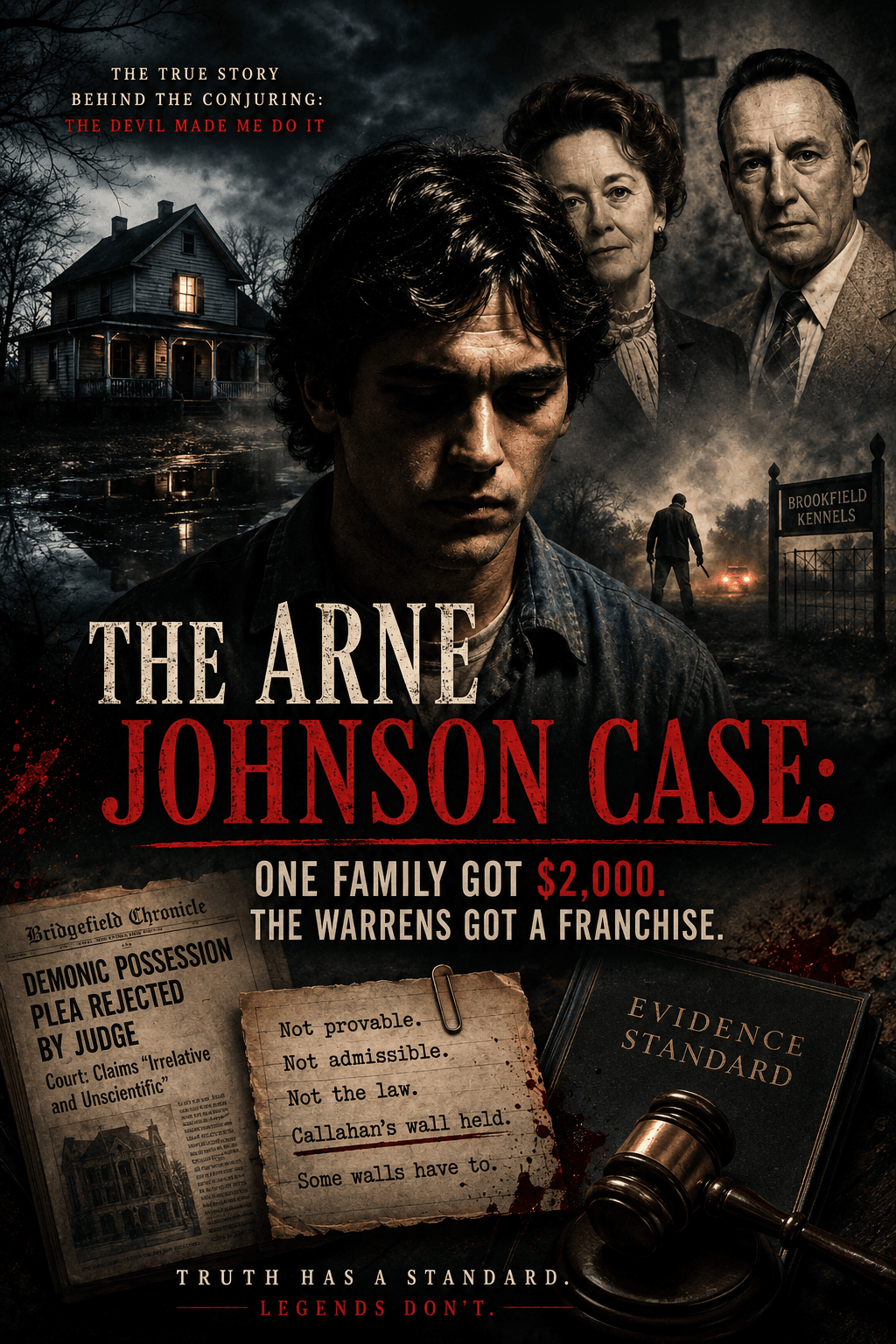
The Arne Johnson Case: One Family Got $2,000. The Warrens Got a Franchise.
Arne Johnson is the defendant in the only murder case in American legal history where a defense attorney tried to plead demonic possession — and that case became The Conjuring: The Devil Made Me Do It. Judge Robert Callahan rejected the defense the same day it was proposed. Understanding why requires understanding what a standard actually is.
René Chabot worked construction with Walter for most of the 1980s — framing and foundation work across rural Ohio, until Walter moved to a different site and their paths stopped crossing. They stayed in touch the way men who’ve worked together stay in touch: occasionally, briefly, with the comfortable shorthand of shared physical labor. I met him at a diner in Columbus about eight months after my father died. He was sixty-something, French-Canadian, came south for work in the seventies and never left. The kind of hands that look like they’ve carried weight for thirty years. They had.
I’d been thinking about Walter’s inflexibility. The rigidity that, when I was a teenager, read as stubbornness — and later, as a kind of honesty I hadn’t understood yet. I mentioned this to René. He nodded the way someone nods when they’re deciding how much to say.
“He wasn’t always wise about it,” René said. Then he told me about the wall.
Walter had given his crew specific instructions on how to frame a load-bearing wall. They did it wrong. He had them tear it down and redo it. They did it wrong again. The second time, Walter picked up a sledgehammer and took the wall apart himself, in the middle of the workday, in front of everyone. Nobody said anything. The third attempt was perfect. “After that,” René said, “they just did it right.”
He paused. “Was it necessary? Maybe. Was it wise? That’s a different question.”
I’ve thought about that distinction ever since. Necessary and wise. Whether they’re the same thing depends entirely on what you’re measuring against.
Judge Robert Callahan understood this.
What Actually Happened in Brookfield, Connecticut in 1980
In the summer of 1980, an eleven-year-old named David Glatzel began exhibiting disturbing behavior in a rental house in Brookfield, Connecticut. He said he saw an old man at the foot of his bed. The visions worsened. He began growling, speaking in different voices, reciting passages from scripture and from Paradise Lost. He convulsed. He told his family he was being beaten by something invisible, and members of the family said they could see the marks on his body.
The Glatzels called Ed and Lorraine Warren.
Ed Warren assessed the situation and concluded David was possessed by forty-three demons. Lorraine confirmed it through her clairvoyance. Three “lesser exorcisms” were performed. Lorraine later stated that six priests participated and that all of them agreed David was possessed. These are the Warrens’ claims. No independent clergy confirmed this on record at the time.
During the exorcisms, a nineteen-year-old named Arne Cheyenne Johnson was present. He was engaged to Debbie Glatzel, David’s older sister. At some point during the proceedings — according to accounts constructed after the fact — Johnson challenged whatever was in David. Told it to come to him instead. What actually happened in that room, outside of what interested parties later said happened, is not recoverable. What is documented is that Johnson began exhibiting behavior similar to David’s: trance states, growling, episodes he later claimed to have no memory of.
On February 16, 1981, Johnson stabbed his landlord, Alan Bono, outside a dog kennel facility in Brookfield. Bono was forty years old. He had been drinking. A dispute had broken out — Bono had grabbed a young girl named Mary and was refusing to let go. Johnson pulled a pocket knife and stabbed Bono multiple times. Bono died on the floor of the kennel. Johnson was arrested about two miles away, an hour later. He told police he remembered nothing.
Alan Bono was forty years old. He had a job and a life and people who knew him. He is the person in this story most often named only as context.
How Ed and Lorraine Warren Used the Arne Johnson Case
Before Johnson’s trial had concluded, the apparatus was already moving.
Ed and Lorraine Warren began giving interviews about the case. They described it as the first time demonic possession had been raised as a murder defense in American legal history — which was accurate. They presented it as evidence of a genuine supernatural event: a boy possessed, a young man who absorbed the demons, a murder the Warrens framed as something beyond Johnson’s full control. The lecture circuit incorporated the case immediately. It was too useful not to use.
Johnson’s defense attorney, Martin Minnella, entered a formal plea of not guilty by reason of demonic possession. He cited two British cases that had permitted similar testimony. Judge Robert Callahan rejected the defense in its entirety. His reasoning was direct: such assertions could not be scientifically or objectively proven by evidence. He called the proposed testimony “irrelative and unscientific.” The jury was never permitted to consider possession as an explanation for Bono’s death. The defense pivoted to self-defense. On November 24, 1981, Arne Cheyenne Johnson was convicted of first-degree manslaughter and sentenced to ten to twenty years. He served five.
In 1983, Gerard Brittle published The Devil in Connecticut, with the Warrens’ collaboration, presenting the Glatzel possession as documented fact. The Glatzel family shared in the proceeds. Their share was two thousand dollars. The Warrens continued lecturing about the case at colleges and universities for years afterward. It became a fixture of their circuit — the case where the defense tried to put the devil on trial.
In 2006, when the book was being prepared for reprint, Carl Glatzel Jr. and David Glatzel sued Lorraine Warren, Brittle, and the publisher for invasion of privacy and libel. Carl’s position was unambiguous: the possession narrative was constructed to exploit a family in crisis, specifically to commercialize his brother’s mental illness. He alleged that their mother had been giving the children Sominex — a sleeping aid that in sufficient doses causes hallucinations and psychotic episodes in children — and that David was suffering from a treatable medical condition throughout. The Warrens, Carl argued, arrived and gave that condition a different name.
Whether Carl’s account is verifiable in a legal sense is a separate question from whether it matters as a moral one. A child drugged into hallucinations and a child experiencing something genuinely unexplained both deserved the same response: someone who investigated what was medically happening before reaching for an exorcism. The Warrens arrived instead, and what they offered was a complete explanation that required no medical investigation — because demonic possession, by definition, is a question medicine is not permitted to answer.
The suit was dismissed. The book was taken out of print regardless.
Why Judge Callahan Rejected the Demonic Possession Defense
Callahan stated the standard and applied it: evidence, objective proof, scientific verifiability. The demonic possession defense failed that standard immediately, completely, and without appeal.
The inflexibility here was necessary. It was also, in the way René was trying to articulate about Walter, wise — because the standard Callahan was applying was external. It existed independently of what anyone in that courtroom believed, wanted, or needed. The rules of evidence do not defer to the conviction of the people presenting testimony. They require that testimony correspond to something that can be examined.
The Warrens had testimony that confirmed their own prior certainty. Across their entire career, every piece of evidence they produced existed inside the framework that generated it — available only to those who had already accepted the premise. Callahan applied his wall test. The defense didn’t pass it. He built it right and it held.
Arne Johnson was convicted of what he did, not of what the Warrens needed him to represent.
What Happened to David Glatzel and the Glatzel Family
David Glatzel is in his fifties now. He appeared in the 2023 Netflix documentary The Devil on Trial, in which members of his family offer contradictory accounts of what happened in 1980. David says there are gaps, blackouts. He doesn’t remember everything. What he does remember, he says, is being possessed.
He still believes it.
That sentence requires more careful reading than it usually gets. It is the specific shape of what happens when a crisis is named for you by people who need it to mean something. The Warrens gave David Glatzel a complete, internally coherent explanation for the worst period of his life: a villain (the demon), a mechanism (the possession), a resolution (the exorcism), a meaning (in the Warren telling, Johnson had volunteered to take the demon so that David could be free). This framework holds together. There is no procedure for auditing your own possession. The thing experienced at eleven years old has one name now, and that name was given by people who needed it to mean something specific. The framework predates the memory.
Carl Glatzel received nothing from the framework except a brother who cannot fully account for what happened to him and decades spent arguing that his family was used. The lawsuit gave him nothing legally. The book went out of print. The franchise is still being built, one prequel at a time, on cases the Warrens named.
Necessary. Wise.
René didn’t finish his coffee that morning. He had a job to get to.
Before he left, he went back to the wall. He said Walter had been right about the wall — structurally, the framing had to be exact or the whole thing was wrong. But René thought Walter had been wrong about the method. Walter had assumed the lesson generalized. That the force of his certainty was what the crew needed to carry forward. The wall needed the standard. The certainty was something else entirely.
“The wall had to be right,” René said. “That part was not flexible.”
Judge Callahan had a standard. The rules of evidence exist precisely because human certainty is not self-validating — because the force of a belief is not evidence for the truth of what’s believed. He applied his standard without apology, and it held.
The Warrens had the sledgehammer. What they brought to every case, every family, every room with a frightened child in it, was the force of their conviction — and that conviction was its own measuring instrument. The sledgehammer came down on the Glatzel family. A man named Alan Bono died on the floor of a dog kennel. A child named David was given a name for his suffering in a language he has never been able to leave. And the Warrens drove home to Monroe, Connecticut with one more case that confirmed everything they already knew.
Necessary and wise.
The Arne Johnson case is the one moment in the Warren career when those two things were separated by someone with the authority to enforce the distinction. Callahan did it in a courtroom in Danbury in 1981, in a matter of minutes, with no ceremony. The Warrens went on for twenty-five more years. David Glatzel is still inside the explanation they gave him.
Callahan’s wall held. Some walls have to.
Frequently Asked Questions About the Arne Johnson Case
Was Arne Johnson really possessed by a demon?
Arne Johnson claimed demonic possession as his murder defense for killing Alan Bono in 1981. Judge Robert Callahan rejected the defense as “irrelative and unscientific,” ruling it could not be proven by objective evidence. Johnson was convicted of first-degree manslaughter and served five years of a ten-to-twenty-year sentence. No court has ever validated the possession claim.
What happened to David Glatzel?
David Glatzel, whose alleged possession preceded the Johnson murder case, appeared in the 2023 Netflix documentary The Devil on Trial and states he still believes he was possessed. His brother Carl has consistently maintained David suffered from a treatable mental illness that the Warrens exploited for profit. David is now in his fifties and lives privately.
Is The Conjuring: The Devil Made Me Do It based on a true story?
It is based on the Warrens’ account of the 1981 Arne Johnson case. The real case differs substantially: the demonic possession defense was rejected outright by the trial judge, the Glatzel family later sued Lorraine Warren alleging the possession narrative was fabricated to exploit David’s mental illness, and Alan Bono’s death occurred during an altercation over a young girl being grabbed by a drunk man.