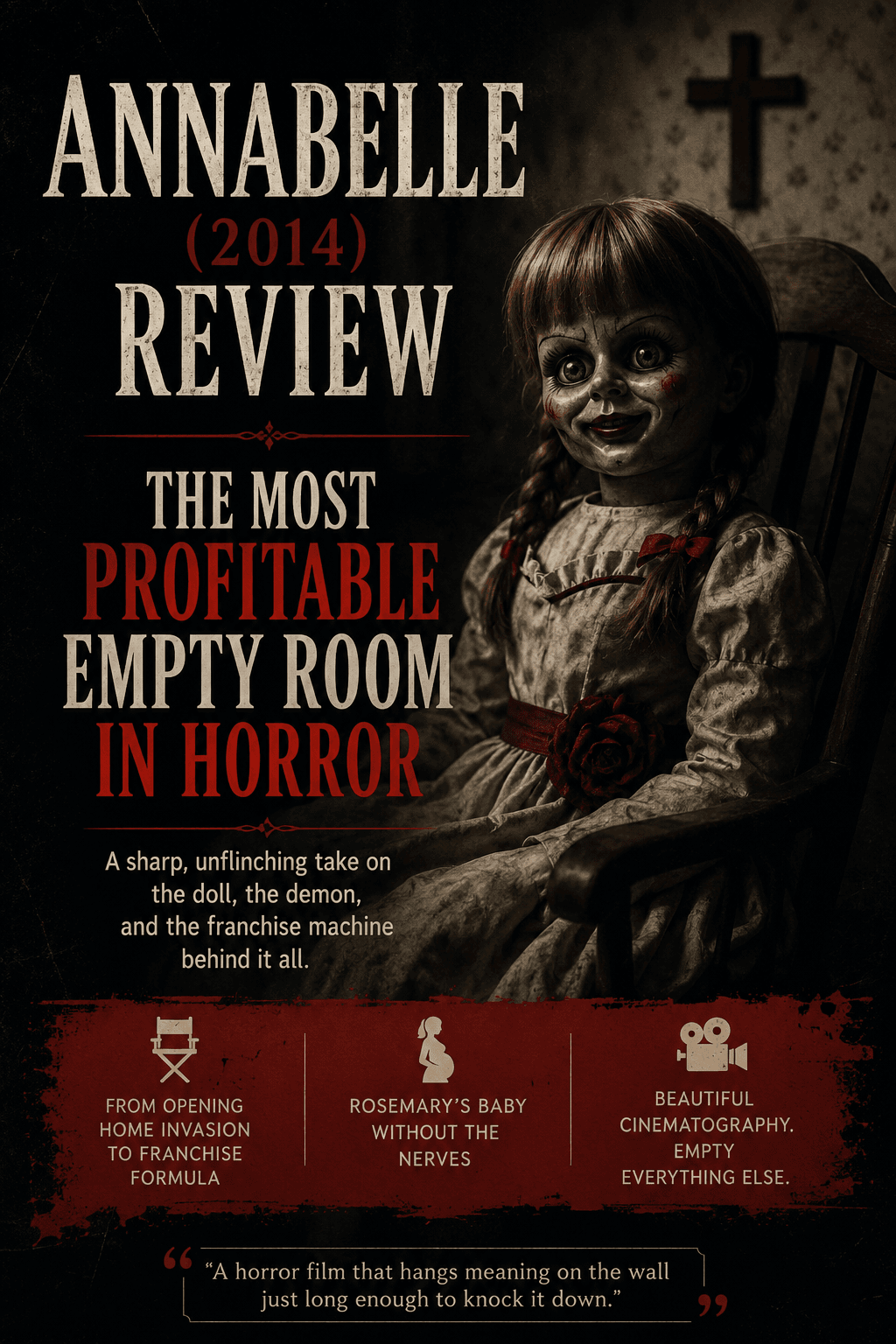
Annabelle (2014) Review: The Most Profitable Empty Room in Horror
Years ago I spent an afternoon in interior Texas with a Catholic priest who was doing the work a psychiatrist would have done, in a town that had no psychiatrist. He was clear-eyed about the arrangement — clear about the people he hadn’t been able to reach, the ones faith couldn’t hold, the ones who needed medicine he had no license to hand out. What stayed with me is how precisely he knew the borders of what he could give, and how honestly he named the places he came up short. He understood he was simply what that town had. I think about him more than I’d have guessed, and I thought about him, of all places, during Annabelle (2014), while the film used a priest the way a set decorator uses a crucifix: a thing you hang on the wall to announce we’ve entered the territory of the sacred, right before knocking it down for the next stinger.
That’s the whole machine. John R. Leonetti’s Annabelle (2014) — the first spin-off of James Wan’s Conjuring universe, built around the doll that stole the prologue of The Conjuring — hangs things on the wall. A demon, a cult, a pregnant woman, a doctor husband, a Black neighbor with a dead daughter, a priest. Each one arrives pre-loaded with meaning borrowed from a better film, gets used for exactly one scare or one plot turn, and is set back down. The movie never asks what any of it means, because asking would slow the delivery, and delivery is the only thing it was built to do.
Any honest Annabelle (2014) review has to start with what works, because there is something here, and pretending otherwise would make me a liar. The opening home-invasion sequence works. Two cult members — the murdered neighbors’ estranged daughter and her boyfriend — come through the wall into a young couple’s house in the dark, and the violence is fast and ugly and upsetting in the way home-invasion horror is upsetting: it could be your street, your door, your unlocked house in a year when the news was full of Manson. The whispered line as the woman stands over the doll collection — “I like your dolls” — does more in five words than the next ninety minutes manage with a full demon. For about eight minutes, this is a real horror film made by people who understood what The Strangers understood. Then the cult dies, a drop of blood slides into the doll’s eye, and the film remembers it has a franchise to feed.
What Annabelle (2014) Takes From Rosemary’s Baby
Here’s my position, stated where it belongs, early: Annabelle (2014) is the skeleton of Rosemary’s Baby with the nervous system removed. Pregnant woman, isolating apartment, satanic conspiracy circling her unborn child, a husband too absorbed in his own ambition to believe her, a world of authority figures — doctors, priests, detectives — who keep telling her she’s tired, she’s hormonal, she’s imagining it. Polanski built an entire architecture of psychological dread out of those exact pieces, because he understood the horror was never the devil. The horror was a woman watching everyone she trusted decide, gently and reasonably, that her own perception couldn’t be trusted. Annabelle has every one of those pieces sitting on the table. It picks them up, looks at them, and uses them to make a doll move when nobody’s watching.
The Cinematography and Joseph Bishara’s Score
The doll is well-designed, I’ll grant that. Making her porcelain and Victorian instead of the soft Raggedy Ann of the real Warren case was pure marketing, and it was correct marketing — she photographs like a threat. The cinematography by James Kniest is the one department working above the floor. There’s a composition the film returns to that’s genuinely good: a static frame, focus held tight on Mia or the baby in the foreground, a doorway or a length of hallway open and unattended in the deep background, so your eye keeps drifting to the dark edge of the frame waiting for something to fill it. That’s negative space used as a weapon, the camera trusting the audience to scare itself. When Annabelle (2014) lets the technique breathe, it earns its unease. The trouble is it won’t trust the technique for more than a few seconds before Joseph Bishara’s score detonates, a thing lunges, and the dread you’d built gets cashed out for a flinch.
Bishara is worth naming, because he’s a genuinely interesting composer doing reliable work for people who only want the reliable part. He scored Insidious and The Conjuring, and — in a detail I find more telling than anything in the script — he plays the demon here too, uncredited, the way he wears the makeup in those other films. The man writes the dread and then becomes it. His cues are all extended dissonance, prepared piano, strings bowed wrong on purpose, and they work the way a defibrillator works: a jolt, a spike, a body reacting before the mind catches up. That’s a fine tool inside a film with a pulse of its own. Here it does all the cardiac work alone, manufacturing startle on a schedule because the movie has nothing slower or quieter underneath it.
A Conjuring Spin-Off Built as a Business Plan
It helps to know who made this and why. Leonetti spent his career as a cinematographer — he shot The Conjuring, he shot Insidious, and, in a piece of cosmic comedy nobody planned, he shot Child’s Play 3. The man has now lit two of the most famous killer dolls in American film. Wan, who actually directs, stepped up to producer and handed Leonetti the camera and a guaranteed audience. Warner Bros. and New Line had landed on a strategy they were refreshingly blunt about in the trade press: take a beloved element from a hit, spin it off on a tiny budget and a fast schedule, collect on the back end. The film cost six and a half million dollars. It grossed over two hundred and fifty-seven million. As a film it’s a hollow thing. As a business instrument it’s one of the most efficient horror productions of the decade, and I genuinely can’t decide whether the people who greenlit it should be ashamed or studied.
What keeps it competent and stops it short of good — and I’ll remind you I don’t even think The Conjuring is a masterpiece, just a well-built haunted house — is that nobody on the writing side did the work to make the borrowed pieces matter. Mia is a function the plot needs filled: she sews, she frets, she’s pregnant, she gets terrorized, and Annabelle Wallis plays her with the competence of an actor who has read the assignment and understood there’s nothing under it to find. She’d go on to Malignant, where Wan finally gave her something demented to play. Ward Horton’s John is the dismissive husband-doctor lifted straight from Guy Woodhouse — except where Cassavetes made you feel the cold transaction under Guy’s charm, John is a man who happens to be at the hospital when the scary things happen and skeptical when he gets home. Rosemary’s Baby made that disbelief the engine of its horror. This film needs him absent and doubting so the haunting has room to operate, so he’s absent and doubting. There’s a slot, and an actor standing in it.
The Ending — Evelyn’s Sacrifice and Father Perez
The exception — the person who walks into this product and behaves as if she’s in a real movie — is Alfre Woodard. She plays Evelyn, the bookstore owner who lays out the demon’s rules for Mia and carries the only grief in the film with any weight under it: a daughter, Ruby, dead in a car accident Evelyn caused, a guilt she’s been carrying toward some reckoning. Woodard is too good for this. She gives the role a lived-in sorrow the screenplay never wrote, importing it from her own toolkit because the page didn’t supply it. And then the film does the thing that turns my respect for the performance into something colder.
Because the demon wants a soul. That’s the cosmology Annabelle settles on — a transaction, a contract, a vending machine that takes a life and dispenses a baby. When the bill comes due, the film sets up the obvious candidate. A priest has spent the movie as the designated man of God; surely the man who’s given his life to resisting the devil is the one who pays. The film lets you believe it for a beat. Then it throws Father Perez across his own church, injures him, lets the demon snatch the doll out of his hands, and quietly takes him off the board. He survives, dazed and useless, his faith reduced by the screenplay to the decorative crucifix from the opening — hung up to signal the sacred and asked to do nothing. The soul the contract demands gets paid by Evelyn, who takes the doll out a high window above the street so the young, photogenic, churchgoing family can keep their baby and their lives — the cult mechanics behind that transaction get a closer look in Annabelle Hidden Details.
The sacrifice is where the film’s emptiness curdles into something worse than empty. It takes the one character it bothered to give an interior life — the only person of color in the production — and spends her like a poker chip to spare its leads, a sacrifice the script manufactures and never earns. Critics clocked the optics at the time, and the optics are bad. The deeper problem is structural: a story that treats a person as a transaction has quietly told you it doesn’t believe people are worth more than transactions. Rosemary’s Baby understood that the cult’s whole horror was that it saw Rosemary as a vessel. Annabelle adopts the cult’s accounting as its own emotional logic and never notices it’s done so.
The priest I sat with in Texas knew the borders of what he could give, and he was honest, to the point of discomfort, about every place his faith ran out. That honesty about his own limits was the most genuinely religious thing about him. Father Perez gets handed the opposite arc and means nothing by it — set up as sufficient, revealed as insufficient, dusted off, walked back into the final scene as if the film had reckoned with the limits of faith, when the film never thought about faith for a second. The priest was set dressing. So were the crosses, the demon, the cult, the dead daughter, the unborn soul — props arranged around a doll the studio already knew how to merchandise.
Annabelle (2014) Review: The Verdict
If you want the honest bottom line from this Annabelle (2014) review: it’s watchable, occasionally effective, and completely hollow. Critics landed in roughly the same place on release — the Rotten Tomatoes consensus pegs it as a film that borrows from better horror for a string of cheap jolts, and that’s about right.
That’s the residue Annabelle leaves once the stingers stop ringing in your ears — a flat, administrative emptiness, the feeling of having watched a very capable crew, a real cinematographer, a serious composer, and an actress who deserved better build a haunted room with great precision and then film a doll sitting in it for the camera. The last shot resets the doll into a thrift store for the next family, the next picture, the next quarter’s earnings, and a closing card assures you the real thing sits behind glass in the Warrens’ own museum, blessed twice a month. The machine simply restocks and rolls on.
The priest in Texas could have told them. Sometimes what’s available isn’t the thing you actually need — and he’d have said it plainly, and meant it, and known exactly where it fell short. Annabelle hangs the line on the wall and moves on to the jump.
Ethan’s Score: 4.5 / 10 — One genuinely strong opening, one cinematographer earning his check, one actress slumming with dignity, bolted to a hollow,