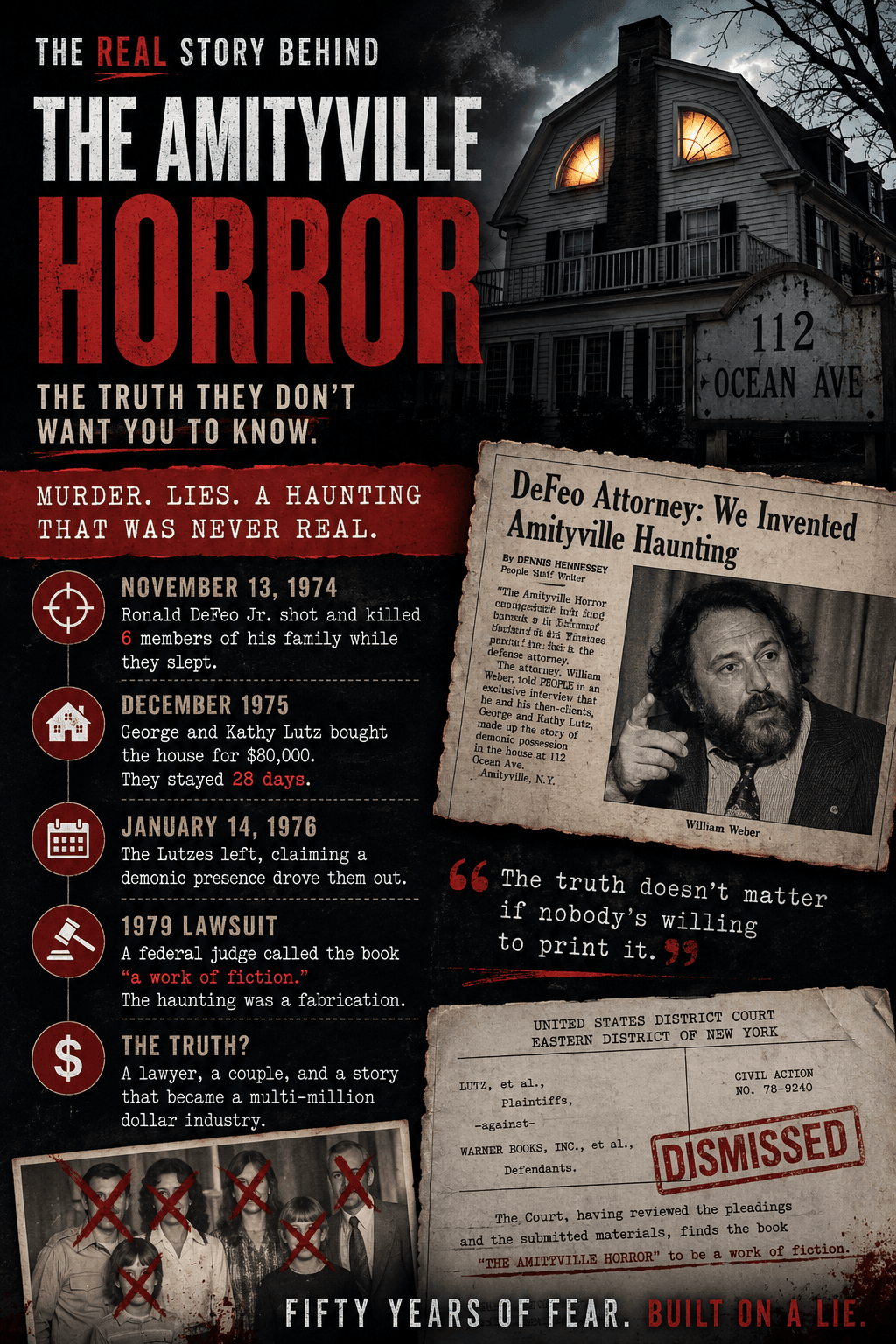
A source once told him, during an investigation that went nowhere for reasons he still finds infuriating: “The truth doesn’t matter if nobody’s willing to print it.” He thinks about that sentence at least once a week. He thought about it again reading the transcript of a 1979 lawsuit dismissal, a judge’s dry legal language doing the work that no headline ever did: confirming, on the record, under oath, that the most famous haunted house in America was a manufactured product built by two people and a lawyer who needed money.Here is the Amityville Horror true story that the industry around this house has spent fifty years avoiding: on November 13, 1974, Ronald DeFeo Jr. shot six members of his own family to death in their home at 112 Ocean Avenue, Amityville, New York, using a .35 caliber Marlin 336C rifle. Just over a year later, George and Kathy Lutz bought that house for $80,000, moved in, stayed twenty-eight days, and left claiming a demonic presence had driven them out. In 1979, DeFeo’s own defense attorney told People magazine he had helped invent the haunting with the Lutzes over wine.A federal judge later called the underlying book a work of fiction. None of this stopped the franchise. It is still running.
The DeFeo Murders: Where the Amityville Horror True Story Begins
Start with the six people the ghost story buried. Ronald DeFeo Sr., forty-three. Louise DeFeo, forty-three. Dawn, eighteen. Allison, thirteen. Marc, twelve. John, nine. All shot in their beds around three in the morning, the parents twice each, the children once. Their son and brother confessed the next day after a day of blaming a mob hitman named Louis Falini, a lie he abandoned only once police found holes in it he couldn’t patch. His own words about the killing, preserved in the trial record: “Once I started, I just couldn’t stop.It went so fast.” He stood trial in October 1975, was convicted on six counts of second-degree murder that November, and was sentenced the following month to six consecutive terms of twenty-five years to life.The DeFeo family had lived in that house since 1965, a decade before any of it happened. At trial, DeFeo’s lawyers argued insanity; the prosecution countered with antisocial personality disorder, and the jury sided with the prosecution. He told investigators during interrogation that he’d drugged his family before the shootings, a claim police could never substantiate — no sedatives turned up in the autopsies.It is worth sitting with that detail for a second, because it is characteristic of everything that follows in this case: a man offering an account of his own actions that made him sound more calculating, more in control, more like the subject of a story, than the physical evidence actually supported. He was already narrating himself into a legend before anyone else got the chance.He spent the next forty-five years finding new ways to lie about what he did, and the industry that grew up around his house never had much use for that part of the story, because a killer who keeps changing his account isn’t nearly as marketable as a house that’s evil on its own. In 1986 he told a Newsday reporter that his sister Dawn had killed their father, that their mother had killed the younger children, and that he had killed only his mother.He claimed an alibi witness, a man named Richard Romondoe, who investigators eventually established never existed. In 1990 he filed a motion insisting Dawn and an unnamed accomplice had killed his parents and that he’d shot his sister by accident during a struggle over the rifle. He named the same fictitious witness again. In a 2000 interview with author Ric Osuna he offered yet another version: himself, Dawn, and two friends, acting together “out of desperation.” Every account moved the guilt around. None of them held up.He died in an Albany hospital on March 12, 2021, sixty-nine years old, and the cause of death was never made public. Six people are dead because of a decision he alone made and then spent a lifetime trying to rewrite, and his name is a footnote in most retellings of a story about the house he grew up in.
The Lutz Family’s Twenty-Eight Days on Ocean Avenue
The Lutzes bought that house in December 1975, a little over a year after the murders, for a price that reflected exactly what had happened there. They moved in December 18. By January 14 they were gone, twenty-eight days later, describing green slime on the walls, swarms of flies in winter, a demonic pig-faced figure watching from a window, and finally a last night so frightening they refused to give investigators a full account of it.A friend told Newsday at the time that the real reason they left was simpler: the heating system had failed and they couldn’t afford to fix it.George and Kathy Lutz had married that July, five months before the purchase. Kathy brought three children into the marriage from a previous relationship — Daniel, nine; Christopher, seven; Melissa, five — along with a dog, a Malamute-Labrador mix named Harry, who reportedly showed no reaction to any of it. That detail rarely survives into retellings, because a family this ordinary is harder to sell than a family under siege by something ancient.Even the book’s own internal chronology couldn’t keep its story straight: the closing paperwork puts the purchase on December 23, but the prologue Anson wrote has the family already moving in on that same date, when other records place the actual move-in five days earlier. A minor discrepancy, on its own. The kind of thing you only notice when you’re checking a “true story” against a calendar instead of taking it on faith, which nobody with a printing deadline had much incentive to do.
The Warren Investigation and the House on Ocean Avenue
Before any of this reached a publisher, a local news crew brought in Ed and Lorraine Warren, who investigated the house on camera not long after the Lutzes fled.George Lutz wouldn’t go inside with them; by most retellings he handed over the keys and waited at a pizzeria nearby while Ed Warren went into the basement alone and came back up describing, in an account that’s followed him ever since, pressure forcing him downward, “hundreds of pinpoints of electricity,” and a sensation he summarized as “I couldn’t breathe.” The Warrens concluded the house was under the influence of diabolical forces — a verdict that fits a much longer pattern this site has examined in full, looking at whether
the Warrens themselves were saviors or frauds.What matters here is narrower: an outside investigator arrived, performed a reading, and left behind a claim nobody with the house’s actual paperwork ever had to test, because the paperwork wasn’t public yet.One of the house’s later owners eventually had the street address changed, from 112 to 108 Ocean Avenue.
How Jay Anson’s Book Became The Amityville Horror
What happened next is the part that should have been the story, if anyone with a platform had been willing to run it as the lead instead of the footnote. A Prentice Hall editor named Tam Mossman connected the Lutzes with a writer named Jay Anson, who never worked with them directly. He built the manuscript from roughly forty-five hours of tape-recorded recollections the couple submitted, and titled it after H.P. Lovecraft’s “The Dunwich Horror.”Before the book was even published, the Lutzes had already filed suit seeking $4.5 million in damages over the story’s exploitation, a detail that tells you what the project was for well before a single reader picked it up. It sold something like ten million copies across its editions and was marketed, consistently, as a true story.
William Weber’s Amityville Horror Hoax Confession
Then the lawyer talked. William Weber had defended Ronald DeFeo Jr. at trial in 1975. Four years later, in the September 17, 1979 issue of People magazine, he described exactly how the haunting narrative came together: “I know this book is a hoax. We created this horror story over many bottles of wine.” He wasn’t a stranger to the deal — he later sued the Lutzes himself for two million dollars, claiming they’d cut him out of a book contract he’d helped engineer.The federal judge overseeing the related civil case, Jack B. Weinstein, put the arrangement in language that should have ended the franchise on the spot: “There is a very serious ethical question when lawyers become literary agents.” He dismissed the Lutzes’ remaining claims against Weber and others in September 1979 and, in doing so, put the Amityville Horror true story into the judicial record as exactly that — fiction.That original 1977 suit is worth naming in full, because the guest list tells you how many hands were already in this before a single reader had opened the book. The Lutzes sued Weber, a man named Paul Hoffman, two self-described clairvoyants, Bernard Burton and Frederick Mars, plus Good Housekeeping, the New York Sunday News, and the Hearst Corporation, all for supposedly misappropriating their story and invading their privacy. The claims against the media companies were quietly dropped before trial.What remained in court was Weber and the Lutzes, both sides of the same manufactured product, arguing over who owned it.
The Lawsuits That Confirmed the Amityville Horror True Story
The confirmation kept coming, and kept changing nothing. When the house’s next owners, the Cromartys, sued Anson, his publisher, and the Lutzes over the disruption tourists and treasure hunters had brought to their front lawn, the trial produced sworn admissions — according to Skeptical Inquirer’s account of the proceedings — that virtually everything in the book was invented. A journalist tried to print the truth. A lawyer confirmed it in a national magazine. A federal judge ruled on it. Another set of homeowners forced it into a second sworn record.Four separate confirmations, four separate mechanisms, inside four years — and the culture absorbed every one of them without consequence, because the fiction had already found its audience, and the audience had no interest in a correction.
The Film, the Franchise, and the Lutzes’ Deaths
The 1979 film, with James Brolin and Margot Kidder standing in for the Lutzes and Rod Steiger as a fictionalized priest, made more than eighty million dollars. It spawned sequels, remakes, and a low-budget franchise that has by now produced more than twenty films trading on the name alone, according to multiple industry tallies, most with no connection to the house, the family, or the case, because at some point the brand detached itself entirely from the specific lie that built it. Later owners of the real house reported nothing unusual. The heating system got fixed.The story never needed the house to keep working; it only needed the name.George Lutz sued again in 2005, this time over a remake he claimed misrepresented him, alleging breach of contract, defamation, and libel. The defamation claim was thrown out that November. He and Kathy had divorced in the late 1980s but stayed on decent terms afterward, according to people who knew them, two people who built an entire second act of their lives on a story neither of them ever had to defend under oath the way Weber eventually did. Kathy died in August 2004 of emphysema. George followed in May 2006, of heart disease.Neither of them, in the years between the book’s publication and their deaths, is on record issuing anything resembling the retraction the paperwork already supported. Why would they. It was still selling.
Why the Amityville Horror True Story Still Loses to the Myth
What makes this different from a ghost story that simply doesn’t hold up under scrutiny is the shape of the money behind it. The Lutzes’ lawsuit predates the book. Weber’s confession names a lawyer angling for a literary agent’s cut of a project he’d helped script. The publisher marketed known fiction as nonfiction because nonfiction sold better in that catalog slot. Every party with access to the record chose the version that paid — the same profit logic that built
the real story behind the Annabelle doll, just with a bigger budget and better distribution.Somewhere underneath all of it are six people who were actually murdered in that house by a man who spent the rest of his life inventing new people to blame, and a killer whose real, undisguised crime got quietly out-marketed by a haunting that never happened.He spent years chasing stories that died for the ordinary reason: an editor who wouldn’t run them, a source who backed out, a paper trail that dried up before it could be verified to print standard. That’s the version of the failure he understands, the one his source was describing, the one he still resents on a schedule. This case offers no such comfort. Every document a reporter would need was filed, argued, and ruled on in open court, inside a five-year window, by multiple separate parties with no reason to coordinate their honesty.A defense attorney admitted the fraud by name in a national magazine most households in the country had a subscription to. A federal judge wrote the word “fiction” into a dismissal. Homeowners suing for their own privacy dragged the same admission out a second time under oath, years later, in a different courtroom, in front of a different judge, and the record still didn’t move the culture an inch.He isn’t sure it’s entirely fair, when he’s being honest with himself, to stay this angry at a public that never read Weinstein’s dismissal or sat through the Cromarty trial testimony — nobody handed them the transcripts, and a nine-year-old’s autopsy report has never been beach reading. The failure might be more structural than personal: nobody ever built a version of the truth that could compete, page for page, with a house and a claim about slime on the walls. He still can’t get all the way to forgiving anyone for it.He can admit the doubt exists, which is further than he usually gets.He thinks about that sentence every week, the one about truth not mattering if nobody prints it, and this case is the version of it that actually keeps him up: the truth got printed. Repeatedly, on the record, by the people best positioned to know they were lying, and it still lost, decisively, to a story that made a killer’s house more famous than the six people he killed inside it. Nobody suppressed this one. They just didn’t need to.The correction ran and the myth outsold it, which is a colder kind of failure than the one his source described, and somehow worse for not requiring a single person to actually hide anything. There’s a version of this story where the house is haunted and none of it is anyone’s fault — the comfortable version, the one that doesn’t require blaming a specific person for a specific decision. The record doesn’t support it.What the record actually supports is a killer who never stopped lying, a family that filed for damages before the book existed, a lawyer who admitted the whole thing over wine and then sued to get paid for it anyway, a paranormal investigator who went into a basement alone and came out with a verdict nobody was in a position to check, and a public that has spent fifty years choosing the ghost over the paperwork proving there wasn’t one.The house is still standing at what is now 108 Ocean Avenue, sold and resold to people who report nothing, who mow the lawn and take out the trash and occasionally find a stranger’s car idling at the curb at an hour that suggests the stranger drove some distance to look at a window.Ronald DeFeo Jr. has been dead for five years now, still serving out the last months of a sentence he was never going to finish, his actual cause of death still unrecorded in any public filing — a fitting last data point for a case built almost entirely out of information nobody bothered to correct. That is the Amityville Horror true story, stripped of the marketing: six people are still dead.That part was never in dispute, was never litigated, was never denied by anyone at any point across five decades of lawsuits — and it is the fact this entire industry has found the least profitable to repeat.
Frequently Asked Questions About the Amityville Horror True Story
Is the Amityville Horror True Story Actually True?
No part of the haunting has ever been independently verified. Ronald DeFeo Jr. really murdered six family members in the house in 1974. Everything the Lutzes reported afterward, the slime, the pig-faced figure, the twenty-eight days of terror, was later called fiction by a federal judge and admitted as fabricated by DeFeo’s own defense attorney.
What Really Happened in the Amityville Horror True Story?
Author Jay Anson built the 1977 book from about forty-five hours of taped interviews with George and Kathy Lutz, who had already filed a $4.5 million lawsuit before publication. DeFeo’s defense attorney, William Weber, later admitted in People magazine that he helped invent the haunting with the Lutzes over wine.