
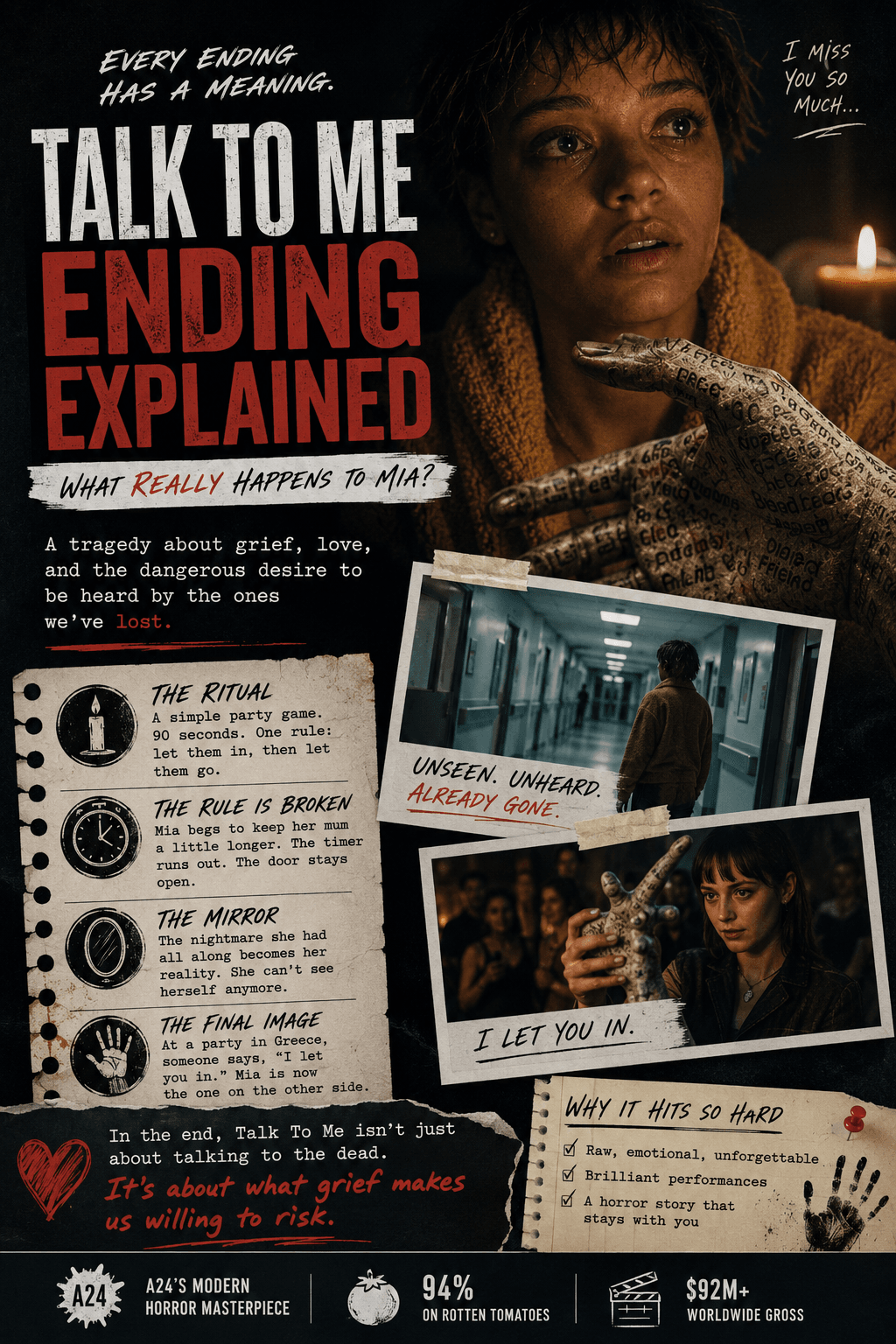
Here’s the Talk to Me ending explained as plainly as it deserves: Mia dies. Talk to Me (2023), directed by Danny and Michael Philippou, closes with its protagonist struck by a car, off-screen, then shown wandering a hospital corridor unseen and unheard, before a final scene confirms she has become one of the spirits reachable through the film’s embalmed hand.
My father died in November 2009, on a rural highway outside the town I grew up in, on a patch of road that had iced over sometime after dark. I drove back to Ohio alone for the funeral, and somewhere on that drive I noticed the trees had already lost all their leaves.
I still don’t know why that detail is the one that stayed with me, over the funeral itself, over the drive, over the phone call that started it. Bare trees, going past a car window, on a road I wasn’t thinking about at the time and haven’t stopped thinking about since.
He built things for a living, my father. Framed walls, mostly, the kind of structural work nobody thinks about because nobody’s supposed to see it. When I was nine he took me to a job site on a Saturday and showed me a wall he’d built. “You can’t see it once the drywall goes up,” he said. “Doesn’t matter. Has to be right.” I think about that sentence more than I’d ever admit to anyone who wasn’t reading this in the dark, alone, the way you’re probably reading it now.
The last conversation I had with him was about a leaking faucet in my first apartment. He walked me through the fix over the phone, step by step, patient in a way he wasn’t always patient. I have fixed every leaking faucet I’ve had since without calling a plumber. He’s been dead seventeen years and his instructions are still the thing operating, invisibly, correctly, every time water starts running somewhere it shouldn’t. That’s what a father’s care does when it’s the good kind. It keeps working after the person is gone, unseen, structural, holding weight nobody thinks to check.
Talk to Me’s ending runs a version of that same mechanism, except the mother is the one giving instructions from the other side, the care curdles somewhere along the way, and the wall comes down.
Talk to Me Ending Explained: What Happens to Mia
She’s struck by a car in the film’s final chase, off-screen and unconfirmed by a single line of dialogue, but confirmed by everything the film shows you afterward — she wanders a hospital corridor unseen and unheard, calls for her father through doors that don’t open for her, and finally looks into a mirror and finds no reflection there. That image doesn’t come from nowhere: she described this exact nightmare to Riley in the film’s first act, months before it happens for real, and the ending simply lets it become literal.
Then the film cuts to a party in Greece, where a stranger completes the ritual and says “I let you in” — confirmed by the directors as the deliberate final image — and the implication is unmistakable: Mia is now the one on the other end of somebody else’s hand, the way her mother was once on the other end of hers.
I want to sit with why that lands as inevitable rather than as a twist, because I think that’s the whole design of the film, and most endings this ambiguous get called “open to interpretation” as a polite way of saying the film didn’t stick the landing — the same double-edged quality that keeps people arguing over Midsommar’s ending years later. This one earns the ambiguity. Every piece of it was placed in act one.
The Mirror Nightmare in Talk to Me, Explained
Start with the mirror. A recurring nightmare, stated in dialogue, months before it happens for real — that’s structural, not the cheap kind of foreshadowing that exists to make you feel clever on a rewatch. Mia already knows, on some pre-verbal level, that she is disappearing.
She’s been disappearing since her mother died two years earlier, and the film is extremely precise about what that means for her specifically: she’s the friend who invites herself along, the one Sue initially accuses of having given Riley something, the one who tells the family’s decades-long friend, out loud, “I’m a bad person. Can you fix me.”
Nobody in Mia’s life is actively cruel to her. That’s the important part. Sue isn’t a villain. Jade isn’t a villain. They’re people with their own grief and their own limits, and Mia has spent two years quietly absorbing the message that she’s a guest in other people’s families rather than a permanent resident of anyone’s life. The mirror nightmare is what already being partially erased feels like from the inside, dressed up as a ghost story because that’s the vocabulary the film has on hand.
Why the Rules of the Hand Fail in Talk to Me’s Ending
The candle rule and the ninety-second rule get their full mythology in the film’s opening stretch. What matters for the ending is narrower: that unverified rule is the only thing standing between a party trick and a catastrophe, and it fails specifically because of Mia, in a way the film wants you to sit with rather than rush past.
When the entity wearing Riley’s body starts speaking as Mia’s dead mother — soft, warm, saying “I miss you so much” in a voice built to feel exactly like closure — Mia begs the group to let it run past the fifty-second mark they’d already talked down to from ninety.
“It’s my mum. Please.” That’s the entire tragedy compressed into four words, spoken by a woman who has spent two years being told, in a hundred small ways, that she doesn’t fully belong to anyone’s family, and who is being offered four extra seconds of a voice that sounds like belonging again.
She takes them. The rule breaks. A fourteen-year-old ends up hospitalized, self-harming every time he wakes, and the group’s first instinct is a cover-up rather than an apology, which tells you everything about how little any of them actually understood what they were playing with.
Cole tries to warn them, and the film doesn’t let that warning pass quietly. Duckett’s brother, cornered by Joss and Jade after Riley collapses, is blunt about what he watched happen to his own sibling: “They’re killing him,” he says of the spirits, and offers the closest thing to a rule anyone actually understands — “his body should kick ’em out, they get weaker the longer they’re in.” The group absorbs it into the same undifferentiated noise as party gossip about psychics and Satanists, without following up, without asking Cole to explain further, without connecting it to Duckett’s own death.
Duckett’s fate gets mentioned almost in passing — he was reportedly seeing spirits even without holding the hand anymore, before he stabbed his brother and killed himself — but it’s the film’s first demonstration of exactly the arc Mia is walking.
Someone who kept going back long after going back stopped being safe, whose friends treated the warning signs as a story to tell at the next party rather than a reason to stop. Mia isn’t a special case the hand found. She’s the second documented instance of the same pattern in the same friend group, and the film trusts you to notice that without underlining it.
There’s a moment, after Riley’s collapse, where Mia and Jade try to guess at the metaphysics they’ve stumbled into — “I thought these spirits were in limbo,” one of them offers, “maybe that’s where Riley is” — and the tentative, guessing tone of that exchange is the whole film’s relationship to its own rules laid bare.
The teenagers don’t understand what’s actually happening, and neither does Cole, and neither, by design, does the audience. The film never cuts away to an expert or an old book that explains the hand’s true nature, because that explanation would let everyone off the hook.
The Suicide Note and the Manipulation in Talk to Me’s Ending
This is where the film’s most quietly devastating reveal does its work: the suicide note. For the entire runtime up to this point, Mia’s mother’s death has been framed, by Mia herself, as an accident — sleeping pills, a locked door, her father asleep on the couch, unable to reach her in time. Mia has clearly told this version of the story so many times that it comes out steady, almost professionally smooth, the way you can talk about anything terrible once you’ve built enough scar tissue around the telling of it.
Her father’s confession — that there was a note, that he’s been too afraid to show her — doesn’t just correct a fact. It removes the one interpretation of the tragedy Mia could survive: that it wasn’t a choice, that her mother didn’t leave her on purpose. The entity, wearing her mother’s voice, immediately exploits the wound this opens, insisting the note is a lie, insisting Mia’s real father is an imposter, insisting the only kind thing left to do is end Riley’s suffering herself.
There’s a rule established earlier in the film, almost as an aside — “didn’t Duckett say they could imitate people?” — that the ending cashes in with real precision. When the entity tells Mia her actual father, pounding on the door trying to reach her, isn’t really him, it isn’t inventing a new power on the spot.
It’s using a mechanic the film already planted, which is what makes the scene land as violation rather than as a convenient plot twist. The one person who might have pulled Mia back from the edge gets disqualified by the exact rule the film told you to remember two acts earlier, and by the time you place it, the damage is already done.
This is manipulation running on the oldest logic there is — love, weaponized, dressed up as the only person left who understands you: I’m the only one who understands you. Everyone else is lying to you. Do this one thing for me.
What I keep returning to, watching this a second time with more distance than the first, is that the film never actually clarifies whether the voice speaking as Mia’s mother is her mother. That ambiguity is the entire argument. It doesn’t matter whether some fragment of Rhea genuinely survives on the other side of that hand, reaching for her daughter, or whether it’s simply an entity fluent enough in grief to wear whatever face gets it what it wants.
Either way, Mia dies believing she was finally being reunited with the one person who never left her. And either way, what actually happens is that she becomes exactly what she was reaching for: a voice on the other end of a hand, reaching for someone else’s daughter, in a country she’s never been to, at a party full of strangers who will use her the same way her friends used the version of her mother trapped in that ceramic hand.
Is Talk to Me’s Ending About Grief or Addiction?
A reading that’s picked up real traction since the film came out treats the whole ritual as a fairly direct metaphor for addiction — the escalating time limits, the chasing of a feeling that’s never quite as good as the first hit, the friends who enable instead of intervene, the catastrophic overdose dressed up as a possession going wrong.
I don’t think the film insists on that reading over the grief reading; I think it’s built to hold both without picking a winner, the way any good metaphor for compulsion usually does. What I’ll say for it: addiction and unprocessed grief aren’t actually two different diagnoses here. They’re the same behavior — reaching for a feeling that used to be safe, past the point where it still is — wearing two different names.
What Talk to Me’s Ending Really Means
My father took me on a road trip once, when I was eleven, no real destination, just a construction site in a distant Texas county he wanted to see and a decision to make a weekend out of it. We spent two hours in a hot car listening to country radio without talking much. It’s one of the few times in my life I remember being completely comfortable with another person’s silence — not the tense kind, not the kind you fill because you can’t stand it, just two people existing near each other with nothing that needed saying.
I think about that car a lot when I think about the silence at the end of this film — Mia calling for her father through doors that won’t open, getting nothing back. Same shape, opposite temperature. One kind of silence is company. The other is the total absence of it, and the film makes you feel the difference by having spent two hours earlier establishing what the first kind sounds like, in the ordinary, unremarkable family scenes before anything goes wrong.
Jade never gets the version of that reconciliation Sue gets. She spends most of the back half of the film furious at Mia, not unreasonably, and the film never carves out a scene where the two of them make peace the way Sue and Mia briefly do at the hospital. That asymmetry isn’t an oversight.
Sue’s forgiveness is what makes the ending hurt as much as it does — you need at least one relationship in this story to almost heal before the film takes everything away regardless — and Jade staying angry, never getting her scene, is its own quiet cruelty. She loses her brother and her best friend in the same week without ever getting to say the thing that might have made either loss easier to carry.
Sue’s line to Mia at the hospital — “you’re not Riley’s friend, Mia, you’re his family” — is the closest thing this film has to a moment of pure grace, and it’s worth noticing how late it arrives and how little time the film gives it to breathe.
Mia has spent two years positioning herself as a guest in this household, and the one sentence that would have told her otherwise shows up with maybe ten minutes of screen time left. The sentiment is true. The timing is what makes it cruel — the thing she needed to hear for two years arrives just in time to be true and just too late to save her.
It’s worth sitting, finally, with the title itself, because “talk to me” is doing more work than functioning as the ritual’s opening line. It’s also the plainest, most universal thing a grieving person wants and can’t have — one more conversation, one more chance to hear a voice that’s gone. The film hands its characters a shortcut to the thing every mourner secretly wishes for, strips out every safeguard a real conversation would have, and watches what happens when people take the shortcut anyway.
By the end, the phrase has curdled into something closer to a trap being sprung than an invitation, but it never stops meaning what it meant the first time someone said it out of genuine longing rather than curiosity.
Talk to Me Ending Explained — Final Reflection
Grief doesn’t get resolved in this film. It gets inherited, unbroken, the way the hand itself gets inherited — chain of custody, no clean origin, nobody left who remembers a version of it that wasn’t already dangerous, the same way Hereditary’s ending treats inheritance as a trap nobody chose to walk into.
I mentioned that the last conversation I had with my father was about a leaking faucet. What I didn’t say is that for a long time afterward, fixing a faucet felt like the closest thing I had to talking to him. I’d hear his instructions in my head, step by step, and for a few minutes it wasn’t a memory — it was closer to a conversation, right up until the water stopped running and the moment ended and he was gone again, exactly as gone as he’d been before I picked up the wrench.
I think that’s the mechanism the hand offers these teenagers, minus the ninety-second honesty about it. It’s not communion with the dead. It’s a very convincing impression of communion with the dead, running on a timer, charging interest you don’t find out about until the bill comes due. My version was safe because a faucet can’t lie to you and can’t ask you for four more seconds. Mia’s version could do both.
The final image — a stranger’s voice, in a language the film doesn’t bother subtitling for you, saying the words that opened the door the first time — works as the last line of a sentence about inheritance rather than as a cliffhanger or a sequel tease. The hand doesn’t remember Mia any more than it remembered whoever came before Duckett. It only needs someone new, in a new room, willing to say the words without understanding what they’re actually agreeing to — which describes every person who has ever picked it up, including, now, the one it kept.
Talk to Me Ending Explained — Frequently Asked Questions
What happens to Mia at the end of Talk to Me?
Mia is implied to be struck by a car while chasing Riley through traffic. The film never states this outright, but her final scenes — wandering unseen, unheard, and finding no reflection in a mirror — confirm she has died and become one of the spirits reachable through the embalmed hand.
Is Riley alive at the end of Talk to Me?
It’s left unresolved. Riley disappears from his hospital bed during the climax, and the entity’s line “we’ll have him forever” is never contradicted by anything the film shows afterward. The ending deliberately withholds confirmation either way.
What does the mirror nightmare mean in Talk to Me?
Mia describes a recurring nightmare early in the film of looking into a mirror and seeing no reflection, which she says feels like not existing. The ending makes this literal: her final scene is her looking into a mirror and finding nothing looking back.
Why is the final scene of Talk to Me set in Greece?
Director Danny Philippou confirmed the intent to end the film in Greece, with a stranger completing the ritual and saying “I let you in.” It signals the hand has moved on to a new owner and a new victim, implying Mia is now among the spirits on the other side.
Is Talk to Me’s ending about addiction or grief?
Both readings coexist without the film picking one. The escalating time limits and enabling friend group support an addiction metaphor, while Mia’s specific backstory and the suicide-note reveal ground the ending in unprocessed grief. The two aren’t mutually exclusive in how the film uses them.